Skip to content
Real Steel
A rust-and-neon underdog fable where a broken father and a stubborn boy rebuild a junkyard robot, and in its mirrored movements they learn to recognize each other.
Real Steel

Real Steel

"Courage is stronger than steel."

28 September 2011 United States of America 127 min 7.2 (9,590)

Director: Shawn Levy

Cast: Hugh Jackman, Dakota Goyo, Evangeline Lilly, Kevin Durand, Anthony Mackie

Drama Action Science Fiction Fatherhood and Reconnection Redemption and Second Chances The Underdog and Self-Respect Human vs. Machine Humility vs. Pride, Poor vs. Rich
Budget: $110,000,000
Box Office: $299,300,000

Overview

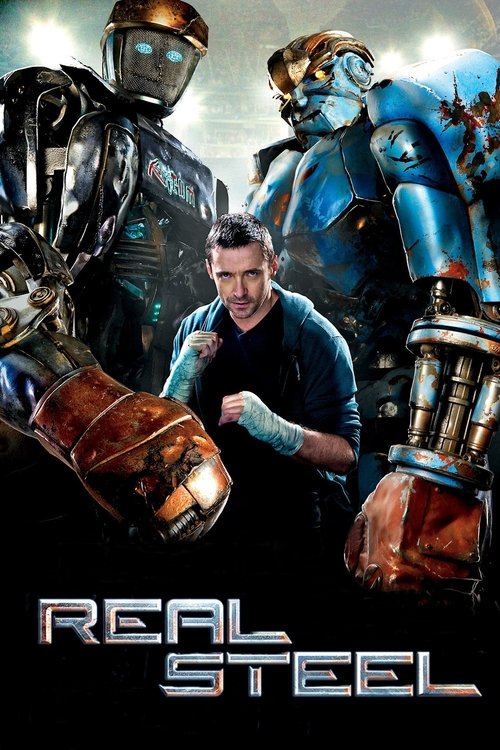
In the near future, human boxing has been replaced by fights between giant steel robots. Charlie Kenton (Hugh Jackman) is a former boxer turned small-time robot promoter who drifts from one bad bet to the next, always broke and always looking for a quick win.

Then the son he barely knows, Max (Dakota Goyo), comes back into his life. The two are strangers at first, joined only by circumstance. That changes when Max finds an old sparring robot called Atom and insists it deserves a real fight.

Directed by Shawn Levy and co-starring Evangeline Lilly, Kevin Durand and Anthony Mackie, Real Steel uses the robot circuit as the backdrop for a father-and-son story about second chances. It plays the classic sports underdog formula straight, with metal fighters in place of human ones.
Core Meaning

Behind the spectacle, Real Steel is a redemption story about connection. Critics noted that the technology is "merely instrumental" to the plot, and that the film is really about people building a bond, reaching a shared understanding and "getting on the same page." The robots give a father and son a common language. By the end, Charlie is fighting for his son rather than for money or pride, and the film argues that winning isn't always about titles. It's about redemption, connection and self-respect.

Thematic DNA

Fatherhood and Reconnection 30%
Redemption and Second Chances 25%
The Underdog and Self-Respect 20%
Human vs. Machine 15%
Humility vs. Pride, Poor vs. Rich 10%

Fatherhood and Reconnection

At its core, the film is a deadbeat dad bonding with his estranged son through a sport. Max's line "I want you to fight for me!" puts the emotional stakes into words: he wants his father to show up for him, not just for the next paycheck.

Redemption and Second Chances

Charlie is a washed-up boxer who gets a second shot through Atom. His redemption comes when he returns to the ring in spirit, boxing so that Atom can copy his moves.

The Underdog and Self-Respect

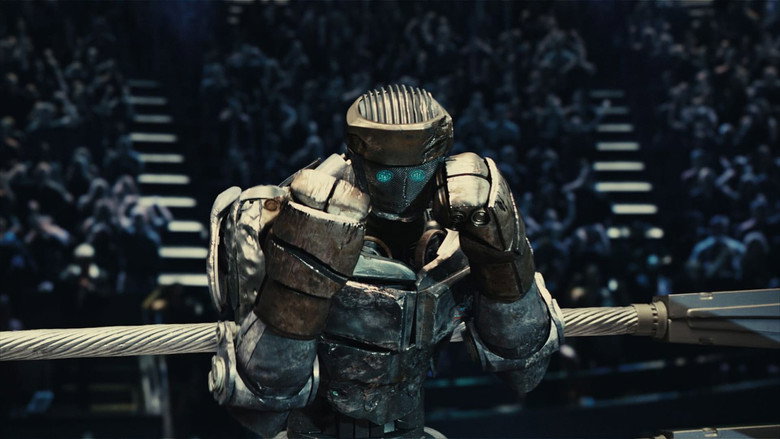
Atom is a junkyard sparring bot that climbs the ranks and faces the champion Zeus. Atom loses on the judges' scorecards but becomes the people's champion, which puts dignity ahead of trophies.

Human vs. Machine

The film plays with the robot:man pairing. Human boxing has been replaced, yet the final fight is decided by a human's instincts and heart passed on to a machine.

Humility vs. Pride, Poor vs. Rich

Critics pointed to the film's clear contrasts: the scrappy, cobbled-together Atom against the polished, heavily funded Zeus, and Charlie's early arrogance against the humility he learns.

Character Analysis

Charlie Kenton

Hugh Jackman

Archetype: Flawed hero / redeemed father Key Trait: Reckless charm hiding real boxing instinct

Motivation

At first, money and quick wins. Later, earning Max's respect and his own self-respect.

Character Arc

He starts as a selfish, broke former boxer who acts before he thinks. By the end he is a father who fights for his son, using his own boxing skills to guide Atom against Zeus.

Max Kenton

Dakota Goyo

Archetype: The believer / catalyst Key Trait: Stubborn faith

Motivation

He wants his father to fight for him: "That's all I ever wanted!"

Character Arc

He starts as an estranged kid stuck with a father who doesn't want him. His faith in Atom and in Charlie pulls both of them back into the fight, and he finally gets the father he wanted.

All 3 characters and cast

Symbols & Motifs

Atom's shadow function

Meaning:

It stands for connection and understanding. The robot can only fight when it moves in step with a human, just as father and son must learn to move in step with each other.

Context:

Atom copies whoever stands in front of it. In the climax, Charlie shadowboxes outside the ring and Atom mirrors every move against Zeus.

The mirror

Meaning:

It hints at possible sentience and self-awareness, leaving open whether Atom is more than a machine.

Context:

A lingering shot shows Atom seemingly "looking" at itself in a mirror. Charlie later asks whether it is alive while it copies him move for move.

Atom as junkyard salvage

Meaning:

It represents discarded people who still have value, including Charlie himself, a has-been with more left in him.

Context:

Max rescues the old sparring robot and pushes for it to get a fight: "His name is Atom. Can we get him a fight?"

Zeus

Meaning:

The champion is named after the king of the gods and stands for wealth, power and pride, the "rich" side of the film's contrasts.

Context:

Zeus is the unbeaten final opponent that the underdog Atom has to face.

Memorable Quotes

What do you want from me? / I want you to fight for me! That's all I ever wanted!
— Charlie Kenton and Max Kenton

Context

A heated confrontation between father and son in which Max finally says what he has needed all along.

Meaning

This is the emotional thesis of the film. The boxing is really about a son asking his father to show up for him.

His name is Atom. Can we get him a fight?
— Max Kenton

Context

Max pleads for Atom to get a shot, a request that recurs through the film.

Meaning

By naming the robot and pushing for its chance, Max shows he believes in overlooked things and overlooked people, Charlie included.

All 3 quotes

Philosophical Questions

Can a machine be alive, or do we project life onto it?

The film never answers this. Atom seems to study itself in a mirror, yet it only ever copies humans. Max's feeling that Atom is special may be what gives the robot its "soul."

What is lost when a sport replaces human bodies with machines?

In this world, human boxing has become obsolete. The climax pushes back on that: the deciding factor is Charlie's human skill and heart, passed through the machine.

Is winning the true measure of worth?

Atom loses on points but wins the crowd and brings father and son back together. The film suggests redemption and connection matter more than the result.

How It Ends

Alternative Interpretations

Is Atom alive? The mirror shot and Charlie's question about whether Atom is alive leave room for partial sentience. Critics called this the film's most effective ambiguity, though the film only hints at it. A skeptical reading says Atom is just a mirror, and everything viewers see in it comes from the humans.Loss as victory: Atom loses on the judges' decision but is cheered as the people's champio...

Full ending explanation

Cultural Impact

Real Steel came out in 2011, when robot spectacle was a big draw at the box office. It set itself apart by pairing that spectacle with an old-fashioned sports underdog melodrama. It is based on Richard Matheson's 1956 story "Steel," also adapted by The Twilight Zone, which ties it to a long line of science fiction.

Critics were mixed. Some admired the "classical elegance" of how closely it follows genre conventions, and Screen Anarchy even named it one of 2011's best. Others said it relied on surface polish and "mindless robot punch-outs." Its technical approach got a lot of attention: large, working animatronics from Legacy Effects, combined with motion capture of real boxing choreographed by Sugar Ray Leonard. This is often cited as a reason the robots feel solid and physical.

Audience Reception

Praised: the effects-driven robot fights (motion-captured from real boxers, with top-notch effects work), the tactile animatronics, Hugh Jackman's charm, and the emotional father-son story. Many viewers welcome its straightforward, crowd-pleasing adherence to underdog conventions.

Criticized: the predictable formula, a focus on surface polish, and fight scenes some felt were built to appeal to gamers rather than to tell a story.

Verdict: critics were mixed, but the film is widely seen as an earnest, feel-good family sports drama that works because of its heart and its physical robots.

Interesting Facts

  • The film is based on Richard Matheson's short story "Steel," first published in the May 1956 issue of The Magazine of Fantasy & Science Fiction.
  • Matheson's story had already been adapted as an episode of The Twilight Zone in 1963.
  • Legacy Effects built the robots: six 'Hero' close-up robots, one partially destroyed robot called Axelrod, and twenty background robots.
  • The practical Atom stands 7 feet 6 inches tall, Noisy Boy 8 feet 6 inches, and Ambush 8 feet 2 inches.
  • Production designer Tom Meyer and his team designed the robots' look, and Legacy Effects worked out how they would function while keeping that look.
  • Legacy made tooling masters for many robot parts from ID Light, a stereolithography (SLA) material made with a process developed by Solid Concepts Inc.
  • Boxing legend Sugar Ray Leonard choreographed the fights and coached the actors, who performed them in motion-capture suits.
  • The visual effects team laid rough digital versions of the robots over the performers during shooting so the fights could be seen in real time.

Easter Eggs

The story comes from Richard Matheson's "Steel," also adapted as a 1963 Twilight Zone episode

Genre fans can see the film as a family-friendly update of a classic sci-fi idea about a washed-up boxer and a robot fighter. Matheson's story and the Twilight Zone version are a much bleaker take on the same premise.

Frequently Asked Questions

Explore More About This Movie

Dive deeper into specific aspects of the movie with our detailed analysis pages

Comments (0)

Leave a comment

No comments yet. Be the first to share your thoughts!

Similar Movies