Skip to content
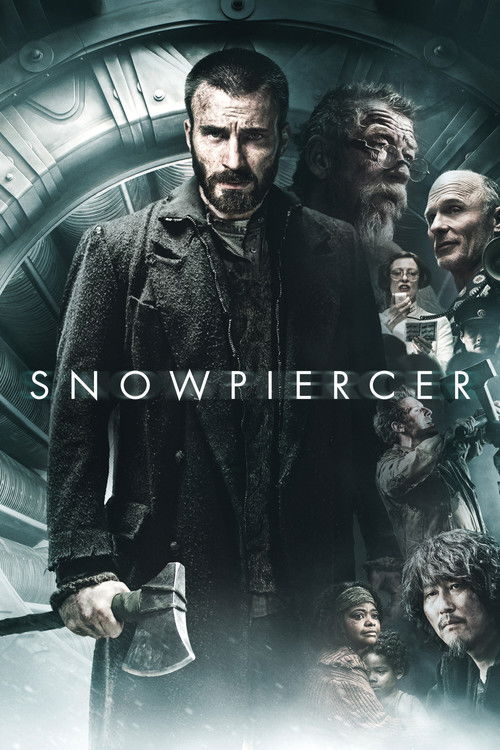
Snowpiercer
A claustrophobic dystopian thriller steeped in visceral desperate rage, where humanity’s last breath hurtles across an icy abyss like a rusting iron cage burning through endless frost.
Snowpiercer

Snowpiercer

설국열차

"Fight your way to the front."

01 August 2013 South Korea 127 min 6.9 (10,526)

Director: Bong Joon Ho

Cast: Chris Evans, Song Kang-ho, Ed Harris, John Hurt, Tilda Swinton

Drama Action Science Fiction Class Struggle and Systemic Inequality Determinism vs. Free Will & Illusion of Choice Ecological Disaster and Technological Hubris Institutional Indoctrination and Control Sacrifice and Moral Compromise for Survival
Budget: $39,200,000
Box Office: $86,758,912

Overview

Set in a bleak post-apocalyptic future, Snowpiercer takes place after a failed global warming experiment—a cooling agent named CW-7—catastrophically triggers a new Ice Age, eradicating all life on Earth. The sole survivors of humanity reside aboard the Snowpiercer, a colossal, self-sustaining train powered by a perpetual-motion engine that continuously circles the frozen globe. Within this sealed ecosystem, a brutal, rigid caste system has emerged over seventeen years: the elite live in decadent, hyper-luxurious front carriages, while the impoverished "Tail-sectioners" are crammed into windowless, filthy rear cars, living off meager rations under the oppressive rule of armed guards.

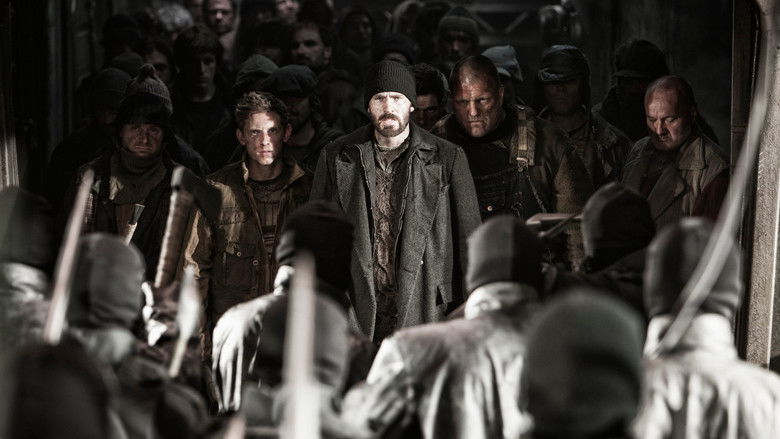
Driven by unyielding desperation and moral outrage, Curtis Everett—a taciturn Tail passenger—plans a meticulously organized rebellion. Encouraged by his elderly mentor, Gilliam, Curtis leads a band of rebels on a dangerous car-by-car assault toward the front of the train to seize control of the Engine room. To navigate the security doors separating the train’s distinct sectors, Curtis frees Namgoong Minsoo, an imprisoned security technician, along with his clairvoyant daughter, Yona.

As the rebels press forward, each opened door exposes them to drastically different, surreal environments—from lush hydroponic gardens and opulent dining cars to indoctrination classrooms and lavish night clubs. The advance comes at a devastating cost, requiring constant bloody combat against the train's brutal enforcers. Curtis's crusade tests the boundaries of sacrifice, ethics, and human survival as he inches closer to Wilford, the mysterious, revered creator of the Engine.
Core Meaning

Director Bong Joon-ho uses the micro-society of the train as a biting political allegory for global capitalism, class struggle, and systemic oppression. The core message of Snowpiercer is that systemic inequality is not an accidental flaw of capitalist structures, but an intentional feature designed to preserve elite power and maintain equilibrium.

The film argues that true liberation cannot be achieved by merely replacing the tyrant at the top of an oppressive system—a strategy that only perpetuates the existing framework. Instead, genuine freedom requires breaking out of the established paradigm altogether, even if doing so demands dismantling the entire structure and venturing into an uncertain, hazardous new reality.

Thematic DNA

Class Struggle and Systemic Inequality 30%
Determinism vs. Free Will & Illusion of Choice 25%
Ecological Disaster and Technological Hubris 20%
Institutional Indoctrination and Control 15%
Sacrifice and Moral Compromise for Survival 10%

Class Struggle and Systemic Inequality

The physical layout of the train visually enforces social stratification: the destitute Tail sectioners represent the exploited working class, while the Front class indulges in luxury. Systemic oppression is maintained through violence, resource hoarding, and ideological propaganda.

Determinism vs. Free Will & Illusion of Choice

The train operates on rigid pre-ordained positions ("Know your place. Keep your place."). Even the rebellion itself is revealed to be a pre-planned mechanism of population control, calling into question whether individual actions can alter systemic outcomes.

Ecological Disaster and Technological Hubris

The apocalypse was caused by human intervention—spraying CW-7 to fix climate change—demonstrating the danger of technological overreach. The train becomes a stark reminder of humanity's attempt to isolate itself from nature through artificial means.

Institutional Indoctrination and Control

The Front uses ritualistic propaganda, religious reverence for the "Sacred Engine," and targeted education to teach children that chaos ensues without Wilford's order.

Sacrifice and Moral Compromise for Survival

Characters are repeatedly forced to choose between personal ethics and survival. Curtis carries heavy guilt from the cannibalistic horrors of the Tail's early days, demonstrating how extreme conditions dehumanize individuals.

Character Analysis

Curtis Everett

Chris Evans

Archetype: Reluctant Hero / Revolutionary Key Trait: Hyper-focused determination masked by deep trauma.

Motivation

Seize the Engine to liberate the Tail section.

Character Arc

Develops from a guilt-haunted survivor to a reluctant leader, ultimately sacrificing himself to shatter the system.

Namgoong Minsoo

Song Kang-ho

Archetype: Visionary / Wildcard Key Trait: Keen observation and lateral thinking.

Motivation

Escape the train and live outside.

Character Arc

Develops from a seemingly erratic drug addict to a pragmatic rebel who sees past the train's walls.

All 5 characters and cast

Symbols & Motifs

The Sacred Engine / The Train

Meaning:

Symbolizes the closed ecosystem of global capitalism and the rigid hierarchy of human society. Its perpetual motion represents an unending cycle of exploitation.

Context:

Serves as the central setting and entire world containing all surviving human life, partitioned into distinct social classes.

The Shoe vs. The Hat (The Shoe Metaphor)

Meaning:

Symbolizes preordained social roles ("I am a hat, you are a shoe").

Context:

Introduced by Minister Mason when she places a shoe on a rebel's head during a public punishment in the Tail section.

Protein Bars

Meaning:

Represent total dependence, dehumanization, and institutional control; later revealed to be made from ground-up cockroaches.

Context:

Fed exclusively to the Tail passengers as their sole gelatinous food ration.

Kronole

Meaning:

Transforms from a symbol of passive escape and addiction into a tool for revolutionary demolition due to its highly flammable nature.

Context:

An addictive industrial drug used by passengers to escape reality, collected by Namgoong Minsoo throughout the journey.

The Catfish / Fish-Gutting Ritual

Meaning:

Symbolizes sacrificial blood, balance, and an intimidating display of power.

Context:

Performed by executioners who gut a catfish and blade-dip their weapons in its blood before the bloody battle at Yekaterina Bridge.

The Polar Bear

Meaning:

Symbolizes the endurance of nature, the rebirth of the ecosystem, and hope for life outside human technological control.

Context:

Appears in the final shot of the film after the train derails, spotted by Yona and Timmy in the icy landscape.

Memorable Quotes

Order is the barrier that holds back the flood of death.
— Minister Mason

Context

Delivered during a public punishment ceremony in the Tail section.

Meaning

Encapsulates the regime's ideology that authoritarian suppression is necessary for collective survival.

I belong to the front. You belong to the tail... Know your place. Keep your place. Be a shoe.
— Minister Mason

Context

Speech after placing a shoe on Andrew's head.

Meaning

Directly states the rigid social hierarchy and preordained roles within the train.

All 5 quotes

Philosophical Questions

Is extreme utilitarianism morally defensible to save humanity from extinction?

Wilford argues that sacrificing individual lives and enslaving children is necessary to maintain ecological balance and prevent total system collapse.

Can a corrupt system be reformed from within, or must it be destroyed?

The film explores whether replacing an oppressive leader alters the system, concluding that the underlying structure forces anyone in power to act similarly.

What is the balance between individual freedom and societal order?

Minister Mason asserts that absolute order is required for survival, posing the question of how much liberty can be surrendered for security.

Alternative Interpretations

Marxist/Revolutionary Reading: The train is an allegory for global capitalism. Changing leadership does not alter systemic oppression; true liberation requires destroying the capitalist apparatus entirely.Hopeful Environmental Reading: Supported by director Bong Joon-ho, this perspective sees the polar bear as evidence that nature is healing and that Yona and Timmy can rebuild human civilization.N...

Full ending explanation

Cultural Impact

Released in 2013, Snowpiercer reflected post-2008 global economic anxieties, debates over climate geoengineering, and growing global wealth inequality. As Bong Joon-ho’s English-language debut, it bridged South Korean cinematic storytelling with international filmmaking.

The film achieved widespread critical acclaim (94–95% on Rotten Tomatoes, 84 Metacritic) and became a box-office hit internationally. Despite distributor conflicts in North America, its success cemented Bong Joon-ho’s reputation, paving the way for his Oscar-winning film Parasite (2019). In 2020, the film was adapted into a multi-season television series.

Audience Reception

Critics praised the visual design, kinetic action sequences, sharp socio-political commentary, and performances by Tilda Swinton and Chris Evans. Some reviewers noted heavy-handed allegories, occasional plot conveniences, and tonal shifts between dark realism and stylized satire.

The third-act twist revealing Gilliam’s complicity and the graphic cannibalism backstory proved polarizing for some viewers. Overall, it is widely regarded as a modern sci-fi classic and a pivotal milestone in Bong Joon-ho's filmography.

Interesting Facts

  • Bong Joon-ho saved the fish-gutting scene from producer Harvey Weinstein's proposed 20-minute cut by lying that his father was a fisherman and the shot was a personal tribute, when his father was actually an industrial graphic designer.
  • Minister Mason was originally scripted as a conventional male bureaucrat, but was rewritten after Tilda Swinton joined, with Swinton helping craft her appearance using fake prosthetics, thick glasses, and wardrobe inspired by politicians like Margaret Thatcher.
  • The train interior sets were constructed on massive moving gimbals at Barrandov Studios in Prague to simulate continuous motion, causing several crew members to experience motion sickness during filming.
  • Bong Joon-ho shoots only the specific coverage he needs based on detailed hand-drawn storyboards, preventing distributors from re-editing the film since almost no extra angles or takes exist.
  • To shoot scenes with international actors, Bong used simple hand signals and translators, creating a multilingual set mirroring the film's world.

Easter Eggs

Graphic Novel Origins

Based on the French graphic novel Le Transperceneige (1982) by Jacques Lob and Jean-Marc Rochette, which Bong discovered in a Seoul comic shop in 2004.

The "Wonkapiercer" Theory

A viral fan theory posits that Snowpiercer serves as an unannounced sequel to the 1971 film Willy Wonka & the Chocolate Factory. Parallels include an eccentric creator building an isolated wonderland, linear progression through themed rooms, protein bars echoing Wonka candy, and small children used to operate internal machinery.

Yekaterina Bridge Battle

The battle location references historical Russian geographic landmarks, signaling the train's global trajectory.

Civilization Progression

The ordering of train cars mirrors the timeline of human evolution—moving from dark cramped quarters (cave dwellers) to food production, education, leisure, and industrial mechanization.

Frequently Asked Questions

Explore More About This Movie

Dive deeper into specific aspects of the movie with our detailed analysis pages

Comments (0)

Leave a comment

No comments yet. Be the first to share your thoughts!

Similar Movies