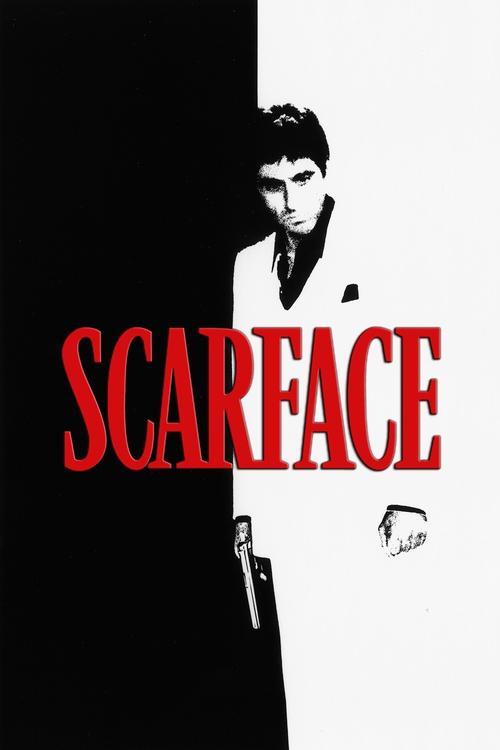
Scarface
"He loved the American Dream. With a vengeance."
Overview
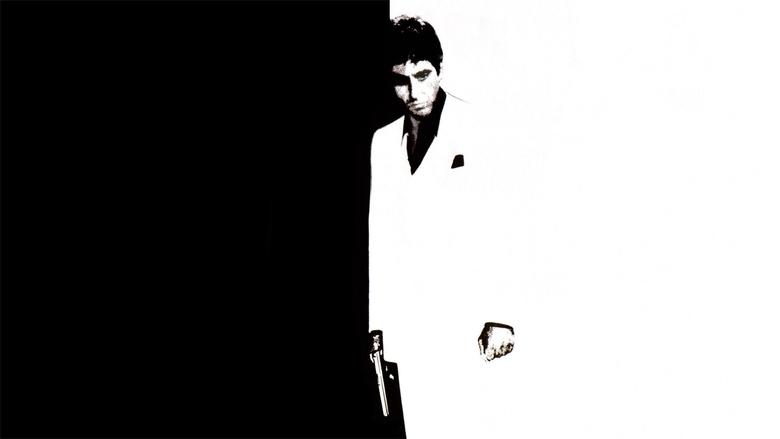
"Scarface" chronicles the brutally violent rise and fall of Tony Montana (Al Pacino), a Cuban refugee who arrives in 1980s Miami with nothing and claws his way up to become a powerful and obscenely wealthy drug kingpin. The film opens with Tony's arrival in Florida during the Mariel boatlift, where he and his close friend Manny Ribera (Steven Bauer) quickly trade a life of menial labor for the lucrative, albeit dangerous, world of the cocaine trade.
Working for Miami drug lord Frank Lopez (Robert Loggia), Tony's ambition, ruthlessness, and volatile temper propel him through the ranks. He becomes infatuated with Frank's girlfriend, Elvira Hancock (Michelle Pfeiffer), and is determined to have her, and everything Frank possesses, for himself. As his power grows, so do his paranoia, his enemies, and his addiction to his own product, leading to an increasingly isolated and self-destructive existence that culminates in a spectacular and bloody downfall.
Core Meaning
At its heart, "Scarface" is a savage deconstruction of the American Dream, presenting a twisted and cautionary tale about the perils of unchecked ambition and greed. Director Brian De Palma and writer Oliver Stone use Tony Montana's tragic trajectory to explore the idea that the relentless pursuit of wealth and power, detached from morality and human connection, ultimately leads to self-destruction. The film suggests that the very system that allows for such a rapid ascent is inherently corrupt and that the ultimate price of wanting "the world and everything in it" is absolute ruin and isolation. It's a critique of a capitalist society where success is measured by material gain, and the path to achieving it is paved with violence and betrayal.
Thematic DNA
The Perversion of the American Dream
Tony Montana arrives in America believing in the promise of endless opportunity, famously stating he wants what's coming to him: "The world, Chico, and everything in it." However, his version of the dream is a grotesque distortion, achieved not through hard work and integrity, but through extreme violence, intimidation, and trafficking. The film portrays his rise not as an achievement but as a descent into moral bankruptcy, where opulent wealth only highlights his profound emptiness and isolation. His ultimate downfall serves as a grim commentary on a dream built on a foundation of greed and corruption.
The Corrupting Nature of Power and Greed
As Tony accumulates power, he becomes increasingly paranoid, erratic, and detached from reality. His greed is insatiable; no amount of money, influence, or luxury can fill the void within him. This theme is illustrated through his deteriorating relationships with his wife Elvira, his sister Gina, and his best friend Manny. He alienates or destroys everyone who cares for him, proving De Palma's point that the hunger for absolute power ultimately consumes the individual, leaving them hollow and alone.
Violence and Its Consequences
"Scarface" is infamous for its graphic and stylized violence, from the harrowing chainsaw scene to the explosive final shootout. Violence is depicted as the primary language of Tony's world and the necessary tool for his ascent. However, the film doesn't merely glorify the bloodshed; it shows its cyclical and destructive nature. Every act of violence Tony commits pushes him further down his tragic path, creating new enemies and ensuring his eventual demise will be just as brutal as his rise.
Hubris and Self-Destruction
Tony Montana is a classic tragic figure whose downfall is precipitated by his own arrogance and overconfidence. He believes himself to be invincible, ignoring the advice of his boss, Frank Lopez ("Don't get high on your own supply"), and his partner, Alejandro Sosa. His hubris leads him to make reckless decisions, betray allies, and underestimate his enemies. His cocaine addiction is the physical manifestation of his ego, fueling his paranoia and ultimately contributing to his spectacular, self-inflicted end.
Character Analysis
Tony Montana
Al Pacino
Motivation
Tony's primary motivation is the acquisition of power, wealth, and respect. He famously articulates his philosophy: "In this country, you gotta make the money first. Then when you get the money, you get the power. Then when you get the power, then you get the women." He desires everything that comes with the American Dream, but wants it on his own terms, scorning legitimate work for the fast and violent path of organized crime.
Character Arc
Tony begins as an ambitious, charismatic, and ruthless Cuban refugee determined to achieve the American Dream by any means necessary. He rises from nothing to become a powerful drug lord, but his journey is one of moral and psychological decay. As he gains wealth and power, he becomes consumed by greed, paranoia, and addiction. His relationships crumble, and he grows increasingly isolated, ultimately leading to a violent and tragic downfall brought about by his own hubris. He does not change or learn from his mistakes; he remains the same proud and defiant character from beginning to end.
Manny Ribera
Steven Bauer
Motivation
Manny shares Tony's desire for a better life but is less driven by a need for ultimate power. His motivations are simpler: loyalty to his friend, enjoying the spoils of their criminal enterprise, and ultimately, his love for Gina, which he pursues despite knowing Tony's dangerously overprotective nature.
Character Arc
Manny is Tony's loyal best friend and right-hand man from the beginning. He is more level-headed and less volatile than Tony, often acting as a voice of caution. Throughout their rise, he remains steadfastly by Tony's side. His arc takes a tragic turn when he falls in love with Tony's sister, Gina. He marries her in secret, and when Tony discovers them together, he kills Manny in a fit of cocaine-fueled rage, a brutal end to their friendship and a pivotal moment in Tony's final descent.
Elvira Hancock
Michelle Pfeiffer
Motivation
Elvira is motivated by a desire for a life of luxury and comfort, which leads her from one powerful drug lord to another. However, she is also deeply unhappy and uses drugs to numb the emptiness of her life. Her ultimate motivation becomes self-preservation, recognizing that staying with Tony will lead to her destruction.
Character Arc
Initially the icy, glamorous mistress of Frank Lopez, Elvira is an object of Tony's desire. After Tony takes over, she becomes his wife, but their relationship is hollow and loveless, defined by materialism and mutual drug addiction. She grows increasingly bored and disgusted with Tony's lifestyle and volatile personality. Her arc is one of disillusionment; she ultimately finds the strength to leave him, delivering a scathing indictment of his empty existence before disappearing from the narrative, a survivor of his destructive world.
Gina Montana
Mary Elizabeth Mastrantonio
Motivation
Gina's primary motivation is to live her own life, free from her brother's overbearing control. She is drawn to the excitement and glamour that Tony's money provides but chafes under his rules. Her love for Manny represents a chance at a normal life and an escape from her brother's shadow, a desire that ultimately costs both of them their lives.
Character Arc
Gina is Tony's beloved younger sister, whom he is fiercely and almost incestuously protective of. He wants to shield her from the corrupt world he inhabits while simultaneously spoiling her with the fruits of his crimes. As she grows up, she rebels against his suffocating control, seeking independence. Her arc ends in tragedy when Tony murders her new husband, Manny. In her grief, she confronts Tony during the final shootout and is accidentally killed, becoming the ultimate victim of her brother's violent life.
Symbols & Motifs
The World Is Yours
This phrase symbolizes the ultimate prize of the American Dream that Tony relentlessly pursues. It represents the boundless ambition and the belief that everything is attainable. However, it's also deeply ironic, as the more of the world Tony acquires, the more miserable and isolated he becomes. His death beneath the statue bearing this inscription signifies the ultimate failure of his quest and the emptiness of his materialistic achievements.
The slogan is first seen on the side of a Pan Am blimp. Tony later adopts it as his personal mantra, having a large, gaudy globe statue with the words "The World Is Yours" installed in the foyer of his mansion. The final shot of Tony's dead body floating in the fountain is framed by this statue, starkly contrasting the promise of the motto with the grim reality of his end.
Cocaine
The mountains of white powder are more than just the source of Tony's wealth; they symbolize the excess, corruption, and addiction at the heart of his empire and the 1980s era. Tony's increasing consumption of his own supply mirrors his descent into paranoia and madness. The drug fuels his ambition and his downfall, representing the very product of the capitalist system he seeks to conquer, which ultimately consumes him.
Cocaine is a constant presence throughout the film, from the tense drug deals to the lavish parties. The most iconic use is in the final act, where Tony buries his face in a massive pile of cocaine on his desk before his last stand, a moment that perfectly visualizes his complete submission to the forces that have destroyed him.
The Tiger
The pet tiger in Tony's mansion represents his own caged, predatory nature. It is a symbol of the immense power and untamed aggression he possesses. Like the tiger, Tony is dangerous and cannot be domesticated. The animal's captivity also reflects Tony's own imprisonment within his opulent but lonely mansion, a gilded cage built from his crimes.
The tiger is shown chained up on the grounds of Tony's estate. It's a symbol of his status and power, a wild thing he has managed to possess. Its presence serves as a constant, silent reminder of the feral nature lurking just beneath the surface of Tony's designer suits.
Memorable Quotes
Say hello to my little friend!
— Tony Montana
Context:
This line is screamed by Tony during the film's climax. His mansion is under siege by assassins sent by Alejandro Sosa. Cornered and heavily outnumbered in his office, Tony grabs the weapon, blasts the door open, and unleashes a torrent of gunfire on the attackers below.
Meaning:
This is arguably one of the most iconic lines in cinema history. It is the ultimate expression of Tony's defiance and aggression. The "little friend" is an M16 rifle with an M203 grenade launcher attached. The quote signifies his readiness to go down in a blaze of glory, embracing violence as his final, definitive act. It has become a cultural shorthand for overwhelming and explosive retaliation.
I always tell the truth. Even when I lie.
— Tony Montana
Context:
Tony says this during a scene in a fancy restaurant where his wife, Elvira, has just left him. He is drunk and high, and he drunkenly admonishes the other patrons, calling them out for needing a "bad guy" like him to feel good about themselves.
Meaning:
This paradoxical statement perfectly encapsulates Tony's worldview and character. It suggests that even his deceptions are a true reflection of his ambitious and self-serving nature. He sees himself as fundamentally honest in his desires, unlike the "good guys" who hide their hypocrisy behind a facade of morality. It's a declaration of his shameless, unvarnished personality.
The world, Chico, and everything in it.
— Tony Montana
Context:
Early in the film, Tony's friend Manny asks him what he wants out of his new life in America. Tony, looking out at Miami, delivers this line, laying bare the immense scope of his aspirations.
Meaning:
This quote is the thesis statement for Tony's ambition. It articulates his boundless desire for everything the American Dream promises: money, power, and possessions. It reflects his belief that he is entitled to seize the entire world for himself, showcasing the scale of his greed and the hubris that will eventually lead to his downfall.
You need people like me so you can point your f**kin' fingers and say, 'That's the bad guy.'
— Tony Montana
Context:
This is part of the same monologue in the restaurant after Elvira leaves him. He is confronting the wealthy patrons, exposing what he perceives as their moral cowardice and dependence on outlaws like him to define their own identities.
Meaning:
This is a moment of sharp, albeit drug-fueled, social commentary from Tony. He accuses mainstream society of hypocrisy, arguing that they secretly envy his freedom from conventional morality but use him as a scapegoat to affirm their own supposed goodness. He positions himself as a more honest form of corruption compared to the hidden lies of the establishment.
Philosophical Questions
What is the true nature of the American Dream, and is it attainable without moral compromise?
"Scarface" interrogates the very concept of the American Dream. Tony Montana fervently pursues his version of it, believing in a meritocracy of force and will. The film asks whether the idealized dream of success through honest hard work is a naive illusion. By showing a world where the most direct path to immense wealth is through criminality and violence, it suggests that the system itself may be inherently corrupt. It forces the viewer to question whether extreme success is possible without exploiting others and whether Tony's violent path is an aberration or simply a more transparent version of the ruthlessness required to get to the top in any field.
Does absolute power inevitably lead to corruption and self-destruction?
The film serves as a powerful exploration of the adage that "power corrupts." As Tony's empire grows, his character degrades. He becomes more isolated, paranoid, and incapable of trust or love. The narrative suggests that the skills needed to acquire power—ruthlessness, suspicion, and aggression—are ultimately destructive to the human spirit. The very qualities that allow Tony to rise are the ones that guarantee his fall. The film poses the question of whether it is possible to maintain one's humanity and relationships when placed in a position of unchecked power.
Alternative Interpretations
While the dominant reading of "Scarface" is that of a cautionary tale against greed and ambition, some interpretations view Tony Montana's story through a more sympathetic or complex lens. One perspective sees the film not just as a critique of an individual's greed, but as a broader allegory for the inherent violence and dissatisfaction of capitalism itself. In this view, Tony is a product of a system that encourages ruthless competition and endless consumption, making his self-destruction almost inevitable.
Another interpretation focuses on the film's portrayal of the immigrant experience. Some audiences, particularly within communities of color, have related to Tony's struggle as an outsider fighting to carve out a place for himself in a society that initially rejects him. From this viewpoint, his defiance and rise to power, however flawed, can be seen as a form of rebellion against a hostile establishment. While the film was criticized for its stereotypes, some viewers see it as a complex reflection of the harsh realities faced by immigrants seeking a better life.
Finally, some analyses have drawn parallels between Tony Montana's rise and fall and Shakespearean tragedies like "Macbeth" or "Richard III." This reading elevates Tony from a mere gangster to a tragic hero, whose great ambition is also his fatal flaw, leading him through a dramatic arc of paranoia, isolation, and ultimately, a bloody demise.
Cultural Impact
When "Scarface" was released in 1983, it was met with a largely negative critical reception due to its extreme violence, constant profanity, and graphic depiction of drug use. Many critics found it excessive and morally bankrupt. Additionally, it sparked controversy within the Cuban-American community in Miami, who protested that the film unfairly portrayed them as violent criminals and drug traffickers.
However, over the decades, the perception of "Scarface" has dramatically shifted. It has undergone a significant critical reappraisal and is now widely regarded as one of the greatest gangster films ever made, achieving the status of a cult classic. Its influence on popular culture has been immense and enduring. The character of Tony Montana has become a cultural icon, symbolizing a ruthless, rags-to-riches ambition that resonates with many.
The film's most profound impact has been on hip-hop culture. For generations of artists, Tony Montana's story of an outsider seizing power and flaunting his wealth became a foundational narrative. Rappers have frequently sampled the film's dialogue, adopted aliases from its characters (like Chief Keef's nickname 'Sosa'), and referenced its themes of struggle, power, and defiance in their lyrics. The film's aesthetic and Tony's persona became synonymous with a certain 'gangsta' archetype in music and beyond. Beyond music, "Scarface" has been referenced in countless television shows, comic books, and video games, including its own successful 2006 game, "Scarface: The World Is Yours," cementing its place as a cornerstone of modern pop culture.
Audience Reception
Upon its 1983 release, audience and critical reception was sharply divided and leaned negative. Many were shocked and repulsed by the film's graphic violence, relentless profanity, and explicit drug use. It was considered by some to be an overblown, empty, and excessively brutal B-movie. The film also generated significant controversy among Cuban expatriates in Miami, who felt it perpetuated harmful stereotypes by portraying them as criminals and drug traffickers.
However, over time, the audience reception has transformed dramatically. The film found a massive following on home video and has since become a revered cult classic. Audiences have come to appreciate Al Pacino's powerhouse, over-the-top performance, which is now considered iconic. The film's quotable dialogue, stylish 1980s aesthetic, and Giorgio Moroder's synth-heavy score have also contributed to its enduring popularity. While some still criticize it for its excess, many fans see it as a masterful, operatic tragedy and a powerful, if grim, statement on ambition and the dark side of the American Dream. Its influence, especially in hip-hop culture, demonstrates how a film initially dismissed by many was ultimately embraced and canonized by a passionate audience.
Interesting Facts
- The prop cocaine used in the film was primarily powdered baby laxative, and according to Al Pacino, inhaling it caused permanent damage to his nasal passages.
- The film was originally going to be shot entirely in Miami, but protests from the local Cuban-American community, who feared the film would negatively stereotype them as criminals, forced the production to move most of the filming to Los Angeles.
- Famed director Steven Spielberg, who was visiting the set, directed a single shot during the climactic shootout scene as a friendly gesture to Brian De Palma.
- Al Pacino severely burned his hand on the hot barrel of his gun during a stunt, forcing production to shut down for over a week while he recovered.
- At the time of its release, "Scarface" was noted for its prolific use of the F-word, with the word and its variants being used 207 times.
- The infamous chainsaw scene was based on real-life events that writer Oliver Stone learned about while researching Miami's drug trade with law enforcement.
- Miriam Colon, the actress who played Tony Montana's mother, was only four years older than Al Pacino.
- Steven Bauer, who played Manny Ribera, was the only actual Cuban in the main cast.
Easter Eggs
The film is dedicated to Howard Hawks and Ben Hecht.
This dedication, shown in the film's closing credits, is a direct homage to the director and screenwriter, respectively, of the original 1932 "Scarface" film. Brian De Palma's version is a remake, and this dedication acknowledges the cinematic lineage and pays respect to the creators of the story that inspired his film.
⚠️ Spoiler Analysis
Click to reveal detailed analysis with spoilers
Frequently Asked Questions
Explore More About This Movie
Dive deeper into specific aspects of the movie with our detailed analysis pages
Comments (0)
No comments yet. Be the first to share your thoughts!