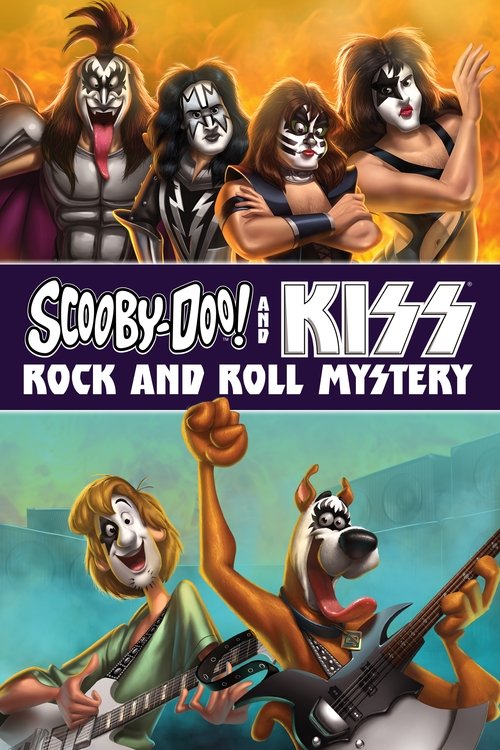
Scooby-Doo! and Kiss: Rock and Roll Mystery
Overview
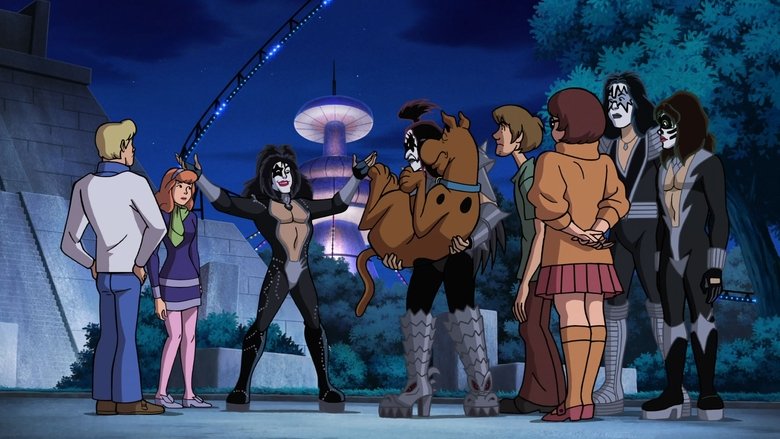
In Scooby-Doo! and Kiss: Rock and Roll Mystery, the Mystery Inc. gang heads to Kiss World, a massive amusement park dedicated to the legendary rock band, for a Halloween concert. The trip is initiated by Daphne, who has a significant crush on Kiss's frontman, Starchild, much to Fred's annoyance. Upon arrival, they find the park terrorized by a menacing figure known as the Crimson Witch, whose hauntings threaten to cancel the big show.
Teaming up with Kiss—The Demon, Starchild, Catman, and Spaceman—the gang dives into one of their strangest cases yet. The mystery deepens when they learn the witch is seeking the Black Diamond, a mystical artifact connected to the band. This leads them on an adventure that blurs the line between a typical 'man in a mask' mystery and a genuine supernatural, cosmic event, complete with a journey to an alternate dimension called Kissteria and a battle to save Earth from a powerful entity known as The Destroyer.
Core Meaning
The core meaning of Scooby-Doo! and Kiss: Rock and Roll Mystery revolves around the playful collision of two distinct pop culture universes and the celebration of their respective mythologies. The film explores the idea that some things are beyond simple, rational explanation, directly challenging the foundational skepticism of the Scooby-Doo formula. The director and writers aimed to create a story where the over-the-top, cosmic superhero personas of Kiss could coexist with the grounded, mystery-solving world of the gang. Ultimately, the film suggests that embracing the fantastic and the spectacular—whether it's rock and roll theatrics or otherworldly powers—is more fun than trying to debunk everything. It's a message about the power of belief and the idea that reality can be stranger and more wonderful than fiction.
Thematic DNA
Skepticism vs. The Supernatural
This is the central theme, embodied by Velma. Throughout the film, she struggles to find a logical explanation for the increasingly bizarre events. Kiss is presented not just as a band but as super-powered guardians from another dimension, a concept Velma dismisses as hokum. The plot constantly forces her to question her staunch belief that every mystery has a rational solution, culminating in an ending where the supernatural elements are confirmed to be real, even after a logical culprit is unmasked.
The Power of Performance and Persona
Kiss's entire identity is built on larger-than-life personas. The film takes these stage characters and elevates them to the status of actual superheroes. Their power literally comes from 'Rock and Roll'. This theme celebrates theatricality and the idea that a performance can be so powerful it creates its own reality. The film itself is a performance, blending the band's music and iconography directly into the narrative fabric.
Fandom and Identity
The characters' relationships with Kiss are central to the plot. Daphne's crush on Starchild drives the gang to the park, creating a humorous subplot of jealousy with Fred. Fred's dislike of Kiss and preference for his favorite acapella group, 'The Ascot Five,' provides a comedic counterpoint and character development. The film playfully explores how being a 'fan' shapes the characters' motivations and interactions.
Unlikely Alliances
The core of the movie is the team-up between the down-to-earth Mystery Inc. and the cosmic rock gods, Kiss. Initially, there's friction, particularly from The Demon (Gene Simmons), who is dismissive of the gang's abilities. However, they learn to combine their skills—the gang's investigative cunning and Kiss's 'power of rock'—to confront the dual threats of the Crimson Witch and The Destroyer, showcasing the strength of combining different talents.
Character Analysis
Velma Dinkley
Mindy Cohn
Motivation
To find the logical, rational explanation behind the mystery and debunk any and all supernatural claims.
Character Arc
Velma undergoes the most significant character arc. She begins as the steadfast voice of reason, convinced the Crimson Witch is a simple fake and that Kiss's powers are mere special effects. As the evidence for genuine supernatural phenomena mounts, she is forced to confront the limits of her logic. The film ends with her offering a 'mass hallucination' theory, but the final scene confirms the magic was real, leaving her worldview subtly challenged.
Fred Jones
Frank Welker
Motivation
To solve the mystery and, on a more personal level, to win Daphne's affection and prove his worth in the face of her rockstar crush.
Character Arc
Fred's arc is driven by his jealousy over Daphne's infatuation with Starchild. He is initially dismissive of Kiss and their music, championing his preferred band, 'The Ascot Five'. Throughout the adventure, he must put aside his personal feelings and work with the band, eventually earning a kiss on the cheek from Daphne, which validates his efforts.
The Demon
Gene Simmons
Motivation
To protect the Black Diamond, defeat the Crimson Witch, and maintain the cosmic balance, all while upholding his fearsome rock-god persona.
Character Arc
The Demon is initially arrogant and hostile towards Mystery Inc., viewing them as amateurs. He is particularly annoyed by Shaggy and Scooby. Over the course of the film, he develops a grudging respect for their abilities and bravery, culminating in him giving Shaggy and Scooby a genuine smile at the end. He acts as a reluctant guide to the cosmic side of the mystery.
The Starchild
Paul Stanley
Motivation
To save Kiss World and the Earth from destruction, and to put on a great rock show.
Character Arc
Starchild serves as the charming and welcoming face of Kiss. He is immediately friendly to the gang and is the object of Daphne's affection. He acts as the bridge between the two groups. His character doesn't have a dramatic arc but remains a consistent force of heroic optimism, leading the charge against the Crimson Witch with flair and confidence.
Delilah Domino / The Crimson Witch
Pauley Perrette
Motivation
As the Crimson Witch, her stated goal is to summon The Destroyer. Her real motivation as Delilah is to steal the Black Diamond—which has properties useful in advanced laser technology—and sell it to a rival defense company as revenge for being fired from her previous job.
Character Arc
Delilah Domino presents herself as the overly zealous head of security, suspicious of Mystery Inc. This is a facade for her true identity as the Crimson Witch. Her arc is the classic Scooby-Doo reveal: a seemingly legitimate authority figure is unmasked as the culprit with a greedy, terrestrial motive hidden beneath a supernatural disguise.
Symbols & Motifs
The Black Diamond (Rock of Kissteria)
The Black Diamond symbolizes the source of Kiss's power and their cosmic origins. It's the MacGuffin of the film, but it also represents the core of Kiss's mythology—a tangible object that contains the raw, otherworldly energy of their music and personas. It's the key that can either save the world through rock or destroy it by unleashing The Destroyer.
The Crimson Witch seeks to steal the diamond to summon The Destroyer. It's used in Kiss's song 'Detroit Rock City' and becomes the focal point of the final conflict. The gang must protect it, and its journey takes them from the theme park to the alternate dimension of Kissteria.
KISS Makeup and Costumes
The makeup and costumes symbolize the transformation from mortal musicians to mythic superheroes. They are the source of the band's power and their iconic identities (Starchild, Demon, etc.). For the Scooby gang, putting on the makeup (as they do at the beginning) symbolizes their entry into Kiss's world and their willingness to engage with the fantastic.
The band is never seen without their makeup and costumes, reinforcing their mythic status. At the start of the film, all of Mystery Inc. except Fred arrive at Kiss World wearing the makeup, signifying their immersion in the fan culture.
Kissteria
Kissteria is the alternate dimension that serves as the physical manifestation of the Kiss mythology. It represents a reality where the band's lore is true and their powers are real. It symbolizes a world governed by the laws of rock and roll, a cosmic, Kirby-esque landscape that stands in stark contrast to the rational world Velma believes in.
The gang and Kiss travel through a portal to Kissteria to confront the Crimson Witch and prevent her from unleashing The Destroyer. The visual style of this dimension is heavily inspired by the cosmic comic book art of Jack Kirby.
Memorable Quotes
My plan was perfect. And I would've gotten away with it too if it hadn't been for you meddling KISS. Er, uh, kids. You meddling kids.
— Delilah Domino
Context:
Spoken immediately after Delilah Domino has been unmasked as the Crimson Witch and her entire plan has been revealed.
Meaning:
This is a direct and humorous twist on the classic Scooby-Doo catchphrase. It acknowledges the unique crossover nature of the film, giving the legendary band credit for foiling the plot before correcting to the traditional line, perfectly blending the two franchises' identities.
Why rock her world?
— Scooby-Doo
Context:
In the final scene, after Kiss flies away in their spaceship, Shaggy asks Scooby if they should tell Velma what they just saw. Scooby delivers this line, and they decide to keep it a secret.
Meaning:
This final line of the film is a poignant and clever pun that encapsulates the movie's core theme. Scooby suggests not telling Velma that Kiss's powers were real, allowing her to keep her rational worldview intact. It shows a deep understanding of his friend and simultaneously winks at the audience, confirming the 'magic' was real all along.
Be careful with that bass." / "Because it's made from alien technology?" / "Because it costs more than your house.
— The Demon and Velma
Context:
While in the alternate dimension of Kissteria, Velma is examining one of the band's instruments, trying to understand its otherworldly properties, when The Demon interjects with a dose of reality.
Meaning:
This exchange perfectly illustrates the film's humor and the clash between Velma's search for the extraordinary and The Demon's pragmatic, rockstar arrogance. It grounds the cosmic elements in the very real-world ego and wealth of a rock legend like Gene Simmons.
Philosophical Questions
What is the relationship between perception and reality?
The film directly engages with this question through its central conflict. Velma perceives a world governed by logic and reason, while Shaggy and Scooby witness a cosmic battle between good and evil. The plot's 'mass hallucination' explanation explicitly questions whether the shared experience of the supernatural was real or imagined. The ending ultimately suggests that reality can be subjective and that a truth doesn't cease to be real simply because a rational mind cannot accept it.
Can the fantastic and the rational coexist?
The entire premise of the film is a test of this question. The Scooby-Doo formula is built on rational explanations for seemingly fantastic events. Kiss's persona is built on embracing the fantastic. The movie resolves this by allowing both to be true simultaneously. There is a rational culprit in a mask (Delilah Domino), satisfying the Scooby-Doo formula. However, there are also genuine superheroes from another dimension, satisfying the Kiss mythology. The film concludes that these two realities don't have to cancel each other out.
Alternative Interpretations
The film's primary ambiguity, which allows for alternative interpretations, is the true nature of Kiss's powers and the events in Kissteria. The narrative deliberately presents two conflicting explanations.
One interpretation, championed by Velma, is that the entire cosmic battle was a 'mass hallucination' induced by the Crimson Witch's gas. In this reading, the adventure in Kissteria was a shared dream, and the only 'real' mystery was Delilah Domino's industrial espionage. This interpretation preserves the traditional, rational framework of the Scooby-Doo universe, where the monster is always a person in a costume and science explains everything.
The alternative, and more strongly supported, interpretation is that everything actually happened. The final shot of Kiss flying off into space in their guitar-shaped ship, witnessed by Shaggy and Scooby, effectively confirms their supernatural origins. This reading suggests that the Scooby-Doo universe is not as strictly rational as Velma believes, and that real magic and cosmic beings exist. Scooby's final line, 'Why rock her world?', implies that the truth is being withheld from Velma to protect her worldview, inviting the audience to be in on a secret that one of the main characters is not.
Cultural Impact
Scooby-Doo! and Kiss: Rock and Roll Mystery represents a significant and self-aware pop culture crossover. Released in 2015, it brought together two enduring American entertainment icons that have been popular for decades. The film functions as both a nostalgic homage and a modern reboot of a concept first tried in the poorly received 1978 TV movie Kiss Meets the Phantom of the Park. The creators were explicit that this film was an opportunity to do justice to the idea of a Kiss and Hanna-Barbera team-up.
Critics and audiences generally received the film positively, particularly praising its high-quality animation, self-deprecating humor, and its embrace of the over-the-top, cosmic mythology of Kiss. Many noted that the film was made with Kiss fans in mind, filled with deep-cut references and Easter eggs that reward longtime followers of the band. The film's premiere at San Diego Comic-Con's prestigious Hall H, attended by the full band, underscored its status as a major event for fans of both properties. While not a theatrical release, its success within the direct-to-video market reaffirmed the enduring appeal of both Scooby-Doo crossovers and the Kiss brand, demonstrating how legacy properties can be successfully combined for multi-generational audiences.
Audience Reception
Audience reception for Scooby-Doo! and Kiss: Rock and Roll Mystery was generally positive, especially among its target demographics: Scooby-Doo fans and Kiss fans. Many viewers praised the film for its fun, self-aware, and over-the-top tone, considering it a significant improvement over the band's 1978 film, Kiss Meets the Phantom of the Park. The high-quality, Jack Kirby-inspired animation was a frequent point of praise, as was the extensive use of Kiss's music.
The main points of criticism revolved around the sometimes convoluted plot, particularly the blend of a traditional mystery with a cosmic space opera, which some found jarring. A few viewers also noted the awkwardness of the age difference in the romantic subplot between the teenage Daphne and the much older Starchild (Paul Stanley). However, most fans embraced the film's wild and bizarre energy, viewing it as one of the more entertaining and memorable entries in the long-running Scooby-Doo direct-to-video series.
Interesting Facts
- This film was the final time Mindy Cohn voiced the character of Velma Dinkley before Kate Micucci took over the role later the same year.
- Filmmakers Kevin Smith and Jason Mewes, famous for playing Jay and Silent Bob, have voice cameos as two bumbling park workers at the beginning of the movie.
- The animation and visual style, particularly for the sequences in the alternate dimension of Kissteria, were heavily inspired by the cosmic comic book art of Jack Kirby.
- The movie features six classic Kiss songs, as well as a new, original song written and performed by the band specifically for the film.
- The movie serves as a spiritual successor or a 'second chance' to get the concept right after the band's notoriously campy 1978 Hanna-Barbera TV movie, Kiss Meets the Phantom of the Park, which had a similar plot but was disliked by the band.
- This was the first time the entire band Kiss attended Comic-Con together, which they did to promote the film at its world premiere in Hall H.
- Many of the minor characters' names are references to Kiss songs or personnel, such as Shandi Strutter, Chip McGhoo (a play on their real manager, Doc McGhee), and Manny Goldman.
Easter Eggs
Reference to Former KISS Members
In a book of lore shown by the character Chikara, symbols representing former Kiss members are visible on a page. These include an ankh for Vinnie Vincent and a fox for Eric Carr, acknowledging the band's history beyond the current lineup.
Album Cover Poses
Throughout the film, the band members and even the Scooby gang strike poses that are direct homages to classic Kiss album covers. For example, the gang appears in outfits from the 'Love Gun' era, and Kiss themselves are seen in a pose from the 'Kiss Alive!' album.
The Ascot Five's Album Art
The cover of the CD for The Ascot Five, Fred's favorite band, is a parody of the iconic album cover for The Beach Boys' 'Pet Sounds'. The song 'Don't Touch My Ascot' was actually performed by Kiss themselves in a barbershop quartet style for the movie.
Jendell
Chikara's book of lore also mentions Jendell, the fictional planet that original Kiss guitarist Ace Frehley (the first Spaceman) famously claimed to be from, a nod to the band's original mythology.
Phantom of the Park Nods
Several visual cues are deliberate callbacks to Kiss Meets the Phantom of the Park. The opening roller coaster scene is reminiscent of a similar scene in the 1978 film, and surveillance monitor shots of the crowd also echo the earlier movie.
⚠️ Spoiler Analysis
Click to reveal detailed analysis with spoilers
Frequently Asked Questions
Explore More About This Movie
Dive deeper into specific aspects of the movie with our detailed analysis pages
Comments (0)
No comments yet. Be the first to share your thoughts!