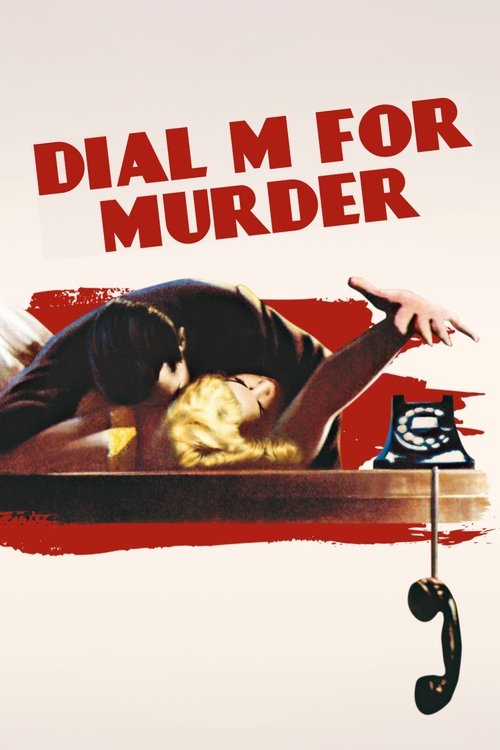
Dial M for Murder
A claustrophobic crime thriller that elegantly weaves a web of meticulous planning and unforeseen chance, turning a London flat into a gilded cage of suspense.
Dial M for Murder

Dial M for Murder

"Is this the man she was waiting for... or the man who was waiting for her?"

29 May 1954 United States of America 105 min ⭐ 8.0 (2,728)
Director: Alfred Hitchcock
Cast: Ray Milland, Grace Kelly, Robert Cummings, John Williams, Anthony Dawson
Crime Thriller
The Fallacy of the Perfect Crime Betrayal and Deceit in Marriage Intellect vs. Chance Appearance vs. Reality
Budget: $1,400,000
Box Office: $3,000,000

Overview

"Dial M for Murder" centers on the chillingly calm Tony Wendice (Ray Milland), a retired professional tennis player who discovers his wealthy wife, Margot (Grace Kelly), has had an affair with American crime-fiction writer Mark Halliday (Robert Cummings). Fearing a divorce would leave him penniless, Tony meticulously plots what he believes to be the perfect murder to inherit her fortune.

He blackmails a shady old university acquaintance, Charles Swann (Anthony Dawson), into carrying out the deed. The plan is precise: Tony will create an alibi for himself, and at a specific moment, he will telephone his own flat. When Margot answers, Swann is to strangle her, making it look like a burglary gone wrong. However, the flawless scheme unravels when Margot fights back, killing her attacker in self-defense. Forced to think on his feet, Tony arrives from his alibi and coolly manipulates the crime scene to frame his wife for premeditated murder, leading to a tense investigation by the shrewd Chief Inspector Hubbard (John Williams).

Core Meaning

The core meaning of "Dial M for Murder" explores the vanity and folly of attempting to orchestrate a "perfect crime." Director Alfred Hitchcock dissects the illusion of control, demonstrating how meticulous intellectual planning is ultimately vulnerable to chance, human nature, and unforeseen complications. The film serves as a cautionary tale about greed and the dark complexities of a marriage poisoned by deceit, where charm and civility mask murderous intent. It posits that true justice isn't just about punishment but about the clever unraveling of a seemingly perfect lie.

Thematic DNA

The Fallacy of the Perfect Crime 35%
Betrayal and Deceit in Marriage 30%
Intellect vs. Chance 20%
Appearance vs. Reality 15%

The Fallacy of the Perfect Crime

The central theme is the intellectual arrogance behind planning a perfect murder. Tony Wendice embodies the meticulous planner, accounting for every detail, from the timing of a phone call to the placement of a key. However, the film systematically dismantles his flawless design, showing how a single unpredictable element—Margot's will to survive—can cause the entire structure to collapse. The suspense arises not from who the killer is, but from watching if and how his perfect plan will fail.

Betrayal and Deceit in Marriage

The film delves into the dark undercurrents of a seemingly sophisticated marriage. Margot's initial infidelity with Mark provides Tony with a motive, but his betrayal is far deeper. He maintains a facade of a charming, considerate husband while methodically plotting his wife's death purely for financial gain. The apartment, a symbol of their shared life, becomes the stage for this ultimate deception, highlighting the profound disconnect between appearance and reality.

Intellect vs. Chance

A classic Hitchcockian theme, the film pits cold, calculated intellect against the unpredictable nature of chance and human behavior. Tony's plan is a masterpiece of logic, but he fails to account for the human element. Conversely, Inspector Hubbard's intellect is reactive and observant; he solves the crime not by grand design, but by noticing small inconsistencies and exploiting the mistakes born from chance—like the wrong key being in the wrong place at the wrong time.

Appearance vs. Reality

From the outset, nothing is as it seems. A sophisticated, wealthy couple's life masks infidelity and murderous greed. A staged burglary is actually a murder-for-hire, and an act of self-defense is twisted to look like premeditated murder. Characters consistently present false fronts: Tony's charm, Swann's pretense of being a car salesman, and Margot's initial composure. The entire narrative is a puzzle where the police, and the audience, must peel back layers of carefully constructed lies to find the truth.

Character Analysis

Tony Wendice

Ray Milland

Archetype: The Mastermind Antihero
Key Trait: Calculating Charm

Motivation

His primary motivation is financial greed. A former professional tennis player, he married his wife Margot for her money and has grown accustomed to a luxurious lifestyle. He fears that if Margot divorces him over her affair, he will be left with nothing. The murder is not a crime of passion or jealousy, but a cold business decision to secure his financial future.

Character Arc

Tony begins as a cool, calculating planner, completely in control. He is charming, ruthless, and intellectually vain. His arc is one of devolution. When his perfect plan fails, he is forced to improvise, becoming increasingly tangled in his own web of lies. His composure slowly cracks under Inspector Hubbard's methodical pressure, until his final, desperate act of using the hidden key exposes his guilt, transforming him from a master manipulator into a trapped criminal.

Margot Wendice

Grace Kelly

Archetype: The Elegant Victim
Key Trait: Vulnerable Grace

Motivation

Initially, her motivation is to navigate the emotional complexities of her marriage and her affair with Mark. After the attack, her motivation is simply to survive—first the physical assault, and then the psychological and legal assault orchestrated by her husband. She is largely unaware of the true extent of Tony's plot for most of the film.

Character Arc

Margot starts as a somewhat passive character, trapped by her affair and her husband's manipulative kindness. Her arc is a journey from victim to survivor, and then back to victim under the law. Her pivotal moment is fighting back and killing Swann. Afterward, she becomes increasingly vulnerable and emotionally detached, especially after being wrongly convicted and sentenced to death. Her innocence and helplessness are what ultimately drive Mark and Hubbard to uncover the truth.

Chief Inspector Hubbard

John Williams

Archetype: The Astute Detective
Key Trait: Methodical Wit

Motivation

Hubbard is motivated by a professional and moral commitment to justice. He is driven by inconsistencies in the case that don't add up, particularly the matter of the latchkey. His determination to solve the puzzle, even after a conviction has been secured, shows his dedication to uncovering the absolute truth rather than settling for an easy answer.

Character Arc

Hubbard initially appears as a polite, methodical, and perhaps unremarkable police inspector. His arc is one of revealing his true, brilliant intellect. He seems to accept Tony's framing of Margot at first, but subtle details niggle at him. He moves from a procedural investigation to a clever, psychological game, laying an elaborate trap for Tony. He remains the calm, moral center of the film, his persistance ensuring that true justice prevails.

Mark Halliday

Robert Cummings

Archetype: The Concerned Lover
Key Trait: Earnest Loyalty

Motivation

His motivation is his love for Margot and his unwavering belief in her innocence. After she is convicted, he becomes singularly focused on saving her from execution, willing to challenge both Tony and the police to find a way to exonerate her.

Character Arc

Mark begins as the 'other man', a crime writer who loves Margot. His arc is one of growing desperation and proactive involvement. Initially an outsider to the central crime, he refuses to believe Margot is guilty. He transitions from a passive lover to an amateur detective, attempting to use his knowledge of crime fiction to concoct a story to save Margot, inadvertently hitting close to the truth and helping Inspector Hubbard corner Tony.

Symbols & Motifs

The Latchkey

Meaning:

The key symbolizes power, control, and access. Initially, it represents domestic ownership. By stealing Margot's key, Tony strips her of her power and transfers it to Swann, the intruder. The key's journey—from Margot's handbag, to under the stair carpet, to Swann's pocket, and the eventual swap of keys—becomes the central thread of the plot. Ultimately, control of the key determines who holds power, with Inspector Hubbard using it as the final tool to spring the trap on Tony.

Context:

The key is a constant focus. Tony hides Margot's key under the stair carpet for Swann to use. After the failed murder, Tony mistakenly takes Swann's key from his pocket and returns it to Margot's bag. This mistake is what Inspector Hubbard eventually discovers, proving Margot could not have planted the key back herself and leading to the climax where Tony uses the hidden key, incriminating himself.

The Telephone

Meaning:

The telephone acts as the primary instrument of the murder plot, a lifeline twisted into a weapon. It is the trigger for the attack, meant to signal the moment of Margot's death. It symbolizes the intrusion of external threat into the domestic space and Tony's detached, remote-controlled method of violence. The title itself emphasizes the phone's central role in the meticulously planned, yet ultimately failed, crime.

Context:

Tony's plan hinges on him calling the flat from a party at a precise time. When Margot answers the phone, Swann is supposed to attack. The phone call is the link between Tony's alibi and the crime scene, a seemingly innocuous action that initiates the intended violence.

The Scissors

Meaning:

The scissors represent the intrusion of chance and feminine resourcefulness into a masculine, rigidly planned crime. Intended as a domestic tool, they become an improvised weapon of survival. While Tony's plan involves a scarf for a clean, silent strangulation, the scissors introduce chaos, violence, and unforeseen consequences, ultimately upending his entire scheme.

Context:

As Swann attacks Margot from behind the curtains, she fumbles behind her on the desk, grabbing a pair of scissors. In a desperate act of self-defense, she stabs him in the back, killing him. Hitchcock took great care filming this scene, reportedly agonizing over getting the 'gleam' of the scissors just right.

Memorable Quotes

Do you really believe in the perfect murder?

— Margot Mary Wendice

Context:

Spoken early in the film during a conversation between Margot, Tony, and Mark Halliday. Mark, a fiction writer, is explaining how he devises his plots by putting himself in the criminal's shoes. Margot's question is posed to him, setting the stage for Tony's real-life attempt to achieve what Mark only writes about.

Meaning:

This line serves as the film's central philosophical question and a piece of dramatic irony. Margot asks it innocently, discussing her lover's crime novels, completely unaware that her husband is, at that very moment, plotting her own "perfect murder." It foreshadows the entire plot and highlights the theme of fiction versus reality.

They talk about flat-footed policemen. May the saints protect us from the gifted amateur.

— Chief Inspector Hubbard

Context:

Hubbard says this to Mark later in the film, after Mark has passionately laid out his theory of Tony's guilt. While Mark's instincts are correct, his approach is based on narrative logic, which Hubbard humorously dismisses in favor of his own police procedure.

Meaning:

This quote is a dryly witty expression of Hubbard's professional frustration. It's directed at Mark Halliday, the "gifted amateur" detective who is trying to solve the case with theories from his novels. The line underscores the difference between fictional crime-solving and the methodical, evidence-based work of a real detective. It also subtly reveals Hubbard's own sharp intelligence beneath his unassuming exterior.

In stories, things usually turn out the way the author wants them to. In real life, they don't... always.

— Mark Halliday

Context:

Said during the initial conversation about the "perfect murder." After Margot asks if he believes in it, Mark replies that he does, but only on paper. He explains that he doubts he could carry one out himself because real life has too many variables, unlike a story where the author is in complete control.

Meaning:

This line is deeply ironic and serves as the film's thesis statement. Mark, a writer, explains the difference between the controllable world of fiction and the unpredictable nature of reality. He is unknowingly predicting the failure of Tony's perfectly 'authored' murder plot, which will be derailed by the chaotic, unscripted elements of real life.

Philosophical Questions

Can a 'perfect' plan ever account for the unpredictability of human nature?

The film relentlessly explores this question through Tony's meticulously crafted plot. He architects a crime that seems flawless on paper, treating people like chess pieces. However, he fails to predict Margot's instinct for survival and Swann's slight incompetence. The film argues that no amount of intellectual planning can fully contain the variables of fear, desperation, and chance. It suggests a fundamental flaw in the idea of a 'perfect crime,' positing that human behavior will always be the unpredictable element that unravels the most logical of schemes.

What is the nature of justice: is it the punishment of the guilty or the exoneration of the innocent?

The film's second half shifts its focus from the crime to the pursuit of justice. The legal system fails, convicting and sentencing an innocent woman to death. True justice is ultimately delivered not by the courts, but by the dogged determination of Inspector Hubbard. His motivation isn't simply to punish Tony, but to prove Margot's innocence. The film suggests that justice is an intellectual puzzle requiring the dismantling of lies, and that its true triumph lies in the restoration of innocence, a theme crystallized in the final scene where Margot is freed and Tony is trapped by his own cleverness.

Alternative Interpretations

While the film's plot is quite direct, some interpretations focus on the subtext of the character dynamics. One perspective views the entire film as a critique of upper-class civility, suggesting that the polite manners and sophisticated lifestyle of the Wendices are merely a thin veneer over brutal, transactional motivations. Tony's lack of emotional jealousy, contrasted with his obsession with money, can be read as a commentary on the decay of marital values in favor of materialism.

Another interpretation considers the film through a feminist lens, where Margot's passivity and victimization highlight the constraints placed upon women in the 1950s. Her affair is the catalyst, but she is quickly rendered powerless, not only by her husband but also by the male-dominated legal system that readily convicts her. Her single act of violent agency—killing Swann—is immediately re-contextualized as a crime by the men around her. Her eventual rescue comes not from her own actions, but from the intervention of two other men, Mark and Hubbard.

Cultural Impact

Released in 1954, "Dial M for Murder" came at a time when the 3D film craze was ending, which ironically secured its legacy more as a masterfully constructed thriller than a technological gimmick. Based on a hit stage play, the film is a quintessential example of a "single-set" thriller, a subgenre Hitchcock had explored before with "Rope" and "Lifeboat." Its success demonstrated how to maintain intense cinematic suspense within a confined, theatrical space, influencing countless subsequent thrillers that rely on psychological tension over expansive action.

Critically, it was well-received as a sophisticated and sinister thriller, though sometimes viewed as a slightly lesser work compared to the masterpieces that immediately followed it, like "Rear Window." Nevertheless, its reputation has endured, and it is often cited for its intelligent script, Ray Milland's chilling performance, and its masterful use of props, particularly the key and scissors, as central plot devices. The film cemented Grace Kelly's status as a quintessential 'Hitchcock blonde' and marked the start of their iconic collaboration. Its premise of a 'perfect murder' gone wrong has been referenced and remade multiple times, including a 1998 film, "A Perfect Murder," demonstrating its lasting influence on the crime genre.

Audience Reception

Audience reception for "Dial M for Murder" has been consistently positive over the years, with many praising it as a clever, suspenseful, and highly entertaining thriller. Viewers frequently celebrate the performance of Ray Milland as the suave and sinister Tony Wendice, finding his charming villainy captivating. The intricate plot, particularly the twists involving the latchkey, is often highlighted as a work of genius, keeping audiences engaged until the very end. The methodical and witty Inspector Hubbard, played by John Williams, is another fan favorite.

The main points of criticism often center on the film's "stagey" or theatrical feel, owing to its origins as a play and its single-set location. Some viewers find it more dialogue-heavy and less cinematic than Hitchcock's other, more visually dynamic films like "North by Northwest." A minority of viewers also find the plot slightly too convenient or far-fetched, particularly the series of events that lead to Tony's downfall. Despite this, the overall verdict is that it is a top-tier thriller and a classic example of Hitchcock's mastery of suspense.

Interesting Facts

  • The film was shot in 3D, making it Alfred Hitchcock's only film in this format. However, by the time it was released in 1954, the 3D craze was waning, and most audiences saw it in a standard 2D format.
  • The vast majority of the film takes place in a single location: the Wendices' London apartment. This was intentional, as Hitchcock wanted to preserve the claustrophobic feeling of the original stage play by Frederick Knott.
  • Hitchcock had a special pit dug into the studio floor to achieve the low-angle shots he wanted, allowing the large 3D camera to be positioned at eye-level with the actors.
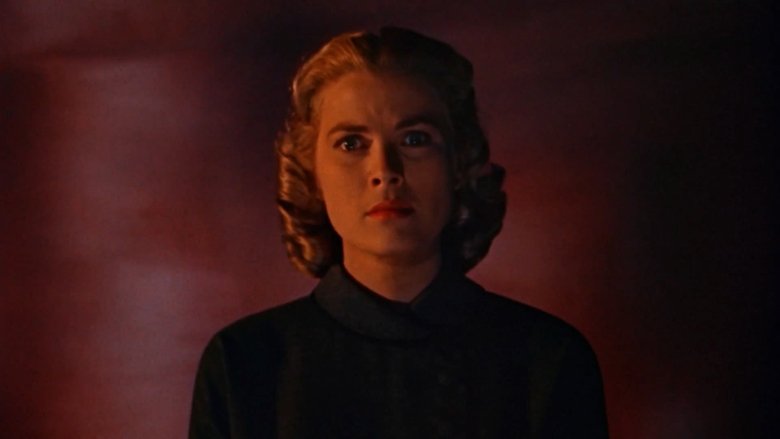
  • Grace Kelly's wardrobe was designed to reflect her emotional state. She begins the film in bright, vibrant colors, but her clothing becomes progressively darker and more muted after the murder attempt and her subsequent arrest.
  • Actors John Williams (Inspector Hubbard) and Anthony Dawson (Charles Swann) reprised their roles from the original Broadway production of the play.
  • Hitchcock was reportedly so stressed about perfecting the pivotal murder scene with the scissors that he lost 20 pounds during the 36-day shoot.
  • This was the first of three films Alfred Hitchcock made with Grace Kelly, followed by "Rear Window" and "To Catch a Thief".

Easter Eggs

Alfred Hitchcock's cameo appearance is in a black-and-white photograph.

About 13 minutes into the film, Tony shows Swann a photograph from a Cambridge University reunion dinner. Hitchcock can be seen sitting at the banquet table on the left side of the photo, among the former students. This is one of the director's more subtle cameos.

⚠️ Spoiler Analysis

Click to reveal detailed analysis with spoilers

Frequently Asked Questions

Explore More About This Movie

Dive deeper into specific aspects of the movie with our detailed analysis pages

Comments (0)

Leave a comment

No comments yet. Be the first to share your thoughts!