Skip to content
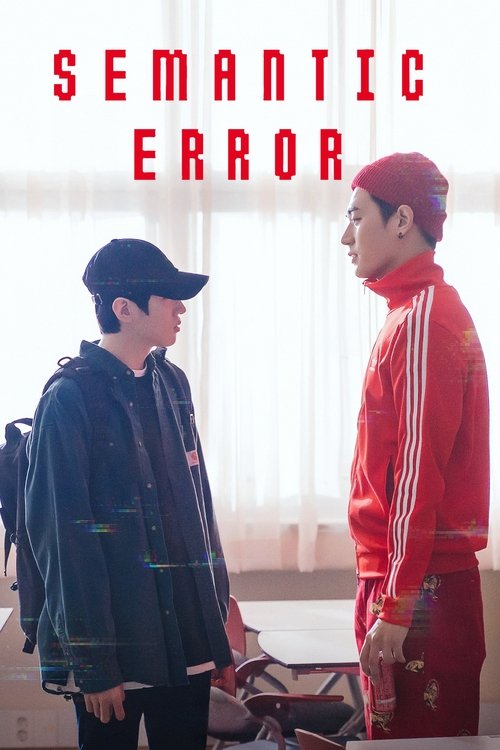
Semantic Error
A sharp-edged campus romance where logic meets chaos: one boy's flawless code of living is invaded by a walking exception, and the crash becomes the most tender thing that ever happened to him.
Semantic Error

Semantic Error

시맨틱 에러

"An exciting error interrupts their perfectly structured life."

16 February 2022 — 10 March 2022 South Korea 1 season 8 episode Ended 8.5 (103)

Cast: Park Seo-ham, Park Jae-chan, Song Ji-oh, Kim No-jin, Kim Won-gi

Drama Order versus disruption Enemies to lovers as mutual recognition The cost of principle Self-knowledge and the fear of feeling Choosing a person over a plan

Overview

Semantic Error (시맨틱 에러) is a 2022 South Korean streaming series adapted from the BL web novel of the same name by Jeo Soo-ri. Directed by Kim Soo-jung and written by Jason, it premiered on Watcha on February 16, 2022, and ran for eight episodes through March 10, 2022, starring Park Seo-ham and Park Jae-chan.

The story begins with an act of pure principle. Chu Sang-woo, a computer science underclassman who prizes reason, rules and a rigid sense of what is right above everything else, is saddled with a liberal-arts group project in which his teammates freeload and contribute nothing. So he does the only logical thing: he deletes their names from the final presentation. What he cannot calculate is the fallout — the deletion wrecks the academic standing and study-abroad plans of Jang Jae-young, a senior from the Design department and the campus's effortlessly adored golden boy.

What follows is an eight-episode escalation of revenge into something neither of them planned for. Jae-young sets out to make Sang-woo's meticulously ordered life unlivable; Sang-woo, immune to charm and allergic to disruption, refuses to bend. But the harassment keeps putting them in the same room, on the same project, in the same orbit — and proximity does what antagonism could not. The series is a compact, contained study of two temperaments colliding: the boy who runs on rules and the boy who is the exception to all of them, discovering that the error in the system was never a malfunction at all.

Core Meaning

At its heart, Semantic Error argues that a life optimized for correctness is not the same as a life that works. Sang-woo's entire personality is a defense mechanism dressed up as integrity: if he follows every rule perfectly, nothing and no one can reach him. Jae-young is the variable that the system cannot parse — and the show's thesis is that being unable to parse someone is the beginning of loving them.

The title is the key. A semantic error is code that compiles and runs without crashing but produces the wrong result — syntactically flawless, meaningfully broken. That is Sang-woo's life before Jae-young, and arguably Jae-young's charmed, frictionless popularity before Sang-woo. The series suggests that meaning is not something you can enforce through procedure; it has to be negotiated with another person, messily, in real time.

Beneath the romantic comedy, the drama also makes a quietly significant cultural argument simply by existing in the form it does: it treats a same-sex relationship as an ordinary campus love story worth mainstream production values and mainstream affection, without pathologizing it. As the first BL series to break through to major success in South Korea, its meaning is partly its presence.

Thematic DNA

Order versus disruption 30%
Enemies to lovers as mutual recognition 25%
The cost of principle 20%
Self-knowledge and the fear of feeling 15%
Choosing a person over a plan 10%

Order versus disruption

The series is built on a single structural collision: Sang-woo lives by schedules, principles and non-negotiable boundaries, while Jae-young is the campus star who has never needed a rule in his life. Early episodes stage this as pure antagonism — Jae-young deliberately corrupts Sang-woo's routines as revenge for the deleted names. Across the middle stretch, the polarity inverts: the disruption stops being an attack and becomes an invitation, and Sang-woo's rigidity is revealed as fear rather than virtue. By the finale the two have not converted each other; they have learned to run on a shared, imperfect protocol.

Enemies to lovers as mutual recognition

The show is a textbook of the enemies-to-lovers form, and its intelligence lies in why the turn happens. Jae-young's tactics shift from pranking to befriending the moment he catches a glimpse of Sang-woo's human side — the loneliness under the rulebook. Hostility in this series functions as unusually close attention: to torment someone effectively you must first study them exhaustively. What begins as surveillance for revenge ends as the only real intimacy either character has.

The cost of principle

Sang-woo is not wrong to delete the freeloaders' names — the series never pretends he is. But it insists that being right has consequences that land on real people, including one who did not deserve them. The arc traces his slow discovery that fairness and kindness are not the same axis, and that a moral system with no room for context will eventually hurt someone he cares about. His growth is not abandoning his principles but learning to hold them alongside another person's needs.

Self-knowledge and the fear of feeling

Even after Sang-woo recognizes his feelings for Jae-young, he still struggles to accept them — the drama draws a careful line between knowing and admitting. His resistance is rendered not as shame imposed from outside but as the terror of a person whose entire identity depends on being legible to himself. The series lets him take his time, and the eventual acceptance registers as the genuine climax, more than any confession scene.

Choosing a person over a plan

Both leads are defined by trajectories: Sang-woo's flawless academic track, Jae-young's study-abroad ambitions and, in the finale, an offer to work in France. The show repeatedly asks whether a future you scheduled for yourself is worth more than a present you did not anticipate. Crucially, it does not frame this as sacrifice-or-nothing; the final movement is about negotiating a life in which the plan and the person can coexist.

Character Analysis

Chu Sang-woo

Park Jae-chan

Archetype: Reluctant hero / the rigid rationalist Key Trait: Uncompromising literal-mindedness

Motivation

Initially: efficiency, fairness and the preservation of a life with no unpredictable inputs. This mutates into a need to understand the one variable he cannot resolve, and finally into the wish to keep that variable close — even though keeping it means accepting permanent unpredictability.

Character Arc

Introduced as the epitome of an inflexible, rule-abiding person: a computer science underclassman who prizes reason and a rigid sense of what is right above all else. Deleting his freeloading teammates' names is, to him, simple arithmetic. The consequences force him into sustained contact with someone he cannot categorize, and his arc is a slow decompression — wariness giving way to a lowered guard, then to a recognition of feelings he still struggles to accept. His transformation is not a personality transplant; he ends the series still precise, still principled, but no longer using precision as a wall.

Jang Jae-young

Park Seo-ham

Archetype: Antagonist-turned-romantic lead / charming trickster Key Trait: Relentless, disarming persistence

Motivation

Starts as wounded pride and the desire for proportional revenge; becomes fascination with the one person on campus immune to him; resolves into an unusually patient, careful persuasion — he wants to be chosen, not merely tolerated.

Character Arc

A Design department senior and campus star whose study-abroad plans are wrecked by Sang-woo's deletion. He begins as the aggressor, weaponizing his charisma to dismantle Sang-woo's routine. The pivot comes when he catches a glimpse of Sang-woo's human side and changes tactics from pranking to befriending — a shift he initially mistakes for a better strategy and only later understands as attachment. His arc runs from effortless popularity toward genuine investment, culminating in a decision about an offer to work in France that forces him to define what he actually wants rather than what is simply available.

Symbols & Motifs

The semantic error itself

Meaning:

A semantic error is code that runs cleanly but returns the wrong answer — technically valid, meaningfully wrong. It stands for a life that satisfies every rule and still fails at the thing that matters.

Context:

The concept structures the entire series, from the title onward. Jae-young is repeatedly framed as the error in Sang-woo's otherwise perfect world; the finale resolves this by showing the on-screen text change from Semantic Error to Clear.

The laptop screen

Meaning:

Sang-woo's interface with a world he can control — everything he can compile, debug and verify. It is his emotional proxy: what he cannot say aloud appears on the screen.

Context:

Recurs throughout as his refuge and workplace, and becomes the vehicle of the drama's closing image, where the error message finally resolves to Clear.

The group project and the deleted names

Meaning:

The founding act of the series: a small, defensible piece of justice that detonates into consequences. It symbolizes how moral clarity in a vacuum becomes collateral damage in a world of other people.

Context:

Established in the opening episode and referenced as the origin of Jae-young's grievance; every subsequent interaction is downstream of it.

Schedule and routine

Meaning:

Sang-woo's timetable is armor. Its violation is the series' primary form of intimacy — to disrupt someone's schedule is to demand a place inside their life.

Context:

Jae-young's revenge campaign consists largely of making Sang-woo late, off-plan and improvisational; the gradual erosion of the routine tracks the romance beat for beat.

The campus as a closed system

Meaning:

The university is a bounded environment, like a runtime: fixed variables, unavoidable collisions, no exit. It makes the two leads' repeated encounters feel structurally inevitable rather than coincidental.

Context:

Almost the whole series takes place across lecture halls, studios, club rooms and dorms — a small world in which avoidance is impossible and proximity does the work of plot.

Memorable Quotes

What do you like about me? Be specific.
— Jang Jae-young

Context

Delivered by Jae-young to Sang-woo during the later stretch of the series, once the antagonism has curdled into open pursuit.

Meaning

The line where the series' comedy and its thesis meet. Jae-young demands from Sang-woo the one thing Sang-woo is actually equipped to give — precision — and in doing so turns a romantic cliché into a request for data. It is both a flirtation and a genuine plea to be seen accurately rather than generically.

You better brace yourself.
— Jang Jae-young

Context

Whispered menacingly into Sang-woo's ear early in the conflict, as Jae-young commits to disrupting his life.

Meaning

The mission statement of the revenge arc. Whispered rather than shouted, it establishes Jae-young's method: not force but invasion — getting close enough that Sang-woo's defenses become irrelevant. In retrospect the threat reads as a promise.

All 3 quotes

Episode Highlights

Episode 1

S1E1

The inciting error. Assigned a liberal-arts group project whose members leave every task to him, Chu Sang-woo removes their names from the final presentation and submits it under his own. The decision is entirely defensible and entirely destructive — it damages the academic standing and study-abroad plans of senior Jang Jae-young, whom Sang-woo has never met.

Significance:

Establishes the premise, the moral ambiguity and the collision that powers all eight episodes. Everything in the series is a consequence of this one keystroke.

The revenge campaign

S1E2

Jae-young identifies the culprit and launches a campaign of deliberate disruption, using his campus-star status and easy charm as instruments against a target who is immune to both. Sang-woo, treating the harassment as a scheduling problem rather than an emotional one, refuses to yield.

Significance:

Locks the two leads into forced proximity and defines their opposing operating systems, setting the terms the rest of the series will invert.

The glimpse

S1E4

The hinge of the series: Jae-young catches a glimpse of Sang-woo's human side — the isolation and vulnerability beneath the rulebook — and changes tactics from pranking to befriending. Sang-woo remains wary, but the antagonism has quietly stopped being antagonism.

Significance:

The structural pivot from enemies to something else. From here the show stops being about revenge and becomes about persuasion.

The accidental kiss

S1E6

Trying to wake Jae-young from a nap, Sang-woo kisses him instead — an impulse with no rational justification, from a character who justifies everything. The gesture bypasses his defenses entirely because it happens before he can argue himself out of it.

Significance:

Externalizes what Sang-woo has refused to admit and forces the emotional question into the open, moving the story from attraction into acknowledgment.

Recognition without acceptance

S1E7

Sang-woo has come to recognize his feelings for Jae-young but still struggles to accept them. Jae-young responds not with pressure but with careful persuasion, and Sang-woo begins to consider giving it a try — the closest thing to surrender his character can manage.

Significance:

The series' true emotional climax, distinguishing knowing from admitting and letting the resolution come from Sang-woo's own choice rather than a grand gesture.

Episode 8 (Finale)

S1E8

Jae-young receives an offer to work in France and must decide whether to accept it or stay and continue working with Sang-woo. The dilemma retroactively completes the premise: the study-abroad chance Sang-woo destroyed in Episode 1 returns as a chance Jae-young now gets to weigh for himself. The series closes on Sang-woo's screen, where the text Semantic Error changes to Clear.

Significance:

Resolves the central conflict on the show's own metaphorical terms and confirms that the two have fallen in love. The final image supplies the emotional statement the characters — particularly Sang-woo — could never articulate in words.

Philosophical Questions

Can a person be right and still be responsible for the harm they cause?

The series opens with an act that is procedurally correct and personally devastating. Sang-woo applies a fair rule to freeloaders and destroys the plans of someone who was not the target. The drama never retracts his justification, but it spends eight episodes making him live inside the consequences — arguing that moral accounting cannot stop at whether an action was defensible.

Is a perfectly ordered life the same as a good one?

Sang-woo's schedule, principles and refusals produce a life with no failures and no contact. The show frames this not as discipline but as a semantic error: a system running correctly toward the wrong output. His arc tests whether the disruption he fears is actually the input the system was missing.

How much of love is attention, and how much is choice?

Jae-young's obsessive study of Sang-woo begins as reconnaissance for revenge and becomes the only sustained attention either character has received. The series suggests that intense attention is love's raw material — but insists, in its final act, that it is not sufficient. Sang-woo must recognize his feelings and then choose to accept them, and the drama treats those as separate acts.

Do we owe our futures to the plans we made before we knew ourselves?

Both leads are governed by trajectories set in advance — academic tracks, study-abroad ambitions, and finally Jae-young's offer to work in France. The finale asks whether honoring a plan made by a past self who did not know this person constitutes integrity or merely inertia.

Alternative Interpretations

Whose error is it? The most productive ambiguity in the series is the title's referent. The obvious reading is that Jae-young is the error in Sang-woo's ordered world — the show says as much. But a second reading inverts it: Sang-woo's life is the program that runs flawlessly and means nothing, making him the semantic error, and Jae-young the exception that reveals the bug. A third reading treats the error as the original deletion of the names: a correct operation with a catastrophic unintended result, which is the textbook definition of the term.

Full ending explanation

Cultural Impact

Semantic Error is widely described as the first BL series to achieve major mainstream success in South Korea, and its reception functioned less like a hit drama's and more like a social phenomenon. It held the No. 1 position on Watcha's Top 10 most-watched dramas for close to three months — an outcome so far beyond expectation that the director had publicly hoped only to crack the Top 10 at all — and effectively introduced the BL genre to a general Korean audience that had previously encountered it mostly through imported Thai productions and niche web novels.

Its institutional acceptance was the more surprising part of its legacy. The drama and its cast were recognized by established Korean award bodies including the Grand Bell Awards, the Blue Dragon Series Awards and the APAN Star Awards, with Park Seo-ham and Park Jae-chan taking Popularity Star Awards at the Blue Dragon Series Awards — a level of mainstream validation the genre had not previously received domestically. Park Jae-chan's inclusion on Forbes Korea's 2022 Korea Power Celebrity 40 as a Rising Star, and the corresponding surge of support for his group DKZ, demonstrated that a BL lead role could function as a career accelerator rather than a career risk.

The property expanded rapidly across formats: from Jeo Soo-ri's original web novel to the Watcha series, then to a theatrical film released on September 16, 2022, which hit No. 2 at the Korean box office on its opening day with screenings selling out almost immediately, and to an English-language comic edition published by Ize Press. Internationally it circulated through Viki and GagaOOLala, where it became many Western viewers' entry point into Korean BL. Its most durable influence has been commercial and structural: it proved a domestic market existed, and the wave of Korean BL productions that followed largely operates in the space it opened.

Audience Reception

Reception was overwhelmingly positive and unusually intense for a single-season, eight-episode streaming drama. The near-three-month run at No. 1 on Watcha's Top 10 was the clearest metric, and it was matched by strong aggregate scores on international platforms — the series holds an 8.5 rating on IMDb and is among the highest-rated Korean BL titles on MyDramaList. Reviewers consistently identified the same strength: the chemistry between Park Seo-ham and Park Jae-chan, repeatedly described as electric and as the element that elevates the material above its genre baseline.

Critics and bloggers also praised the production values, calling out the cinematography, the soundtrack and the tightness of the storyline; multiple reviews noted the absence of dull stretches, arguing that every episode in the eight-episode run earns its place. The enemies-to-lovers construction drew particular admiration — outlets covering the show framed it as an exemplary execution of the trope rather than a lazy deployment of it. Audiences also responded to the pacing of Sang-woo's emotional acceptance, which many found more patient and more credible than genre convention typically allows.

Criticism, where it appears, clusters in two places. The first is the early revenge arc: some viewers found Jae-young's campaign of deliberate disruption hard to read as romantic, and questioned a structure in which harassment resolves into courtship. The second is scope — the eight-episode format and campus setting leave several supporting threads underdeveloped, and viewers coming from full-length K-dramas noted the compression. Opinion over time has, if anything, warmed: the theatrical film's opening-day No. 2 box office finish, the sold-out screenings, and the awards recognition at the Blue Dragon Series Awards, Grand Bell Awards and APAN Star Awards all arrived months after the finale, indicating an audience that stayed rather than dispersed. The overall verdict is that Semantic Error is a genre landmark carried by two performances, with a premise smart enough to justify the affection it received.

Interesting Facts

  • The series is adapted from the BL web novel of the same name by Jeo Soo-ri; it premiered on Watcha on February 16, 2022, and ran for eight episodes through March 10, 2022.
  • It was directed by Kim Soo-jung and written by Jason, with cinematography by Ahn Gyeom-seo and music direction by Jo Eun-young.
  • Park Jae-chan's agency initially tried to stop him from accepting the role; he persuaded them to let him take it.
  • In a March 2022 SportsW interview, director Kim Su-jeong revealed that kiss scenes were suggested by the actors themselves — Park Seo-ham and Park Jae-chan — for moments that had originally been scripted only as hugs.
  • The director said the two leads were so good at 'guiding NGs' (blown takes) that all the NG cuts were released to viewers.
  • The series stayed at No. 1 on Watcha's Top 10 most-watched dramas for nearly three months; the director had said he initially only hoped for a Top 10 placement at all.
  • A theatrical film version, 'Semantic Error: The Movie,' was released on September 16, 2022, and reached No. 2 at the Korean box office on its first day.
  • A behind-the-scenes production session was held at Cine21 Space in September 2022 with director Kim Soo-jung, cinematographer Ahn Gyeom-seo, music director Jo Eun-young, and Watcha's Kim Hye-jeong.
  • Park Jae-chan's performance earned him a place on Forbes Korea's 2022 Korea Power Celebrity 40 'Rising Star' list, and the show drove a surge of support for his group DKZ.
  • Both leads won the Popularity Star Award at the Blue Dragon Series Awards, and the production and cast were recognized at Korean ceremonies including the Grand Bell Awards and APAN Star Awards.
  • The comic adaptation of the property was licensed for English publication by Ize Press.

Easter Eggs

The title is a real programming term

A semantic error is a specific class of bug: code that compiles and executes without crashing but produces an unintended result. Because Sang-woo is a computer science major, the show's title doubles as an in-universe technical joke and as its complete thematic argument — the world runs, but wrongly, until Jae-young interrupts it.

The closing 'Semantic Error → Clear' text on the laptop

The finale's last image is a payoff planted in the title itself. Rather than a spoken declaration, the resolution appears as a status change on a screen — a confession delivered in the only syntax Sang-woo fully trusts, and a callback that rewards viewers who caught the programming metaphor from Episode 1.

The full set of NG (blooper) cuts released alongside the series

Director Kim Soo-jung said the actors were so adept at 'guiding NGs' that every blown take was released. The bloopers became a parallel text for fans, and their circulation was part of how the show's chemistry spread beyond the episodes themselves.

Frequently Asked Questions

Explore More About This Movie

Dive deeper into specific aspects of the movie with our detailed analysis pages

Comments (0)

Leave a comment

No comments yet. Be the first to share your thoughts!

Similar Movies