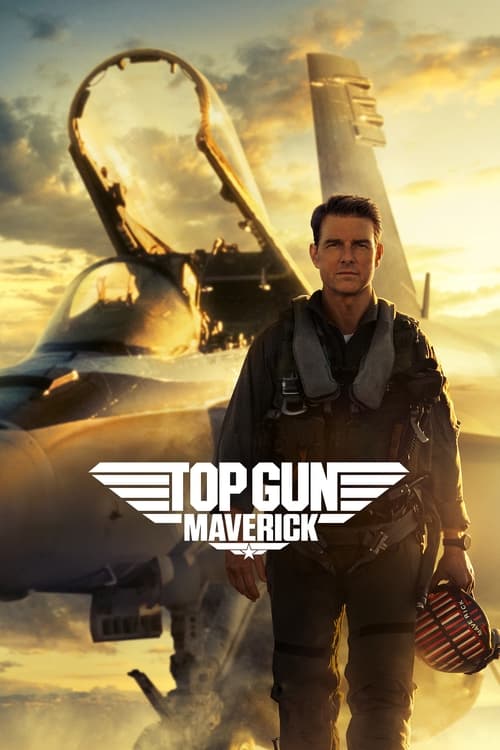
Top Gun: Maverick
An electrifying elegy to the analog hero, soaring through canyons of supersonic action and emotional turbulence, painting the sky with defiance against time itself.
Top Gun: Maverick

Top Gun: Maverick

"Feel the need... The need for speed."

21 May 2022 United States of America 131 min ⭐ 8.2 (10,231)
Director: Joseph Kosinski
Cast: Tom Cruise, Val Kilmer, Miles Teller, Jennifer Connelly, Bashir Salahuddin
Drama Action
Legacy and Reconciliation Man vs. Technology Aging and Obsolescence Teamwork vs. Individualism
Budget: $170,000,000
Box Office: $1,488,732,821

Overview

Over three decades after graduating from the elite TOPGUN program, Captain Pete "Maverick" Mitchell (Tom Cruise) has purposefully dodged promotions to remain where he feels he belongs: in the cockpit, pushing the limits of experimental aircraft. His rebellious spirit puts him at odds with the Navy's top brass, who see him as a relic in an age of unmanned drones.

Forced back to TOPGUN, Maverick is tasked not with flying, but with instructing a new generation of the Navy's finest pilots for a seemingly impossible mission: to destroy an unsanctioned uranium enrichment plant located in a heavily fortified mountain canyon. Among the trainees is Lt. Bradley "Rooster" Bradshaw (Miles Teller), the son of Maverick's late best friend and RIO, "Goose." This reunion forces Maverick to confront the ghosts of his past and his deepest fears, as he must prepare a team, including the resentful Rooster, for a mission that may demand the ultimate sacrifice.
Core Meaning

The core meaning of "Top Gun: Maverick" revolves around the enduring value of human instinct, experience, and courage in a world increasingly dominated by technology. The film posits that while technology advances, the pilot—the human element—remains indispensable. This is encapsulated in the recurring mantra, "It's not the plane, it's the pilot." Beyond the cockpit, the film explores themes of reconciliation, legacy, and confronting the past. It's a testament to the idea that it's never too late to make amends, find closure, and prove that experience, far from being obsolete, is a vital asset.

Thematic DNA

Legacy and Reconciliation 35%
Man vs. Technology 30%
Aging and Obsolescence 25%
Teamwork vs. Individualism 10%

Legacy and Reconciliation

The central emotional thrust of the film is Maverick's relationship with Rooster, the son of his deceased wingman, Goose. Maverick is burdened by guilt over Goose's death and a promise he made to Rooster's mother to keep him from flying. This creates a deep rift between them, with Rooster resenting Maverick for hindering his career. Their journey from animosity to mutual respect and forgiveness forms the heart of the narrative, exploring how one grapples with the legacy of the past and the responsibility to the next generation.

Man vs. Technology

A prominent theme is the tension between human pilots and unmanned drone technology. Characters like Admiral Cain declare that Maverick's kind is "heading for extinction." The film champions the idea that human instinct, intuition, and the ability to "not think, just do" are irreplaceable in high-stakes situations where machines might fail. Maverick's success in training the pilots and leading the mission serves as a powerful argument for the enduring relevance of the human spirit in warfare.

Aging and Obsolescence

After more than 30 years, Maverick is still a Captain, a man who has resisted promotion to stay in the sky. He is viewed by his superiors as a "fossil" and an anachronism. The film is a powerful exploration of aging and the fight against being deemed obsolete. Maverick must prove to the Navy, to his students, and to himself that his experience is not a liability but his greatest strength, demonstrating that wisdom and skill honed over a lifetime can outperform newer, less experienced talent.

Teamwork vs. Individualism

While the original "Top Gun" celebrated Maverick's swaggering individualism, the sequel emphasizes the importance of teamwork and self-sacrifice. Maverick evolves from a hotshot pilot to a mentor who must teach a diverse group of individualistic pilots to function as a cohesive unit. The mission's success hinges not on a single hero, but on the team's ability to rely on and protect each other, a lesson crystallized when pilots willingly put themselves in harm's way for their wingmen.

Character Analysis

Capt. Pete 'Maverick' Mitchell

Tom Cruise

Archetype: The Aging Hero / Mentor
Key Trait: Rebellious Defiance

Motivation

His primary motivation is his deep, intrinsic need to fly, which he describes as "who I am." This is coupled with a profound, albeit buried, sense of responsibility for Rooster's well-being, stemming from a promise made to Rooster's dying mother. He is driven by a need to prove that his methods and experience are still valuable in a changing world.

Character Arc

Maverick transforms from a lone-wolf test pilot, clinging to the sky to avoid being grounded, into a true leader and mentor. Initially reluctant to teach, he is forced to confront his past failures, specifically his guilt over Goose's death and his strained relationship with Rooster. By successfully training the team and leading the mission, he reconciles with the past, accepts his role as a teacher, and proves his enduring relevance, finally finding a measure of peace and readiness for a life beyond the cockpit.

Lt. Bradley 'Rooster' Bradshaw

Miles Teller

Archetype: The Protege / The Resentful Son
Key Trait: Cautious Loyalty

Motivation

Rooster is motivated by a desire to honor his father's legacy while simultaneously being terrified of suffering the same fate. He wants to prove himself as a pilot but is shackled by his anger towards Maverick and an over-cautious approach to flying born from his trauma.

Character Arc

Rooster begins the film as a cautious, by-the-book pilot, held back by his resentment toward Maverick, whom he blames for his father's death and for stalling his career. Throughout the training, he is challenged by Maverick to overcome his hesitation and trust his instincts. His arc culminates in the final mission where he disobeys orders to save Maverick, finally letting go of his anger and embracing the instinctual flying style of both his father and Maverick. He reconciles with Maverick, understanding the difficult choices his surrogate father had to make.

Lt. Jake 'Hangman' Seresin

Glen Powell

Archetype: The Rival / The Maverick-in-Waiting
Key Trait: Arrogant Confidence

Motivation

Hangman is driven by an overwhelming desire to be the best. He is supremely confident in his abilities and believes he is the most qualified pilot for any mission. His motivation is to prove his superiority over every other pilot in the program, especially Rooster.

Character Arc

Hangman starts as an arrogant, cocky pilot reminiscent of a young Maverick or Iceman from the original film. He is highly skilled but selfish and untrustworthy as a wingman, always willing to abandon a teammate to ensure his own success. Initially left as a reserve pilot for the main mission, his arc completes in the final act when he makes the selfless decision to swoop in and save Maverick and Rooster from enemy fighters, proving he has finally learned the most important lesson: never leave your wingman.

Adm. Tom 'Iceman' Kazansky

Val Kilmer

Archetype: The Wise Mentor / Guardian Angel
Key Trait: Quiet Authority

Motivation

Iceman is motivated by his deep, abiding friendship with Maverick and his belief in Maverick's unique abilities as a pilot. He understands that Maverick, despite his flaws, is a necessary asset to the Navy and that he is the only one who can guide Rooster.

Character Arc

Iceman's role is brief but pivotal. Having risen to the rank of Admiral, he has spent his career protecting Maverick from the consequences of his insubordination. Terminally ill, his final interaction with Maverick provides the emotional guidance his old rival needs. He urges Maverick to let go of the past and accept his role as a teacher, reminding him that "the Navy needs Maverick." His death serves as the catalyst that removes Maverick's protection, forcing him to stand on his own.

Symbols & Motifs

F-14 Tomcat

Meaning:

The F-14 Tomcat, the jet Maverick flew in the original film, symbolizes the past, legacy, and the triumph of analog skill over modern technology. It represents a bygone era of aviation that is perceived as obsolete.

Context:

The F-14 makes a dramatic return in the film's climax. After being shot down, Maverick and Rooster steal an enemy F-14 from an airbase. Their ability to successfully pilot this older, less advanced aircraft against superior "fifth-generation" fighters powerfully reinforces the film's central theme that "it's not the plane, it's the pilot."

The P-51 Mustang

Meaning:

Maverick's privately owned P-51 Mustang, a World War II-era fighter, symbolizes his personal freedom, his enduring love for pure aviation, and a connection to a more romanticized history of flight. It represents his life outside the structured confines of the Navy.

Context:

The plane appears at the end of the film. Maverick is seen working on it in his hangar, a place of personal solace. The final shot shows him flying the Mustang with Penny Benjamin, signifying his readiness to move on to a new chapter in his life, one where he has found peace and companionship.

Goose's Dog Tags

Meaning:

While a central symbol in the first film representing Maverick's grief, Goose's memory and legacy function as a powerful symbolic presence in the sequel. It embodies Maverick's unresolved guilt and the burden of the past that he carries with him.

Context:

Goose's presence is felt throughout the film, primarily through his son, Rooster, who mirrors his father's appearance (mustache) and even plays "Great Balls of Fire" on the piano. Maverick's actions are constantly driven by his memory of Goose and his promise to Goose's wife. The reconciliation with Rooster is, symbolically, a final coming to terms with Goose's death.

Memorable Quotes

It's not the plane, it's the pilot.

— Multiple Characters

Context:

The line is first said mockingly by Rooster, but Maverick later adopts it as a genuine teaching point. Maverick proves it definitively when he flies the mission's simulation course in a record time and later when he and Rooster defeat advanced enemy fighters using an antiquated F-14.

Meaning:

This quote is the central thesis of the film. It argues for the supremacy of human skill, instinct, and experience over technological superiority. It's a recurring refrain that validates Maverick's old-school approach and serves as the core lesson for the young pilots.

Don't think, just do.

— Pete 'Maverick' Mitchell

Context:

Maverick repeats this advice to his trainees, especially Rooster, who is prone to overthinking in the cockpit due to the trauma of his father's death. The lesson comes full circle when Rooster uses this logic to justify his decision to go back and save Maverick.

Meaning:

This is Maverick's core philosophy of aerial combat, emphasizing instinct over analysis in high-pressure situations. It's a lesson about overcoming the paralysis of fear and trusting one's training and gut feelings. It's a callback to the original film's lesson: "You think up there, you're dead."

The end is inevitable, Maverick. Your kind is heading for extinction.

— Admiral Cain

Context:

Admiral Cain says this to Maverick at the beginning of the film after Maverick's unsanctioned test flight of the "Darkstar" hypersonic jet. It sets the stakes for Maverick, who spends the rest of the movie proving that his "kind" is more necessary than ever.

Meaning:

This line establishes the film's central conflict: the perceived obsolescence of human fighter pilots in the age of drones and advanced technology. It represents the institutional opposition and skepticism Maverick must overcome.

It's time to let go.

— Tom 'Iceman' Kazansky

Context:

Iceman communicates this message to Maverick via his computer screen due to his illness. The poignant conversation takes place in Iceman's home, where he convinces a conflicted Maverick that he must train Rooster for the mission, for both the Navy's and Rooster's sakes.

Meaning:

Delivered by Iceman during his final scene, this line is not just about the mission, but about Maverick's personal guilt regarding Goose's death. It's a crucial piece of advice from a trusted friend, giving Maverick the permission he needs to forgive himself and repair his relationship with Rooster.

Philosophical Questions

What is the value of human instinct in an age of technological perfection?

The film constantly pits Maverick's intuitive, instinct-driven approach against the Navy's reliance on data, procedure, and new technology like drones. The mission parameters are deemed impossible by computers and strategists, yet Maverick proves it can be done by pushing beyond calculated limits. The film suggests that there are elements of human experience—courage, gut feelings, the willingness to sacrifice—that cannot be replicated by algorithms, and that true success lies in the synergy between human skill and technological tools, not the replacement of one by the other.

How does one reconcile personal ambition with responsibility to the past and future?

Maverick has spent his life avoiding the responsibilities that come with rank, choosing the personal freedom of being a pilot. The film forces him to confront this. His responsibility to Goose (the past) clashes with his responsibility for Rooster (the future). He must evolve from a figure of pure ambition and rebellion into a mentor who can pass on his wisdom. The film explores the idea that a meaningful life isn't just about individual achievement, but about how we honor our debts to those who came before us and pave the way for those who come after.

Alternative Interpretations

While the film is largely a straightforward action-drama, some interpretations delve deeper into its subtext. One perspective is that the unnamed, faceless enemy is intentionally ambiguous not just to avoid geopolitical conflict, but to emphasize that the true adversary is internal. The mission is secondary to Maverick's personal battle with his own past, his guilt, and his mortality. In this reading, the enemy fighters are simply a physical manifestation of the obstacles he must overcome to find peace.

Another interpretation views the film as a powerful metaphor for Tom Cruise's own career and the state of Hollywood. Maverick, the aging analog hero, insists on real-world skill and practical stunts in a world moving towards digital effects (drones). This mirrors Cruise's own advocacy for practical filmmaking and the in-theater experience in an industry increasingly reliant on CGI and streaming. The film's message, "it's the pilot, not the plane," can be read as "it's the star, not the special effects," a defiant statement on the enduring power of classic movie stardom and craftsmanship.

Cultural Impact

"Top Gun: Maverick" was released in a post-pandemic landscape and became a cultural phenomenon, widely credited with revitalizing the box office and encouraging older audiences to return to theaters. It grossed nearly $1.5 billion worldwide, becoming one of the highest-grossing films of all time. The film received overwhelmingly positive reviews from critics and audiences, earning a rare A+ CinemaScore and a 99% audience score on Rotten Tomatoes. Its success was attributed to its breathtaking practical aerial sequences, emotional resonance, and satisfying blend of nostalgia and fresh storytelling.

The film had a tangible impact on military recruitment, much like its predecessor. The U.S. Navy and Air Force saw a significant increase in inquiries following the movie's release, leveraging the film's positive and exciting portrayal of naval aviation. Furthermore, the film's cast was notably more diverse than the original, reflecting the changing demographics of the actual military and resonating with a broader audience. "Top Gun: Maverick" proved that a traditional, optimistic, and character-driven blockbuster could achieve immense success, reasserting the power of the communal cinematic experience.

Audience Reception

Audience reception for "Top Gun: Maverick" was overwhelmingly positive, bordering on ecstatic. The film holds a 99% audience score on Rotten Tomatoes and earned a rare A+ CinemaScore, indicating exceptional approval from viewers. Audiences widely praised the film's stunning and visceral aerial combat sequences, which were filmed with practical effects and put the actors in the cockpits of real F/A-18s. Many viewers found the story to be deeply emotional and satisfying, particularly the arc between Maverick and Rooster and the poignant return of Val Kilmer as Iceman. The blend of high-octane action with genuine heart was a frequent point of acclaim. Criticism was minimal, with most viewers feeling that the film successfully honored the legacy of the original while surpassing it in terms of plot, character development, and technical achievement.

Interesting Facts

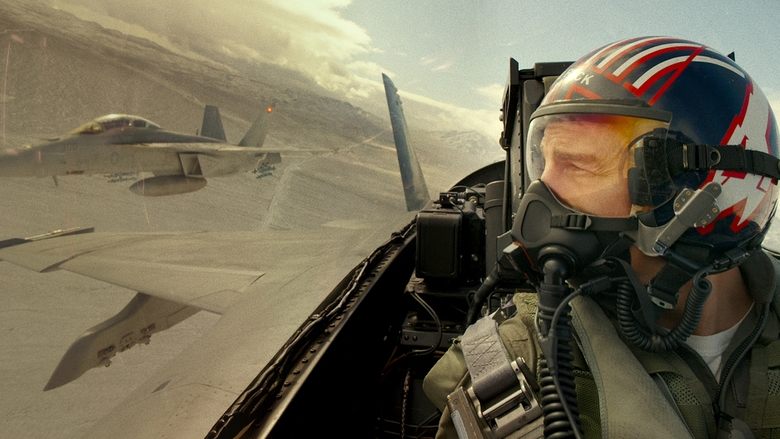
  • The actors underwent a rigorous, three-month flight training program designed by Tom Cruise himself to withstand the G-forces of flying in real F/A-18 Super Hornets.
  • Almost all of the actors got sick from the intense G-forces during filming; only Tom Cruise and Monica Barbaro (Phoenix) reportedly did not throw up.
  • The production paid the U.S. Navy $11,374 per hour to use the F/A-18 Super Hornets for filming.
  • Over 800 hours of aerial footage were shot for the film.
  • The scene where Admiral Cain's guard shack roof is blown off by Maverick's flyby was a practical effect that happened unexpectedly. The crew only had one take, and Ed Harris's genuine reaction was kept in the film.
  • Miles Teller was chosen for the role of Rooster over Nicholas Hoult and Glen Powell. However, Tom Cruise and producers were so impressed with Powell that they offered him the role of 'Hangman' instead.
  • The P-51 Mustang featured in the film is Tom Cruise's own personal aircraft.
  • Val Kilmer's voice was recreated using advanced A.I. technology, which utilized archival recordings of his voice, as the actor's ability to speak has been affected by his battle with throat cancer.
  • The film is dedicated to the memory of Tony Scott, the director of the original "Top Gun," who passed away in 2012.

Easter Eggs

The opening sequence is a near shot-for-shot recreation of the original film's opening.

The sequence uses the same title font, Harold Faltermeyer's iconic theme, and Kenny Loggins' "Danger Zone" over shots of flight deck operations on an aircraft carrier. This immediately sets a nostalgic tone and pays homage to the 1986 classic.

Rooster plays "Great Balls of Fire" on a piano in a bar.

This directly mirrors a famous scene from the original "Top Gun" where his father, Goose, played the same song. Maverick's emotional reaction to seeing this highlights the unresolved grief and the strong connection between Rooster and his late father.

Penny Benjamin, Maverick's love interest, was mentioned in the original film.

In "Top Gun," Goose teases Maverick about his history of "high-speed passes over five air control towers and one admiral's daughter." Later, Commander Stinger mentions her by name: Penny Benjamin. Her appearance as a main character in the sequel is a deep-cut reference for dedicated fans.

Maverick performs a high-speed 'tower buzz'.

This is a direct callback to Maverick's reckless behavior in the original film, where he startles an officer, causing him to spill his coffee. Repeating the maneuver in the sequel shows that despite his age and experience, Maverick's rebellious spirit is still intact.

During the bar scene, the jukebox number selected for 'Slow Ride' is 86.

This is a subtle nod to 1986, the year the original "Top Gun" was released.

⚠️ Spoiler Analysis

Click to reveal detailed analysis with spoilers

Frequently Asked Questions

Explore More About This Movie

Dive deeper into specific aspects of the movie with our detailed analysis pages

Comments (0)

Leave a comment

No comments yet. Be the first to share your thoughts!