Skip to content
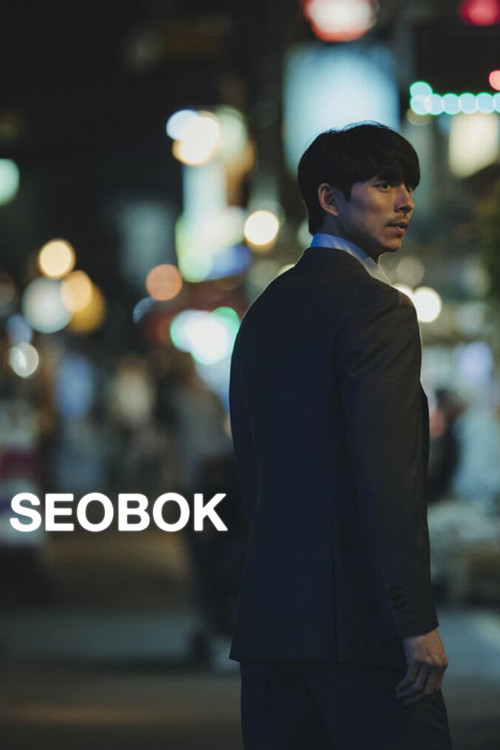
Seobok
A melancholic sci-fi road trip drenched in existential yearning, where a dying bodyguard and an immortal clone drift across rain-swept highways like colliding comets searching for the meaning of fleeting life.
Seobok

Seobok

서복

"Live the Moment."

12 April 2021 South Korea 114 min 7.2 (263)

Director: Lee Yong-ju

Cast: Gong Yoo, Park Bo-gum, Jo Woo-jin, Jang Young-nam, Park Byung-eun

Action Thriller Mystery Science Fiction Mortality and the Search for Meaning The Duality of Fear and Greed Human Commodification and Bioethics Surrogate Brotherhood and Compassion

Overview

Seobok follows Min Ki-heon, an ex-intelligence agent suffering from terminal brain cancer, debilitating chronic pain, and unresolved trauma from his covert past. Living in complete isolation and awaiting death, Ki-heon is approached by his former superior, Director Ahn, with a top-secret proposition: oversee the secure transfer of Seo Bok, the world's first genetically engineered human clone, to a classified research bunker. In exchange for escorting the specimen, Ki-heon is promised access to groundbreaking clinical trials utilizing the clone's genetically altered DNA, which holds the secret to cellular regeneration and eternal life.

When the heavily guarded transport convoy is violently ambushed by armed mercenaries seeking to seize the invaluable specimen, Ki-heon and Seo Bok narrowly escape into the civilian world. Seo Bok, having spent his entire existence confined within the cold, clinical laboratory of the biotech firm Ensin, experiences the outside world for the very first time. Possessing astonishing telekinetic abilities and a completely naive worldview, Seo Bok regards everyday human experiences with wide-eyed curiosity, while Ki-heon remains hyper-vigilant, focused entirely on survival and mission completion.

As government intelligence factions, private corporate executives, and international operatives close in to exploit or destroy the clone, the duo's cross-country journey gradually shifts from an uneasy tactical alliance to a deeply intimate philosophical bond. Traveling across South Korea, Ki-heon confronts his desperate fear of dying, while Seo Bok questions why humanity clings so ruthlessly to an existence defined by fear, suffering, and greed.
Core Meaning

Director Lee Yong-ju conceived Seobok not merely as a high-octane action thriller, but as an existential meditation on human mortality and the destructive nature of fear. The central thesis of the film is that human life derives its intrinsic meaning, value, and capacity for empathy precisely because it is finite.

Through the juxtaposition of a dying mortal (Ki-heon) and an ageless being (Seo Bok), the film explores how the fundamental terror of death corrupts human ethics. The pursuit of immortality—embodied by corporate conglomerates and political institutions—inevitably leads to commodification, tyranny, and violence. By demonstrating that Seo Bok's infinite life is a form of eternal imprisonment rather than a blessing, the narrative argues that true peace comes not from cheating death, but from discovering purpose, human connection, and dignified acceptance within our allocated time.

Thematic DNA

Mortality and the Search for Meaning 40%
The Duality of Fear and Greed 25%
Human Commodification and Bioethics 20%
Surrogate Brotherhood and Compassion 15%

Mortality and the Search for Meaning

The film directly contrasts Ki-heon's desperate struggle to extend his life with Seo Bok's indifference toward his endless biological clock. The narrative reveals that endless existence without purpose, freedom, or dignity is merely prolonged torture, whereas embracing mortality allows human beings to cherish individual moments.

The Duality of Fear and Greed

Fear of death drives humanity into moral degradation. The intelligence agency, corporate oligarchs, and Ki-heon himself initially act out of self-preservation and rapacious greed, demonstrating that the existential dread of dying often destroys the very humanity one seeks to preserve.

Human Commodification and Bioethics

Seo Bok is legally classified and treated as proprietary intellectual property—a collection of harvested bone marrow and stem cells rather than a sentient being. The film explores the hubris of modern genetic engineering and the ethical boundaries crossed when science treats living consciousness as an exploitable resource.

Surrogate Brotherhood and Compassion

The emotional core rests on the evolving dynamic between Ki-heon and Seo Bok. Moving from captor-guard and test subject to brotherly figures, their mutual empathy allows Ki-heon to find redemption for his past moral failures and grants Seo Bok genuine human agency for the first time.

Character Analysis

Min Ki-heon

Gong Yoo

Archetype: The Fallen Hero / Reluctant Protector Key Trait: Haunted resilience mixed with deeply buried compassion

Motivation

Originally motivated by the promise of genetic treatment to save his own life; later motivated by an urgent desire to protect Seo Bok's dignity and agency.

Character Arc

Begins as a broken, cynical, guilt-ridden former agent terrified of his impending death from brain cancer; through protecting Seo Bok, he shifts from selfish survivalism to selfless sacrifice, finding moral redemption and peace.

Seo Bok

Park Bo-gum

Archetype: The Holy Innocent / The Ageless Child / The Manufactured Messiah Key Trait: Childlike curiosity juxtaposed with terrifying psychic omnipotence

Motivation

To understand his identity, discover why he was created, experience the world, and escape perpetual exploitation.

Character Arc

Evolves from a passive, inquisitive laboratory subject who follows orders into an autonomous sentient entity who chooses how his life—and death—should conclude.

All 5 characters and cast

Symbols & Motifs

The Sea / Ocean

Meaning:

Represents freedom, eternity, the infinite unknown, and peace.

Context:

Seo Bok frequently yearns to see the ocean. When they finally visit the shoreline, the crashing waves represent the boundless world beyond laboratory glass, serving as the setting for their profound philosophical dialogues on life.

Instant Noodles (Cup Ramyeon)

Meaning:

Symbolizes earthly, mundane humanity and simple sensory joy.

Context:

Confined to nutrient pastes in the lab, Seo Bok's fascination with eating multiple bowls of spicy instant noodles in a convenience store symbolizes his awakening to sensory human pleasure and cultural normalcy.

Stone Cairns (Doltap)

Meaning:

Represents hope, remembrance, prayer, and mourning for the dead.

Context:

Seo Bok and Ki-heon encounter traditional stone towers near a grave site. Adding stones to the pile reflects Seo Bok's budding spiritual awareness and his contemplation of what happens to the human soul after physical demise.

Laboratory Restraints / Needles

Meaning:

Embodies exploitation, clinical coldness, and objectification.

Context:

The recurring imagery of massive automated needles harvesting bone marrow from Seo Bok's spinal cord underscores his nightmarish reality as a biological commodity.

Birds / Telekinetic Waves

Meaning:

Represents untamed power, liberation, and the wrath of nature.

Context:

Seo Bok's telekinesis manifests in ripple effects that disrupt gravity and levitate surrounding objects such as stones, vehicles, and debris, visualizing his transcendent state caught between human vulnerability and godlike detachment.

Memorable Quotes

살아있다는 건 좋은 거네요.
— Seo Bok (Park Bo-gum)

Context

Spoken quietly while experiencing simple physical sensations and observing nature.

Meaning

Marks Seo Bok's first genuine appreciation of conscious living outside a testing enclosure, signifying his awakening to sensory existence.

죽는 게 두려운 게 아니라, 영원히 사는 게 두려운 거야.
— Seo Bok (Park Bo-gum)

Context

Seo Bok explains the existential curse of his nature to Ki-heon.

Meaning

Turns the human fear of death on its head, highlighting that eternal existence without freedom or purpose is a waking nightmare.

All 4 quotes

Philosophical Questions

Does mortality give life its inherent value?

The film explores whether an infinite lifespan would destroy empathy and purpose, concluding that the finitude of existence is what forces humans to love, create, and find meaning.

Where does personhood begin in artificial life?

It challenges legal and bioethical definitions of humanity, questioning whether a clone created from modified DNA has an intrinsic soul and human rights.

Can fear ever produce genuine morality?

The narrative suggests that actions motivated purely by the fear of annihilation will inevitably breed violence, selfishness, and societal ruin.

Alternative Interpretations

Several distinct interpretations of the narrative exist:

Full ending explanation

Cultural Impact

Seobok made a notable industry impact through its distribution strategy during the COVID-19 pandemic. Originally scheduled for a December 2020 theatrical release, CJ Entertainment delayed the film to April 15, 2021, and launched it simultaneously in movie theaters and on its proprietary streaming platform, TVING. It served as a landmark test case for South Korea's emerging day-and-date theatrical/OTT distribution model.

Despite seating capacity limits and pandemic hesitation, the film opened at #1 at the domestic Korean box office, attracting over 385,000 theater admissions in its early run alongside substantial viewership on TVING. It demonstrated the viability of hybrid releases for high-budget Korean blockbusters.

Audience Reception

Audience and critical reception highlighted several strengths and weaknesses:

  • Praise: Reviewers and audiences celebrated the lead performances, particularly Park Bo-gum's nuanced portrayal of innocence and dormant fury, and Gong Yoo's raw, unglamorous depiction of physical vulnerability. The emotional resonance of the climax and the striking visual effects also received broad acclaim.
  • Criticism: Several mainstream action fans found the pacing uneven, noting that the movie marketed itself as a kinetic action thriller but spent long middle stretches as a contemplative, dialogue-heavy road-trip melodrama.
  • Verdict: A poignant, character-driven sci-fi drama that trades conventional relentless blockbuster tropes for existential philosophy and emotional weight.

Interesting Facts

  • Director Lee Yong-ju developed the script over several years as his long-awaited return to feature filmmaking following his massive 2012 romantic melodrama box-office hit Architecture 101.
  • To portray a terminal cancer patient in chronic physical agony, Gong Yoo underwent a severe diet and weight-loss regimen to achieve an exhausted, hollowed appearance.
  • The film was Park Bo-gum's final cinematic project filmed before he enlisted in the Republic of Korea Navy in August 2020; promotional duties fell predominantly on Gong Yoo during the 2021 release cycle.
  • With a production budget estimated around 16 billion KRW (approx. $14 million USD), it was one of CJ Entertainment's most ambitious sci-fi tentpoles, combining extensive practical stunts with complex CGI for telekinesis effects.
  • Park Bo-gum noted in interviews that playing an emotion-suppressed clone required relying almost exclusively on micro-expressions and eye acting rather than dialogue to convey inner awakening.

Easter Eggs

The Legend of Xu Fu (Seobok)

The title and clone's name are a direct reference to Xu Fu (pronounced Seo Bok in Korean), the court sorcerer sent by Qin Shi Huang (the first Emperor of China) across the eastern seas to locate the elixir of life. Like the mythological figure whose quest proved elusive and destructive, the clone represents humanity's futile, obsessive hunt for physical immortality.

Homage to Akira and The Fury

Seo Bok's telekinetic shockwaves, crushing shock barriers, and explosive laboratory destruction strongly echo Katsuhiro Otomo's classic sci-fi anime Akira and classic 1970s psychic thrillers.

Frankenstein Mythos Reversal

While Mary Shelley's Frankenstein features a creature rejected for its hideous appearance, Seobok presents a visually pristine, gentle young man whose inner biological perfection makes him an object of grotesque societal greed.

Frequently Asked Questions

Explore More About This Movie

Dive deeper into specific aspects of the movie with our detailed analysis pages

Comments (0)

Leave a comment

No comments yet. Be the first to share your thoughts!

Similar Movies