Skip to content
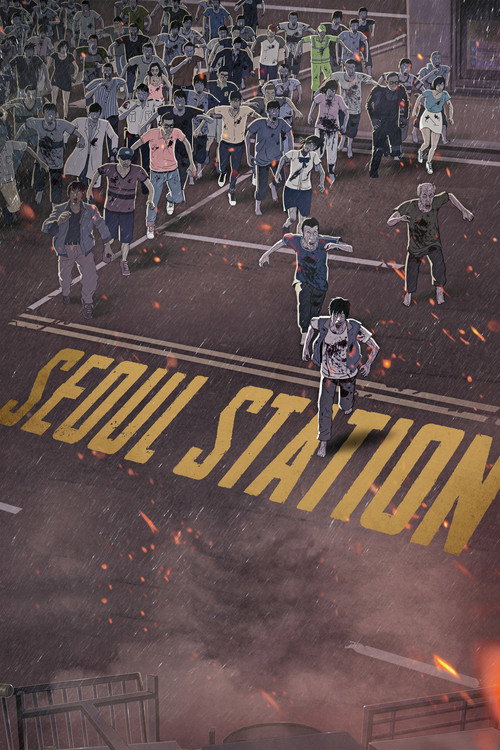
Seoul Station
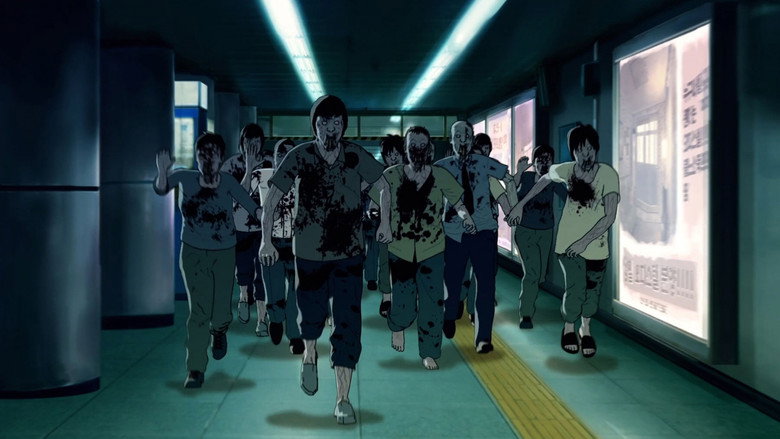
A bleak, grey-toned zombie nightmare in which a sprawling city turns on its own castoffs. Rage and grief ripple through hand-drawn streets, and a faded pink dress is the only trace of colour.
Seoul Station

Seoul Station

서울역

"It all started here."

17 August 2016 South Korea 92 min 6.5 (516)

Director: Yeon Sang-ho

Cast: Ryu Seung-ryong, Shim Eun-kyung, Lee Joon, Kim Jae-rok, Jang Hyuk-jin

Animation Action Thriller Science Fiction Horror Exploitation of women and misogyny Social and economic inequality Marginalisation and prejudice Broken family and false bonds Institutional failure
Box Office: $2,021,735

Overview

Seoul Station (서울역) is a 2016 South Korean adult animated zombie horror film written and directed by Yeon Sang-ho. It serves as a prequel to Train to Busan, although it was actually made first. It opens with a wounded homeless man wandering the Seoul Station area until he lies down, and this becomes the starting point of an outbreak that engulfs the capital.

The story follows a few strands of people caught in the chaos. Hye-sun is a young runaway, Ki-woong is her boyfriend, and a middle-aged man searches the disaster zone for her. Voice acting comes from Shim Eun-kyung, Lee Joon and Ryu Seung-ryong. As the government struggles to seal off the infected area, the film is less about spectacle than about the people no one was looking after before the apocalypse began.

It is slower, more somber and more cynical than its live-action successor. Yeon has described it as a story about a homeless society. The film uses the zombie genre to look at class, abandonment and exploitation.
Core Meaning

Yeon Sang-ho uses the outbreak as a magnifying glass for a society that was already broken. The marginalised (the homeless, a runaway girl, an exploited young woman) are ignored, then blamed, then sacrificed. Critics note that in this world mostly the disadvantaged show compassion, while institutions and the comfortable choose distrust and self-preservation. The film suggests that the true horror is not the infected but the indifference that existed before them, which is why the bleak ending feels like a diagnosis and not a twist for shock's sake.

Thematic DNA

Social and economic inequality 30%
Marginalisation and prejudice 25%
Exploitation of women and misogyny 20%
Broken family and false bonds 15%
Institutional failure 10%

Social and economic inequality

The outbreak begins with a homeless man whom nobody helps, and the poor are treated as expendable and as a source of contagion. The film turns its attention to class and the people society discards.

Marginalisation and prejudice

The homeless are mistaken for zombies and feared, a reflection of social prejudice. Yeon portrays the vulnerable as more humane than the authorities.

Exploitation of women and misogyny

Hye-sun's backstory involves sexual exploitation, including being advertised online by her boyfriend. Reviewers read the film as an attack on ingrained misogyny.

Broken family and false bonds

A father-figure search for a runaway daughter drives the plot, but a late revelation overturns what we believed about the leads and their relationships.

Institutional failure

Riot police and then the military try to contain the outbreak with callousness, leaving ordinary people to fend for themselves.

Character Analysis

Hye-sun

Shim Eun-kyung

Archetype: Survivor / tragic victim Key Trait: Resilient despite her traumatic past

Motivation

To survive and escape the people who have used her.

Character Arc

A runaway who has been exploited, she is abandoned at Seoul Station and must survive with strangers. Her journey tests who she can trust and what family means.

Suk-gyu

Ryu Seung-ryong

Archetype: Searcher / ambiguous father figure Key Trait: Dogged and desperate

Motivation

To find the girl at any cost.

Character Arc

He crosses the disaster zone looking for Hye-sun and presents himself as her father. A late twist overturns what we believe about him, and in the film Hye-sun says he is not her father.

All 3 characters and cast

Symbols & Motifs

The homeless man at the station

Meaning:

The invisible poor, whose suffering is ignored until it becomes a threat.

Context:

He is the first carrier, bleeding and ignored in the opening scene before the infection spreads.

Seoul Station itself

Meaning:

A threshold between the city's prosperity and its castoffs, and a point of departure and abandonment.

Context:

Hye-sun is abandoned there by Ki-woong, and the station is where the outbreak first takes hold.

Hye-sun's pink dress

Meaning:

Fragile youth and femininity draining of vitality in a hostile world.

Context:

One viewer noted that even its bright pink looks grey under the film's muted palette.

The police cell

Meaning:

Supposed safety that becomes a trap, showing how institutions fail to protect.

Context:

Survivors shelter in a police station jail cell with a bitten officer, who reanimates and attacks.

The phone call

Meaning:

Fragile human connection that can also doom people.

Context:

Ki-woong's call to Hye-sun outside Hoehyeon Station alerts nearby infected.

Philosophical Questions

Who counts as a monster?

The film blurs infected and uninfected, showing society's prejudice against the homeless and the cruelty of the supposedly healthy.

Does a society deserve its apocalypse?

One critic described the film as a diagnosis of the moral misery of a society that was already living its apocalypse.

What makes a family?

False and real bonds are tested, with the revelation about Suk-gyu and Hye-sun overturning assumptions about kinship.

How It Ends

Alternative Interpretations

Some read it as a straightforward class allegory in which the poor are the true victims of the outbreak. Others read it as a feminist film about the many forms of predation women face, with zombies as only one of them. A third view treats it as a loose prequel that stands apart from Busan, since the two are only loosely connected.

Full ending explanation

Cultural Impact

The film belongs to Yeon Sang-ho's run of dark adult animation about human nature and social realism. It is part of the Train to Busan franchise: as Yeon explained, Busan imagines the day after Seoul Station. Critics see both films as in the tradition of Romero's "Dead" series, with social critique built into the zombie genre. Reception was positive overall, and the film holds a Rotten Tomatoes consensus calling it layered and vicious. Seoul Station is far less known than Busan, and was released about a month after it.

Audience Reception

Praised: its social commentary, bleakness, brutality and powerful, surprising ending. Criticised: the animation is seen by some as plain or lacking stylisation, the pacing in the first half is slow, and some found the characters unlikeable or the story too dark. After its Bucheon screening, audiences were divided over the sudden shift in the second half. It is generally considered less emotionally engaging than Train to Busan, but a solid, grim zombie film in its own right. Letterboxd reviewers were mixed, often finding it weaker as a prequel.

Interesting Facts

  • Although it is a prequel, Seoul Station was made before Train to Busan, and its production gave Yeon the chance to make the live-action film.
  • The idea for Train to Busan came to Yeon while he was making Seoul Station.
  • Seoul Station premiered at the Brussels International Fantastic Film Festival on 5 April 2016 and was released in South Korea on 18 August 2016.
  • The film won Best Animated Feature at the 10th Asia Pacific Screen Awards in 2016.
  • Ryu Seung-ryong, Shim Eun-kyung and Lee Joon voiced the leads; they were cast in 2014.
  • Yeon said in 2014 that the project had been in planning since 2006.
  • It was Yeon's third animated feature, after The King of Pigs (2011) and The Fake (2013).
  • According to Screen Daily, it took about $1m at the local box office.

Frequently Asked Questions

Explore More About This Movie

Dive deeper into specific aspects of the movie with our detailed analysis pages

Comments (0)

Leave a comment

No comments yet. Be the first to share your thoughts!

Similar Movies