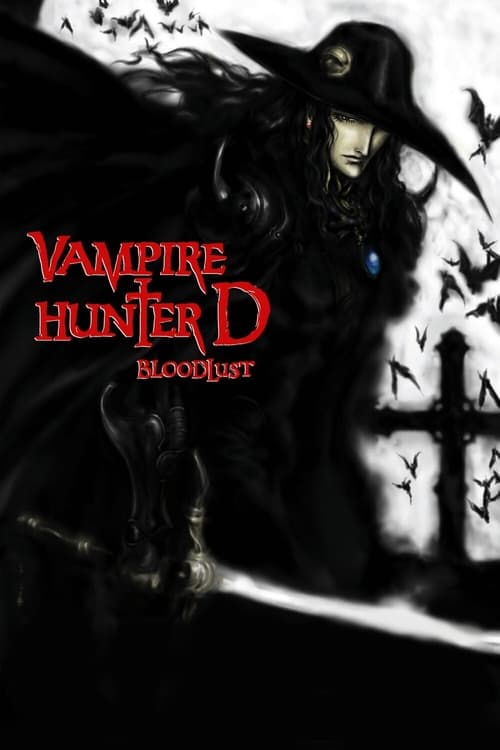
Vampire Hunter D: Bloodlust
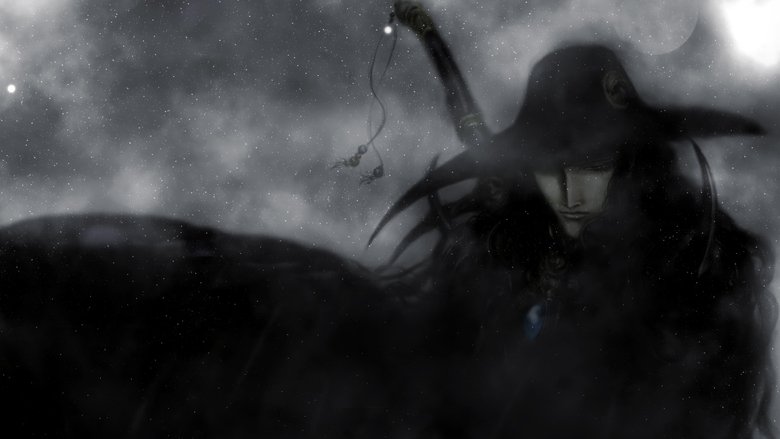
A melancholic gothic fantasy steeped in tragic romance and visceral action. Like a lone silhouette riding against a blood-red moon, it explores the eternal isolation of being caught between the warmth of humanity and the cold eternity of the night.
Vampire Hunter D: Bloodlust

Vampire Hunter D: Bloodlust

吸血鬼ハンターD ブラッドラスト

"When the sun sets, the hunt begins."

21 April 2001 Japan 103 min ⭐ 7.7 (770)
Director: Yoshiaki Kawajiri
Cast: Yoko Soumi, Hideyuki Tanaka, Koichi Yamadera, Megumi Hayashibara, Akiko Yajima
Animation Fantasy Action Adventure Science Fiction Horror
Isolation and the Burden of Eternity Prejudice and Moral Ambiguity The Transcendent Power of Love Legacy and Inevitable Extinction
Box Office: $151,086

Overview

Set in a post-apocalyptic dark fantasy world, vampires (known as the Nobility) once ruled the earth but are now a dying race, actively hunted by skilled mercenaries. The story follows D, a stoic and immensely powerful dhampir (half-human, half-vampire), who is hired by a wealthy patriarch to track down Meier Link, a formidable vampire lord. Meier has allegedly abducted the patriarch's beautiful daughter, Charlotte, and D is tasked with returning her safely or killing her if she has been turned.

The mission quickly escalates into a deadly race against time. D must contend not only with Meier Link's hired mutant bodyguards, the Barbarois, but also with the Marcus brothers—a ruthless, heavily armed group of rival human bounty hunters who are after the same prize. As D traverses the perilous, ruined landscapes, he discovers that the nature of Charlotte's disappearance is far more complicated than a simple kidnapping, forcing all parties to confront the gray areas of their morality.

As the pursuit leads to the ominous Castle of Chaythe, a gothic fortress presided over by the malevolent spirit of the ancient Blood Countess Carmilla, hunters and hunted alike are pushed to their absolute limits. The film masterfully weaves high-octane action with poignant reflections on loneliness, forbidden love, and the inescapable burdens of one's lineage.

Core Meaning

Director Yoshiaki Kawajiri uses Vampire Hunter D: Bloodlust to explore the heavy burden of eternity and the tragedy of the outcast. The film blurs the lines between good and evil, challenging the prejudice that all humans are inherently righteous and all monsters are inherently wicked. It suggests that true nobility is defined by resisting one's base instincts rather than by one's bloodline.

The central message is a meditation on the transcendent power of love and the pain of isolation. Whether it is D's eternal loneliness as a dhampir rejected by both worlds, Leila's fear of dying unremembered, or Meier Link's desperate desire to protect the human he loves from his own monstrous nature, the film ultimately argues that empathy and connection are the only true salvation in a decaying, ruthless world.

Thematic DNA

Isolation and the Burden of Eternity 35%
Prejudice and Moral Ambiguity 25%
The Transcendent Power of Love 25%
Legacy and Inevitable Extinction 15%

Isolation and the Burden of Eternity

The theme of isolation is perfectly embodied by D, who wanders the earth as a pariah—feared by humans and despised by vampires. Similarly, Meier Link experiences the agonizing loneliness of immortality, carrying the weight of eternal darkness. The film visually and narratively isolates its characters, showing that eternal life is less a blessing than an inescapable, lonely curse.

Prejudice and Moral Ambiguity

The narrative continuously subverts the black-and-white morality of humans versus monsters. The human bounty hunters, particularly the Marcus brothers, are shown to be greedy, cruel, and ruthless, whereas the supposed monster, Meier Link, acts with devotion and restraint. The film challenges the audience's assumptions about race and intrinsic evil.

The Transcendent Power of Love

Charlotte and Meier Link's Romeo-and-Juliet-esque romance serves as the emotional core of the film. Their love defies the boundaries of their warring species, proving powerful enough to make a vampire resist his bloodlust and a human abandon her family. Love is depicted as a redeeming, albeit tragic, force.

Legacy and Inevitable Extinction

The world of Bloodlust is one of decay. The Nobility is facing inevitable extinction, losing their grip on the world they once ruled. Carmilla's desperate, parasitic attempt to resurrect herself represents a stagnant past trying to consume the future, while D acts as the grim reaper guiding his own ancestors to their end.

Character Analysis

D

Hideyuki Tanaka (Japanese) / Andy Philpot (English)

Archetype: The Stoic Antihero
Key Trait: Stoic and enigmatic

Motivation

D is driven by a personal code to eradicate the evil of the Nobility, acting as a bounty hunter while carrying the heavy burden of being a dhampir.

Character Arc

D remains largely static in his quiet stoicism, but his journey allows his hidden capacity for empathy to surface. Though he begins the film strictly adhering to his mission to hunt vampires, he ultimately shows mercy to Meier Link and honors his promise to the human Leila, proving his humanity outweighs his vampire nature.

Meier Link

Koichi Yamadera (Japanese) / John Rafter Lee (English)

Archetype: The Tragic Romantic
Key Trait: Nobly devoted

Motivation

To protect Charlotte and find a sanctuary—the City of the Night—where a vampire and a human can live together in peace.

Character Arc

Initially framed as the villainous kidnapper, Meier is revealed to be a devoted, gentle lover. He struggles against his own monstrous instincts to protect Charlotte, ultimately losing her and departing for the stars to mourn her in eternal solitude.

Leila Marcus

Megumi Hayashibara (Japanese) / Pamela Segall Adlon (English)

Archetype: The Fierce Warrior
Key Trait: Tough yet vulnerable

Motivation

Initially seeking to avenge her mother's death by vampires, she is secretly driven by a deep-seated fear of dying alone and unremembered.

Character Arc

Leila starts as a cynical, hardened bounty hunter driven by vengeance. Through her interactions with D and witnessing Charlotte's genuine love for Meier, she softens, realizing there is more to life than violence. She ultimately retires, choosing to live a full human life and build a family.

Charlotte Elbourne

Emi Shinohara (Japanese) / Wendee Lee (English)

Archetype: The Defiant Lover
Key Trait: Idealistic and resolute

Motivation

To be with Meier Link at any cost, defying her family, society, and the hunters chasing them.

Character Arc

Charlotte abandons her comfortable life to elope with Meier. She never wavers in her devotion, proving that her love is genuine until her tragic death at the hands of Carmilla.

Left Hand

Ichiro Nagai (Japanese) / Mike McShane (English)

Archetype: Symbiotic Mentor / Comic Relief
Key Trait: Sarcastic and pragmatic

Motivation

To consume energy and keep D (and by extension, itself) alive at all costs.

Character Arc

The parasitic face in D's palm does not change fundamentally, but it serves as D's voice of reason and pragmatic survival instinct, often voicing the thoughts D keeps hidden.

Symbols & Motifs

The Sun and Daylight

Meaning:

The sun symbolizes the absolute barrier between the human world and the realm of the Nobility. It represents life, truth, and the natural order that vampires have forsaken.

Context:

Meier Link is physically burned by the sun, representing his inability to exist in Charlotte's world. D, as a dhampir, can endure the sun but suffers from "sunlight syndrome," beautifully illustrating his painful existence caught halfway between the human and vampire worlds.

Castle of Chaythe

Meaning:

The castle symbolizes the oppressive, stagnant weight of vampire history, false promises, and the inescapable gravity of the past.

Context:

Carmilla uses the castle as a trap, projecting beautiful illusions of sanctuary to lure Meier and Charlotte. It stands as a magnificent but decaying monument to a dying species that feeds on the living to sustain its own ghost.

Flowers on a Grave

Meaning:

Flowers symbolize human fragility, remembrance, and the profound need for mortal connection and legacy after death.

Context:

Leila and D make a pact that whoever dies first will have the other bring flowers to their grave. In the film's poignant finale, D leaves flowers at Leila's funeral, proving his underlying humanity and ensuring she is not forgotten.

Memorable Quotes

You don't know what it's like, Charlotte, to live forever in darkness eternal, forever thirsting for blood despite your best intention.

— Meier Link

Context:

Meier says this while drawing back from Charlotte after she willingly offers her neck to him, begging him to turn her so they can be together completely.

Meaning:

This quote highlights the tragic, torturous curse of vampirism. It reveals Meier's deep love for Charlotte, showing that he would rather suffer his own thirst than curse her with the same monstrous, immortal existence.

Since we're both in it for the long haul: whoever dies first, the other one can come and bring flowers to their grave.

— Leila Marcus

Context:

Leila proposes this pact to D while they are taking shelter from the rain, reflecting on the isolating life of a bounty hunter.

Meaning:

This establishes the profound bond of loneliness between the two hunters. It exposes Leila's greatest fear of dying alone and anchors D's final act of humanity at the end of the film.

Your time is coming to an end. Your kind must face extinction. You cannot survive, you must die. THAT is the rule of nature.

— D

Context:

D delivers this cold, fatalistic judgment during his confrontation with Carmilla's spirit, denying her assertion that vampires are eternal.

Meaning:

D firmly rejects the Nobility's arrogant claim to superiority and their view of humans as mere livestock. He embraces his role as the grim reaper of his own ancestors.

Philosophical Questions

Does eternal life strip away one's humanity?

The film contrasts the brief, passionate lives of humans with the cold, stagnant eternity of vampires. Carmilla represents the horrific endpoint of immortality—a ghost feeding off the living just to exist. Meier Link's struggle against his own nature questions whether immortality is a blessing, or a curse of endless, lonely deprivation.

Can true connection overcome intrinsic nature and societal prejudice?

Charlotte and Meier belong to warring species defined by the dynamic of predator and prey. Their genuine romance challenges the deeply ingrained prejudices of the human bounty hunters and the arrogant vampire Nobility, asking if love can rewrite the fundamental 'rules of nature.'

Alternative Interpretations

One of the most debated alternative interpretations centers around Charlotte's ultimate fate. While D states that she simply died from Carmilla's bite, some viewers argue that she had begun the transformation into a vampire. In this reading, D spares Meier Link and allows him to take her body to the stars not just to mourn, but because the City of the Night might offer the only environment where a newly turned Charlotte could survive away from human persecution.

Another interpretation focuses on D's internal motivations. While he acts as a noble protector of humans, his relentless slaughter of the Nobility can be read as a manifestation of profound self-hatred. Because he despises his own vampiric blood, his crusade is less about saving humanity—who generally shun him anyway—and more about violently eradicating the half of his own identity that he cannot reconcile with.

Cultural Impact

Vampire Hunter D: Bloodlust stands as a watershed moment in the history of adult-oriented anime in the West. Releasing during the early 2000s anime boom, the film proved that the medium could deliver high-budget, cinematic gothic horror with profound emotional depth. The hand-drawn animation by Madhouse is still widely regarded as a masterclass in technical filmmaking, influencing an entire generation of animators and directors.

Its unique fusion of post-apocalyptic science fiction, spaghetti western tropes, and Victorian gothic horror created a highly specific aesthetic that heavily influenced later dark fantasy works, notably the Castlevania animated series. Critics and audiences alike praised it as a massive improvement over the 1985 original, cementing D's status as an iconic pop-culture antihero and expanding the global appetite for mature, atmospheric anime.

Audience Reception

Audiences and critics overwhelmingly revere Vampire Hunter D: Bloodlust for its breathtaking, fluid, hand-drawn animation and intricate gothic art style. The film's kinetic action choreography, moody atmospheric world-building, and Marco D'Ambrosio's sweeping orchestral score are frequently highlighted as masterpieces of the medium.

Viewers widely consider it a monumental improvement over the 1985 original, praising the complex, morally gray narrative and the sympathetic portrayal of its antagonists, particularly Meier Link. While some minor criticisms point to underdeveloped secondary characters among the Marcus brothers, the overarching consensus is that the film is a timeless, must-watch classic that perfectly encapsulates the beauty and tragedy of the dark fantasy genre.

Interesting Facts

  • The film was highly unusual for an anime because it was originally recorded with an English voice cast under the direction of Jack Fletcher, with the Japanese dub produced later.
  • The story is based on 'Demon Deathchase,' the third novel in the long-running Vampire Hunter D series by author Hideyuki Kikuchi.
  • The word 'dhampir' (a half-vampire) was transliterated from Japanese as 'dunpeal' in the English dub, leading to a unique term used specifically in this franchise's Western release.
  • Director Yoshiaki Kawajiri intended the film specifically for a Western theatrical release, blending elements of Westerns, Hammer Horror, and dark fantasy.
  • The character designs painstakingly recreate the ethereal, intricate art style of Yoshitaka Amano, famous globally for his 'Final Fantasy' concept art.

Easter Eggs

References to Dracula / The Sacred Ancestor

Though never explicitly named in the film, the lore strongly implies that D's vampire father is Dracula himself, known in the novels as the 'Sacred Ancestor.' This hidden detail explains D's royal bearing, his ability to overcome ancient vampire magic, and why Carmilla's illusions feature his lineage so prominently.

Yoshitaka Amano's Art Style

The flowing, delicate, and almost androgynous gothic character designs are a direct homage to Yoshitaka Amano's original novel illustrations. Fans of the Final Fantasy series can easily recognize Amano's signature aesthetic in D's intricate armor, pale complexion, and flowing hair.

⚠️ Spoiler Analysis

Click to reveal detailed analysis with spoilers

Frequently Asked Questions

Explore More About This Movie

Dive deeper into specific aspects of the movie with our detailed analysis pages

Comments (0)

Leave a comment

No comments yet. Be the first to share your thoughts!