Skip to content
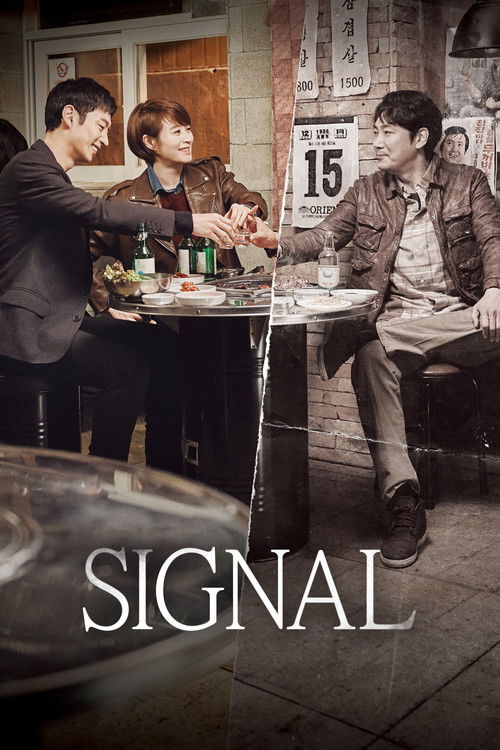
Signal
A gritty, time-bending noir pulsating with harrowing grief and unyielding hope, where transmissions across a battered walkie-talkie serve as lifelines in search of buried truth.
Signal

Signal

시그널

"There are those who are born monsters, but there are also those who are made into monsters by people."

22 January 2016 — 12 March 2016 South Korea 2 season 17 episode Returning Series 8.2 (197)

Cast: Lee Je-hoon, Kim Hye-soo, Cho Jin-woong, Jang Hyun-sung, Jung Hae-kyun

Drama Crime Sci-Fi & Fantasy Mystery Systemic Corruption vs. Individual Moral Duty The Burden of Choice and the Butterfly Effect Memory, Grief, and the Refusal to Forget Hope and Temporal Solidarity

Overview

Signal is a South Korean police procedural, crime thriller, and supernatural mystery series written by Kim Eun-hee and directed by Kim Won-seok. The narrative centers on Park Hae-young, a young, cynical police lieutenant and criminal profiler who harbors a deep distrust of law enforcement stemming from a childhood tragedy. Hae-young unexpectedly discovers an old, battery-less walkie-talkie that inexplicably crackles to life at 11:23 PM, connecting him across time to Detective Lee Jae-han, a relentlessly upright investigator operating in the late 1980s through the early 2000s.

Recognizing that their anomalous cross-temporal link can uncover clues lost to time, Hae-young teams up in the modern era with veteran detective Cha Soo-hyun—who, unbeknownst to Hae-young initially, was once Jae-han’s rookie junior and has spent fifteen years mourning his mysterious disappearance. Operating as a specialized Cold Case Squad, the detectives in the present and Jae-han in the past work in tandem across decades to solve notorious, long-unsolved crimes.

However, altering the past comes with severe butterfly effects: saving one life can inadvertently claim another, and rewriting historical facts resets the memories and physical realities of the present. As their investigations dig into institutional cover-ups, police corruption, and high-level political greed, the trio becomes locked in a high-stakes struggle where the price of justice is paid in personal sacrifice.

Core Meaning

The overarching thesis of Signal is that the past can be changed if someone refuses to give up, but justice demands vigilance, moral courage, and an acceptance of consequence.

Through its blend of realistic police procedural and supernatural temporal communication, the series asserts that cold cases are not merely abandoned files; they are unresolved wounds belonging to living victims and grieving families. The creators demonstrate that true justice is not an automatic outcome of time or legal institutions, but rather an active, exhausting moral choice. Giving up on the truth allows systemic corruption to fester, whereas persistent, uncompromised human resolve can transcend temporal boundaries to right institutional wrongs.

Thematic DNA

Systemic Corruption vs. Individual Moral Duty 30%
The Burden of Choice and the Butterfly Effect 25%
Memory, Grief, and the Refusal to Forget 25%
Hope and Temporal Solidarity 20%

Systemic Corruption vs. Individual Moral Duty

Explores how systemic greed within police brass and political elites stifles justice. It evolves from low-level precinct cover-ups to high-level systemic conspiracies, such as the Inju case and Superintendent Kim Bum-joo’s rampant corruption.

The Burden of Choice and the Butterfly Effect

Jae-han and Hae-young learn that altering past events incurs unforeseen costs—saving one victim may displace tragedy onto another or erase a loved one. The theme shifts from naive attempts to fix everything to a mature, agonizing acceptance of responsibility.

Memory, Grief, and the Refusal to Forget

Focuses on the psychological weight carried by surviving victims and families. This is represented by Soo-hyun searching for Jae-han’s remains for fifteen years and Hae-young remembering erased timelines alone, proving unsolved crimes remain open wounds until acknowledged and answered.

Hope and Temporal Solidarity

Highlights the belief that human empathy and shared dedication to truth can bridge generational gaps. The walkie-talkie represents solidarity between lonely individuals standing against a corrupt system across time.

Character Analysis

Park Hae-young

Lee Je-hoon

Archetype: The Traumatized Seeker / Flawed Profiler Key Trait: Razor-sharp psychological perception mixed with stubborn defiance against authority

Motivation

Initially driven by bitter survival and uncovering his brother's truth; evolves into an uncompromising pursuit of justice for all forgotten victims.

Character Arc

Starts as an abrasive, skeptical profiler moonlighting as a tabloid source who distrusts police hierarchy. As he cooperates with Jae-han, he sheds his detachment, confronting his personal trauma regarding his brother Sun-woo’s framed suicide and growing into an empathetic detective willing to face fatal risks for the truth.

Lee Jae-han

Cho Jin-woong

Archetype: The Tragic Moral Crusader / Reluctant Hero Key Trait: Unbending moral backbone and raw emotional vulnerability

Motivation

An unshakeable, visceral conviction that police work is about protecting the powerless, evolving into a desperate mission to fix the future even at the cost of his own safety.

Character Arc

Begins as a naive, clumsy patrol officer who refuses to compromise his moral compass. Over decades, he faces severe heartbreak, rampant institutional sabotage, and the knowledge of his own impending death, yet steadfastly refuses to look the other way.

All 5 characters and cast

Symbols & Motifs

The Walkie-Talkie (Transceiver)

Meaning:

Serves as a literal and metaphysical bridge between past and present, symbolizing desperate human connection, the transmission of hope, and the refusal to let cold cases die in obscurity.

Context:

A battery-less, vintage transceiver found by Hae-young that mysteriously activates strictly at 11:23 PM to link detectives across different eras.

Omurice (Omelette Rice)

Meaning:

Symbolizes unspoken care, quiet paternal mentorship, and the enduring warmth of human decency amidst crushing loneliness.

Context:

A recurring culinary motif tied to Jae-han’s silent, protective watch over the young Park Hae-young after his brother's wrongful conviction and death.

The Smudged Sticky Note / Jae-han's Notebook

Meaning:

Represents memory, foresight, and the tangible imprint of past decisions on the future.

Context:

Jae-han’s police notes and Soo-hyun’s warning note left on Jae-han's desk serve as physical records that anchor shifting timelines.

The Red String / Ligatures

Meaning:

Visually signifies fatal predestination, trauma, and the systemic entrapment of vulnerable victims until broken by decisive police action.

Context:

Featured prominently in the crime scenes of both the Gyeonggi Nambu and Hongwon-dong serial murder cases.

Hospital Room / Dialysis Machine

Meaning:

Symbolizes liminality, recovery, and the unresolved boundary between survival and mortality.

Context:

Featured in the ambiguous climax as Jae-han waits in a long-term medical facility in the rewritten timeline.

Memorable Quotes

포기하지 마요. 과거는 바뀔 수 있습니다.
— Lee Jae-han

Context

Transmitted across the walkie-talkie during early temporal communications in Episode 2 and echoed in the finale.

Meaning

Serves as the primary philosophical engine and guiding ethos of the entire drama, emphasizing that perseverance can alter tragic realities.

거기도 그럽니까? 돈 있고 빽 있으면 무슨 개망나니 짓을 해도 잘 먹고 잘 살아요? 그래도 20년이 지났는데, 뭐라도 달라졌겠죠?
— Lee Jae-han

Context

Spoken to Hae-young over the walkie-talkie from the 1990s timeline during the corrupt Inju case investigation.

Meaning

A biting, poignant social critique questioning whether modern society has truly progressed toward equitable justice or simply maintained elite impunity.

All 4 quotes

Episode Highlights

The First Transmission

S1E1

Introduces the 15-year-old kidnapping and murder case of Kim Yoon-jung as the statute of limitations is mere hours from expiring. Hae-young unearths the walkie-talkie and connects with Jae-han at the site of suspected murderer Seo Hyung-joon's buried remains.

Significance:

Establishes the temporal mechanics and psychological stakes, prompting the legislative abolition of the statute of limitations for first-degree murder and leading to the creation of the Cold Case Squad.

The Bus Stop at Gyeonggi Nambu

S1E4

Jae-han attempts to save his first love, Kim Won-kyung, from the Gyeonggi Nambu serial killer using information from Hae-young, but her death is sealed when temporal shifts trigger fatal butterfly effects.

Significance:

Solidifies the tragic reality that changing the past incurs severe emotional costs and establishes Jae-han's heartbreak as his driving purpose.

The Collapsing Bridge and Butterfly Effects

S1E8

Resolves the 1995 Daedong Bridge collapse and burglary ring cases. Jae-han catches the real thief, but the unintended aftermath leads to Soo-hyun’s death in an explosion in the present, forcing Hae-young to rewrite past actions to resurrect her.

Significance:

Demonstrates the extreme volatility of temporal shifts where main characters' lives in the present hang in the balance.

The Hongwon-dong Shadow

S1E10

Focuses on the psychologically traumatic Hongwon-dong serial murder case, where Soo-hyun confronts the serial killer who abducted and nearly murdered her during her rookie days.

Significance:

Allows Soo-hyun to achieve personal healing and closure, proving that trauma can be actively confronted and conquered in the present.

The Inju Incident and Sun-woo's Innocence

S1E14

Unveils the harrowing conspiracy behind the 1999 Inju school assault incident, where Hae-young’s older brother, Sun-woo, was falsely framed as the ringleader to shield the sons of high-ranking executives.

Significance:

Connects the personal backstories of all three protagonists to Kim Bum-joo’s web of police corruption, setting the stage for the final confrontation.

The Signal Never Dies (Finale)

S1E16

Hae-young is fatally shot protecting Soo-hyun in 2015, but Jae-han, warned by transmissions, alters the 2000 confrontation at Sunil Mental Hospital, surviving the ambush and dismantling Kim Bum-joo’s empire. Hae-young wakes in a newly rewritten timeline where he and Soo-hyun journey toward a remote medical facility to finally meet Jae-han.

Significance:

Closes the central character arcs while delivering an iconic open-ended conclusion signaling that the fight against corruption remains continuous.

Philosophical Questions

Does changing past tragedies truly create a better world, or merely trade one suffering for another?

Explored through the butterfly effect where saving certain victims inadvertently places others in the killer's path, forcing the protagonists to confront the agonizing ethical dilemmas of temporal intervention.

Can justice truly exist if it is delayed past the lifetimes of the victims?

Examined across the cold cases where apprehending elderly culprits decades later brings legal resolution but cannot restore decades of stolen lives and unresolved trauma for grieving families.

Is institutional corruption an inevitable product of power, or can persistent individual defiance dismantle systemic decay?

Posed through Jae-han's relentless battles against Kim Bum-joo and high-ranking officials who leverage societal hierarchies to evade accountability.

Alternative Interpretations

The narrative invites two distinct readings of its timeline mechanics and central device:

Full ending explanation

Cultural Impact

In 2015, South Korea enacted the 'Taewan-i Law,' which abolished the 25-year statute of limitations for first-degree murder cases. Signal aired directly in the wake of this legislative shift, capturing public enthusiasm for reopening real cold cases and examining past police oversights.

The series redefined the Korean crime thriller landscape, proving that complex, dark, non-romantic procedural narratives with time-slip mechanics could achieve massive commercial and critical success on cable networks (peaking at 12.54%–13.54% viewership on tvN). Furthermore, it spawned official international remakes, including a Japanese drama adaptation in 2018 and the Indian series adaptation Gyaarah Gyaarah in 2024.

Audience Reception

Signal received unanimous acclaim as a landmark masterwork of Korean television, celebrated for Kim Eun-hee’s tightly woven screenplay, Kim Won-seok’s atmospheric direction, and Cho Jin-woong’s emotionally commanding performance. It achieved major award success at the 52nd Baeksang Arts Awards and secured impressive cable ratings peaking between 12.54% and 13.54%.

Audiences praised the respectful, poignant handling of real-life tragedy, noting that cases felt like sincere tributes to victims rather than exploitative entertainment. While Lee Je-hoon's high-tension delivery in the opening episodes drew minor scrutiny initially, viewers quickly embraced the ensemble dynamic as the plot converged. The open-ended cliffhanger finale was widely hailed as a fitting, hopeful testament to ongoing justice, creating immense demand for Season 2.

Interesting Facts

  • Writer Kim Eun-hee based several major arcs on notorious South Korean cold cases, including the Hwaseong serial murders, the 1994 Seongsu Bridge collapse, the 1997 Park Chorong Bitnari kidnapping, and the 2004 Miryang school assault case.
  • Director Kim Won-seok insisted on completing large portions of the filming prior to broadcast to ensure intricate editing, cohesive temporal continuity, and cinematic color-grading.
  • Director Kim Won-seok previously helmed the critically acclaimed workplace drama Misaeng (2014) and applied his signature humanistic, detail-oriented realism to Signal.
  • Cho Jin-woong initially hesitated to take on the role of Lee Jae-han due to the intense emotional and physical exhaustion demanded by the character's relentless suffering, but accepted after being deeply moved by the script's social conscience.
  • At the 52nd Baeksang Arts Awards, Signal won Best Drama, Best Screenplay (Kim Eun-hee), and Best Actress (Kim Hye-soo).
  • In March 2024, production for a second season was officially confirmed with writer Kim Eun-hee and producing studios B.A. Entertainment and Studio Dragon.

Easter Eggs

Memories of Murder Homage

The Gyeonggi Nambu serial murder storyline directly pays homage to Bong Joon-ho’s film Memories of Murder (2003). In 2016 when Signal aired, the real Hwaseong killer had not yet been identified; the show offered fictional catharsis by solving the case decades early, anticipating the real-world identification of Lee Choon-jae in 2019.

The 11:23 PM Transmission Timestamp

The walkie-talkie transmits strictly at 11:23 PM, matching the exact time of Jae-han’s original recorded time of death at Sunil Mental Hospital, symbolizing that the radio signal is Jae-han’s dying spirit calling out across time to rewrite his fate.

Kim Won-hae’s Supporting Role

Actor Kim Won-hae plays Detective Kim Gye-chul, providing grounding comedic relief and emotional loyalty across the squad.

Ochang Manhole Reference

The body discovery scene inside the public reservoir and building structure mirrors South Korea's real-life 2010 Ochang manhole cold case.

Frequently Asked Questions

Explore More About This Movie

Dive deeper into specific aspects of the movie with our detailed analysis pages

Comments (0)

Leave a comment

No comments yet. Be the first to share your thoughts!

Similar Movies