
Skip to content
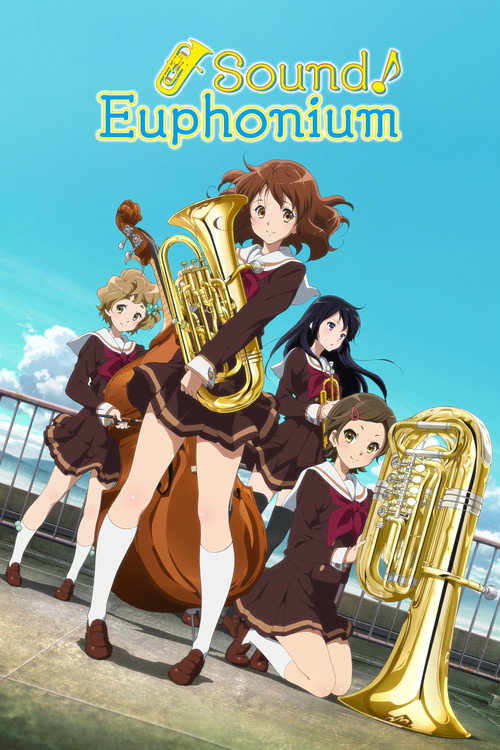
Sound! Euphonium
An evocative coming-of-age drama steeped in bittersweet adolescent yearning, where youth glints like polished brass under the afternoon sun and every breathless breath carries the fierce agony and ecstasy of striving for perfection.
Sound! Euphonium

Sound! Euphonium

響け!ユーフォニアム

08 April 2015 — 30 June 2024 Japan 3 season 39 episode Ended 8.0 (108)

Cast: Tomoyo Kurosawa, Chika Anzai, Ayaka Asai, Moe Toyota, Takahiro Sakurai

Drama Animation The Burden and Solitude of Striving for Excellence Meritocracy versus Sentimental Attachment Emotional Awakening and Growth Through Communication The Ephemeral Beauty of Youth

Overview

Sound! Euphonium follows the tumultuous journey of the Kitauji High School Concert Band club, chronicling its evolution from a lackadaisical hobbyist group into a fiercely competitive ensemble pursuing gold at the National Championships. At the center of this transformation is Kumiko Oumae, a girl who enters high school hoping for a fresh start away from middle school regrets, only to be drawn back to the euphonium. Alongside her classmates—the determined trumpet prodigy Reina Kousaka, bubbly tubist Hazuki Katou, and experienced contrabassist Sapphire Kawashima—Kumiko finds herself swept up in a turbulent environment demanding intense dedication.

Under the guidance of their enigmatic and exacting advisor, Noboru Taki, the band undergoes a radical shift toward strict meritocracy. The club faces fierce internal friction, intergenerational resentments, competitive auditions, and personal crises, forcing each member to confront their own dedication to music. As the ensemble progresses through regional competitions, the students discover that creating a unified harmony requires navigating raw insecurity, fragile friendships, and painful sacrifices.

Spanning all three years of Kumiko's high school life, the narrative tracks her maturation from an emotionally detached observer into the club's respected president. The series examines the emotional cost of excellence, the beauty of shared ephemeral youth, and the enduring bonds forged through musical collaboration.

Core Meaning

The core message of Sound! Euphonium is that genuine artistic and personal fulfillment requires confronting one's vulnerabilities and embracing the agony of effort without any guarantee of reward. The series rejects comforting tropes of effortless talent and unearned triumph, emphasizing instead that true resonance—both in music and human connection—is born from raw honesty, disciplined struggle, and radical empathy. Achieving greatness demands the courage to say "I want to improve" and face heartbreak, yet the communal pursuit of a fleeting moment of beauty makes every tear worthwhile.

Thematic DNA

The Burden and Solitude of Striving for Excellence 30%
Meritocracy versus Sentimental Attachment 25%
Emotional Awakening and Growth Through Communication 25%
The Ephemeral Beauty of Youth 20%

The Burden and Solitude of Striving for Excellence

Throughout all three seasons, the series explores how pursuing true mastery is an isolating endeavor. While communal camaraderie is vital, players like Reina, Asuka, and eventually Kumiko realize that striving to be special alienates them from peers who simply want casual recreation. Excellence demands uncompromising sacrifice, exposing the painful rift between mediocrity and brilliance.

Meritocracy versus Sentimental Attachment

A persistent source of club conflict is advisor Taki's strict principle of blind auditions and skill-based selection over seniority. From Kaori yielding the solo to first-year Reina in Season 1, to the climatic third-year audition between Kumiko and transfer student Mayu Kuroe, the narrative continually tests whether personal bonds can withstand objective artistic standards.

Emotional Awakening and Growth Through Communication

Kumiko begins the story as a passive, non-confrontational figure who hides behind pleasant pleasantries. Her emotional journey across the series involves learning to voice difficult truths, confront interpersonal fractures, and embrace her own unvarnished passions and jealousies without retreating into apathy.

The Ephemeral Beauty of Youth

High school concert band is inherently transitory, as seniors graduate and club compositions shift each spring. The series emphasizes that an ensemble's specific sound exists only for a single fleeting season, charging every competition, summer training camp, and rehearsal with poignant temporality.

Character Analysis

Kumiko Oumae

Tomoyo Kurosawa

Archetype: Reluctant Hero / Maturing Leader Key Trait: Empathetic, introspective, and candidly perceptive

Motivation

Initially seeks an easy, low-stakes routine, but evolves into a passionate pursuit of excellence and the desire to guide Kitauji to national gold.

Character Arc

Starts as a guarded, detached teenager who joined Kitauji to escape bad memories. Across three seasons, Kumiko evolves into a fiercely dedicated musician and a selfless club president capable of placing the ensemble's integrity above her own pride.

Reina Kousaka

Chika Anzai

Archetype: The Driven Perfectionist Key Trait: Steely determination and passionate musical virtuosity

Motivation

Desires to become extraordinary and refuse mediocrity at all costs, while proving her worth to mentor Noboru Taki.

Character Arc

Unapologetically uncompromising from the start, Reina challenges Kitauji's complacency. Over time, she learns to channel her fierce individualism into constructive drum major leadership while maintaining her intense artistic bond with Kumiko.

All 4 characters and cast

Symbols & Motifs

The Euphonium

Meaning:

Representing balance, supportive harmony, and overlooked emotional depth [1.1.1]. As a mid-range brass instrument rarely spotlighted by casual audiences, it mirrors Kumiko's role as the anchor holding the fractured ensemble together.

Context:

Used centrally across all seasons; it passes philosophically from Asuka Tanaka to Kumiko, carrying the notebook piece titled "Hibike! Euphonium".

Mount Daikichi and the Night City Lights

Meaning:

Symbolizes transcendent ambition, intimacy outside social confines, and the declaration to break free from ordinary expectations.

Context:

Featured prominently in Season 1, Episode 8 during the nocturnal trek of Kumiko and Reina, and revisited in later seasons during pivotal moments of private revelation.

The Uji River Bridge

Meaning:

A threshold of catharsis and transitional realization, connecting Kumiko's inner turmoil with public release.

Context:

The site of Kumiko's iconic running breakdown in Season 1, Episode 12, where she weeps while shouting her desperate longing to become better.

Brass Instrument Reflections

Meaning:

A visual metaphor for self-reflection, distorted self-perception, and emotional transparency under technical scrutiny.

Context:

Directorial close-ups frequently show musicians' anxious or determined expressions warped in the polished bell or tubing of trumpets, tubas, and euphoniums.

Memorable Quotes

上手くなりたい、上手くなりたい!誰にも負けたくない!
— Kumiko Oumae

Context

Shouted in tears while sprinting across the Uji River bridge after being stripped of a challenging phrase in Season 1, Episode 12.

Meaning

Captures Kumiko's fundamental awakening from passive indifference to raw, unapologetic artistic passion.

私、特別になりたいの。他の奴らとは違うって思いたい。
— Reina Kousaka

Context

Spoken to Kumiko atop Mount Daikichi under the city lights during the Agata Festival in Season 1, Episode 8.

Meaning

Defines Reina's core life philosophy and sets the moral standard for Kumiko's transformation.

All 4 quotes

Episode Highlights

Festival Triangle

S1E8

Kumiko and Reina hike up Mount Daikichi in formal dresses carrying their heavy instruments, sharing secret ambitions and playing a duet overlooking the moonlit town.

Significance:

Widely regarded as a masterpiece of anime direction; it establishes the electric, transformative bond between Kumiko and Reina.

My Euphonium

S1E12

Kumiko is cut from a difficult musical passage by Taki-sensei and subsequently suffers an emotional breakdown, running down the bridge shouting her desperation to improve.

Significance:

Kumiko fully confronts her artistic ego, shedding her lifelong detachment and discovering her true passion for music.

Goodbye Euphonium

S1E13

The Kitauji concert band delivers their definitive performance of 'Crescent Moon Dance' at the Kyoto Prefectural competition.

Significance:

Validates the club's excruciating efforts as they qualify for the Kansai Regional tournament against all odds.

Station Euphonium

S2E10

Kumiko travels to Asuka's home, discovering the painful domestic reality behind Asuka's aloof demeanor and hearing her play her father's piece.

Significance:

Resolves the leadership crisis of the band and solidifies the emotional inheritance between Asuka and Kumiko.

Final Audition

S3E12

In an anime-original twist, a blind audition is held to determine the euphonium soli for Nationals, resulting in Kumiko losing the soloist spot to Mayu Kuroe.

Significance:

Subverts conventional protagonist triumph to demonstrate Kumiko's ultimate maturity as a leader who champions the band's collective dream over personal glory.

The Final Movement

S3E13

Kitauji performs at the National Competition hall in Nagoya, earning their historic first Gold, followed by a time skip to Kumiko's adulthood.

Significance:

Provides the definitive, emotionally soaring conclusion to the three-year saga of Kitauji High School Band.

Philosophical Questions

Is true fairness achievable in art, or are all evaluations inherently subjective?

The series repeatedly tests the concept of meritocracy through blind auditions, highlighting how technical precision and emotional resonance clash under competitive evaluation.

Does the pursuit of individual exceptionalism justify fracturing collective harmony?

Reina and Kumiko's yearning to be special directly collides with the cooperative ethos of a hundred-member brass band, probing whether personal genius and community can truly coexist.

How It Ends

Alternative Interpretations

Audiences and critics frequently debate the nature of Kumiko and Reina's relationship, viewing it either as a profound portrayal of queer romantic longing or as an intense, platonic artistic soulmate dynamic. Additionally, Season 3's altered climax sparked discussions regarding Noboru Taki's philosophy: some interpret his meritocratic approach as an inspiring pursuit of musical purity, while others see it as emotionally destructive pedagogy that places unfair psychological strain on teenagers.

Full ending explanation

Cultural Impact

Sound! Euphonium elevated modern television anime realism by setting a gold standard for technical depiction of classical and wind music ensembles. The series established the city of Uji in Kyoto Prefecture as a premier anime pilgrimage site, generating significant local cultural tourism along the Keihan Railway and Uji River landmarks. Critics and animators internationally have cited the series—particularly under directors Tatsuya Ishihara and Naoko Yamada—as a pinnacle of visual storytelling through subtle character body language, naturalistic dialogue, and lighting design.

Audience Reception

Sound! Euphonium received widespread acclaim across all three seasons for its exceptional animation fidelity, sophisticated character dynamics, and grounded depiction of high school music culture. While Season 1 was lauded for Kumiko's breakthrough development and Season 2 for Asuka's emotional arc, Season 3 provoked heated debate due to its daring divergence from the light novel in Episode 12. Ultimately, fans and critics widely praised this creative choice as a profound artistic statement that elevated Kumiko's leadership and thematic maturity, cementing the show as one of Kyoto Animation's crowning masterpieces.

Interesting Facts

  • Kyoto Animation animators physically studied the intricate fingerings, embouchures, and slide positions of real brass instruments to achieve photographic accuracy in performance scenes [1.1.8].
  • Series technical director Naoko Yamada and director Tatsuya Ishihara worked in tandem to craft the show's realistic suburban atmosphere and intimate emotional resonance.
  • The musical performances were performed and recorded by the Senzoku Gakuen College of Music's Freshmen Wind Ensemble, deliberately capturing both novice hesitation and polished competitive brilliance.
  • Chief animation director and character designer Shoko Ikeda was one of the central creative pillars who defined the visual identity of the series across its run.
  • The anime adaptation diverged significantly from Ayano Takeda's original novels in Season 3 by having Kumiko lose the National euphonium soli audition to Mayu Kuroe.

Easter Eggs

Kousaka Reina's ringtone is the famous trumpet melody from Antonin Dvořák's Symphony No. 9 'From the New World'.

Highlights her classical immersion and foreshadows her ambitious desire to journey beyond conventional boundaries.

Cameos and posters of Kyoto Animation's fictional mascot characters, including Baku and characters reminiscent of other studio works, appear across school festival backdrops.

Serves as Kyoto Animation's signature self-referential studio trademark woven into realistic environments.

The photograph of sunflowers tucked inside Kumiko's sheet music binder.

A visual keepsake given by Asuka following the second-year Kansai competition, carrying handwritten encouragement that anchors Kumiko's leadership in Season 3.

Frequently Asked Questions

Explore More About This Movie

Dive deeper into specific aspects of the movie with our detailed analysis pages

Comments (0)

Leave a comment

No comments yet. Be the first to share your thoughts!

Similar Movies