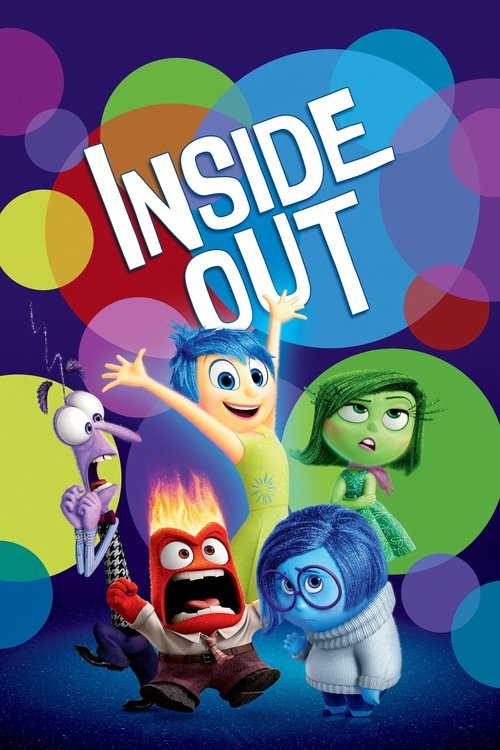
Inside Out
"Meet the little voices inside your head."
Overview
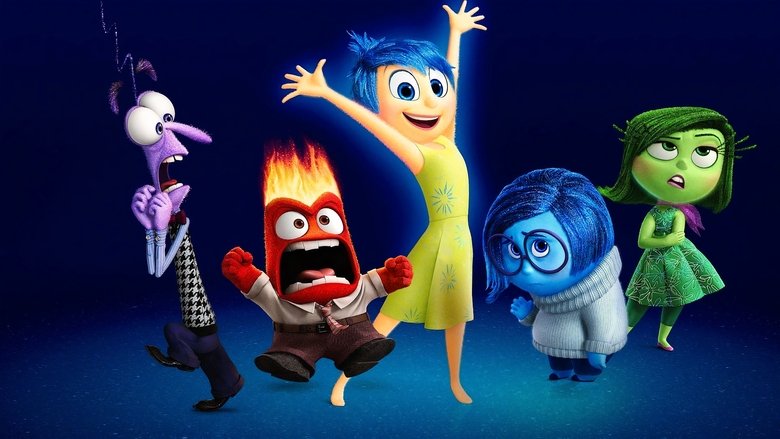
"Inside Out" centers on Riley, an 11-year-old girl whose life is uprooted when her family moves from Minnesota to San Francisco. Her five core emotions—Joy, Sadness, Anger, Fear, and Disgust—personified as characters, try to guide her through this difficult transition from a control center in her mind called Headquarters. Joy, Riley's dominant emotion, works tirelessly to keep her happy and marginalizes Sadness, believing her to be a negative influence.
A mishap during Riley's challenging first day at her new school causes Joy and Sadness to be accidentally swept out of Headquarters into the vast landscape of Riley's mind, along with her crucial "core memories." As Anger, Fear, and Disgust are left in charge, their attempts to manage Riley's feelings result in disaster, causing her to become withdrawn and distant from her parents. Joy and Sadness must embark on a perilous journey through Long-Term Memory, Imagination Land, and the Memory Dump to return to Headquarters before Riley's personality islands crumble and she makes a decision she'll regret.
Core Meaning
The central message of "Inside Out" is the profound importance of acknowledging and embracing all emotions, especially sadness, for genuine emotional well-being and growth. Director Pete Docter, inspired by the changes in his own daughter, wanted to convey that sadness is not a negative state to be avoided, but a vital emotion that fosters connection, empathy, and healing. The film argues against the relentless pursuit of happiness, showing that suppressing difficult feelings leads to emotional disconnection. Ultimately, it reveals that true emotional maturity comes from understanding that joy and sadness are often intertwined, creating a more complex and resilient sense of self.
Thematic DNA
The Necessity of Sadness
The film's most prominent theme is the validation of sadness as a crucial emotion. Initially, Joy sees Sadness as a problem to be contained. However, through their journey, Joy discovers that Sadness allows for empathy and connection. A key memory of Riley's hockey loss, initially perceived as sad, is revealed to be a moment where her parents' and teammates' comfort brought her joy. This realization culminates in the film's climax, where allowing Riley to feel and express her sadness to her parents is what ultimately brings comfort and restores her emotional balance, creating a new, nuanced core memory of both joy and sadness.
Coming of Age and Identity
Riley's move to San Francisco acts as a catalyst for her transition from childhood to adolescence. This change challenges her previously stable identity, represented by the crumbling "Islands of Personality." The film illustrates that growing up involves loss—of childhood innocence, old friends, and even imaginary friends like Bing Bong. Her identity becomes more complex; the control panel in her mind expands at the end, symbolizing her increased emotional capacity and the understanding that memories and feelings are not one-dimensional but can be a mix of emotions.
The Nature of Memory
"Inside Out" brilliantly visualizes how memories are formed, stored, and influence personality. Memories are depicted as glowing orbs, colored by the emotion associated with them. The concept of "core memories" shows how significant life events shape our identity by creating the personality islands. The film also explores how memories can change over time, as Sadness is able to retroactively alter the emotional tone of happy memories. The Memory Dump, where forgotten memories fade away, poignantly represents the impermanence of our past.
Family and Connection
The film underscores the importance of family support during difficult times. Riley's emotional turmoil stems from her feeling of disconnection from her parents after the move. Her decision to run away is a direct result of the inability of Anger, Fear, and Disgust to manage her distress. It is only when she is able to be vulnerable and honestly express her sadness to her parents that the family bond is restored. The final, cathartic group hug creates a new, multi-colored core memory, symbolizing that shared emotional experience is the foundation of a strong family.
Character Analysis
Joy
Amy Poehler
Motivation
To ensure Riley is happy at all times and to protect her from any negative feelings, which she initially sees as harmful.
Character Arc
Joy begins as a well-intentioned but controlling leader, believing that Riley's happiness is the only thing that matters. Her primary goal is to minimize Sadness's influence. Her arc is one of enlightenment; stranded in the depths of Riley's mind, she discovers a happy core memory that was born from a moment of sadness. This helps her realize Sadness's crucial role in signaling a need for help and creating empathy. She evolves from a proponent of relentless positivity to a wise leader who understands that emotional balance is key, ultimately ceding control to Sadness in the film's climax to save Riley.
Sadness
Phyllis Smith
Motivation
An instinctual, initially misunderstood compulsion to touch memories and engage with Riley's pain, which is later revealed to be a drive to create empathy and seek comfort.
Character Arc
Sadness starts as a perceived burden, an emotion no one, including herself, understands the purpose of. She is ostracized by Joy for uncontrollably turning happy memories sad. However, her journey reveals her true strength: empathy. She is the only one who can comfort the grieving Bing Bong by simply listening and validating his feelings. Her arc is one of self-acceptance and empowerment. She goes from being a passive, marginalized figure to the hero who saves Riley by allowing her to connect with her parents through shared vulnerability.
Riley Andersen
Kaitlyn Dias
Motivation
To find happiness and stability after a disruptive move, and to reclaim the life she once had in Minnesota.
Character Arc
Riley is less a traditional character and more the setting in which the story unfolds. Her arc is an external reflection of the internal journey of her emotions. She begins as a happy, well-adjusted child defined by her cheerful memories of Minnesota. The move to San Francisco plunges her into turmoil, causing her to become sullen, angry, and withdrawn. Her journey culminates in a moment of emotional crisis where she tries to run away. Her resolution comes when she finally embraces the complexity of her feelings, confessing her sadness to her parents. She matures into a more emotionally complex individual, capable of feeling joy and sadness simultaneously.
Bing Bong
Richard Kind
Motivation
To be remembered by Riley and to help her be happy again, ultimately wanting to "take her to the moon" one last time.
Character Arc
Bing Bong is Riley's forgotten imaginary friend, a whimsical creature made of cotton candy who cries candy tears. He represents the fading innocence and magic of early childhood. He is initially lost and irrelevant in the vastness of Long-Term Memory. He joins Joy and Sadness, guiding them through the abstract parts of Riley's mind. His arc is short but powerful, culminating in his heroic self-sacrifice in the Memory Dump. He lets himself fade away forever so that Joy can escape and save Riley, poignantly symbolizing the necessary act of letting go of the past to grow up.
Symbols & Motifs
Core Memories
Core Memories symbolize the foundational experiences that shape an individual's personality and identity. They are so powerful that they create the "Islands of Personality," which represent Riley's key traits and interests like family, honesty, and hockey.
These are the most important memories, stored in a special hub in Headquarters. When they are knocked loose and Joy and Sadness are sucked out of the control center, Riley's personality islands begin to shut down and crumble, visually representing her loss of identity and emotional crisis.
Memory Orbs
The memory orbs are a physical manifestation of individual memories. Their color represents the primary emotion associated with that experience (e.g., gold for joy, blue for sadness). This symbolizes how emotions encode our experiences and how our perception of the past is colored by our feelings.
Throughout the film, these orbs are created, sent to long-term memory, recalled, and sometimes altered. When Sadness touches a golden happy memory, it turns blue, showing how present feelings can change our recollection of the past. At the end, new memories are multicolored, symbolizing Riley's growing emotional complexity.
The Train of Thought
The Train of Thought is a literal representation of the stream of consciousness, carrying thoughts, ideas, and memories throughout the mind. It symbolizes the logical, and sometimes chaotic, progression of thought processes.
Joy, Sadness, and Bing Bong try to use the Train to get back to Headquarters. Its erratic schedule and route highlight how thoughts can be unpredictable. When Honesty Island collapses, the train derails, symbolizing how Riley's emotional breakdown disrupts her ability to think clearly.
The Memory Dump
The Memory Dump is a dark abyss where faded memories are sent to be forgotten forever. It symbolizes loss, the fading of childhood, and the painful process of letting go of parts of oneself that are no longer relevant. It is the subconscious graveyard of forgotten experiences.
Joy and Bing Bong fall into the Memory Dump in a moment of despair. It is here that Bing Bong, Riley's imaginary friend, makes the ultimate sacrifice, allowing Joy to escape while he fades away—a powerful and heartbreaking depiction of the inevitable loss of childhood innocence as one grows up.
Memorable Quotes
Take her to the moon for me, okay?
— Bing Bong
Context:
After multiple failed attempts to fly out of the Memory Dump on his wagon rocket, Bing Bong realizes their combined weight is too much. He jumps off mid-flight, allowing Joy to soar out while he fades into oblivion.
Meaning:
This is Bing Bong's final, heartbreaking line as he sacrifices himself in the Memory Dump. It encapsulates the selfless love of childhood and the poignant necessity of letting go of the past for future growth. It represents his ultimate wish for Riley's happiness, even if he can no longer be a part of it.
Crying helps me slow down and obsess over the weight of life's problems.
— Sadness
Context:
Joy is trying to hurry a despondent Sadness along on their journey back to Headquarters. Sadness explains her state in a characteristically downbeat but surprisingly insightful way.
Meaning:
This quote, seemingly pessimistic, actually hints at Sadness's true function. While Joy sees only the negative, Sadness's statement reveals that her nature is to focus, process, and reflect on difficult experiences. This process is essential for understanding and eventually moving past emotional pain, a concept the film validates.
Congratulations, San Francisco, you've ruined pizza! First the Hawaiians, and now YOU!
— Anger
Context:
Riley's family tries a local pizza place on their first day in San Francisco, only to discover the sole topping is broccoli. Anger, voiced by Lewis Black, erupts at this culinary travesty from inside Headquarters.
Meaning:
This comedic line perfectly captures Anger's personality: explosive, judgmental, and focused on injustice, however minor. It provides a moment of levity while also reflecting Riley's genuine frustration and disappointment with her new environment, where even familiar comforts like pizza are now alien and wrong.
I just wanted Riley to be happy…
— Joy
Context:
At her lowest point in the Memory Dump, Joy re-examines a core memory of a hockey game. She sees that Riley's sadness after missing a shot prompted her parents and team to comfort her, which in turn led to a powerful, happy moment of connection.
Meaning:
This is Joy's moment of crisis and realization. Holding a memory that is both happy and sad, she understands her narrow-minded pursuit of pure happiness was flawed. It marks the turning point where she begins to appreciate the value of all emotions, particularly Sadness, in creating a rich, meaningful life for Riley.
Philosophical Questions
What is the nature of the Self?
The film explores the idea that the 'Self' is not a single, unified entity but a composite of different, often competing, parts. Riley's personality is literally constructed from her core memories and represented by her personality islands. The film challenges the notion of a static self by showing how these islands can crumble and change with new experiences. It suggests that personal identity is a fluid narrative, constantly being co-authored by our memories and the full spectrum of our emotions working together.
What is the function of emotions, particularly negative ones?
"Inside Out" directly confronts the cultural bias towards happiness. Joy's initial belief that only she is beneficial for Riley reflects a common societal pressure to remain positive. The film's central revelation is that 'negative' emotions like sadness, fear, and anger have crucial, adaptive purposes. Sadness fosters empathy and social connection, Fear protects from danger, and Anger fights against injustice. It posits that a healthy life is not one devoid of pain but one where all emotions are understood, accepted, and integrated.
How do memory and emotion shape our identity?
The film visualizes the intimate link between memory and emotion. Memories are not objective recordings of events but are tagged with emotional data, represented by their color. This emotional coloring dictates how we interpret our past and, in turn, shapes our personality (the islands). Joy's realization that a single event can contain both sadness and happiness highlights the complexity of memory. The film suggests that who we are is less about what happens to us and more about the emotional meaning we attach to those experiences.
Alternative Interpretations
While the film is widely seen as a story about emotional balance, some interpretations offer different perspectives. One view is that the film can be read through the lens of Plato's tripartite theory of the soul, where the emotions represent different parts of the psyche (like appetite and spirit) that must be governed, not by a single emotion like Joy, but by an un-depicted 'Reason' or 'Self' that Riley is developing.
Another interpretation focuses on the parents' minds. Riley's father is led by Anger and her mother by Sadness, which could be seen as reinforcing gender stereotypes. However, an alternative reading suggests this isn't about pathology but about personality. The father's 'Anger' could represent a strong sense of fairness and decisiveness, while the mother's 'Sadness' could signify empathy and sentimentality. The fact that they are well-functioning adults suggests they have achieved a balance where their leading emotion doesn't dominate them, unlike Riley, who is still learning.
A more critical interpretation might question whether personifying emotions oversimplifies the human experience. By treating emotions as distinct agents, the film could imply a lack of personal responsibility for one's actions, though the narrative ultimately shows that Riley's growth depends on the integration and cooperation of these internal forces.
Cultural Impact
"Inside Out" was a major critical and commercial success, grossing over $858 million worldwide and winning the Academy Award for Best Animated Feature. More significantly, the film had a profound cultural impact by providing a new, accessible vocabulary for discussing emotions and mental health. It has been widely adopted by parents, educators, and therapists as a tool to teach emotional literacy to children, helping them identify and articulate their feelings using the film's personified characters.
The film was praised by mental health professionals for its nuanced and accurate depiction of complex psychological concepts, particularly its central thesis that sadness is not only acceptable but necessary for connection and well-being. This challenged a cultural narrative often fixated on constant positivity. By visualizing abstract concepts like memory, personality, and the subconscious, it demystified the inner workings of the mind for a mass audience. The film has become a touchstone in popular culture for conversations about emotional intelligence, fundamentally changing how a generation understands their own inner world.
Audience Reception
"Inside Out" was overwhelmingly praised by audiences, who found it both entertaining and deeply moving. On review aggregators, it holds very high audience scores. Viewers frequently lauded its creativity, originality, and emotional depth, with many adults noting that the film resonated with them as much, if not more, than with their children. The character of Bing Bong and his sacrificial scene were frequently cited as exceptionally poignant and tear-jerking.
The film's primary strength, according to viewers, was its meaningful and relatable message about the importance of all emotions. Many praised it for providing a useful framework for discussing feelings with their children. Criticisms were rare and generally minor. A small fraction of viewers found the plot simplistic or the core message predictable. Some felt the high concept was less entertaining than other Pixar adventures. However, the vast majority of audience reviews celebrate it as one of Pixar's best, a smart, funny, and profoundly heartfelt film.
Interesting Facts
- The film's director, Pete Docter, was inspired by observing the personality changes in his own daughter as she grew up.
- To ensure psychological accuracy, the filmmakers consulted with numerous psychologists and neuroscientists, including Dr. Dacher Keltner from UC Berkeley.
- The five emotions chosen were based on the scientific theories of Dr. Paul Ekman, who identified six universal emotions (the sixth, Surprise, was merged with Fear for simplicity).
- In early versions of the story, Joy was paired with Fear on her journey, and Sadness was not a major character.
- The look of the emotions is based on simple shapes: Joy is a star, Sadness is a teardrop, Anger is a fire brick, Fear is a raw nerve, and Disgust is a stalk of broccoli.
- Each emotion has a unique visual texture; Joy emits particles of light, while Sadness has a softer, flowing movement.
- When the characters travel into Abstract Thought, they go through four stages: Non-Objective Cubism, Deconstruction, and finally becoming two-dimensional shapes, an homage to different art movements.
- Bill Hader, the voice of Fear, also served as a writer and took a "tour" of Pixar to help with the story development.
- The appearance of the mind's 'Headquarters' was modeled after the It's a Small World attraction at Disneyland.
Easter Eggs
The Pizza Planet Truck
The iconic Pizza Planet truck from Toy Story, a staple Easter egg in Pixar films, appears three times in "Inside Out," most clearly inside a memory orb that rolls by during one scene.
A113
The code "A113," a reference to the CalArts classroom where many Pixar animators studied, appears as graffiti on a wall behind Riley when she gets a call from her mom after running away. In the first film, it was the number of Riley's classroom.
The Luxo Ball
The famous yellow ball with a blue stripe and red star from Pixar's first short, Luxo Jr., appears in a flashback memory of Riley playing with Bing Bong.
Characters from other Pixar films
In Riley's long-term memory, a board game called "Find Me!" features a picture of Nemo from Finding Nemo. Additionally, a magazine in the family's living room features Colette from Ratatouille on the cover.
Chinese Food Containers
The family eats Chinese takeout from the same distinct oyster-pail containers that have appeared in several other Pixar films, including A Bug's Life and Toy Story 2.
Tri-County Area Reference
The hockey rink where Riley plays is located in the "Tri-County" area, the same region where the Toy Story films are set, suggesting a shared universe.
⚠️ Spoiler Analysis
Click to reveal detailed analysis with spoilers
Frequently Asked Questions
Explore More About This Movie
Dive deeper into specific aspects of the movie with our detailed analysis pages
Comments (0)
No comments yet. Be the first to share your thoughts!