Skip to content
Space Sweepers
A kinetic, dust-choked space western wrapped in warm humanism, where desperate outcasts drift through a cosmic junkyard only to discover that a tender seed of found family can bloom amidst cold, corporate steel.
Space Sweepers

Space Sweepers

승리호

"2092, the space sweep begins!"

05 February 2021 South Korea 136 min 7.0 (1,164)

Director: Jo Sung-hee

Cast: Song Joong-ki, Kim Tae-ri, Yoo Hai-jin, Jin Sun-kyu, Richard Armitage

Drama Fantasy Science Fiction Class Struggle and Capitalist Exploitation Found Family and the Redemption of Grief Environmental Catastrophe vs. Corporate Escapism Multilingualism, Collectivism, and Cross-Cultural Solidarity Transhumanism, Self-Determination, and Identity
Budget: $21,000,000
Box Office: $24,571

Overview

Set in the year 2092, Space Sweepers presents a grim, stratified future where planet Earth has turned into an arid, unbreathable wasteland choked by environmental degradation. The mega-corporation UTS, headed by the seemingly benevolent visionary James Sullivan, has constructed an idyllic orbiting biosphere and is terraforming Mars—privileges reserved solely for an elite five percent of humanity. The remaining billions struggle on the dying planetary surface or eke out a living in Earth's orbit performing hazardous low-wage labor.

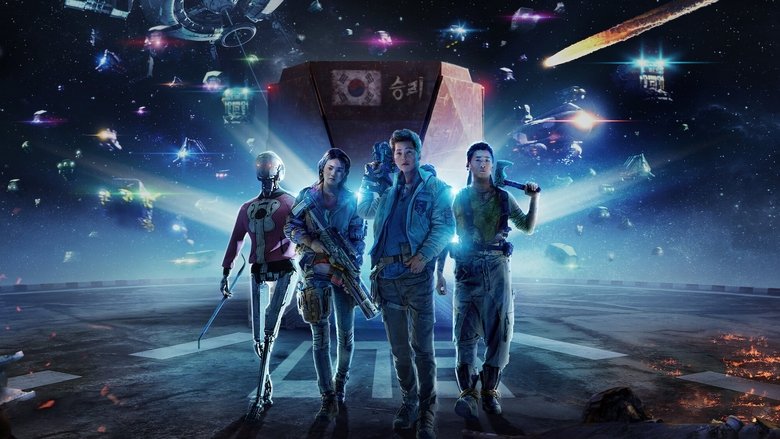
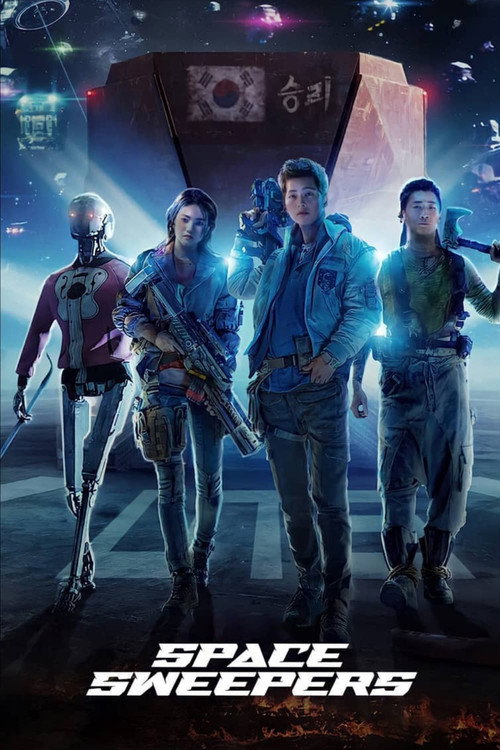
The story centers on the crew of the Victory (Seungriho), a rickety salvage vessel competing against rival scavenger ships to capture high-speed orbital space debris. The ragtag team consists of pilot Kim Tae-ho, who is desperately trying to raise money; enigmatic ex-pirate Captain Jang; muscular former drug kingpin Tiger Park; and Bubs, a snarky reprogrammed combat android. Despite their extraordinary flying and harpooning skills, the crew remains drowning in compounding debt, fines, and repair costs.

Their fortunes seemingly change during a routine salvage run when they discover a seven-year-old girl named Dorothy hidden inside a crashed shuttle. UTS media alerts proclaim Dorothy to be an ultra-lethal android packed with a weapons-grade hydrogen core, built by the eco-terrorist group Black Foxes. Seeing a way out of crippling poverty, the cash-strapped scavengers arrange an illicit black-market trade for her return, only to be drawn into a galactic conspiracy where corporate benevolence masks ruthless planetary extermination.
Core Meaning

Director Jo Sung-hee uses the expansive canvas of South Korea’s first big-budget space opera to deliver an urgent critique of neoliberal capitalism, environmental destruction, and neo-colonial class stratification. The film's primary thesis argues that salvation for humanity and the Earth will not come from billionaire tech oligarchs seeking to abandon a wounded planet for pristine off-world colonies. Instead, renewal lies in cross-cultural solidarity, the resilience of the working class, and the moral choice to preserve living connections rather than chasing capital accumulation. Jo subverts traditional colonial space exploration narratives by showing that true human dignity is found by cleaning up the debris of the past together, rather than leaving the marginalized behind in pursuit of corporate utopias.

Thematic DNA

Class Struggle and Capitalist Exploitation 30%
Found Family and the Redemption of Grief 25%
Environmental Catastrophe vs. Corporate Escapism 20%
Multilingualism, Collectivism, and Cross-Cultural Solidarity 15%
Transhumanism, Self-Determination, and Identity 10%

Class Struggle and Capitalist Exploitation

The film illustrates how capitalism extends into the cosmos. Space scavengers perform perilous, vital labor but are kept in perpetual systemic debt through fines, fees, and exorbitant living costs imposed by the UTS monopoly.

Found Family and the Redemption of Grief

The cynical, self-serving outlaws on the Victory are bonded not by blood or national origin, but by shared affection and communal care for an orphaned child. This bond heals Tae-ho’s paralyzing trauma and gives the crew a purpose higher than mere survival.

Environmental Catastrophe vs. Corporate Escapism

The contrasting settings of the dusty, dying Earth and Sullivan’s lush orbital gardens critique modern eco-apartheid. The narrative emphasizes ecological restoration and planetary coexistence rather than escapist colonization.

Multilingualism, Collectivism, and Cross-Cultural Solidarity

Unlike Western sci-fi that enforces a monolingual future, the film portrays a multilingual working class where characters speak Korean, Spanish, Tagalog, Danish, Russian, and Nigerian Pidgin via universal translators, uniting across borders against corporate tyranny.

Transhumanism, Self-Determination, and Identity

Explored primarily through Bubs' desire for synthetic skin and feminine self-actualization, alongside Kot-nim's nanobot-human symbiosis, arguing for identity autonomy free from corporate conditioning.

Character Analysis

Kim Tae-ho

Song Joong-ki

Archetype: Reluctant Hero / Grieving Father Key Trait: Tactical pilot genius, emotionally vulnerable, resilient.

Motivation

Secure funds to hire UTS body recovery tracking for his lost daughter.

Character Arc

Starts as an emotionally closed, money-obsessed scavenger unable to accept the loss of his adopted daughter Su-ni; rediscovers his humanity and sacrificial courage through Kot-nim.

Captain Jang (Jang Hyun-sook)

Kim Tae-ri

Archetype: Rebel Leader / Badass Anti-Heroine Key Trait: Unflinching charisma, sharp intellect, customized laser blaster.

Motivation

Bring down James Sullivan and dismantle the UTS corporate hegemony.

Character Arc

Former child prodigy, UTS officer, and pirate captain; masks her profound moral clarity behind alcohol, gambling, and a gruff demeanor.

All 5 characters and cast

Symbols & Motifs

The Sprouting Plant / Tomato Shoot

Meaning:

Serves as a visual metaphor for regeneration, proving that life on Earth can still heal without terraforming new worlds.

Context:

Early in the film, Kot-nim touches a withered plant aboard the Victory, revitalizing it with nanobots.

The Harpoon (Jak-sal)

Meaning:

Symbolizes working-class ingenuity, physical grit, and the scavengers' defiance against sleek, automated corporate weaponry.

Context:

Wielded by Bubs and mounted on the Victory, this traditional whale-hunting tool is adapted for orbital space salvage.

Shoes and Bare Feet

Meaning:

Symbolizes Tae-ho's vulnerability, spiritual destitution, and grounding in the mud of reality, placed in direct contrast with UTS elites who wear pristine boots.

Context:

Tae-ho begins the story wearing worn socks with holes in them, unable to afford shoes while obsessively saving money to find his lost daughter.

The Crayon Sketch / Children's Drawings

Meaning:

Reflects the transformative power of an innocent perspective to redefine human worth and identity.

Context:

Kot-nim draws pictures of the Victory crew, presenting them not as feared outlaws, but as family (uncles, aunties, and protectors).

Space Debris (Lagrange Cloud)

Meaning:

Represents the byproduct of unbridled human greed and industrial waste, while acting as both a working-class lifeline and a physical shield against oppression.

Context:

The deadly orbital junk is scavenged by sweepers for survival and ultimately serves to obscure the heroes from corporate surveillance.

Memorable Quotes

태호 삼촌 그거 알아요? 우주에서는 위도 없고 아래도 없대요. 우주의 마음으로 보면, 버릴 것도 없고 귀한 것도 없구요. 다 자기 자리에서 소중하대요.
— Kang Kot-nim (Park Ye-rin)

Context

Spoken to Uncle Tae-ho while sitting on the ship deck.

Meaning

The philosophical core of the entire film. It refutes Sullivan's caste system and explains that even space trash and discarded humans possess equal dignity in the cosmos.

비켜라, 이 무능한 것들아!
— Captain Jang (Kim Tae-ri)

Context

Her iconic entrance line as she commandeers salvage operations during an orbital race against international sweepers.

Meaning

Establishes Captain Jang’s dominant authority, swagger, and competitive edge over rival scavengers.

All 5 quotes

Philosophical Questions

What dictates human worth in an era of technological hyper-stratification?

The film examines whether human value is determined by utility to capital (UTS citizenship) or by an intrinsic, egalitarian connection to the ecosystem.

Can nature and advanced synthetic technology peacefully co-exist?

Through the nanobots, technology is explored as either an apocalyptic weapon of mass destruction or an instrument capable of restoring organic planetary life.

Is human nature inherently selfish or inherently cooperative?

Sullivan asserts that humans are genetically flawed and predisposed to cruelty; the Victory crew's instinctive willingness to sacrifice themselves for a child disproves his cynicism.

Alternative Interpretations

The film can be analyzed through several distinct theoretical frameworks:

Full ending explanation

Cultural Impact

Historically, the South Korean film industry excelled in thrillers, historical period pieces, melodramas, and urban zombie horror (Train to Busan, Kingdom), while space operas remained largely unattempted due to financial risk and technical limitations. Space Sweepers shattered this boundary upon its global February 2021 Netflix release, reaching #1 on the streaming platform in over 28 countries within days.

It garnered historic genre recognition as one of the few Korean films nominated for major international speculative fiction awards, including the Hugo Award for Best Dramatic Presentation (Long Form) and the Ray Bradbury Nebula Award. Its success proved that high-concept space science fiction could thrive with distinct Korean emotional sensibilities (han and jeong) and non-Western worldbuilding.

Audience Reception

Critics and audiences widely lauded the visual effects from Dexter Studios, noting that on a $21M budget, the visuals rivaled $200M Hollywood productions. The organic multilingual interactions, vivid worldbuilding, and charismatic chemistry of the central cast received unanimous appreciation.

Conversely, reviewers pointed out that the overarching narrative relies heavily on well-worn tropes, such as an evil corporate CEO, a cute child melting gruff hearts, and ragtag underdogs. The film's third-act shift into high melodrama and the miraculous nanobot survival divided viewers between those moved by its emotional resonance and those finding it overly sentimental. Overall, it was celebrated as a milestone for Korean cinema that set a high benchmark for non-Hollywood space adventures.

Interesting Facts

  • Produced on a budget of approximately ₩24 billion KRW (~$21 million USD)—a fraction of comparable Hollywood sci-fi films—Space Sweepers pioneered deep-space CGI in Korean cinema.
  • Led by South Korea's Dexter Studios and WYSIWYG Studios, more than 1,000 VFX artists worked on the film, creating over 2,000 visual effects shots out of the film's 2,500 total cuts (around 80% CGI).
  • WYSIWYG Studios utilized Epic Games' Unreal Engine to run real-time pre-visualization for complex zero-gravity space dogfights and orbital debris collisions.
  • Yoo Hai-jin performed full on-set motion capture wearing sensor-laden suits in addition to voice acting for Bubs, rather than having the robot purely generated via post-production animation.
  • Captain Jang’s slicked-back, greasy hairstyle and loose casual clothes were Kim Tae-ri’s personal suggestion, arguing that a scavenger surviving on strict water rations would not have clean, styled hair.
  • Director Jo Sung-hee originally conceived the script around 2009 after a friend talked to him about the genuine danger of space debris and the hypothetical role of future junk collectors.
  • British actor Richard Armitage stated in interviews that he was thrilled by the script's originality and embraced shooting in South Korea alongside Korean actors who spoke their native language during takes.

Easter Eggs

Kim Hyang-gi Cameo

Popular Korean actress Kim Hyang-gi makes a surprise cameo in the epilogue as Bubs' new human-like synthetic body, delivering Bubs' lines while reading classic poetry.

Rilke's Life and Songs

In the final sequence, the newly embodied Bubs reads Rainer Maria Rilke’s Life and Songs (Leben und Lieder), reflecting themes of embracing life's transient, unconditional beauty without greed.

Nod to Tazza: The High Rollers

In the crew's card game scene, the deceptive card-swapping tricks (Mitjang-ppaegi) mirror famous gambling scenes from the iconic Korean movie Tazza, which originally co-starred Yoo Hai-jin.

Cowboy Bebop and Planetes Aesthetics

The lived-in grime, debt burdens, eccentric junk collection, and ragtag crew dynamics pay direct homage to classic anime space operas like Shinichirō Watanabe’s Cowboy Bebop and Makoto Yukimura’s orbital debris manga/anime Planetes.

Frequently Asked Questions

Explore More About This Movie

Dive deeper into specific aspects of the movie with our detailed analysis pages

Comments (0)

Leave a comment

No comments yet. Be the first to share your thoughts!

Similar Movies