Skip to content
Spider-Man: Far From Home
A sun-drenched European coming-of-age action adventure wrapped in grief and deceptive illusion, where vulnerable teenage romance collides with a shattered kaleidoscope of weaponized holograms and heavy heroic expectations.
Spider-Man: Far From Home

Spider-Man: Far From Home

"It's time to step up."

28 June 2019 United States of America 129 min 7.4 (17,222)

Director: Jon Watts

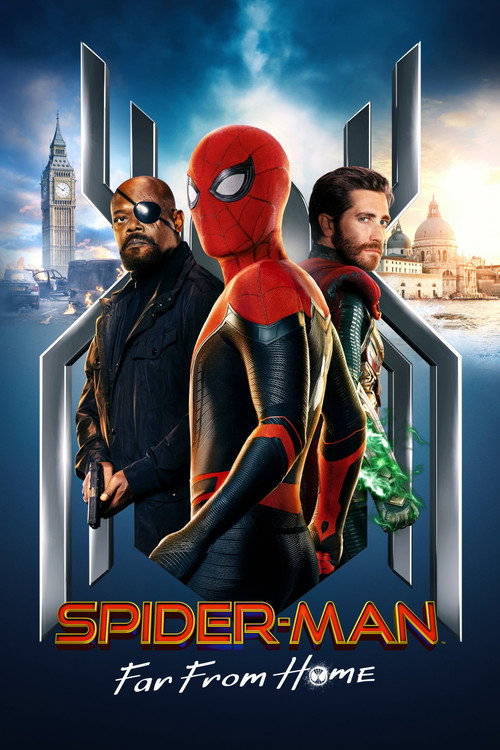
Cast: Tom Holland, Jake Gyllenhaal, Samuel L. Jackson, Marisa Tomei, Jon Favreau

Action Adventure Science Fiction Truth, Perception, and Deception in the Media Age Grief, Legacy, and Imposter Syndrome Escapism vs. Civic Responsibility Vulnerability, Trust, and Identity
Budget: $160,000,000
Box Office: $1,132,723,226

Overview

Following the universe-altering events of Avengers: Endgame and the traumatic loss of his mentor Tony Stark, high school student Peter Parker struggles to find his footing. Desperate for a break from superhero duties, Peter embarks on a two-week European class trip alongside his friends, including his best friend Ned and his crush MJ. His primary goal is simple: enjoy a normal vacation, confess his feelings to MJ atop the Eiffel Tower, and leave Spider-Man behind in Queens.

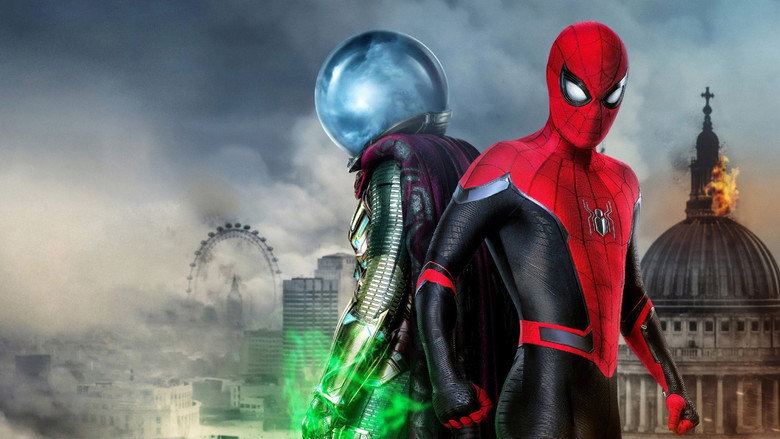
However, Peter’s plans for a quiet getaway are upended when super-spy Nick Fury tracks him down in Venice. Massive elemental entities—monsters composed of water, fire, earth, and wind—begin laying waste to major European cities. To counter this terrifying threat, Fury introduces Peter to Quentin Beck, a heroic extra-dimensional warrior dubbed "Mysterio," who claims his home universe was destroyed by these same creatures.

Thrust onto the international stage while grappling with immense public pressure to become "the next Iron Man," Peter must balance his personal desires with global duty. As he travels through Venice, Prague, and London alongside Beck and Fury, Peter is forced to grow up rapidly and decide what kind of hero he wants to be in a world where appearances can be deeply deceiving.
Core Meaning

Director Jon Watts uses Spider-Man: Far From Home to examine grief, identity, and the danger of deception in a "post-truth" era. At its core, the film explores what happens when public desperation for safety meets weaponized spectacle and fake news. Through Mysterio, the film demonstrates how easily public narrative can be manipulated by charismatic actors wielding visual tech and fear-mongering.

For Peter, the meaning centers on overcoming imposter syndrome. He realizes that honoring a legacy does not mean copying a predecessor—he must trust his own intrinsic instincts rather than external illusions or societal pressure.

Thematic DNA

Truth, Perception, and Deception in the Media Age 30%
Grief, Legacy, and Imposter Syndrome 30%
Escapism vs. Civic Responsibility 20%
Vulnerability, Trust, and Identity 20%

Truth, Perception, and Deception in the Media Age

Exposed primarily through Mysterio’s elaborate holographic illusion campaign. The film critiques how easily fear and emotional manipulation make people accept manufactured realities.

Grief, Legacy, and Imposter Syndrome

Peter carries the crush of Tony Stark’s absence, feeling inadequate to fill the void left by Iron Man. This theme is developed through omnipresent Iron Man murals and Peter's internal struggle with the responsibility handed to him.

Escapism vs. Civic Responsibility

Peter constantly attempts to dodge Nick Fury's calls to pursue a normal teenage life. The narrative highlights the tension between personal happiness and the unavoidable call to help others when one possesses power.

Vulnerability, Trust, and Identity

Both in his high school romance with MJ and his superhero partnership with Beck, Peter learns hard lessons about whom to trust and the emotional risk of revealing his true self.

Character Analysis

Peter Parker / Spider-Man

Tom Holland

Archetype: Coming-of-Age Hero / Reluctant Heir Key Trait: Deep empathy combined with self-doubt and resilience.

Motivation

Protect his friends and confess his feelings to MJ while carrying Iron Man's torch.

Character Arc

Transitions from an overwhelmed teen looking to escape responsibility into a confident hero who accepts his own unique identity.

Quentin Beck / Mysterio

Jake Gyllenhaal

Archetype: False Mentor / Illusionist Villain Key Trait: Narcissistic theatricality and master manipulation.

Motivation

Achieve universal acclaim, control the narrative, and gain revenge on Tony Stark's memory.

Character Arc

Appears as a tragic multidimensional savior before revealing himself as a bitter ex-Stark employee leading a crew of disaffected technicians.

All 4 characters and cast

Symbols & Motifs

E.D.I.T.H. Glasses

Meaning:

Symbolize both Stark's legacy and the terrifying, unilateral military authority thrust onto an unready teenager.

Context:

Left to Peter by Tony Stark, granting access to a global tactical satellite system.

Mysterio’s Fishbowl Helmet and Holographic Drones

Meaning:

Symbolize theatrical deception, manufactured narrative, and political illusion hiding high-tech destruction.

Context:

Used by Quentin Beck and his crew throughout their staged Elemental attacks across European cities.

Iron Man Murals

Meaning:

Represent the ghost of Tony Stark and the inescapable weight of societal expectations placed upon Peter.

Context:

Scattered across various European cities visited by Peter during his trip.

The "Peter Tingle" (Spider-Sense)

Meaning:

Represents Peter's internal intuition and connection to objective truth, allowing him to penetrate visual lies.

Context:

Relied upon by Peter when physical senses fail him during Mysterio's visual illusions.

Suit Fabricator Machine

Meaning:

Symbolizes Peter coming into his own, forging his own path rather than inheriting Tony's designs.

Context:

Located inside Stark’s private jet, where Peter designs his new black-and-red suit.

Memorable Quotes

People need to believe. And nowadays, they'll believe anything.
— Quentin Beck / Mysterio

Context

Spoken during Beck's monologue on his vision of villainy.

Meaning

Encapsulates the film's thesis on the weaponization of false news and public gullibility in moments of crisis.

Don't ever apologize for being the smartest one in the room.
— Quentin Beck

Context

Spoken to Peter during their early bonding session.

Meaning

Beck manipulates Peter's desire for validation by mirroring Tony Stark's intellect-driven mentorship.

All 5 quotes

Philosophical Questions

How is truth distinguished from illusion in a media-saturated world?

The film explores epistemological skepticism through Mysterio's holograms, showing that visual evidence can be engineered, making internal intuition ("Peter Tingle") essential for discerning reality.

Is inherited legacy an obligation or a trap?

It examines existential freedom, questioning whether young people are obligated to fulfill the unachieved ideals and power structures of their elders.

Does the promise of security justify total surveillance tech?

By showcasing the E.D.I.T.H. system, the film asks whether drone warfare and privacy invasion are ethical, even when created by well-intentioned leaders like Tony Stark.

Alternative Interpretations

The film offers several compelling layers of analysis:

Full ending explanation

Cultural Impact

Released in July 2019, Spider-Man: Far From Home served as the cultural decompression chamber for audiences recovering from the emotional devastation of Avengers: Endgame. It resonated deeply within the late 2010s zeitgeist by directly tackling fake news, deepfake technological anxiety, and media-driven cynicism.

By reinventing Mysterio from a traditional comic-book magician into a disaffected tech developer leveraging visual effects and military drones, the movie tapped into contemporary concerns regarding corporate tech power and narrative spin. Visually and commercially, it solidified Tom Holland's Spider-Man as a tentpole hero for a new generation.

Audience Reception

Spider-Man: Far From Home received strong positive acclaim from critics and audiences, earning a 90% score on Rotten Tomatoes and being widely hailed as a satisfying, visually bold epilogue to the MCU's Infinity Saga.

Praised Aspects: Critics lauded the electrifying chemistry between Tom Holland and Jake Gyllenhaal, the creative brilliance of Framestore's illusion sequences, and the lighter high school comedy tone.

Main Points of Criticism & Controversy: Some fans expressed frustration over Spider-Man's narrative reliance on Tony Stark’s tech and legacy, while others felt the high-school travel antics were slow-paced. Additionally, Peter blithely handing control of a global satellite weapon to a stranger raised eyebrows, though it aligns with his youthful naivety.

Interesting Facts

  • Marvel Studios President Kevin Feige confirmed that Spider-Man: Far From Home—not Avengers: Endgame—was the official finale of MCU Phase 3.
  • It became the first Spider-Man film in history to gross over $1 billion worldwide ($1.132 billion).
  • Jake Gyllenhaal almost played Peter Parker/Spider-Man in 2004's Spider-Man 2 when Tobey Maguire injured his back; 15 years later, he entered the franchise as Mysterio instead.
  • Production designer Claude Paré built a massive, functional replica of London's Tower Bridge on a backlot in Leavesden, England, because the crew was granted only one morning to film on the real location.
  • Marvel Studios Head of Visual Development Ryan Meinerding personally painted the Iron Man memorial murals seen in the film, which were added digitally post-production to avoid Endgame spoilers leaking during location shoots.

Easter Eggs

Uncle Ben's Initials

Peter's suitcase bears the initials "BFP," referencing his uncle, Benjamin Franklin Parker.

Comic Debut License Plates

Multiple license plates contain hidden codes referencing first appearances in Marvel Comics (e.g., "ASM28965" in Prague references The Amazing Spider-Man #28, published in 1965).

Wrestling Homage

A poster at Aunt May's charity event advertises a match between "Crusher Hogan" and "Bone Saw McGraw," honoring Peter Parker's amateur wrestling origin story.

Beck’s Crew Hiding in Plain Sight

Members of Quentin Beck’s team (such as Gutterman and Victoria) appear in background scenes long before the villain reveal, including a henchman watching Peter in Venice.

Hydro-Man & Molten Man References

Flash Thompson reads a BuzzFeed article mentioning "Morris Bench" (Hydro-Man's comic name) while in Venice.

Frequently Asked Questions

Explore More About This Movie

Dive deeper into specific aspects of the movie with our detailed analysis pages

Comments (0)

Leave a comment

No comments yet. Be the first to share your thoughts!

Similar Movies