Skip to content
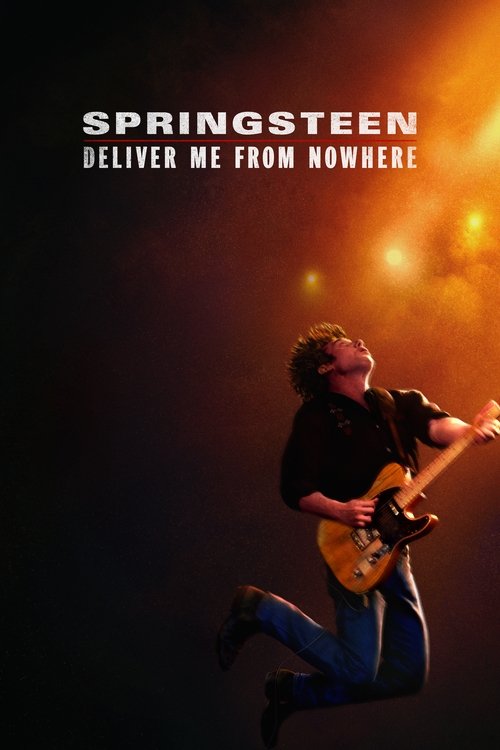
Springsteen: Deliver Me from Nowhere
A hushed, wintry drama about a rock star at the height of his powers recording his loneliest record — fame's stadium lights dimmed to the single bulb of a New Jersey bedroom.
Springsteen: Deliver Me from Nowhere

Springsteen: Deliver Me from Nowhere

"Witness a true story of risking it all to fight for what you believe in."

22 October 2025 United States of America 120 min 6.6 (351)

Director: Scott Cooper

Cast: Jeremy Allen White, Jeremy Strong, Paul Walter Hauser, Stephen Graham, Odessa Young

Drama Music Depression behind the myth Inherited wounds and fatherhood Art as confession and as evasion Fame, commerce and the people who manage it Home, roots and the impossibility of return
Budget: $55,000,000
Box Office: $45,240,624

Overview

New Jersey, 1981. Bruce Springsteen (Jeremy Allen White) comes off The River tour a certified American rock star and, instead of chasing the arena that awaits him, retreats from the glare — guided by his manager and producer Jon Landau (Jeremy Strong) to a quiet rented house near his hometown of Freehold. He buys his first new car, sits with a tape machine, and starts tinkering with songs that have no chorus big enough to fill a stadium.

What comes out of that room is Nebraska, the 1982 lo-fi album of murderers, drifters and fathers that Springsteen recorded largely alone. Scott Cooper's film, adapted from Warren Zanes' 2023 book of the same name, narrows a whole legendary life down to the months around those recordings, cutting between the present-tense work of making music and black-and-white flashbacks to a childhood shadowed by his mother Adele and his volatile father Douglas "Dutch" Springsteen (Stephen Graham).

Around the songs, a life keeps trying to happen. Bruce grows close to Faye Romano (Odessa Young), the younger sister of an old classmate, and to her young daughter, while Landau tries to protect an artist who is sinking without quite saying so. It is less a biopic about how a hit is made than about a man discovering that the darkness he has been writing about is not only outside him.
Core Meaning

Cooper's film argues that the most famous kind of American success — the roar of a full stadium, the working-class hero made good — can coexist with a private collapse, and that art is not a cure for it. Nebraska here is not a triumph of craft but a symptom: the sound of a man tuning his radio to the frequency of his own inherited grief and finding he cannot switch it off.

The message the film finally lands on is unfashionably plain for a rock movie: you cannot record your way out of depression. The turn is not a hit single or a sold-out night, it is the decision to ask for help and to speak the thing aloud — and, eventually, to let a father's apology land. Cooper treats that choice as the real climax, more consequential than any master tape.

Beneath it sits a second idea: that the songs about condemned men and lost sons on Nebraska were never reportage. They were a form of confession the singer could not yet make in the first person, and the film's whole structure — present-day recording intercut with black-and-white childhood — exists to show where those voices came from.

Thematic DNA

Depression behind the myth 30%
Inherited wounds and fatherhood 25%
Art as confession and as evasion 20%
Fame, commerce and the people who manage it 15%
Home, roots and the impossibility of return 10%

Depression behind the myth

The film's spine is Springsteen's 1982 struggle with depression at the precise moment the world decided he was invincible. Cooper keeps him flawed and damaged without melodrama — the withdrawal reads as recognizable rather than operatic, and the turn toward seeking help is staged as the film's genuine act of courage.

Inherited wounds and fatherhood

Black-and-white flashbacks to Freehold establish a home ruled by a father on the verge of violence and a mother holding it together. Douglas Springsteen (Stephen Graham) is the ghost haunting both the album and the man, and the film's most emotionally exposed moment is his belated accounting of his own failures — the son's reconciliation with a past he had been writing around for years.

Art as confession and as evasion

Nebraska's murderers and drifters are shown as displaced self-portraits: Bruce can voice despair through a character long before he can name it as his own. The film makes his creative process simultaneously heroic and avoidant — the tape machine is both an instrument of truth-telling and a place to hide.

Fame, commerce and the people who manage it

Jon Landau embodies the tension between the industry that wants the stadium record and the friend who can see the man breaking. The film dramatizes the cost of an artist insisting on a bleak, unmarketable cassette record when everything around him is built to produce the opposite.

Home, roots and the impossibility of return

Bruce goes back to the towns that made him — a rented house near Freehold, a new car, a girlfriend from the old neighborhood, Faye and her daughter — as if proximity to his origins might heal him. Instead the return reactivates everything he fled, and the ordinary life on offer keeps slipping past a man who cannot yet occupy it.

Character Analysis

Bruce Springsteen

Jeremy Allen White

Archetype: The wounded artist / reluctant hero Key Trait: Uncompromising interiority; a compulsion to tell the truth in song before he can speak it aloud

Motivation

To make something true enough to settle the ghosts of Freehold, and — beneath that — to survive being the man everyone else has decided he is.

Character Arc

Comes off a triumphant tour into withdrawal, channels a depression he will not name into the starkest songs of his career, and finally accepts that the music is not treatment — choosing therapy, and then accepting his father's apology, as the real resolution.

Jon Landau

Jeremy Strong

Archetype: Mentor / loyal steward Key Trait: Watchful patience — the friend who reads the silence

Motivation

To keep Bruce's work and Bruce himself intact at the same time, when the two goals pull in opposite directions.

Character Arc

Begins as the manager-producer steering a career at its commercial peak, recognizes that his artist is sinking, and shifts from protecting the record to protecting the man — including defending an unsellable cassette album against the industry's expectations.

All 4 characters and cast

Symbols & Motifs

The home tape machine

Meaning:

Solitude as both refuge and trap: a technology that lets one man be an entire band, and therefore lets him avoid needing anyone.

Context:

The Nebraska demos were famously cut alone at home, and the film organizes its recording scenes around that intimacy — Cooper had performances played live on camera, shooting close-ups first to capture the real takes and using playback only for wider shots.

Black-and-white childhood

Meaning:

Memory as a separate, unfixable order of reality — bleached of the present's color, permanently available, impossible to enter.

Context:

The film opens in black-and-white in Freehold, sketching the household with Adele and the volatile "Dutch," and returns there whenever the songs press on the same nerve.

The new car

Meaning:

The American escape myth in miniature — motion as salvation, the promise that the next road solves what the last one caused.

Context:

Newly off The River tour, Bruce buys his first new car after retreating to New Jersey; in a film full of songs about driving away, the vehicle mostly circles home.

The empty house near Freehold

Meaning:

Chosen isolation: a space small enough to contain a man who has stopped believing he deserves the stadium.

Context:

Landau installs him there to get him out of the glare; it becomes the birthplace of the album and the container of his worst months.

Faye and her daughter

Meaning:

The ordinary future — partnership, domesticity, a child's trust — held out as an alternative to the mythic life.

Context:

Faye Romano is a composite character invented for the film (a choice Springsteen himself signed off on), which makes her less a biographical fact than a deliberate emblem of the life Bruce cannot yet reach for.

The stadium, deferred

Meaning:

Public adoration as a thing that can be present and meaningless at once — the roar that does not reach the man inside it.

Context:

The film brackets its story between the end of The River tour and, in its final movement, Bruce performing publicly again six months on, with the crowd now framing a recovery rather than concealing a collapse.

Philosophical Questions

Can art heal the wound it comes from?

The film lets Bruce pour his inheritance into Nebraska and then shows him no better for it. The songs articulate the pain with total precision and relieve none of it — which is the movie's quiet case that expression and healing are separate operations, and that the second requires another person in the room.

What do we owe a parent who harmed us and later apologizes?

Douglas Springsteen spends most of the film as a threat in monochrome memory before returning to acknowledge his faults. The film declines to litigate whether the apology is adequate; it simply shows that it is enough for Bruce, proposing forgiveness as something the wounded party grants for their own sake rather than something the offender earns.

Does success protect anyone from despair?

By setting the story immediately after a triumphant tour, the film strips the usual causal logic from depression: nothing has gone wrong. The adoration is real and irrelevant, which forces the audience to locate the illness somewhere the world's approval cannot reach.

Is it possible to go home?

Bruce physically returns to the towns that made him — Freehold, a rented house, an old classmate's family — and finds that geography reactivates rather than resolves the past. The film treats 'home' as a condition of memory, not an address.

Who is the self underneath a public myth?

'The Boss' is a role written by other people's needs. By blending Jeremy Allen White's voice with Springsteen's own on the soundtrack, the film even makes its protagonist audibly double — a man perpetually accompanied by the version of himself the world recognizes.

Alternative Interpretations

The recovery reading. The dominant interpretation takes the ending at face value: Bruce accepts that he must confront his demons in therapy rather than bury them in music, and the father's backstage apology closes a wound the songs could only describe. Read this way the film is a sincere, even public-service-minded argument about seeking help — and critics who responded warmly praised exactly its refusal to romanticize the suffering as fuel for genius.

Full ending explanation

Cultural Impact

The film arrived as part of the post-Bohemian Rhapsody wave of music biopics but deliberately broke the format's rules: rather than cradle-to-Hall-of-Fame, it compresses its whole story into the narrow window between 1981 and 1982 and centers a record — Nebraska — that sold modestly and was never designed for arenas. Several critics singled out precisely this refusal of both canonization and smug demystification as what makes it more than a jukebox exercise.

Its cultural footprint is inseparable from the album's own reputation. Nebraska has long been the cult totem of Springsteen's catalogue — the record cited by indie and alt-country musicians as proof that a superstar could make something small and pitiless — and the film's release renewed mainstream attention on it, along with on Springsteen's decades-long public openness about depression and therapy.

Commercially it underperformed badly, opening to about $9.1 million domestically and finishing around $45 million worldwide against a $55 million budget, a result widely reported as a box-office bomb. Its second life came on streaming, where it drew a far larger audience than its theatrical run suggested. Critical reception settled around a 60% Rotten Tomatoes approval rating, with a notably warmer 85% audience score and an IMDb average of roughly 6.6 — a split that became part of the conversation about the film itself.

Audience Reception

The split. Audiences liked the film considerably more than critics did — roughly 85% audience approval on Rotten Tomatoes against a 60% critical score, with an IMDb user average near 6.6. Its theatrical run was a commercial failure, but it became a genuine streaming hit afterward, suggesting the material played better as an intimate home viewing than as an event release.

Praised: the two lead performances above all — Jeremy Allen White's committed, interiorized Springsteen (widely described as star-making, and notable for his own live singing) and Jeremy Strong's watchful Jon Landau. Viewers also responded to the film's honesty about depression, its restraint, and the sound work that folds Springsteen's real voice into White's.

Criticized: the narrow 1981–82 time frame, which left some feeling shortchanged of a life; the childhood flashbacks, which several reviewers found repetitive or on-the-nose; and the emphasis on Springsteen's mental state and private life over the music. The harshest notices called it simultaneously long and fruitless, with no payoffs and few genuinely moving beats, and some accused it of clichéd biopic construction despite its unconventional scope.

Contested: the fictional girlfriend Faye Romano, defended as a legitimate composite (Springsteen approved her) and attacked as a fabricated emotional shortcut; and the reconciliation ending, read by some as earned catharsis and by others as too neat.

Verdict: a serious, unusually quiet music biopic whose performances are its consensus strength, admired most by viewers who came for the man rather than the hits.

Interesting Facts

  • Scott Cooper adapted the screenplay from Warren Zanes' 2023 non-fiction book 'Deliver Me from Nowhere: The Making of Bruce Springsteen's Nebraska,' which examines Springsteen's struggles with depression during the 1982 recording of the album.
  • Jeremy Allen White performs his own singing in the film rather than lip-syncing to Springsteen's recordings.
  • Cooper had the musical performances played live on camera, shooting close-ups first to capture the live takes and using playback only for the wider coverage.
  • Cooper wanted the soundscape to be, in his words, 'a haunting mix between Jeremy and Bruce, with Bruce kind of always in the background' — the real Springsteen's voice is layered beneath White's.
  • Both Bruce Springsteen and his longtime manager and producer Jon Landau were involved with the production.
  • Faye Romano, the girlfriend played by Odessa Young, is a fictional/composite character invented for the film — a choice Springsteen personally approved.
  • The film opens in black-and-white, dramatizing Springsteen's childhood in Freehold, New Jersey with his mother Adele and his father Douglas 'Dutch' Springsteen.
  • It premiered at the Telluride Film Festival on August 30, 2025, and was released theatrically by 20th Century Studios on October 24, 2025.
  • The film was a box-office disappointment, opening to roughly $9.1 million domestically and grossing about $45 million worldwide against a reported $55 million budget, before finding a much larger audience on streaming.
  • Jeremy Strong plays Jon Landau; the supporting cast also includes Paul Walter Hauser and Stephen Graham.

Easter Eggs

Bruce's real voice buried under Jeremy Allen White's

Cooper's sound team deliberately blended White's live vocals with Springsteen's own recordings so that the Boss is 'always in the background' — an audio ghost that mirrors the film's theme of a past you can never fully mix out.

The invented girlfriend, Faye Romano

Attentive viewers looking for her in Springsteen biographies won't find her: she is a composite created for the film, approved by Springsteen himself, which quietly signals that the movie is after emotional truth rather than documentary fidelity.

The black-and-white Freehold prologue

The switch from color to monochrome codes the childhood material as a different register of reality — closer to the newsreel-bleak Americana of Nebraska's own cover and lyrics than to the film's 1981 present.

Bruce's first new car

A small biographical detail from the Zanes book that doubles as a wink at the entire Springsteen songbook, where cars are the standard vehicle of escape — here bought by a man who has nowhere left to drive.

Frequently Asked Questions

Explore More About This Movie

Dive deeper into specific aspects of the movie with our detailed analysis pages

Comments (0)

Leave a comment

No comments yet. Be the first to share your thoughts!

Similar Movies