Skip to content
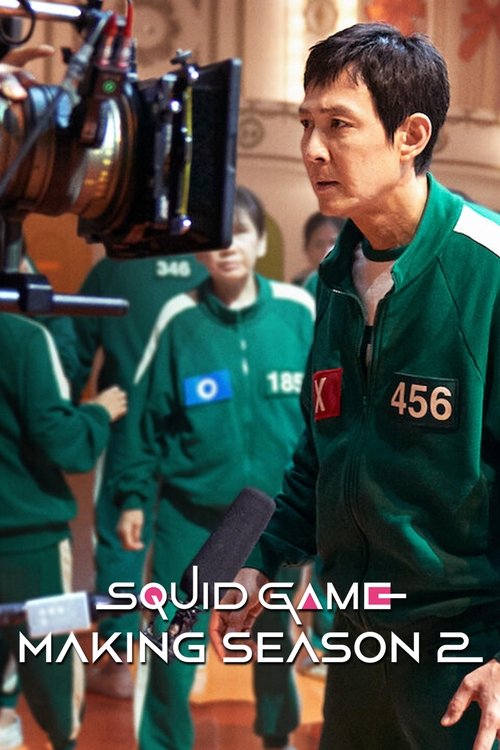
Squid Game: Making Season 2
This raw documentary unravels the grueling weight of unprecedented fame, peeling back hyper-saturated pastel walls to expose the psychological sweat, mechanical gears, and creative sacrifices fueling global spectacle.
Squid Game: Making Season 2

Squid Game: Making Season 2

오징어 게임: 시즌2 제작 이야기

02 January 2025 South Korea 28 min 8.4 (456)

Cast: Hwang Dong-hyuk, Lee Jung-jae, Lee Byung-hun, Chae Kyoung-sun, Kim Ji-yong

Documentary The Burden of Unprecedented Global Expectations Physicality and Scale of Production Design Moral Polarization and Societal Division via Game Mechanics Psychological Evolution of Returning and New Characters Collaborative Craftsmanship Across Camera, Sound, and Editing

Overview

Squid Game: Making Season 2 (오징어 게임: 시즌2 제작 이야기) is a 2025 behind-the-scenes documentary produced by Netflix to offer an intimate, high-definition look into the immense creative and logistical effort required to produce the follow-up to the most-watched series in streaming history. Released alongside the premiere of Season 2, the film gathers creator-director Hwang Dong-hyuk, lead actors Lee Jung-jae and Lee Byung-hun, production designer Chae Kyoung-sun, cinematographer Kim Ji-yong, and composer Jung Jae-il to discuss how they expanded the world of the deadly survival tournament.

The documentary covers the journey from initial script conceptualization to the physical construction of massive, functional sets built from the ground up. It details how protagonist Seong Gi-hun (Lee Jung-jae) transitions from a traumatized survivor into a resolute crusader re-entering the games to dismantle the organization. Meanwhile, it explores the expanded role of the enigmatic Front Man (Lee Byung-hun) and introduces a new ensemble cast whose interpersonal rivalries and moral choices drive the dramatic engine of the second season.

Beyond character arcs, the featurette provides an insider’s look at the mechanics of newly introduced games—such as the "Mingle" carousel challenge and the 5-person, 6-legged pentathlon—alongside the physical construction of the iconic dormitory, which now features interactive floor lights for a mid-game voting system. Through candidate discussions, set tours, and on-set footage, the film presents a chronicle of craftsmanship, narrative pressure, and the collaborative labor behind modern global television.
Core Meaning

The primary narrative goal of Squid Game: Making Season 2 is to highlight the delicate balance between maintaining thematic continuity and innovating under the weight of colossal global expectations. Director Hwang Dong-hyuk and his creative team demonstrate that a sequel cannot merely repeat past formulas; it must deepen its socio-political commentary.

The documentary emphasizes that the real-world creation of Squid Game mirrors the high-stakes survival of its fictional participants. Hwang Dong-hyuk’s decision to write and shoot Seasons 2 and 3 back-to-back created an extraordinary physical and psychological strain on the cast and crew. By showing the raw physical effort—from hand-building massive practical sets to choreographing hundreds of extras—the documentary asserts that genuine artistic impact stems from human sweat and physical design rather than superficial digital effects.

Thematic DNA

The Burden of Unprecedented Global Expectations 30%
Physicality and Scale of Production Design 25%
Moral Polarization and Societal Division via Game Mechanics 20%
Psychological Evolution of Returning and New Characters 15%
Collaborative Craftsmanship Across Camera, Sound, and Editing 10%

The Burden of Unprecedented Global Expectations

The film continually returns to the immense pressure felt by Hwang Dong-hyuk and the production team following Season 1’s unexpected global success. Interviews reveal how every set decision, color choice, and plot turn was scrutinized to ensure it honored fan devotion while pushing the story forward.

Physicality and Scale of Production Design

A core focus of the documentary is production designer Chae Kyoung-sun's refusal to rely heavily on CGI. The film illustrates how full-scale, functioning physical sets—such as giant spinning carousels and life-sized arena tracks—were engineered to evoke authentic physical reactions from the actors.

Moral Polarization and Societal Division via Game Mechanics

The documentary details the ideological intent behind new game rules, particularly the O/X voting system embedded directly into the dormitory floor. Director Hwang explains that forcing players to vote after every single game was designed to visually and psychologically capture modern political and social polarization, turning survivors against each other.

Psychological Evolution of Returning and New Characters

The film traces Lee Jung-jae's preparation to portray a transformed Gi-hun—moving from an aimless victim to an active strategist—while detailing how new cast members (such as Yim Si-wan, Kang Ha-neul, and Jo Yu-ri) integrated into the intense production environment.

Collaborative Craftsmanship Across Camera, Sound, and Editing

The documentary showcases how cinematographer Kim Ji-yong, editor Nam Na-young, and composer Jung Jae-il harmonized their disciplines. Through wide-angle lensing, rhythmic cutting, and childlike orchestral arrangements, they built an atmosphere of claustrophobic dread.

Character Analysis

Hwang Dong-hyuk

Hwang Dong-hyuk

Archetype: The Exhausted Visionary / Auteur Key Trait: Uncompromising meticulousness combined with candid vulnerability about burnout

Motivation

Delivering a meaningful narrative continuation that lives up to global expectations without losing critical social critique.

Character Arc

Transitioned from an auteur who originally envisioned a single-season story into an overworked showrunner steering a massive global franchise.

Lee Jung-jae (Seong Gi-hun / Player 456)

Lee Jung-jae

Archetype: The Reluctant Crusader Key Trait: Intense emotional discipline and deep character ownership

Motivation

Translating Gi-hun’s dark internal grief and anti-system crusade into believable physical acting.

Character Arc

Re-enters the production process not as a desperate underdog, but as a seasoned leader carrying heavy psychological weight and moral responsibility.

All 5 characters and cast

Symbols & Motifs

Floor-Embedded Red (X) and Blue (O) Lights

Meaning:

Institutional division, forced public political choices, and societal binary polarization.

Context:

Installed directly into the center floor of the main contestant dormitory, forcing players to physically stand under harsh glowing red or blue illumination during mandatory voting sessions.

The "Mingle" Spinning Carousel

Meaning:

Chaotic fate, volatile human alliances, and rapid betrayal under existential deadlines.

Context:

Featured prominently during the behind-the-scenes breakdown of the "Mingle" game, where a physically rotating set forces players to form groups of exact numbers or face instant execution.

Hwang Dong-hyuk’s Physical Toll / Lost Teeth

Meaning:

The destructive personal sacrifice required by capitalist media production.

Context:

Referenced as a recurring real-life motif representing the extreme stress of writing, directing, and managing back-to-back multi-million-dollar seasons.

Reconstructed Warehouse Bunk Beds

Meaning:

Industrial commodification, human storage, and the relentless pressure to climb over others.

Context:

Shown during set construction footage of the dormitory, where stacked metal beds mimic warehouse storage racks to emphasize how the game treats human beings like stacked merchandise.

Young-hee and Cheol-su (Giant Robot Dolls)

Meaning:

Perverted childhood innocence, automated state surveillance, and mechanical judgment.

Context:

Detailed in the prop and visual effects department featurette, showing the mechanical upgrades made to the iconic surveillance dolls for Season 2.

Memorable Quotes

시즌1 마지막에 돌아선 기훈이 자기가 한 말을 지켜가는 과정, 게임을 연 사람들은 누구며 왜 그런 짓을 하는지 밝혀내려고 분투하는 기훈의 이야기가 시즌2의 중요한 스토리라인입니다.
— Hwang Dong-hyuk

Context

Said during his central interview segment breaking down the script direction.

Meaning

Contextualizes the narrative pivot of the sequel from a survival story to a revenge/investigation narrative.

OX 투표는 시즌1에선 없던 혜택을 줌으로써 교묘하고 자발적으로 속행이냐 중단이냐를 가지고 서로 양쪽으로 갈라져서 더 격렬하게 갈등하고 대립하는 과정입니다.
— Hwang Dong-hyuk

Context

Spoken during the dormitory set breakdown.

Meaning

Explains the sociological theory behind Season 2’s main game mechanism.

All 4 quotes

Philosophical Questions

Can artistic integrity survive extreme commercial success?

The documentary explores how a director who initially crafted a self-contained story must re-engage with his vision under the pressure of global commercial demand.

Does the illusion of democratic choice excuse systemic oppression?

Through the analysis of the O/X voting system, the film questions whether participating in voting within a rigged system makes individuals complicit in their own exploitation.

Why does human society find comfort in competitive cruelty?

By examining why innocent childhood games translate so easily into mortal combat, the film ponders whether human socialization inherently conditions people for hyper-competitive survivalism.

Alternative Interpretations

Industrial Meta-Commentary: Many critics interpret the documentary as an unintentional meta-commentary on streaming capitalism. Hwang Dong-hyuk’s intense physical exhaustion mirrors the plight of the players in his show: creative workers trapped in a system where immense success yields even higher demands and tighter deadlines.

Full ending explanation

Cultural Impact

Squid Game: Making Season 2 reflects the immense transformation of South Korea’s entertainment industry on the global stage. When Season 1 premiered in 2021, it became a cultural phenomenon, generating almost $900 million in value for Netflix and proving that non-English series could dominate international pop culture.

By the time Season 2 arrived in late 2024 / early 2025, South Korean content had become a central pillar of global streaming platforms. The release of this dedicated behind-the-scenes documentary underscores how Korean creators are now treated with the same artistic reverence and promotional scale as major Hollywood showrunners. Furthermore, the documentary captures how the show’s themes—capitalist competition, social division, and voluntary submission to systemic exploitation—resonated even more acutely in a post-pandemic global economy marked by inflation, political polarization, and digital division.

Audience Reception

Praise: Audiences and critics praised Hwang Dong-hyuk and the cast for openly discussing the immense stress and artistic doubts involved in making a sequel to a global hit. Fans expressed fascination with Chae Kyoung-sun's architectural setups, particularly the functional mechanics of the floor-embedded O/X LED lighting and the physical carousel builds. The featurette itself was commended for slick editing, crisp cinematography, and comprehensive interviews.

Criticism: At approximately 27–28 minutes, many viewers felt the documentary was too brief, wishing for an episodic, deep-dive series exploring individual episodes in greater detail. Some hardcore fans noted that the documentary held back on revealing certain deep-level production secrets or narrative twists to avoid spoiling viewers who had not finished Season 2 immediately.

Overall Verdict: A sleek, highly informative, and engaging supplementary film that provides essential context for Squid Game fans, serving as both a tribute to physical filmmaking and a record of creative perseverance.

Interesting Facts

  • Historical Netflix First for Korean Content: Squid Game: Making Season 2 is the first Korean production ever to receive an official, dedicated standalone "Making Of" documentary on Netflix—a distinction previously limited to global flagship franchises like Stranger Things and Money Heist.
  • Rebuilding Everything from Scratch: Absolutely none of the iconic sets from Season 1 were preserved after filming wrapped in 2020. Production designer Chae Kyoung-sun had to reconstruct the entire maze staircases, dormitories, and control rooms from scratch while simultaneously designing all-new arenas.
  • The Tracksuit Color Debate: The creative team briefly sampled sky-blue tracksuits for Season 2 participants. However, after reviewing tests, Hwang Dong-hyuk decided to keep the classic green uniforms, concluding that fans would react negatively to losing the iconic visual identity.
  • Real-Time Game Mechanics Testing: During pre-production testing for the "5-person 6-legged relay race," Hwang Dong-hyuk initially set the time limit at 10 minutes. After observing stunt extras easily completing the course, he slashed the timer to 5 minutes to create genuine panic and realistic failure rates.
  • Left-Handed Top Spinning: Lee Byung-hun (The Front Man) revealed during interviews that because his character was written as left-handed, he had to spend weeks practicing traditional Korean top spinning with his non-dominant left hand for a specific scene.
  • Physical Mingle Set: Rather than relying on green screen or digital background replacement, the production crew built a fully functioning, motorized spinning carousel set for the "Mingle" game to force actors to physically struggle with momentum and balance during filming.
  • Back-to-Back Filming Scale: Seasons 2 and 3 were shot continuously back-to-back over a grueling multi-month production schedule. The total budget across both combined seasons reached roughly ₩100 billion KRW (~$67+ million USD), marking the highest production cost in South Korean drama history.

Easter Eggs

Return of Season 1 Minor Characters

The documentary highlights the deliberate return of minor characters from Season 1 Episode 1—specifically Gi-hun's drinking friend Jung-bae (Lee Seo-hwan) and the ruthless loan shark Kim—showing how minor threads were woven into Season 2's primary narrative backbone.

Homage to Classic Korean Animation

Chae Kyoung-sun revealed that the sample sky-blue tracksuit tested during pre-production was inspired by the outfit worn by character Hong Du-kke in the famous 1980s Korean animated series Run Hani.

School Playground Floor Lines

The painted track lines on the floor of the 5-legged relay race arena were styled exactly after South Korean elementary school athletic grounds from the 1980s and 1990s, grounding the fatal games in nostalgic childhood memories.

Gong Yoo’s Extended Cameo Energy

Behind-the-scenes footage reveals Gong Yoo (The Recruiter) improvising manic, unsettling laughter during his subway scenes with Lee Jung-jae, elevating his role from a calm broker to an unhinged fanatic.

Frequently Asked Questions

Explore More About This Movie

Dive deeper into specific aspects of the movie with our detailed analysis pages

Comments (0)

Leave a comment

No comments yet. Be the first to share your thoughts!

Similar Movies