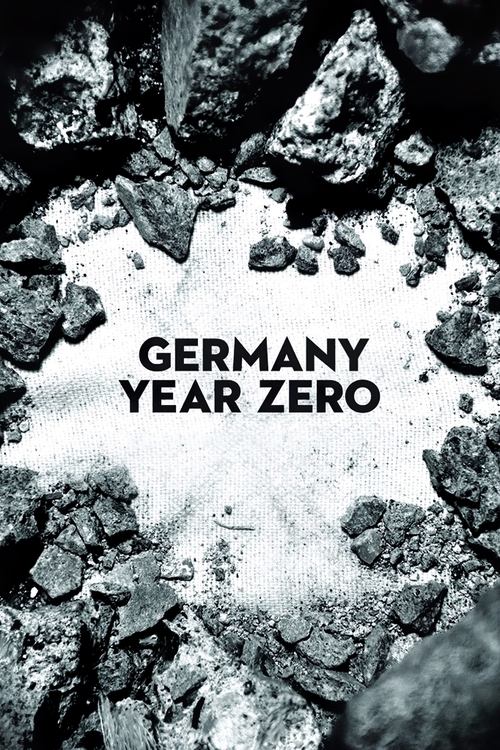
Germany, Year Zero
Germania anno zero
"A soldier can lose everything but his courage."
Overview
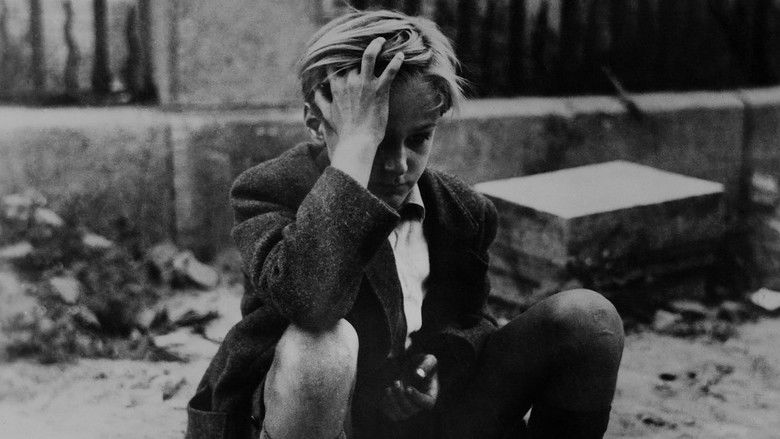
Set against the apocalyptic, rubble-strewn backdrop of bombed-out Berlin in 1947, Germany, Year Zero follows twelve-year-old Edmund Kohler, a boy forced into the role of primary breadwinner for his destitute family. With his father severely ill, his brother Karl-Heinz hiding from the authorities due to a shadowy Nazi past, and his sister Eva spending her nights at dance halls to secure cigarettes and rations, the crushing burden of survival falls squarely on Edmund's small, fragile shoulders.
As Edmund wanders the desolate streets, he becomes entangled in the city's predatory black market and falls under the sway of his former schoolteacher, Herr Henning. A lingering Nazi sympathizer with pedophilic undertones, Henning poisons the vulnerable boy's mind with twisted philosophies of social Darwinism. The film becomes a profound, harrowing exploration of innocence lost amidst the physical and spiritual ruination of a fallen empire, leading to an unforgettable and devastating climax.
Core Meaning
Roberto Rossellini masterfully confronts the lingering ideological poison of Nazism and the devastating human cost of war. The film suggests that the physical destruction of a city is secondary to the profound moral decay of its inhabitants. By making an impressionable child the protagonist, Rossellini demonstrates how toxic ideologies—like the survival of the fittest—outlive the regimes that created them and corrupt the most innocent among us.
The Year Zero of the title represents both the absolute obliteration of the old world and a terrifyingly blank slate. Rossellini asks a terrifying question: Is true rebirth possible when the roots of fascist ideology and absolute despair remain deeply embedded in the survivors?
Thematic DNA
The Corruption of Innocence
Edmund represents the ultimate victim of the war: a child forced to bear adult responsibilities without the emotional maturity to process them. His innocence is systematically dismantled by the adults around him, culminating in his tragic internalization of a monstrous ideology.
Survival vs. Morality
In the starving, freezing landscape of 1947 Berlin, traditional ethics have completely collapsed. The film reveals how extreme desperation forces characters into theft, prostitution, and even murder, demonstrating that morality is often a luxury of the comfortable.
The Shadow of Nazism
Despite the end of World War II, the ideological ghosts of the Third Reich persist. This is embodied by the teacher, Herr Henning, who continues to preach social Darwinism, proving that military defeat does not instantly eradicate toxic cultural beliefs.
Physical and Spiritual Ruination
The destroyed landscape of Berlin serves as a constant externalization of the characters' internal desolation. The rubble is not merely a setting, but a tangible manifestation of a spiritually leveled society with no clear path forward.
Character Analysis
Edmund Kohler
Edmund Moeschke
Motivation
To provide for his starving family and relieve their suffering by any means necessary.
Character Arc
Edmund devolves from a dutiful, hardworking son into a traumatized murderer. His desperate search for guidance in a fractured world leads him to commit the ultimate sin, destroying his own will to live.
Herr Henning
Erich Gühne
Motivation
Self-preservation, predatory grooming of vulnerable boys, and maintaining his fascist superiority.
Character Arc
Henning remains a static, unrepentant figure. He casually manipulates his young students, but cowardly recoils in horror when faced with the actual, deadly results of his own teachings.
Mr. Kohler
Ernst Pittschau
Motivation
Overwhelming guilt over his utter helplessness and inability to provide.
Character Arc
He degrades from what was once likely a proud man to a pathetic, bedridden invalid who openly wishes for death to spare his children further hardship.
Karl-Heinz Kohler
Franz-Otto Krüger
Motivation
Avoiding Allied punishment for his actions as a former Nazi soldier.
Character Arc
He spends almost the entire film hiding in fear, completely paralyzing his family's ability to get proper rations. He only gains the courage to turn himself in to the authorities after it is entirely too late.
Symbols & Motifs
The Ruined Cityscape of Berlin
The bombed-out buildings symbolize the complete collapse of civilization, moral order, and the German psyche. The ruins act as an inescapable labyrinth of despair.
The ruins tower over Edmund throughout the film, most notably during the long, unbroken tracking shots where the environment physically dwarfs the child.
Hitler's Recorded Voice
It symbolizes the haunting, inescapable ghost of Germany's recent past, mocking the current state of absolute destitution with grandiose, hollow promises.
Edmund attempts to sell a record of the Führer's speech to Allied soldiers. When played on a gramophone in the ruined Chancellery, the booming voice creates a chilling juxtaposition against the surrounding devastation.
The Poisoned Tea
The tea represents the direct, fatal translation of social Darwinist theory into action. It is a perverted act of mercy driven by corrupted logic.
Edmund prepares the deadly brew for his ailing father, genuinely believing he is alleviating the family's burden based on the survival-of-the-fittest ideology taught by his mentor.
Memorable Quotes
This film is not an accusation against the German people, nor yet a defence of them. It is simply a presentation of the facts.
— Opening Narrator
Context:
Spoken in the prologue during the opening tracking shots over the real, horrifying ruins of Berlin.
Meaning:
This line establishes the film's core neorealist philosophy—seeking an objective, unvarnished truth over melodramatic moralizing or political vengeance.
Why doesn't he die and give us some peace?
— The Landlord
Context:
The landlord aggressively berates Edmund about his ailing father, viewing the sick old man only as a useless drain on their limited rations.
Meaning:
This cruel statement reflects the social Darwinist decay of compassion in a starving city, heavily planting the seed for Edmund's ultimate, tragic decision.
I did my duty.
— Karl-Heinz Kohler
Context:
Spoken when his sister Eva presses him about his shadowy actions during the war and why he stubbornly refuses to register with the Allied authorities.
Meaning:
This brief, chilling line encapsulates the terrifying reality of the 'just following orders' mentality held by former Nazi soldiers.
Philosophical Questions
Can an individual maintain a moral compass in a state of absolute deprivation?
The film explores how extreme starvation and the collapse of societal structure strip away traditional ethics. It asks whether morality is an inherent human trait or merely a luxury afforded by civilization.
Are children morally responsible for actions driven by the corrupted ideologies of their adult mentors?
Edmund commits patricide, but he does so under the ideological grooming of his former teacher. The film challenges the viewer to place the blame not on the child, but on the enduring toxicity of fascist doctrines.
Can a society truly reach a 'Year Zero' and rebuild itself, or is the poison of its history inescapable?
By showing Nazi sympathizers like Henning still operating in the ruins, the film questions the concept of a clean slate (Stunde Null), suggesting that physical destruction does not erase psychological and cultural rot.
Alternative Interpretations
The film's devastating conclusion—Edmund's suicide—has been hotly debated by critics for decades. The primary, pessimistic interpretation views his death as the ultimate defeat: the innocent child is entirely crushed by the monstrous legacy of Nazism and the physical ruination of his world, demonstrating that the 'Year Zero' offers no real hope for rebirth. He dies because the ideology of the adults around him left no room for his humanity.
Conversely, an affirmative interpretation suggests that Edmund's suicide is his only remaining act of agency. Upon realizing the horror of poisoning his father, Edmund refuses to continue living in a morally bankrupt world. His death is seen as a tragic but principled rejection of the social Darwinist nightmare Herr Henning tried to force upon him. Furthermore, critics debate Rossellini's claim of 'objectivity'; while he stated the film was merely a presentation of facts, many argue its bleakness and haunting score push it into the realm of highly subjective German Expressionism, functioning as an externalization of Rossellini's own grief over the loss of his son.
Cultural Impact
Germany, Year Zero holds a monumental place in the history of cinema, serving as the devastating conclusion to Roberto Rossellini's unofficial War Trilogy (following Rome, Open City and Paisan). Upon its release, it was highly controversial; critics like Bosley Crowther found it 'oddly passive' and overwhelmingly bleak. However, history has vindicated the film as a masterpiece of Italian neorealism.
Its cultural impact extends heavily into the French New Wave. Auteurs like Jean-Luc Godard (who referenced it in Germany Year 90 Nine Zero) and François Truffaut considered it foundational for its unsentimental, raw depiction of childhood trauma. By refusing to paint the German people solely as monsters or martyrs, Rossellini forced audiences to confront the universal vulnerability of humanity in the face of systemic collapse. The film's uncompromising gaze at the horrific intersection of fascist ideology and childhood innocence remains a benchmark for anti-war cinema to this day.
Audience Reception
Upon its initial release, audiences and critics were deeply divided. Many praised the unparalleled, pseudo-documentary visual capture of 1947 Berlin and the heartbreaking, naturalistic performance of young Edmund Moeschke. However, major points of criticism centered around its oppressive, unrelenting bleakness.
Contemporary audiences found the juxtaposition of location exteriors and studio interiors slightly jarring, and the film's central acts of patricide and child suicide were considered deeply shocking and controversial. Over the decades, the verdict has shifted dramatically. Today, film historians, critics, and cinephiles revere it as an essential, uncompromising masterpiece. It is celebrated for its bravery in showing the 'humanity of the defeated' and stands as one of the most powerful anti-war statements ever committed to celluloid.
Interesting Facts
- Roberto Rossellini dedicated the film to his nine-year-old son, Romano, who tragically died of an inflamed appendix in 1946 shortly before production.
- French director François Truffaut was deeply moved by the film, famously stating that 'there would be no The 400 Blows without Rossellini\'s Germany Year Zero.'
- Rossellini used mainly local, non-professional actors found on the streets. Ernst Pittschau, who played the father, was a former silent film actor discovered sitting on the steps of a retirement home.
- The exteriors were shot entirely on location in the bombed-out ruins of Berlin in 1947, while the interior scenes were filmed later in a studio in Rome, Italy.
- The film's haunting, doom-ridden modernist score was composed by Roberto Rossellini's brother, Renzo Rossellini.
Easter Eggs
The carved dead horse in the street.
The brutal image of starving citizens carving meat from a dead horse in the street was visually quoted and referenced decades later by Swedish director Ingmar Bergman in his film The Serpent's Egg.
The 'Pan-Up to the Sky' ending.
The final camera movement, panning up to the sky after Edmund's death, serves as a direct visual echo and inversion of the ending of Rossellini's earlier neorealist masterpiece Rome, Open City, bridging the wartime tragedies of both nations.
⚠️ Spoiler Analysis
Click to reveal detailed analysis with spoilers
Frequently Asked Questions
Explore More About This Movie
Dive deeper into specific aspects of the movie with our detailed analysis pages
Comments (0)
No comments yet. Be the first to share your thoughts!