Straight Outta Compton
"The world's most dangerous times created the world's most dangerous group."
Overview
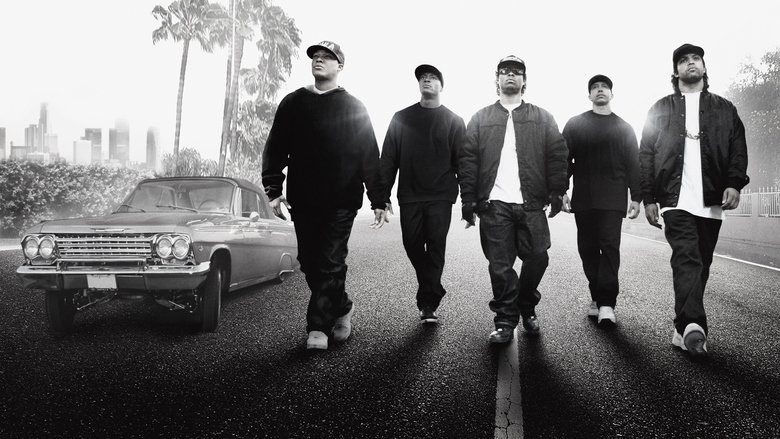
Straight Outta Compton is a sweeping biographical drama that chronicles the meteoric ascent and turbulent collapse of the pioneering rap group N.W.A. Set in the mid-1980s, the film begins in the crime-ridden streets of Compton, California, where Dr. Dre, Ice Cube, and Eazy-E find an escape from poverty and police harassment through 'reality rap.' Under the guidance of manager Jerry Heller, they form a group that shocks the American establishment with its unfiltered lyrical depictions of life in the hood.
The narrative follows the group as they navigate the complexities of the music industry, facing censorship from the FBI and violent crackdowns by local law enforcement. As they achieve global stardom, internal fractures begin to emerge over financial transparency and creative control. This leads to high-profile departures, bitter solo feuds, and the eventual rise of rival empires like Death Row Records, culminating in a poignant look at the personal toll of their cultural revolution.
Core Meaning
The film serves as a powerful testament to the strength of street knowledge and the transformative power of art as a weapon against oppression. Director F. Gary Gray portrays N.W.A not merely as musicians, but as essential journalists of a neglected reality. The core message emphasizes that when a community is silenced by systemic violence and economic disenfranchisement, their only recourse is to speak their truth so loudly that the world has no choice but to listen. It is a story about reclaiming agency and the double-edged sword of the American Dream.
Thematic DNA
Systemic Injustice and Police Brutality
The film explicitly links the group's aggressive lyrics to the constant racial profiling and harassment they endure. Scenes of police shakedowns in Compton and Torrance provide the visceral justification for the anthem 'Fuck tha Police', framing the music as a direct response to a militarized state.
Freedom of Speech vs. Censorship
The conflict between N.W.A and the FBI, as well as the Detroit police, highlights the battle over artistic expression. The film argues that rap music is protected speech that holds a mirror to society, even when that reflection is uncomfortable for the establishment.
The Pitfalls of Corporate Exploitation
Through the character of Jerry Heller, the film explores how young artists from marginalized backgrounds are often exploited by the industry. The tension between creative loyalty and financial transparency becomes the primary catalyst for the group's dissolution.
Loyalty and Brotherhood
Despite the bitter 'diss tracks' and legal battles, the film's emotional backbone is the bond between the original five members. Their journey from friends to enemies and back toward reconciliation emphasizes that their shared history in Compton is stronger than the industry that divided them.
Character Analysis
Eazy-E (Eric Wright)
Jason Mitchell
Motivation
To build a legacy and escape the violence of the streets through his own label, Ruthless Records.
Character Arc
Starts as a small-time drug dealer looking for an exit; becomes the wealthy face of N.W.A but is eventually humbled by financial ruin and a terminal illness, finding redemption through reconciliation.
Ice Cube (O'Shea Jackson)
O'Shea Jackson Jr.
Motivation
Artistic integrity and the desire to be compensated fairly for his 'truth-telling' lyrics.
Character Arc
The group's primary lyricist who recognizes his worth and refuses to be exploited, leading him to a successful solo career and a role as a political voice for his generation.
Dr. Dre (Andre Young)
Corey Hawkins
Motivation
To create a sound that defines an era and to achieve creative freedom without the interference of thugs or shady managers.
Character Arc
A musical perfectionist who evolves from a DJ in a small club to a genre-defining producer, eventually breaking free from toxic partnerships to find his own independence.
Jerry Heller
Paul Giamatti
Motivation
To reclaim his relevance in the music industry by managing the 'next big thing' while ensuring his own financial security.
Character Arc
Provides the group with their first legitimate platform but slowly reveals a self-serving nature that prioritizes his own wealth over the group's unity.
MC Ren
Aldis Hodge
Motivation
To push the boundaries of rap and maintain the group's hardcore identity.
Character Arc
The loyal core member who provides much of the group's lyrical backbone, remaining focused on the music even as the leaders fragment.
Symbols & Motifs
The Battering Ram (Tank)
Symbolizes the overwhelming and indiscriminate power of the state used against its own citizens.
Used in the opening drug raid scene, literally smashing through the walls of a Compton home, establishing the high-stakes environment the characters must navigate.
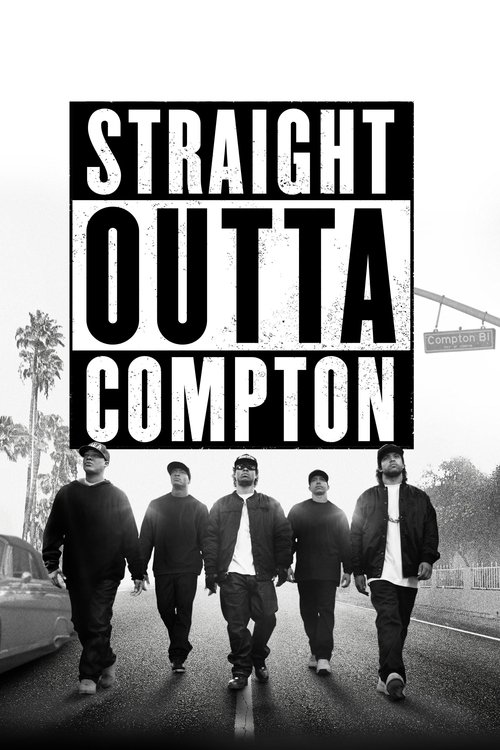
The 'Straight Outta' Logo
A symbol of identity, pride, and the branding of a specific geographical struggle as a global movement.
Adapted from the 'Parental Advisory' warning, turning a mark of censorship into a badge of authenticity and rebellion.
The 6-4 Impala
Symbolizes West Coast hip-hop culture, status, and the mobility (literal and social) of the group.
Seen throughout the film in music videos and street scenes, bridging the gap between their humble roots and their arrival as icons.
Memorable Quotes
Speak a little truth and people lose their minds.
— Ice Cube
Context:
Said while watching a crowd of protesters destroy their records, highlighting the fear that 'reality rap' instilled in mainstream America.
Meaning:
Sums up the reaction of the establishment to N.W.A's lyrics, which were seen as dangerous simply because they were honest.
You are now about to witness the strength of street knowledge.
— Dr. Dre
Context:
Heard over the introductory sequences as the group's sonic landscape begins to take shape.
Meaning:
The opening statement of the album and the film, signaling a shift in power where the streets become the source of wisdom.
I'd rather be broke than to get fucked.
— Ice Cube
Context:
Said during the contract negotiations with Jerry Heller, right before Cube decides to leave the group.
Meaning:
A declaration of independence and self-worth over financial convenience.
Philosophical Questions
Does art reflect reality, or does it create it?
The film explores this through the 'reality rap' debate: the group argues they are merely mirroring their environment, while the FBI and police claim they are inciting the violence they describe.
What is the true cost of the American Dream for marginalized people?
It reveals how success requires entering the very systems (corporate and legal) that were designed to exclude the characters, often forcing them to compromise their loyalty and identity.
Alternative Interpretations
Critics and audiences have discussed the film as a 'history written by the victors'. Because Ice Cube and Dr. Dre were producers, some interpret the film as a sanitized version of their lives that selectively omits their more controversial actions, such as Dr. Dre's history of violence against women (most notably the incident with journalist Dee Barnes). Another reading suggests the film is a subversive tragedy where the true antagonist is not just the police, but the corrosive nature of sudden wealth that turns brothers against each other in a capitalist cycle. Some view the ending not just as a tragedy for Eazy-E, but as a symbolic death of the group's original raw, anti-corporate spirit.
Cultural Impact
Straight Outta Compton significantly impacted both the film industry and contemporary social discourse. Culturally, it arrived during a peak in the Black Lives Matter movement, making its 1980s depictions of police brutality feel hauntingly relevant to modern audiences. It proved that a film with an almost exclusively Black cast and a focus on 'niche' urban history could achieve massive mainstream commercial success, grossing over $200 million. It revitalized interest in West Coast rap history and cemented N.W.A's legacy for a new generation. Furthermore, it paved the way for other successful musical biopics by demonstrating a blueprint for balancing hagiography with gritty, realistic social commentary.
Audience Reception
The film was met with widespread critical acclaim, praised for its electric energy, powerful lead performances (especially Mitchell and Jackson Jr.), and its timely relevance. However, it was not without controversy. A major point of criticism from both critics and the public was the 'erasure' of the group's history of misogyny and physical abuse against women. Despite these critiques, the audience verdict was overwhelmingly positive, with many viewing it as an epic, high-stakes drama that finally gave N.W.A the cinematic respect their cultural influence deserved.
Interesting Facts
- O'Shea Jackson Jr., who plays Ice Cube, is the real-life son of the rapper and had to undergo a rigorous two-year audition process to land the role.
- The film was the highest-grossing music biopic of all time upon its release, surpassing Walk the Line (2005) until it was later overtaken by Bohemian Rhapsody.
- F. Gary Gray, the director, made a cameo appearance as Greg Mack, the radio DJ who plays the group's first record.
- Dr. Dre and Ice Cube served as producers, ensuring the film's musical accuracy and providing first-hand accounts of the events.
- The 'Straight Outta Somewhere' marketing campaign became a massive viral hit, with millions of users creating personalized memes using the iconic logo.
- Real-life hip-hop legends like Snoop Dogg and The D.O.C. are portrayed in the film by LaKeith Stanfield and Marlon Yates Jr., respectively.
Easter Eggs
The White Ford Bronco
A subtle reference to the 1994 OJ Simpson car chase, which is visible in a street scene during the Death Row Records era of the film.
The 'Bye Felicia' Origin
The film provides a fictionalized origin for the famous line from the movie Friday (also directed by F. Gary Gray), showing a woman named Felicia being kicked out of a hotel party.
Suge Knight Theory
One character at a Death Row party is seen wearing a police badge, nodding to the real-world conspiracy theory regarding Suge Knight's ties to the LAPD in the murder of Biggie Smalls.
⚠️ Spoiler Analysis
Click to reveal detailed analysis with spoilers
Frequently Asked Questions
Explore More About This Movie
Dive deeper into specific aspects of the movie with our detailed analysis pages
Comments (0)
No comments yet. Be the first to share your thoughts!