Skip to content
Summer Time Rendering
Under the blinding glare of an idyllic island sun, grief curdles into suffocating paranoia as time unravels like a rewound tape, trapping desperate hearts in an inescapable labyrinth of mimicry, blood, and salt water.
Summer Time Rendering

Summer Time Rendering

サマータイムレンダ

15 April 2022 — 30 September 2022 Japan 1 season 25 episode Ended 8.1 (194)

Cast: Natsuki Hanae, Anna Nagase, Saho Shirasu, Yoko Hikasa, Jin Urayama

Drama Animation Mystery Mortality, Impermanence & the Burden of Time Loops Identity, Doppelgängers & the "Soul" vs. Data Duplication Grief, Acceptance & Letting Go of Loved Ones Collective Trust vs. Paranoia and Isolation Folklore, Local Heritage & the Distorting Corruption of Myth

Overview

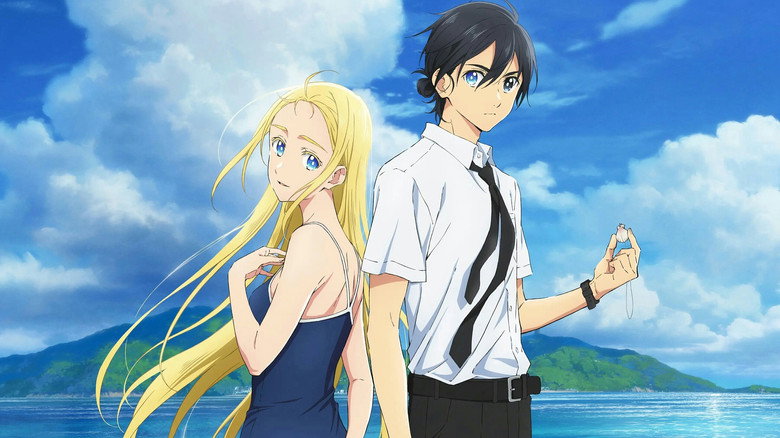
Summer Time Rendering is a 25-episode supernatural mystery and psychological action-thriller adapted by studio OLM from Yasuki Tanaka’s manga. The story begins with protagonist Shinpei Ajiro returning to his isolated island hometown of Hitogashima in Wakayama Prefecture after two years in Tokyo, having received news of the drowning death of his childhood friend and foster sister, Ushio Kofune. What initially appears to be a tragic marine accident quickly twists into a sinister homicide case when strangulation marks are discovered on Ushio’s neck, alongside rumors of a legendary local affliction known as the "Shadow Disease".

Upon investigating the island's secluded areas, Shinpei and Ushio’s younger sister, Mio, encounter doppelgängers that precisely copy the appearances, memories, and abilities of living islanders before executing and replacing them. Shinpei is abruptly murdered by one of these "Shadows," only to instantly awaken hours earlier on the passenger ferry approaching Hitogashima, retaining full memory of his demise.

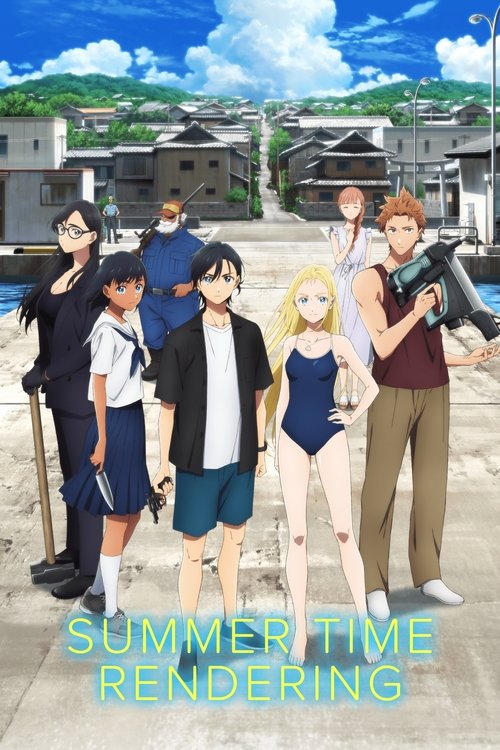
As Shinpei realizes he possesses the ability to rewind time each time he dies, he discovers the rules of his curse: every successive death loop resets to a point slightly later than the last, creating a rapidly shrinking window of opportunity. Banding together with a fractured coalition of islanders—including the stoic novelist Hizuru Minakata, huntsman Ginjiro Nezu, his childhood friend Sou Hishigata, and a rogue, sentient duplicate of Ushio—Shinpei must wage a high-stakes tactical war against ancient parasitic entities orchestrating a catastrophic ritual.
Core Meaning

At its core, Summer Time Rendering is an exploration of mortality, identity, grief, and the irreproducible worth of human life. Through the contrast between human beings and the immortal, copying "Shadows," the narrative examines what constitutes the genuine self—whether a consciousness made of cloned data and biological mimicry possesses a soul, or if authentic identity is forged solely through shared bonds, impermanence, and choice.

The creators emphasize that life derives its profound meaning from its finality. The antagonists' pursuit of twisted eternity and control over time is framed as an unnatural corruption of human nature, whereas genuine love and sacrifice lie in accepting loss, confronting harsh realities, and fighting to preserve the fragile, finite present.

Thematic DNA

Mortality, Impermanence & the Burden of Time Loops 30%
Identity, Doppelgängers & the "Soul" vs. Data Duplication 25%
Grief, Acceptance & Letting Go of Loved Ones 20%
Collective Trust vs. Paranoia and Isolation 15%
Folklore, Local Heritage & the Distorting Corruption of Myth 10%

Mortality, Impermanence & the Burden of Time Loops

Unlike traditional time-travel narratives with unlimited resets, the mechanism steadily moves the respawn point forward. Death carries genuine weight, forcing characters to treat every reset not as an expendable trial, but as a dwindling resource where mistakes become irreversible.

Identity, Doppelgängers & the "Soul" vs. Data Duplication

The Shadows replicate physical forms, DNA, memories, and personal habits. The series constantly tests characters and viewers on what makes an individual "real," culminating in Shadow Ushio’s heartbreaking struggle to exist as a true person despite being born from the very darkness threatening the island.

Grief, Acceptance & Letting Go of Loved Ones

Much of the catastrophe is rooted in characters' inability to process personal bereavement—from the overarching tragedy of Haine and Shide to the everyday sorrow of the Kofune and Hishigata families. The narrative shows that attempting to resurrect or freeze the dead inevitably breeds monstrosity.

Collective Trust vs. Paranoia and Isolation

Because Shadows can perfectly mimic loved ones, mistrust threatens to dismantle the human resistance from within. Victory is achieved only when characters share intelligence, establish verifiable proof of identity, and place absolute faith in each other.

Folklore, Local Heritage & the Distorting Corruption of Myth

Hitogashima’s folk religion surrounding the Hiruko deity conceals a parasitic extraterrestrial occurrence that was mythologized over three centuries. The series deconstructs how religious veneration can be manipulated to sustain systemic exploitation and cruelty.

Character Analysis

Shinpei Ajiro

Natsuki Hanae

Archetype: The Reluctant Strategist / Tragic Hero Key Trait: "Bird's-eye view" (objective spatial and strategic visualization under intense pressure)

Motivation

Uncover the truth behind Ushio’s death, protect Mio and the islanders, and break the cycle of time.

Character Arc

Shinpei begins as an emotionally detached, observant young man who fled to Tokyo to escape unresolved family grief. Forced into a recurring cycle of agonizing deaths, he transforms into a resolute, calculating commander who embraces sacrifice and steps beyond human temporal boundaries to save his loved ones.

Ushio Kofune / Shadow Ushio

Anna Nagase

Archetype: The Sacrificial Catalyst / Rebellious Doppelgänger Key Trait: Uncompromising emotional honesty, dynamic martial power, and biological hacking via her hair tentacles

Motivation

Protect Shinpei and Mio, reclaim her lost identity, and stop the mother Shadow Haine.

Character Arc

While human Ushio tragically dies before the series opens, Shadow Ushio emerges as a defective copy that retains the real Ushio's soul, conscience, and fierce loyalty. She evolves from a confused apparition into the vanguard of humanity's fight, ultimately rewriting history at the source.

All 4 characters and cast

Symbols & Motifs

The Mismatched Eyes (Heterochromia / Haine's Right Eye)

Meaning:

Symbolizes multidimensional perception, divine observation, and temporal control.

Context:

Shinpei inherits the blue right eye containing Haine’s power, turning perception itself into both a weapon and a curse.

The Summer Festival (Natsu Matsuri)

Meaning:

Represents the convergence of celebration, communal joy, and impending slaughter.

Context:

It serves as the narrative’s ticking clock and the focal point of the Shadows' grand ritual.

The Shadow / Silhouette

Meaning:

Represents the Jungian shadow, hidden repressed trauma, and existential replication.

Context:

Shadows must eliminate their source to fully ground their reality, embodying the fear of being superseded and forgotten.

The Camcorder and Cassette Recordings

Meaning:

Symbolizes preservation of truth and historical memory across loops.

Context:

Hizuru’s recordings and Ushio’s video messages bridge disconnected realities, proving that human connection transcends erased timelines.

The Cicadas and Blinding Sunlight

Meaning:

Contrasts serene, scorching countryside beauty with claustrophobic, violent horror.

Context:

Used throughout the series as an omnipresent acoustic and visual motif across the island.

Memorable Quotes

私を見つけて。
— Ushio Kofune

Context

Spoken to Shinpei in visions and audio logs throughout Episode 1 and multiple loops.

Meaning

The foundational mantra that serves as the emotional anchor guiding Shinpei across timelines to reunite with her.

伏瞰しょ。
— Shinpei Ajiro

Context

Shinpei's recurring internal monologue during high-pressure situations, prominently in Episodes 1 and 15.

Meaning

Shinpei’s psychological coping mechanism and tactical doctrine, allowing him to suppress panic, view life-or-death scenarios objectively, and calculate optimal moves against superior foes.

All 4 quotes

Episode Highlights

Goodbye Summer Days

S1E1

Sets the premise, introduces Hitogashima, establishes the mystery of Ushio’s death, and delivers the shocking twist where Shinpei and Mio are murdered.

Significance:

Triggers Shinpei's first time-loop reset and establishes the core supernatural mechanic of the series.

Maelstrom

S1E5

The climax of the first major timeline during the Summer Festival, where Haine and the Shadows massacre the entire island populace.

Significance:

Reveals the overwhelming power disparity between the humans and Shadows and the horrifying scale of the threat.

Bloody Night

S1E12

Shinpei consolidates his team (Hizuru, Nezu, Sou) for a pre-emptive strike, establishing coordinated counter-tactics against Shadow infiltrators.

Significance:

Cements the tactical transition of the show from passive survival to proactive warfare.

Lights, Camera, Action

S1E15

A pivotal psychological reset where Shinpei learns that Haine can mark him across loops and that his respawn checkpoint is shortening.

Significance:

Drastically raises the narrative stakes by proving that time resets are a limited, dwindling resource.

Eternal Night

S1E23

Depicts the assault on Tokoyo (the Realm of Shadows/Timeless Void).

Significance:

Lays bare Shide’s centuries-spanning master plan to collapse reality.

Summertime Re-Rendering

S1E24

The decisive battle where Shinpei and Shadow Ushio use the original god Hiruko's temporal power to defeat Shide.

Significance:

Allows the protagonists to travel back 300 years to eliminate the alien shadow origin entirely.

I'm Home

S1E25

Depicts the peaceful, restored timeline where the supernatural tragedy never occurred.

Significance:

Serves as the series finale, bringing Shinpei and the living Ushio back together on a sunny July 22nd.

Philosophical Questions

If a copy preserves every memory, emotion, and flaw of an individual, does it possess equal moral and existential worth as the original?

Explored through Shadow Ushio's fight for autonomy, conscience, and genuine personhood despite being an organism cloned from dark matter and data duplication.

Is immortality inherently self-destructive to the human psyche without the boundary of death giving value to experience?

Examined via the antagonist Shide, whose 300 years of cloned life and omnipotence lead to an utter detachment from empathy and an obsessive desire to witness cosmic extinction.

Does eliminating a tragedy’s origin justify the ontological erasure of memories and sacrifices forged throughout alternate timelines?

Reflected in the final timeline reset, where the historical suffering and heroic deaths of countless loops are unwritten to restore peace to Hitogashima.

Alternative Interpretations

The series can be analyzed through several distinct interpretive lenses:

Full ending explanation

Cultural Impact

Premiering in Spring 2022, Summer Time Rendering arrived during a renaissance of high-concept time-loop and psychological mystery anime. Despite universal critical praise for its pacing, airtight logic, and animation quality, the show’s initial international pop-culture footprint was heavily constrained by Disney+'s regional licensing strategy ("Disney Jail"), which delayed official Western streaming releases on Hulu until early 2023.

Once made globally accessible, the series earned strong word-of-mouth acclaim, being celebrated among anime critics and audiences as one of the most cohesive, tightly plotted mystery thrillers of the decade.

Audience Reception

Critics and viewers universally lauded the series for its airtight internal consistency, absence of narrative plot holes, high-octane battle animation by OLM, intelligent protagonists, and the satisfying finality of its ending.

Minor criticisms were directed at initial tonal whiplash caused by early fan-service tropes in episode 1, as well as the abrupt genre shift from slow-burn psychological horror in the first half to fast-paced shonen battle action in the second half. Overall, it is regarded as a modern masterclass in mystery pacing and time-travel storytelling that sticks its landing completely.

Interesting Facts

  • Unlike many ongoing manga adaptations, the anime was planned and produced as a continuous 2-cour, 25-episode full adaptation covering all 139 chapters of Yasuki Tanaka’s manga from start to finish.
  • Creator Yasuki Tanaka is a native of Wakayama Prefecture, and the production team placed heavy emphasis on linguistic accuracy, hiring dialect coaches and ensuring voice actors delivered authentic regional dialogue (Kishū-ben).
  • Hitogashima is directly modeled on Tomogashima, a cluster of deserted military-fortress islands in Wakayama Channel known for its red-brick ruins and dense maritime foliage.
  • Acclaimed director Ayumu Watanabe (Children of the Sea, Space Brothers) utilized cinematic storyboarding, realistic physics in action choreography, and intense atmospheric sound design to enhance tension.
  • The soundtrack was composed by MONACA’s Keiichi Okabe, Ryuichi Takada, and Keigo Hoashi (famed for their work on NieR: Automata), providing eerie choral chants and kinetic orchestral themes.

Easter Eggs

Nam June Paik's TV Buddha homage

In the climax, the villain Shide meditatively sits in front of a tower of CRT television monitors—a direct homage to video artist Nam June Paik’s famous 1974 installation TV Buddha, recontextualized as a villain contemplating cosmic nihilism.

Shinto Creation Mythology (Hiruko & Tokoyo)

The Shadow origin integrates the Japanese myth of Hiruko (the "leech child" born to Izanagi and Izanami who was abandoned at sea) and Tokoyo no Kuni (the mysterious eternal realm beyond the sea associated with the dead).

Yasuki Tanaka’s Shared Universe

The author’s subsequent works, including Summertime Rendering 2026: The Room that Dreams of Murder and the light novel Nagumo Ryuunosuke's 100 Views, explicitly tie into Hizuru Minakata’s supernatural investigations in Tokyo.

Frequently Asked Questions

Explore More About This Movie

Dive deeper into specific aspects of the movie with our detailed analysis pages

Comments (0)

Leave a comment

No comments yet. Be the first to share your thoughts!

Similar Movies