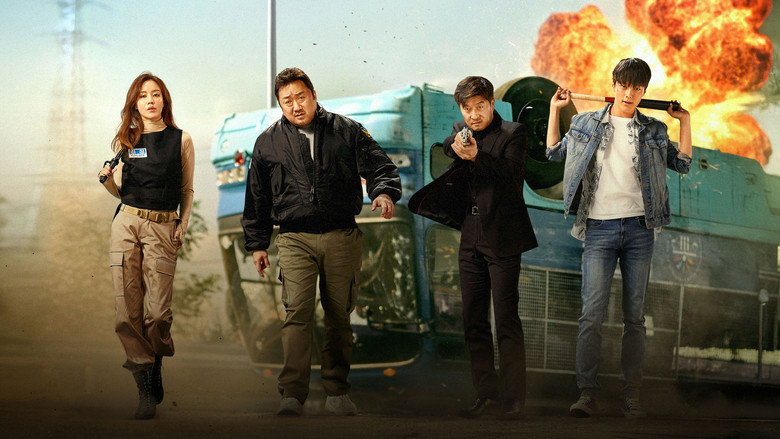
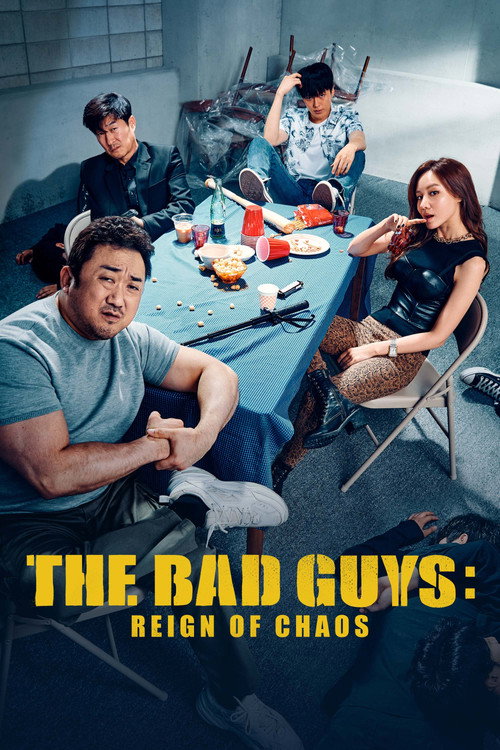
Full spoilers follow.
The setup. Park Woong-cheol is serving a 28-year sentence he accepted on behalf of a friend. During a prisoner transport, an ambush kills several police officers and frees a former gangster boss — crucially, a man who had agreed to testify against the real leader of his own organization. That detail is the hinge of the entire plot: the escape is not a jailbreak, it is a silencing operation dressed as one. Oh Goo-tak, the former head of the unorthodox special unit, is rehired to recapture the boss and the other escapees, and rebuilds his team from incarcerated talent.
The betrayal. The investigation's real obstacle turns out to be internal. A head officer aligned with the antagonist Yoshihara steals the diary containing the incriminating evidence and murders Sang-sik, the man connected to it, then attempts to eliminate the unit in a fire. They escape. This is the film's structural pivot: with the documentary route to prosecution destroyed and a fellow officer exposed as an asset of the enemy, the story abandons any pretense of procedure. From here the unit is not investigating — it is hunting.
The personal cost. Nam Myung-seok's death converts the assignment into a vendetta, particularly for Woong-cheol. What began as a sentence-reduction transaction becomes the one motivation the character has always operated on: a debt owed to someone he cared about. The film is quite deliberate about this equivalence — the 28 years he served for a friend and the beating he will deliver for a friend are the same act expressed in different currencies.
The climax. The team pinpoints Yoshihara's location at a factory and assaults the basement, working through his men. Woong-cheol reaches Yoshihara and administers punishment for Nam Myung-seok's death; Yoshihara and his associates are arrested. Reviewers found the finale ambitious in scale but short on invention, and structurally it is the film's thesis rendered literally — the descent beneath a legitimate industrial building to find the man who was never on any charge sheet.
The ending and what it means. Oh Goo-tak recovers from cancer and returns to duty. The unit's prison sentences are reduced, and Woong-cheol is hired for another assignment. Read straightforwardly, this is a happy ending: the sick mentor survives, the criminals are rewarded, the villain is in custody. Read again, it is more ambivalent. Nobody is freed — they are re-employed. The commuted sentences buy the state a standing extralegal unit rather than buying the men a life. The corruption that made the whole operation necessary is resolved at the level of one officer and one kingpin, leaving intact the structure that produced them. And the closing hire makes explicit what the premise implied all along: these people are useful precisely because they remain criminals, and the system has no incentive to let them stop being that.
The retrospective clarity. Once you know Yoshihara was always the name in the diary, the opening ambush reframes entirely — the "escape" was an execution order that missed, and every officer killed on that transport died protecting a witness whose testimony the film never lets be heard. Justice in Reign of Chaos arrives only in the one form the system cannot corrupt: in person, with fists.