Skip to content
The Bad Guys: Reign of Chaos
A bruising Korean crime-action ride where convicts wear the badge: fists land like sledgehammers, humor cracks through the grime, and justice arrives smelling of concrete dust and blood.
The Bad Guys: Reign of Chaos

The Bad Guys: Reign of Chaos

나쁜 녀석들: 더 무비

"Sometimes Justice Requires Force."

11 September 2019 South Korea 114 min 7.0 (174)

Director: Son Yong-ho

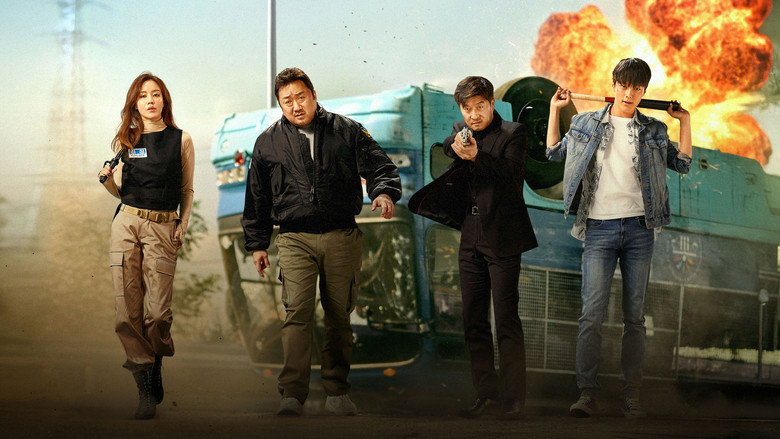
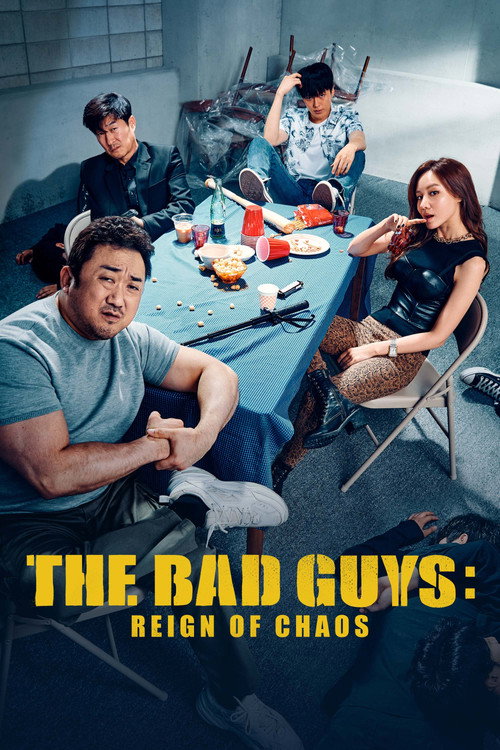
Cast: Don Lee, Kim Sang-joong, Kim A-joong, Jang Ki-yong, Park Hyo-joon

Crime Action Criminals as instruments of justice Loyalty and the debt you choose to carry Institutional rot and betrayal from within Redemption bought in sentence reductions Violence as spectacle and as language

Overview

Adapted from the 2014 OCN series Bad Guys, The Bad Guys: Reign of Chaos revives Korean cinema's dirtiest bargain: to catch monsters, you deputize monsters. Park Woong-cheol, a gangster serving a 28-year sentence he accepted to shield a friend, is pulled back into the light when a prisoner transport is ambushed, several officers are killed, and a former crime boss — a man who was about to testify against the real power behind his organization — vanishes into the city with a pack of escaped convicts.

To clean up the mess, the authorities reinstate Oh Goo-tak, the hard-nosed veteran who once ran an unorthodox special unit staffed by criminals. He reassembles a team of the very people the system locked away, adding new faces to the old roster, and sets them loose on a manhunt that leads from back alleys and holding cells toward a criminal network with reach far beyond Korea's borders.

Director Son Yong-ho keeps the machinery lean and loud: a chase, a brawl, a wisecrack, repeat. The pleasure is less in the mystery than in the physics — Don Lee's granite bulk, Kim Sang-joong's growling authority, and a supporting cast that turns each confrontation into a set piece. It is a film that knows exactly what it sells and delivers it with a straight face and a swinging fist.

Core Meaning

At its core the film argues that the line between criminal and enforcer is drawn by circumstance, not character. Every member of the unit is defined by loyalty, code, or debt — the same qualities the law claims for itself — and the story keeps asking why the state must borrow those qualities from people it has already condemned.

Son Yong-ho's message is blunt and populist: institutions are too compromised, too slow, or too corrupt to deliver justice, so justice becomes a physical act performed by men and women with nothing left to lose. Reign of Chaos doesn't romanticize crime; it romanticizes accountability — the idea that someone, anyone, should have to answer in person for what they did. When the system's own officers can be bought, the film's rough moral arithmetic is that a punch landed by the right person is more honest than a verdict handed down by the wrong institution.

Underneath the spectacle sits a quieter idea about redemption as service. Reduced sentences are the transaction, but what the characters actually pursue is the chance to be useful — to matter to someone other than a cellmate. The film's final beat, in which the work simply continues, suggests redemption here is not a destination but a job you keep showing up for.

Thematic DNA

Criminals as instruments of justice 30%
Loyalty and the debt you choose to carry 22%
Institutional rot and betrayal from within 20%
Redemption bought in sentence reductions 16%
Violence as spectacle and as language 12%

Criminals as instruments of justice

The central premise inverts the crime genre's usual moral hierarchy: the state's answer to organized crime is to hand weapons and authority to convicts. Oh Goo-tak assembles his unit not despite their records but because of them — they know the terrain, the codes, and the violence that police procedure can't touch. The film treats this bargain as pragmatic rather than scandalous, and the recruits' willingness to work with the badge becomes its own kind of moral statement.

Loyalty and the debt you choose to carry

Park Woong-cheol is in prison because he took the blame for a friend — 28 years accepted voluntarily. That single fact reframes every fight scene that follows: he is not a brute but a man who understands obligation better than the institutions around him. The unit's cohesion runs on the same currency, and the deaths of allies are what convert a job into a personal reckoning.

Institutional rot and betrayal from within

The manhunt is complicated less by the fugitives than by corruption on the inside — a senior officer working for the enemy, evidence destroyed, a witness silenced before he can testify. The escaped boss was going to name the real leader behind the organization, and everything that goes wrong flows from powerful people protecting that name. The film's villains are not only tattooed thugs but the respectable machinery that shields them.

Redemption bought in sentence reductions

Every member of the unit is working off time, which turns heroism into a transaction with a price tag. The film plays this for both comedy and pathos: characters bicker about their deals while risking deaths that no reduced sentence could compensate. By the end, commuted sentences and a new assignment suggest that for these people freedom and duty have become the same thing.

Violence as spectacle and as language

Critics repeatedly described the structure as action scene, a little talking, action scene, and that rhythm is the point. Character is expressed through physical style — Woong-cheol's immovable mass, the female recruit's capacity to charm a room and then win a hand-to-hand fight — while dialogue mostly supplies comic friction between the blows.

Character Analysis

Park Woong-cheol

Don Lee (Ma Dong-seok)

Archetype: Antihero / reluctant enforcer with a code Key Trait: Immovable physical presence paired with deadpan, unexpectedly warm humor

Motivation

Loyalty first, freedom second. He fights to settle debts owed to the people he considers his own, and the promise of a reduced sentence is a bonus rather than a cause.

Character Arc

Begins as an incarcerated gangster serving 28 years for a crime he took on for a friend, and is pulled back into service as the unit's blunt instrument. Reviewers singled out his tough-guy attitude and comedy scenes as the film's biggest strength — the arc runs from resigned muscle-for-hire to a man taking the mission personally after an ally is killed, culminating in his confrontation with the boss Yoshihara. The ending finds him not released into peace but recruited for the next job.

Oh Goo-tak

Kim Sang-joong

Archetype: Mentor / hard-boiled handler Key Trait: Growling, uncompromising authority over men who answer to no one else

Motivation

Closing the case that defines him, and protecting a method the establishment considers indefensible: that the right criminals, correctly aimed, are the best police force available.

Character Arc

The former boss of the unorthodox special unit, rehired to hunt down the escaped crime boss and the other fugitives. He carries the weight of the operation and of his own failing body — sources describe him recovering from cancer and returning to duty — so his arc is one of a man refusing to be retired by either bureaucracy or illness.

All 5 characters and cast

Symbols & Motifs

The prison transport bus

Meaning:

The film's opening rupture and its governing metaphor: the container the state uses to move dangerous men, breached from outside. It symbolizes the fragility of institutional control — the moment the vehicle is compromised, the entire premise of custody collapses and the story's chaos is released.

Context:

The ambush on the inmate transfer, in which several officers are killed and the former crime boss is freed, is the inciting incident that forces the disbanded unit back into existence.

The diary / ledger of names

Meaning:

Written evidence stands for the possibility of lawful justice — a world where the truth can be filed, entered, and used in court. Its theft signals that the paper route to accountability is closed, licensing the fists that follow.

Context:

A senior officer aligned with the antagonist steals the diary and kills the witness who held it, pushing the unit from investigation into direct assault.

The 28-year sentence

Meaning:

A number that functions as a character trait. It quantifies loyalty, turning an abstract virtue into something measurable and costly, and it is the film's shorthand for the injustice built into the system the unit now serves.

Context:

Established as Park Woong-cheol's backstory: time served for a crime he shouldered on a friend's behalf, hanging over every negotiation about reduced sentences.

The basement and the factory

Meaning:

The descent into an underground space literalizes the journey beneath legitimate society, where the real hierarchy lives. Industrial architecture — concrete, machinery, dead space — frames crime as an enterprise rather than an aberration.

Context:

The climax takes the unit to the antagonist Yoshihara's factory, where they assault the basement to reach him.

Fire

Meaning:

Purification and erasure at once: the enemy burns evidence and witnesses, but the team walks out of the flames, marking the point where they stop being employees and become avengers.

Context:

The unit escapes a fire set after the witness's murder — a survival that resets the mission on personal terms.

The badge lent to the unbadged

Meaning:

Temporary authority granted to permanent outsiders. It represents the state outsourcing its own violence and, more cynically, its ability to withdraw legitimacy the moment the job is done.

Context:

Oh Goo-tak's rehiring and the reassembly of the special unit; reinforced at the end when Woong-cheol is engaged for yet another assignment.

Philosophical Questions

Can a just outcome be produced by unjust means?

The entire premise is a utilitarian wager: release violent men to stop worse men. The film stacks the deck in favor of yes — the unit's targets are unambiguously monstrous, and the corrupt officer proves that lawful channels have already failed. But it never shows the cost side of the ledger, and that omission is itself an answer worth interrogating.

Is loyalty a virtue when it is owed to the wrong people?

Park Woong-cheol lost 28 years honoring a bond to a friend. The film celebrates this as proof of his worth, yet it also means the finest thing about him is what destroyed his life. The story quietly proposes that the capacity for loyalty is transferable — that a man who kept faith with a criminal will keep faith with a unit — without ever asking whether he should have kept faith at all.

Who has the right to punish?

When the diary is stolen and the witness killed, the film closes off adjudication and opens retribution. Woong-cheol's beating of Yoshihara is framed as payment for a fallen ally, not as law enforcement, yet the state pockets the result: arrests are made, sentences are reduced. The film lets both authorities coexist without reconciling them.

Is redemption something you earn, or something you are permitted?

Every character's moral progress is measured in months struck off a sentence — redemption administered as an incentive scheme. The ending, in which the reward for good service is more service, suggests the permission never fully arrives, and that the men remain useful precisely because they are never quite forgiven.

Alternative Interpretations

Reading one — populist fantasy of accountability. The most sympathetic interpretation treats the film as wish fulfilment for audiences exhausted by institutional impunity. When the police contain a traitor and the real boss hides behind respectability, the fantasy of a convict who can simply walk into the basement and hit the untouchable man becomes a form of catharsis. The reduced sentences at the end are then not corruption but a small correction of who the system has been punishing.

Full ending explanation

Cultural Impact

The Bad Guys: Reign of Chaos arrived at a peak moment for two Korean industry trends: the migration of successful cable drama IP to the multiplex, and the emergence of Don Lee (Ma Dong-seok) as a bankable one-man action genre. Built from the 2014 OCN series Bad Guys on a ₩8.1 billion budget, it proved the model commercially, topping the box office over the Chuseok holiday, crossing 1 million admissions in three days and 2 million faster than any previous Korean Chuseok release, before finishing above 4.5 million admissions and roughly US$22.3 million worldwide.

Its reception also placed it inside a wider conversation about how Korean action films frame their villains. Critics noted that the film effectively pits Korean cops and gangsters against Japan, with a Japanese-linked criminal power at the top of the pyramid — a choice that read differently in 2019, a year of unusually raw Korea–Japan public tension, than it might have in another season. Whether one reads that as commercial instinct or cultural temperature-taking, it gave the film a nationalist charge its plot mechanics never explicitly argue.

Artistically its influence is modest; the film has not been treated as a landmark so much as a well-executed unit of a formula. Its lasting significance is industrial: it reinforced the viability of drama-to-film spin-offs, extended the Korean tradition of institutionally-sanctioned outlaws (a lineage running through Veteran, The Outlaws and the wider gangster-cop cycle), and confirmed that a Don Lee fist connecting with a jaw is, by itself, a marketable event.

Audience Reception

Commercially, a hit. Audiences turned out in force over Chuseok 2019: number one at the box office, 1 million admissions in three days, about 2.49 million within a week and roughly 4.56 million by the end of its run. Whatever critics thought, the public verdict was decisive.

What was praised. Almost universally, Don Lee: reviewers credited his tough-guy presence and comic timing as the film's biggest strength, with the fight choreography and the sheer physical impact of his scenes close behind. The humor was described as charmingly awkward and pleasantly entertaining, and the ensemble chemistry — including Kim A-joong's shift from seductive manipulation to credible hand-to-hand combat — was welcomed as a genuine addition rather than decoration. The pacing, fast and unpretentious, was frequently listed as a virtue.

What was criticized. The screenplay. Critics repeatedly flagged little to no story development, little to no investigation and no suspense, reducing the film to an alternation of action beats and short talking scenes. The plot was called simple and predictable, some sequences clumsy, and the climax — despite its ambition — was judged to lack the creativity needed to be memorable. On IMDb it sits at a middling 6.2, which captures the split neatly.

Points of contention. Two recur. First, the value of adapting the OCN drama at all: viewers who knew the series debated whether the film deepened the characters or merely gave them a bigger budget. Second, the decision to make the apex villain part of a Japanese criminal network, which some read as standard genre geography and others as pointed given the political climate of 2019.

Overall verdict. A crowd-pleaser that delivers exactly what its poster promises and nothing more — enthusiastically recommended to viewers who want Don Lee dismantling a room, and easily skipped by anyone hoping for a crime story with a mystery inside it.

Interesting Facts

  • The film is a spin-off adaptation of the 2014 OCN television series Bad Guys, expanding the show's premise of a detective recruiting criminals into a special crime unit.
  • Don Lee (Ma Dong-seok) and Kim Sang-joong reprise their roles from the original series, while Kim A-joong and Jang Ki-yong were brought in as new characters created for the film.
  • Principal photography began on 10 September 2018 and wrapped on 11 January 2019.
  • The production budget was reported at ₩8.1 billion.
  • The film was released for the Chuseok holiday period in September 2019 and topped the South Korean box office.
  • It passed 1 million admissions in just three days of release.
  • By 14 September 2019 it had recorded roughly 2.49 million admissions, making it the fastest Korean film released during a Chuseok holiday to reach the 2 million mark at that time.
  • Its final domestic run reached 4,561,520 admissions and about ₩39.48 billion in gross, with worldwide takings reported around US$22.3 million.
  • It holds a 6.2 user rating on IMDb, where it is also listed under the title The Bad Guys: The Movie.
  • Reviewers noted the film's structure as essentially alternating action set pieces with short comic dialogue scenes, with little conventional investigation or suspense in between.

Easter Eggs

Returning cast from the OCN drama

Don Lee's Park Woong-cheol and Kim Sang-joong's Oh Goo-tak are carried directly over from the 2014 series Bad Guys, so their history together is treated as pre-existing rather than explained. For viewers of the show, the reassembly of the unit works as a reunion payoff; for newcomers it plays as efficient shorthand.

The 28-year sentence taken for a friend

Woong-cheol's backstory is a callback to the code-of-honor gangster tradition in Korean crime cinema, where taking the fall for a brother is the ultimate proof of character. It quietly justifies the audience's sympathy for a convicted criminal before he throws his first punch.

The closing hire for another assignment

Rather than freeing its hero, the ending has Woong-cheol taken on for a new job — a franchise hook signalling that the unit is a renewable resource. It also mirrors the drama's episodic structure, implying the story simply resets rather than concludes.

Frequently Asked Questions

Explore More About This Movie

Dive deeper into specific aspects of the movie with our detailed analysis pages

Comments (0)

Leave a comment

No comments yet. Be the first to share your thoughts!

Similar Movies