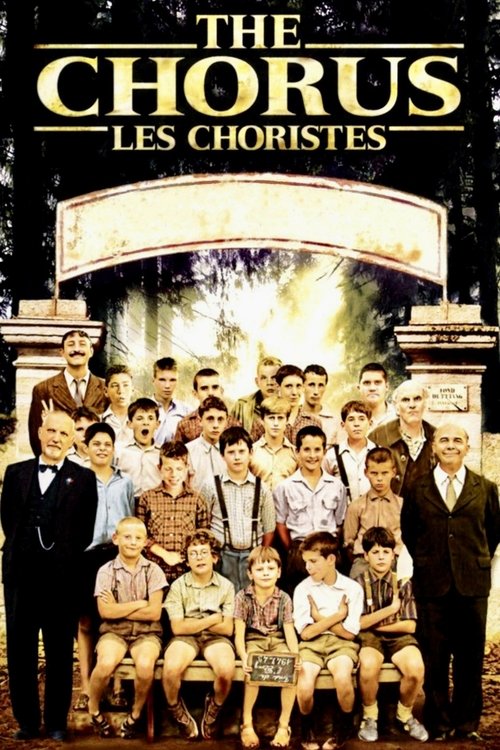
The Chorus
Les Choristes
Overview
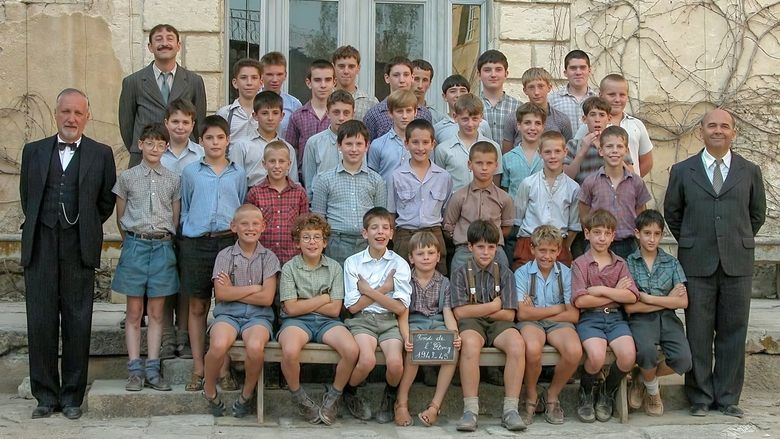
In 1949 France, Clément Mathieu, an unemployed musician, accepts a position as a supervisor at Fond de l'Étang ('Bottom of the Pond'), a gloomy boarding school for troubled boys. The school is run by the authoritarian headmaster Rachin, who strictly enforces a brutal policy of 'Action – Reaction,' punishing students severely for any infraction. Mathieu, shocked by the harsh treatment and the boys' unruly behavior, decides to hide his true identity as a composer but secretly begins to teach the students to sing, forming a choir.
As the choir develops, the school's atmosphere begins to transform. Mathieu discovers a prodigious talent in Pierre Morhange, a rebellious boy with an 'angel's face but the devil's spirit.' While cultivating Morhange's gift and protecting the fragile orphan Pépinot, Mathieu clashes with Rachin's cruel methods. The music brings hope and discipline to the students, challenging the school's oppressive system and changing the lives of everyone involved, even as tragedy strikes with the arrival of a vicious student named Mondain.

Core Meaning
The Chorus serves as a testament to the transformative power of art and human connection. Its core message is that dignity, encouragement, and creative expression are far more effective educational tools than fear and punishment. The film illustrates that no child is truly 'lost' or 'hopeless'—they only need a guide to help them find their voice. It ultimately posits that success is not defined by fame or fortune, but by the quiet, positive impact one has on the lives of others.
Thematic DNA
Action vs. Compassion (Education)
The film contrasts Rachin's brutal 'Action – Reaction' policy, which breeds resentment and rebellion, with Mathieu's approach of empathy and creative engagement. It demonstrates that kindness often yields better disciplinary results than corporal punishment.
The Transformative Power of Music
Music is not just a hobby but a savior for the boys. It provides them with structure, beauty, and a collective goal. For characters like Morhange, it offers a literal escape from poverty and a future path; for the group, it offers a momentary escape from their bleak reality.
Redemption and Second Chances
Mathieu sees himself as a 'failed musician' and the boys are seen by society as 'lost causes.' The choir offers redemption for both: Mathieu finds purpose and his music finally comes alive, while the boys prove they are capable of beauty and discipline.
Childhood Innocence vs. Institutional Cruelty
The film highlights the fragility of childhood. The cold, grey walls of the school symbolize the crushing weight of institutional neglect, which threatens to extinguish the boys' innocence until Mathieu's intervention provides a shield.
Character Analysis
Clément Mathieu
Gérard Jugnot
Motivation
To survive his new job; later, to instill hope in the boys through music and to protect them from Rachin's cruelty.
Character Arc
Starts as a timid, 'failed' musician taking a job he hates. He gains confidence through teaching and eventually defies authority to protect his students. He leaves the school unemployed but spiritually fulfilled, having saved Pepinot.
Pierre Morhange
Jean-Baptiste Maunier
Motivation
To express his repressed emotions and win the approval of his mother and Mathieu (though he hides it).
Character Arc
Initially distant, sullen, and a troublemaker who refuses to sing. Under Mathieu's guidance, he discovers his gift, learns discipline, and eventually becomes a world-famous conductor.
Rachin
François Berléand
Motivation
To maintain order through fear and to advance his own career at the expense of the children.
Character Arc
Static villain. He seeks career advancement and control. He briefly softens when the choir brings the school fame, but quickly reverts to cruelty when things go wrong, leading to his eventual firing.
Pépinot
Maxence Perrin
Motivation
Waiting for his father to come pick him up on Saturday.
Character Arc
The youngest boy who refuses to believe his parents are dead, waiting every Saturday at the gate. In the end, his wish comes true in an unexpected way when Mathieu takes him away.
Symbols & Motifs
Paper Airplanes
They represent freedom, flight, and communication across barriers. In the final scene, they symbolize the boys' voiceless gratitude and their spirit escaping the school's walls.
The boys are forbidden from saying goodbye to Mathieu when he is fired. Instead, they launch paper planes with messages from the window, creating a 'rain' of farewells that Rachin cannot stop.
Fond de l'Étang (Bottom of the Pond)
The name of the school symbolizes 'hitting rock bottom.' It represents the social status of the children (orphans, delinquents) and Mathieu's own career low point before his ascent.
The sign is shown prominently at the gates, setting the grim tone immediately. It is a place where society deposits those it wishes to forget.
The Diary
Represents the legacy of a 'forgotten' man. It proves that Mathieu's life had meaning and history, even if he died famous only to his students.
The film is framed by the adult Pépinot giving Mathieu's diary to the adult Morhange, unlocking the narrative of the past.
Violette Morhange
She represents an idealized, unattainable love and the maternal warmth lacking in the school. For Mathieu, she is a muse but also a reminder of his own limitations/loneliness.
Mathieu falls for her while discussing her son Pierre, but she only sees him as a kind teacher, eventually marrying an engineer.
Memorable Quotes
Action - Réaction.
— Rachin
Context:
Repeated throughout the film whenever Rachin punishes a student or orders them to the dungeon.
Meaning:
The school's motto and Rachin's philosophy: every misbehavior must be met with immediate, disproportionate physical punishment. It symbolizes the cycle of violence Mathieu tries to break.
Vois sur ton chemin, gamins oubliés égarés. (See upon your path, forgotten, lost children.)
— The Choir (Lyrics)
Context:
Sung during the main theme song performance, becoming the anthem of the film.
Meaning:
The lyrics summarize the film's theme: acknowledging the forgotten children and guiding them toward a better tomorrow.
Monsieur Mathieu! Monsieur Mathieu! Take me with you!
— Pépinot
Context:
The final scene where Mathieu is boarding the bus and Pépinot runs after him, insisting on coming along because it is Saturday.
Meaning:
The moment of ultimate rescue. It signifies that Mathieu is not leaving empty-handed; he has saved a life.
Ne jamais dire jamais. Il y a toujours quelque chose à tenter. (Never say never. There is always something to attempt.)
— Clément Mathieu
Context:
Written in his diary/voiceover when reflecting on the hopeless situation at the school.
Meaning:
Reflects Mathieu's persistent optimism despite his self-proclaimed failure. He refuses to give up on the boys.
Philosophical Questions
Is fear or encouragement more effective in education?
The film sets up a dialectic between Rachin's 'Action-Reaction' (behaviorism/punishment) and Mathieu's humanism. The film clearly sides with Mathieu, showing that while fear suppresses behavior temporarily, art and respect transform character permanently.
What constitutes a meaningful life?
Mathieu dies unknown to the public, yet his influence is profound. The film questions the modern obsession with celebrity (represented by adult Morhange's fame) vs. the quiet virtue of service (Mathieu's anonymity).
Alternative Interpretations
The 'Successful Failure' Theory: While Mathieu describes himself as a failure in his diary because he never achieved fame as a composer, the film argues he is the ultimate success. He composed the music that launched a world-famous conductor's career (Morhange) and saved an orphan (Pépinot). His success is not in what he became, but who he helped.
The Unreliable Narrator: The story is told through the reading of a diary by two nostalgic old men. Critics have noted the film's sepia-toned, overly sentimental view might be a result of this memory-filtering, presenting a 'fable' version of the past rather than a gritty realistic one.
Cultural Impact
The Chorus was a cultural phenomenon in France (2004), becoming one of the highest-grossing French films of all time. It sparked a nationwide 'choral boom,' with music schools reporting a massive surge in choir enrollments. Internationally, it was embraced for its heart and nostalgia, receiving two Academy Award nominations (Best Foreign Language Film and Best Original Song). The soundtrack by Bruno Coulais became a best-seller. It is often cited as a definitive 'teacher' movie alongside Dead Poets Society, proving that French cinema could succeed globally with traditional, humanist storytelling.
Audience Reception
Praised: Audiences universally loved the emotional warmth, the angelic music, and the 'feel-good' ending. Jean-Baptiste Maunier's voice and Gérard Jugnot's understated performance were highlights. It is considered a tear-jerker in the best sense.
Criticized: Some critics found it 'saccharine,' 'manipulative,' or 'predictable,' noting it follows the standard Hollywood formula of an inspirational teacher saving at-risk youth without adding narrative complexity. However, the general public largely ignored these critiques.
Interesting Facts
- The film is a remake of the 1945 French film 'La Cage aux rossignols' (A Cage of Nightingales).
- Jean-Baptiste Maunier (Morhange) was a real soloist in the choir 'Les Petits Chanteurs de Saint-Marc' and did his own singing in the movie.
- Most of the other children were not professional actors but were selected from schools in the region of Auvergne where filming took place.
- Gérard Jugnot (Mathieu) mortgaged his Paris apartment to help finance the film because producers were skeptical about a period drama with no sex or violence.
- The film was a massive box office phenomenon in France, selling over 8.5 million tickets and revitalizing interest in choir singing across the country.
- The song 'Vois sur ton chemin' was nominated for an Academy Award for Best Original Song.
- Maxence Perrin, who played the adorable Pépinot, is the son of Jacques Perrin, the actor who played the adult Morhange and produced the film.
Easter Eggs
Jacques Perrin's Cameo
Jacques Perrin, who plays the adult Morhange in the frame story, also produced the film. He is a legendary French actor, known for Cinema Paradiso.
Reference to 1945 Original
The plot structure and character names (Mathieu, Rachin) are direct tributes to La Cage aux rossignols (1945), acknowledging its cinematic ancestor.
⚠️ Spoiler Analysis
Click to reveal detailed analysis with spoilers
Frequently Asked Questions
Explore More About This Movie
Dive deeper into specific aspects of the movie with our detailed analysis pages
Comments (0)
No comments yet. Be the first to share your thoughts!