Nothing Left to Do But Cry
A whimsical, improvised journey through time where modern neuroses clash with Renaissance realities. Laughter meets melancholy in a rustic, surreal exploration of friendship and destiny.
Nothing Left to Do But Cry

Nothing Left to Do But Cry

Non ci resta che piangere

20 December 1984 Italy 112 min ⭐ 7.7 (1,177)
Director: Massimo Troisi Roberto Benigni
Cast: Massimo Troisi, Roberto Benigni, Amanda Sandrelli, Iris Peynado, Carlo Monni
Fantasy Comedy
The Clash of Eras Friendship and Duality The Futility of Control Language and Communication

Overview

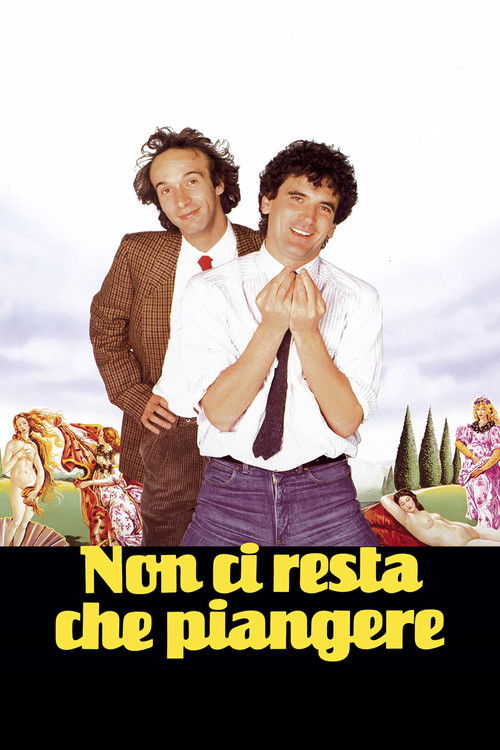
Nothing Left to Do But Cry (Non ci resta che piangere) follows the misadventures of Saverio (Roberto Benigni), a high-strung intellectual teacher, and Mario (Massimo Troisi), a shy and romantic school janitor. While driving through the Tuscan countryside, they get stuck at a railroad crossing and seek shelter from a storm in an old inn. Upon waking, they discover they have been mysteriously transported back in time to the year 1492, specifically to the fictional village of Frittole.

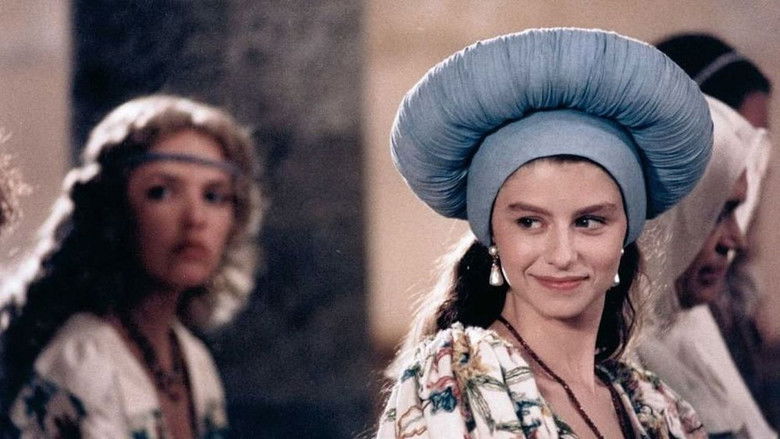
Trapped in the 15th century, the duo struggles to adapt to the era's customs, hygiene, and dangers. While Mario focuses on wooing a local girl named Pia, Saverio becomes obsessed with the political implications of the year 1492. He convinces a reluctant Mario to travel to Spain to stop Christopher Columbus from discovering America, hoping to spare his sister from a future heartbreak caused by an American lover. Their journey is filled with absurd encounters, including a meeting with Leonardo da Vinci and a run-in with the austere preacher Savonarola.
Core Meaning

At its heart, the film is a celebration of improvisation and friendship. It deconstructs the solemnity of history by viewing it through the eyes of two confused, neurotic 20th-century Italians who are utterly ill-equipped to be heroes. The film suggests that modern knowledge is useless without practical application and that destiny is a force that cannot easily be rewritten, no matter how hard one tries to intervene.

Thematic DNA

The Clash of Eras 30%
Friendship and Duality 30%
The Futility of Control 20%
Language and Communication 20%

The Clash of Eras

The film humorously contrasts modern sensibilities with medieval realities. Saverio and Mario try to explain concepts like thermometers, trains, and democracy to confused peasants and a bewildered Leonardo da Vinci, highlighting the absurdity of both the past and the present.

Friendship and Duality

The core dynamic is the chemistry between the aggressive, proactive Saverio and the passive, reactive Mario. Their bickering and mutual reliance drive the narrative, symbolizing two different ways of facing the unknown: intellectualizing it or emotionally enduring it.

The Futility of Control

Saverio's grand plan to stop Columbus represents the human desire to control fate. Their failure to change history—and the ironic twist that their interference only leads to Leonardo inventing the train early—underscores the idea that the river of time cannot be easily dammed.

Language and Communication

The film relies heavily on linguistic comedy, from the famous letter to Savonarola to the repetitive bureaucratic questions at the customs post. It satirizes how language can be both a bridge and a barrier.

Character Analysis

Saverio

Roberto Benigni

Archetype: The Manic Planner
Key Trait: Neurotic Energy

Motivation

To change history for personal reasons (saving his sister from an American boyfriend) and to assert modern dominance over the past.

Character Arc

Saverio starts as a frustrated intellectual and becomes the driving force of their historical interference. He moves from confusion to a messianic determination to stop Columbus, only to be thwarted by the immutability of history.

Mario

Massimo Troisi

Archetype: The Reluctant Dreamer
Key Trait: Melancholy Charm

Motivation

To find love and comfort, and eventually to just go home.

Character Arc

Mario is dragged along by Saverio but remains focused on immediate, personal needs like love and safety. His arc is one of romantic pursuit, culminating in his awkward courtship of Pia.

Leonardo da Vinci

Paolo Bonacelli

Archetype: The Deconstructed Genius
Key Trait: Bemused Curiosity

Motivation

To understand the strange concepts Saverio and Mario are trying to explain.

Character Arc

Presented not as a god-like intellect but as a slightly slow, curious man who struggles to understand the duo's frantic explanations of modern technology, eventually 'inventing' the train based on their ramblings.

Symbols & Motifs

The Train

Meaning:

It symbolizes the border between the modern world and the past. Initially, it is the barrier that traps them; in the end, it returns as a 'false hope' of salvation.

Context:

The film begins with them waiting for a train that never passes, and ends with them seeing a steam locomotive driven by Leonardo da Vinci.

The Florin

Meaning:

A symbol of senseless bureaucracy and the arbitrary nature of power.

Context:

In the iconic customs scene, the guard repeatedly asks 'Who are you? What do you bring? One florin!' regardless of their answers.

The Letter

Meaning:

A vehicle for their fears and a futile attempt to negotiate with authority (Savonarola).

Context:

The duo composes a chaotic, obsequious letter to Savonarola seeking mercy, directly referencing a similar scene in the classic film Totò, Peppino e la malafemmina.

Memorable Quotes

Ricordati che devi morire!

— Passerby / Mario

Context:

A gloomy preacher shouts this at Mario from a window. Mario replies: 'Sì, sì... no... mo' me lo segno' (Yeah, yeah... no... I'll write it down now).

Meaning:

A memento mori turned into a comic refusal of religious guilt. It satirizes the heavy religious atmosphere of the era.

Chi siete? Cosa portate? Sì, ma quanti siete? Un fiorino!

— Customs Guard

Context:

Every time Mario and Saverio try to cross the border, the guard asks the exact same questions and demands payment, even if they just stepped back for a second.

Meaning:

The ultimate expression of bureaucratic absurdity and repetition.

Santissimo Savonarola, quanto ci piaci a noi due!

— Mario and Saverio

Context:

Sitting at a table, trying to write a letter to the friar to beg for freedom for their friend Vitellozzo.

Meaning:

The opening line of their letter. It highlights their cowardly attempt to flatter a tyrant using clumsy language.

Philosophical Questions

Can we change our destiny?

The film explores the 'Grandfather Paradox' through comedy. Saverio's obsession with stopping Columbus fails, suggesting that history has a self-correcting momentum that individual agency cannot easily derail.

What is the value of modern knowledge?

Mario and Saverio know about electricity, trains, and the Beatles, but without the infrastructure or specific technical skills to reproduce them, this knowledge is useless. It questions the arrogance of modern man feeling superior to the past.

Alternative Interpretations

Some critics view the film as a metaphor for the political stagnation of Italy in the 80s: two men trapped in an immutable past, unable to move forward or effect change despite their knowledge. The ending, where Leonardo invents the locomotive but they remain stuck, can be seen as a commentary on how technological progress does not necessarily equate to social escape or personal freedom. Additionally, the ambiguity of how they time-traveled suggests the entire experience might be a shared purgatorial dream or a fable about the timeless nature of the Italian character.

Cultural Impact

Nothing Left to Do But Cry holds a legendary status in Italy, comparable to Monty Python films in the UK. Released during a golden era of Italian comedy, it solidified Benigni and Troisi as cultural icons. The film's lines (especially 'Un fiorino!') have entered the daily Italian lexicon. It represents a shift from the politically charged 'Commedia all'italiana' of the 70s to a more surreal, personal, and whimsical style of comedy. While less famous internationally than Life is Beautiful or Il Postino, it remains a beloved touchstone for Italian millennials and Gen X.

Audience Reception

The film is universally adored in Italy, holding a high score on local review sites. Audiences praise the chemistry between Benigni and Troisi, citing it as a 'perfect storm' of comedic talent. The 'Customs Scene' and the 'Letter Scene' are frequently cited as some of the funniest moments in Italian cinema history. Criticism is rare but usually focuses on the thin plot and the somewhat abrupt, nonsensical ending, though fans argue this chaotic structure is part of its charm.

Interesting Facts

  • The film had no completed script during production; much of the dialogue was improvised based on a loose 'canovaccio'.
  • The title 'Non ci resta che piangere' (Nothing left to do but cry) is a reference to a poem by Petrarch, chosen by Massimo Troisi.
  • Despite being set in Tuscany, the film was primarily shot in the Lazio region, including locations like the Castello di Rota and the muddy streets of Caprarola.
  • It was the highest-grossing film in Italy for the 1984-1985 season.
  • There are three versions of the film: the theatrical release, a longer television cut, and a DVD extended edition with a different sub-plot involving a character named Astriaha.
  • This is the only time Roberto Benigni and Massimo Troisi, two giants of Italian comedy, starred in a film together.
  • Amanda Sandrelli, who plays Pia, is the daughter of famous actress Stefania Sandrelli and singer Gino Paoli.

Easter Eggs

The Letter Scene

The scene where they write to Savonarola is a direct homage to the famous letter-writing scene in the 1956 film Totò, Peppino e la malafemmina, honoring the legacy of Italian comedy duos.

Yesterday

Mario tries to impress Pia by singing 'Yesterday' by The Beatles, claiming he wrote it. This predates the film Yesterday (2019) by decades as a joke about plagiarism in time travel.

⚠️ Spoiler Analysis

Click to reveal detailed analysis with spoilers

Frequently Asked Questions

Explore More About This Movie

Dive deeper into specific aspects of the movie with our detailed analysis pages

Comments (0)

Leave a comment

No comments yet. Be the first to share your thoughts!