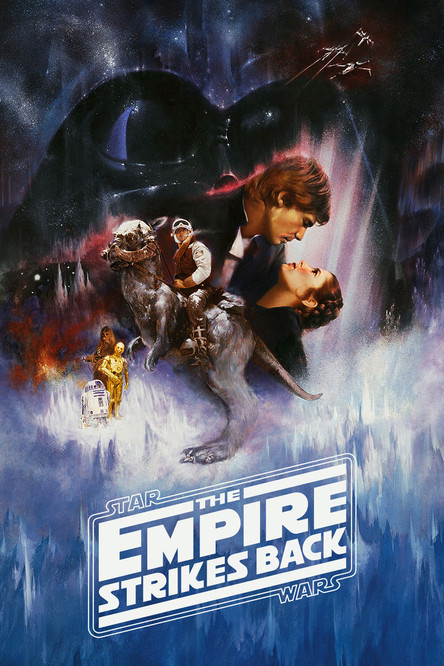
The Empire Strikes Back
"The Star Wars saga continues."
Overview
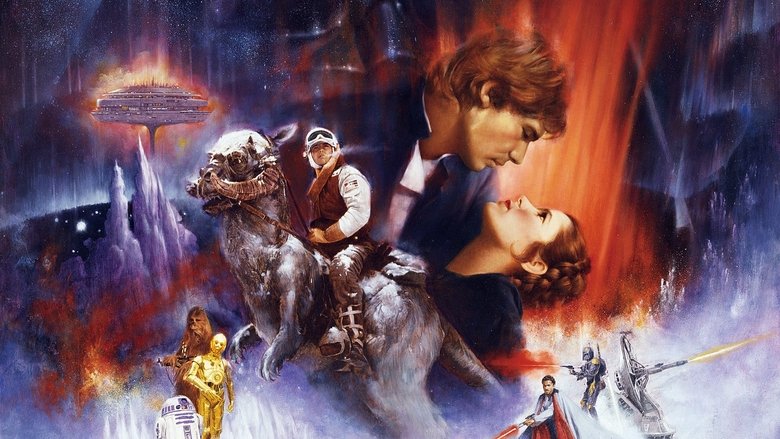
Three years after the destruction of the Death Star, the Rebel Alliance faces a relentless pursuit from the Galactic Empire, led by the formidable Darth Vader. Forced to abandon their secret base on the ice planet Hoth, the heroes are scattered across the galaxy. While Han Solo, Princess Leia, Chewbacca, and C-3PO flee in the Millennium Falcon, navigating treacherous asteroid fields and seeking refuge in the seemingly idyllic Cloud City, Luke Skywalker follows a different path.
Guided by the spirit of Obi-Wan Kenobi, Luke travels to the swampy planet of Dagobah to be trained in the ways of the Force by the ancient and powerful Jedi Master, Yoda. As Luke delves deeper into his Jedi training, he must confront his own fears and impatience. Meanwhile, his friends find themselves ensnared in a trap laid by Darth Vader, who is determined to capture Luke. The film culminates in a series of dramatic confrontations that test the loyalties and resolve of all the characters, leading to a shocking revelation that will forever alter the course of the saga.
Core Meaning
"The Empire Strikes Back" delves into the complexities of good versus evil, suggesting that the line between them is not always clear. The film posits that the potential for both light and darkness exists within everyone, a concept symbolically represented when Luke sees his own face inside Darth Vader's helmet during a vision. It is a story about maturation and the painful trials one must endure to grow. The director, Irvin Kershner, wanted to explore the idea that in the face of overwhelming despair, true character is forged. The film's core message is one of perseverance and hope, even in the darkest of times, emphasizing that victory is not always immediate or easy, and that setbacks are an integral part of the journey to ultimate triumph.
Thematic DNA
Good vs. Evil
The film moves beyond a simplistic portrayal of good versus evil, exploring the internal struggles of its characters. Luke Skywalker's training with Yoda forces him to confront the anger and fear within himself, warning him of the seductive nature of the dark side of the Force. This internal conflict is externalized in his climactic duel with Darth Vader, who himself represents the ultimate corruption of a once-good Jedi. The revelation of Vader's true identity further complicates this theme, suggesting that the capacity for good and evil can coexist within the same bloodline.
The Hero's Journey and Failure
Luke Skywalker's journey in this film is a crucial, and often painful, part of his development as a hero. He seeks out a mentor in Yoda, undergoes rigorous training, and faces trials that test his physical and spiritual strength. A significant aspect of this theme in "The Empire Strikes Back" is the exploration of failure. Luke's decision to prematurely end his training to save his friends, despite Yoda's warnings, leads to a devastating defeat. This experience teaches him a crucial lesson about patience, control, and the consequences of his actions, which are vital for his growth as a Jedi.
Fate vs. Free Will
The film constantly questions whether the characters' paths are predetermined or if they have the power to choose their own destinies. The prophecy of the "son of Skywalker" looms large over Luke, with both the Emperor and Yoda seeing him as a pivotal figure in the galaxy's future. However, Luke's choices, such as his decision to confront Vader against his mentors' advice, demonstrate his struggle to assert his own will. The tension between his perceived destiny and his personal choices is a central conflict of the narrative.
Friendship and Loyalty
The bonds of friendship and loyalty are tested throughout the film. Han Solo's initial desire to leave the Rebellion to settle his debts is overshadowed by his loyalty to his friends, particularly his developing feelings for Leia. The betrayal by Lando Calrissian, who is forced to choose between his friendship with Han and the safety of his city, highlights the difficult moral choices that characters must make. Ultimately, it is the unwavering loyalty of his friends that leads to Luke's rescue after his confrontation with Vader.
Character Analysis
Luke Skywalker
Mark Hamill
Motivation
Luke's primary motivation is to become a Jedi Knight and defeat the Galactic Empire. He is also driven by a strong sense of loyalty to his friends, which leads him to cut his training short to rescue them from Darth Vader's clutches.
Character Arc
Luke begins the film as an aspiring Jedi, eager to learn but impatient. His journey to Dagobah to train with Yoda is a humbling experience, forcing him to confront his own weaknesses. He evolves from a naive farm boy into a more mature, yet still impulsive, individual who must grapple with the immense weight of his lineage and the choices he must make. His defeat at the hands of Darth Vader is a crucial turning point in his development.
Han Solo
Harrison Ford
Motivation
Initially, Han is motivated by self-preservation and financial gain. However, as the story progresses, his motivation shifts to protecting Princess Leia and helping his friends in the Rebel Alliance.
Character Arc
Han Solo starts as a cynical smuggler looking to pay off his debts. Throughout the film, his love for Princess Leia and his loyalty to the Rebellion grow, pulling him deeper into their cause. His character arc is one of transformation from a self-serving individual to a committed member of the Alliance, culminating in his selfless sacrifice when he is frozen in carbonite.
Princess Leia Organa
Carrie Fisher
Motivation
Leia's primary motivation is the defeat of the Galactic Empire and the restoration of freedom to the galaxy. She is also motivated by her growing affection for Han Solo and her desire to protect her friends and the Rebel cause.
Character Arc
Leia continues to be a strong and determined leader of the Rebel Alliance. Her arc in this film is more personal, as she grapples with her feelings for Han Solo. She evolves from a stoic and focused leader to someone who allows herself to be vulnerable and express her love, even in the face of immense danger and loss.
Darth Vader
David Prowse (body), James Earl Jones (voice)
Motivation
Vader is motivated by his desire to crush the Rebel Alliance and turn his son, Luke Skywalker, to the dark side. He sees Luke as a potential ally who could help him overthrow the Emperor and rule the galaxy.
Character Arc
Darth Vader is portrayed as a ruthless and powerful enforcer of the Emperor's will. However, the film adds depth to his character by revealing his obsession with finding Luke Skywalker. The climactic revelation that he is Luke's father recontextualizes his actions and adds a tragic dimension to his villainy, suggesting a flicker of internal conflict.
Yoda
Frank Oz (voice and puppetry)
Motivation
Yoda's motivation is to preserve the Jedi Order by training a new generation of Jedi. He sees Luke as the last hope for the galaxy but is also wary of his potential to fall to the dark side, as his father did before him.
Character Arc
Yoda is introduced as a wise and ancient Jedi Master, living in self-imposed exile. He is initially reluctant to train Luke, seeing the same impatience and anger in him that led his father to the dark side. Throughout the training, he imparts profound wisdom about the nature of the Force, and his character serves as a moral and spiritual compass for Luke.
Symbols & Motifs
The Cave on Dagobah
The cave represents a journey into the subconscious and a confrontation with one's inner darkness. It symbolizes the idea that the greatest enemy often lies within. By entering the cave, Luke is forced to face his fears and the potential for him to turn to the dark side.
During his training with Yoda, Luke is instructed to enter a cave that is strong with the dark side of the Force. Inside, he has a vision of Darth Vader and, after striking him down, sees his own face in Vader's shattered helmet, foreshadowing their connection and his own potential for darkness.
Lightsabers
The color of a lightsaber is symbolic of its wielder's allegiance. Luke's blue lightsaber represents the Jedi and the side of good, while Darth Vader's red lightsaber symbolizes the Sith and the dark side. The clash of these two colors visually represents the central conflict of the film.
Lightsabers are used in the pivotal duel between Luke Skywalker and Darth Vader. The fight is not just a physical battle but an ideological one, with each combatant wielding a weapon that signifies their connection to the Force.
Hoth
The icy, desolate landscape of Hoth symbolizes the dire situation of the Rebel Alliance. The stark white environment reflects a sense of isolation and the seemingly insurmountable odds they face against the Empire.
The film opens on the planet Hoth, where the Rebels have established a secret base. The Empire's discovery of this base and the subsequent battle force the Rebels to flee, emphasizing their vulnerability and the beginning of a dark chapter for the heroes.
Darth Vader's Helmet
Darth Vader's helmet and armor symbolize his loss of humanity and his transformation into a tool of the dark side. The brief glimpse of his scarred head beneath the helmet offers a hint of the man he once was, adding a layer of tragedy to his character.
Throughout the film, Vader is an intimidating, faceless presence. The scene where he is in his meditation chamber and his helmet is lowered onto his head provides a rare moment of vulnerability, reminding the audience that there is a damaged human being inside the machine.
Memorable Quotes
No. I am your father.
— Darth Vader
Context:
During their lightsaber duel in Cloud City, Darth Vader corners Luke and reveals the shocking truth about his parentage, in an attempt to persuade him to join the dark side.
Meaning:
This is arguably the most famous quote in the Star Wars saga and one of the most iconic plot twists in cinema history. It fundamentally changes the nature of the conflict for Luke, transforming the fight against a monolithic evil into a deeply personal and familial struggle.
Do. Or do not. There is no try.
— Yoda
Context:
Yoda speaks these words to Luke on Dagobah as Luke expresses doubt about his ability to lift his sunken X-wing fighter from the swamp using the Force.
Meaning:
This quote encapsulates Yoda's philosophy on commitment and the power of belief. It suggests that success requires absolute conviction and that hesitation or a lack of faith will inevitably lead to failure.
I love you. / I know.
— Princess Leia / Han Solo
Context:
As Han Solo is about to be frozen in carbonite in Cloud City, Princess Leia finally confesses her love for him. His reply is a classic Han Solo moment of understated affection.
Meaning:
This exchange perfectly captures the personalities of both characters. Leia's heartfelt confession is met with Han's characteristic swagger and confidence. It's a moment of emotional vulnerability and connection amidst the chaos and despair.
Never tell me the odds!
— Han Solo
Context:
Han shouts this at C-3PO as the droid is explaining the low probability of successfully navigating an asteroid field while being pursued by Imperial Star Destroyers.
Meaning:
This quote embodies Han Solo's reckless and daring nature. He is a character who relies on his instincts and piloting skills rather than calculated probabilities, and he consistently defies expectations.
Philosophical Questions
Does destiny control our lives, or do we have the freedom to choose our own path?
The film explores this question through Luke Skywalker's journey. He is told by Obi-Wan and Yoda that he is the galaxy's last hope and that he has a destiny to fulfill. However, he is also warned about the choices he will have to make and the temptation of the dark side. His decision to leave Dagobah to save his friends is a clear example of him exercising his free will, even if it goes against the guidance of his mentors and potentially jeopardizes his destiny. The tension between what is foretold and what is chosen is a central theme of the film.
What is the nature of good and evil?
"The Empire Strikes Back" presents a more nuanced view of good and evil than its predecessor. It suggests that the potential for both exists within individuals. Luke's vision in the cave, where he sees his own face in Vader's helmet, implies that he could succumb to the dark side. The revelation that Vader is Luke's father further blurs the lines, showing that the embodiment of evil was once a good man. This raises the question of whether anyone is truly beyond redemption, a theme that would be more fully explored in the next film.
What is the role of faith and belief in overcoming obstacles?
The concept of faith is central to Luke's Jedi training. Yoda emphasizes the importance of believing in oneself and the Force to accomplish the seemingly impossible. Luke's failure to lift his X-wing from the swamp is attributed to his lack of belief. Yoda's famous line, 'Do. Or do not. There is no try,' underscores the idea that true commitment and faith are necessary for success. This theme is not just limited to the Force but can be seen as a broader commentary on the power of belief in overcoming any challenge.
Alternative Interpretations
One alternative interpretation of the film centers on the idea that Darth Vader was not lying about Obi-Wan Kenobi killing Luke's father. In this view, 'Anakin Skywalker' as a persona was metaphorically 'killed' by Obi-Wan from a certain point of view, when he was left for dead on Mustafar and reborn as Darth Vader. This reading adds another layer of complexity to the Jedi's relationship with the truth. Another interpretation focuses on the film as a political allegory, with the Galactic Empire representing a totalitarian regime and the Rebel Alliance symbolizing a revolutionary struggle against oppression. The film's darker tone can be seen as a reflection of the political climate of the late 1970s and early 1980s. Some have also interpreted the film through a psychoanalytic lens, viewing Luke's journey as a classic Oedipal struggle, where he must confront and ultimately overcome the 'father figure' to achieve his own identity.
Cultural Impact
"The Empire Strikes Back" is widely regarded as one of the greatest films ever made and a landmark in cinematic history. Released in 1980, it defied the conventions of blockbuster sequels by being darker, more complex, and emotionally resonant than its predecessor. Its influence on filmmaking is immeasurable, particularly in its popularization of the 'dark middle chapter' in a trilogy, a narrative structure that has been emulated in countless film series since. The film's stunning visual effects, including the stop-motion animation of the AT-AT walkers, set a new standard for the industry.
The film's reception was initially mixed, with some critics and audiences finding its darker tone and cliffhanger ending unsettling. However, it has since been critically reassessed and is now almost universally praised. The shocking revelation of Darth Vader's parentage is a pivotal moment in pop culture history, becoming a widely parodied and referenced plot twist. The introduction of iconic characters like Yoda and Boba Fett, as well as John Williams' unforgettable 'Imperial March,' further cemented the film's place in the cultural zeitgeist. "The Empire Strikes Back" elevated the Star Wars saga from a simple space adventure to a complex, multi-generational epic with enduring themes that continue to resonate with audiences worldwide.
Audience Reception
Upon its initial release in 1980, audience reception for "The Empire Strikes Back" was mixed. Many viewers were taken aback by the film's darker tone, which was a significant departure from the more optimistic and straightforward adventure of 'A New Hope.' The cliffhanger ending, which left the fates of the main characters unresolved, was also a point of contention for some, who felt it was an unsatisfying conclusion. The shocking revelation that Darth Vader was Luke's father was met with widespread disbelief and debate among fans, with many initially believing it to be a lie.
However, over time, the perception of the film has shifted dramatically. It is now widely considered by audiences to be the best film in the Star Wars saga and one of the greatest sequels ever made. It is praised for its emotional depth, complex character development, and ambitious storytelling. The film's mature themes and willingness to take risks are now seen as its greatest strengths. On platforms like Rotten Tomatoes, it holds a very high audience score, reflecting its enduring popularity and esteemed status among fans.
Interesting Facts
- George Lucas financed the film himself, which was an unusual move for such a large-scale production, to maintain creative control.
- The pivotal plot twist of Darth Vader being Luke's father was kept a closely guarded secret. On set, David Prowse was given a fake line to say, and only a handful of people knew the real line before the film's premiere.
- The opening scenes on the ice planet Hoth were filmed in Finse, Norway, during a massive snowstorm. Director Irvin Kershner filmed Mark Hamill from the warmth of the hotel as he acted in the blizzard.
- The voice of Yoda was performed by puppeteer Frank Oz, who was also known for his work on "The Muppet Show."
- The initial draft of the screenplay was written by Leigh Brackett, but she sadly passed away before she could revise it. Lawrence Kasdan was then brought in to complete the script.
- The iconic 'Imperial March' theme by John Williams was introduced for the first time in this film.
- The Emperor was originally portrayed by an old woman with chimpanzee eyes, and voiced by Clive Revill. This was later changed in subsequent releases to feature actor Ian McDiarmid.
Easter Eggs
In the asteroid field sequence, one of the asteroids is actually a potato. Another is a shoe.
These were inside jokes from the special effects team at Industrial Light & Magic. Frustrated with the numerous changes requested by George Lucas, they playfully inserted these mundane objects into the chaotic asteroid field.
The designation of the cell where Han, Leia, and Chewbacca are held in Cloud City is 2187.
This is a recurring Easter egg in the Star Wars universe. It's a reference to the 1964 experimental short film '21-87' by Arthur Lipsett, which had a significant influence on George Lucas. Princess Leia's cell on the Death Star in 'A New Hope' was also 2187.
⚠️ Spoiler Analysis
Click to reveal detailed analysis with spoilers
Frequently Asked Questions
Explore More About This Movie
Dive deeper into specific aspects of the movie with our detailed analysis pages
Comments (0)
No comments yet. Be the first to share your thoughts!