Skip to content
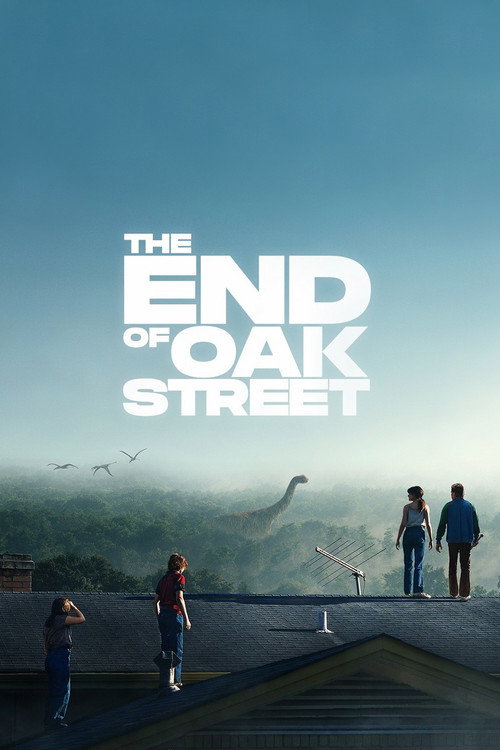
The End of Oak Street
Beneath the sunny veneer of 1982 suburbia lies a suffocating domestic crisis, which fractures violently into raw terror and breathless wonder as manicured lawns are swallowed by prehistoric primeval wilderness.
The End of Oak Street

The End of Oak Street

"Where goes the neighborhood."

12 August 2026 United States of America 99 min 6.6 (225)

Director: David Robert Mitchell

Cast: Anne Hathaway, Ewan McGregor, Christian Convery, Maisy Stella, Jordan Alexa Davis

Thriller Mystery Science Fiction Suburban Complacency & Hidden Decay Survival Through Family Solidarity Cosmic Insignificance and Deep Time Second Chances and Moral Compromise
Budget: $80,000,000
Box Office: $47,010,488

Overview

Set in the summer of 1982 in the quiet town of Flowervale, Michigan, The End of Oak Street centers on the Platt family: pragmatic mother Denise, her husband Greg, their astronomy-obsessed teenage daughter Audrey, mischievous son Brian, and their golden retriever Starbuck. On the surface, the neighborhood is the very picture of suburban Americana, complete with cul-de-sacs, bicycles, and neighborhood block parties. Beneath this façade, the Platt family is on the verge of total collapse: Denise is secretly harboring dreams of running away, while Greg is hiding severe financial troubles and personal vices.

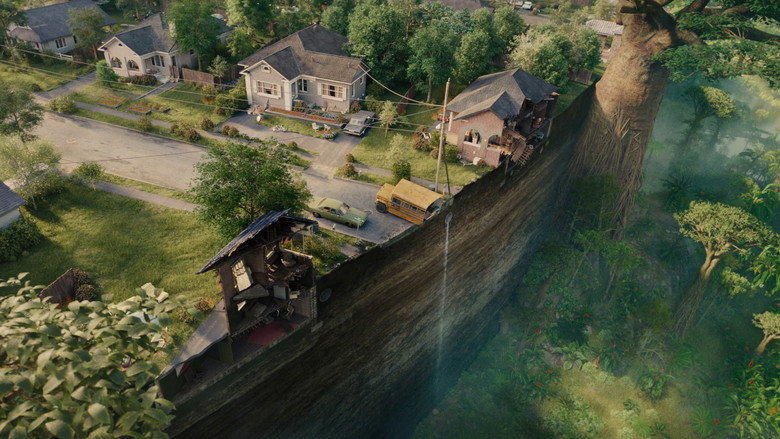
The family’s domestic struggles are violently upended when a strange cosmic anomaly rips their entire suburban block out of the twentieth century and deposits it millions of years into the past. Cut off from modern civilization, electricity, and outside communication, the residents of Oak Street find themselves marooned in a dense, hostile prehistoric jungle ruled by predatory dinosaurs and ancient beasts.

As their neighbors are picked off one by one, the fractured Platt family is forced to put aside their simmering resentments to stay alive. To make it through the nightmare and search for a way home, they must navigate both ravenous prehistoric predators and the unresolved fractures inside their own household.


Core Meaning

Writer-director David Robert Mitchell uses the absurd, high-octane premise of suburban dinosaur horror to explore the fragile illusion of safety and domestic routine. The arrival of apex predators acts as a visceral externalization of the unspoken decay eating away at the nuclear family. Mitchell’s core message suggests that unresolved domestic alienation and silent resentment are just as destructive as any prehistoric monster, and that true reconciliation often requires breaking through the comfortable illusions of everyday life. The film also reflects on cosmic scale and impermanence: in the grand expanse of geological time, human egos, domestic grievances, and entire eras are fleeting, making active love and presence paramount.

Thematic DNA

Suburban Complacency & Hidden Decay 30%
Survival Through Family Solidarity 25%
Cosmic Insignificance and Deep Time 25%
Second Chances and Moral Compromise 20%

Suburban Complacency & Hidden Decay

The film deconstructs the idyllic 1980s American Dream. Neat lawns and white picket fences conceal emotional estrangement, financial ruin, and unspoken despair. The literal tearing away of the neighborhood mirrors the collapse of the family's internal façade.

Survival Through Family Solidarity

While each family member initially retreats into isolation or individual coping mechanisms, survival in the prehistoric wilderness demands total cooperation, mutual trust, and selflessness.

Cosmic Insignificance and Deep Time

By thrusting twentieth-century suburbanites into the Mesozoic Era, the film contrasts mundane human problems with the vast, uncaring scale of planetary history. Human constructs, technology, and social hierarchies are meaningless against nature's raw forces.

Second Chances and Moral Compromise

The narrative delves into the desire to reset mistakes and rewrite history, examining what one is willing to sacrifice—and overlook—in order to reclaim lost time and salvage broken bonds.

Character Analysis

Denise Platt

Anne Hathaway

Archetype: The Reluctant Protector / Practical Matriarch Key Trait: Pragmatic, observant, and resilient under immense pressure

Motivation

Protecting her children and breaking free from emotional stagnation.

Character Arc

Begins as an emotionally detached, frustrated housewife contemplating divorce; transforms into a fierce, resourceful survivalist who fights to keep her children alive and orchestrates a temporal rescue.

Greg Platt

Ewan McGregor

Archetype: The Flawed Patriarch / Tragic Protector Key Trait: Well-meaning optimism burdened by chronic denial

Motivation

Regaining self-worth and preserving his family unit.

Character Arc

Starts as an insecure, secret-keeping father masking unemployment and alcoholism behind an optimistic grin; steps up in the crucible of survival to defend his family, culminating in a heroic sacrifice.

All 5 characters and cast

Symbols & Motifs

The Cul-de-Sac Telephone Pole

Meaning:

Represents suburban containment and artificial security that collapses when disconnected from modern civilization.

Context:

Stands prominently at the end of Oak Street with radiating power lines resembling a circus big-top tent before becoming completely useless after the time displacement.

Denise’s Hidden Manuscript

Meaning:

Symbolizes suppressed personal ambition, unexpressed resentment, and the longing for liberation from domestic entrapment.

Context:

Begins as a secretly penned novel about an unfulfilled mother plotting her escape, later transforming into a physical record of the family's survival.

The Sledgehammer

Meaning:

Represents blue-collar domestic labor re-purposed into a desperate assertion of patriarchal protection and defense.

Context:

Greg wields his standard household work tool as a makeshift weapon against massive prehistoric carnivores.

Starbuck the Golden Retriever

Meaning:

Embodies untainted loyalty, family innocence, and an instinctual bridge connecting domestic security with the wild.

Context:

Accompanies the Platt family throughout their prehistoric ordeal, alerting them to unseen dangers and anchoring their emotional humanity.

Flickering Streetlights and Static Radios

Meaning:

Sensory manifestations of cosmic rupture and the utter breakdown of twentieth-century human technology.

Context:

Recurs prior to dimensional disruptions and throughout the temporal shifts affecting the neighborhood block.

Memorable Quotes

I think our house, our neighborhood, our whole street, has moved.
— Denise Platt

Context

Delivered the morning after the cosmic event as Denise steps onto her front porch and looks out past the sidewalk into prehistoric vegetation.

Meaning

Marks the definitive pivot point from a grounded domestic suburban drama into surreal science-fiction survival horror.

Why'm I doing this again? — Fatherly duty.
— Greg Platt & Denise Platt

Context

Spoken during the neighborhood 1982 block party sack race just prior to the temporal displacement.

Meaning

Establishes Greg's search for marital purpose and highlights the undercurrent of domestic exhaustion that is later tested by extreme survival stakes.

All 3 quotes

Philosophical Questions

If you replace a deceased loved one with an earlier timeline version of themselves, does the emotional bond remain authentic?

Explored through Denise's bittersweet realization at the film's conclusion, living alongside a husband who never experienced the shared trauma and sacrificial growth of their ordeal.

Is suburban safety an artificial illusion shielding humanity from the indifferent violence of the natural cosmos?

Examined through the immediate, violent collapse of modern infrastructure and social hierarchy once the neighborhood is detached from the power grid and modern era.

How much personal ambition should an individual sacrifice to sustain the health of a family collective?

Reflected in Denise's character arc, moving between her desire for individual escape via her secret writing and the deep instinct to preserve her children and household.

Alternative Interpretations

Several distinct readings have emerged around the film's narrative structure:

Full ending explanation

Cultural Impact

Released in August 2026 as a late-summer counter-programming tentpole, The End of Oak Street arrived amid growing audience fatigue with sprawling multi-sequel franchises and heavy digital de-aging blockbusters. Critics celebrated the film as a refreshing, kinetic genre hybrid, earning an 85–86% score on Rotten Tomatoes. Commentators highlighted Mitchell's deft ability to fuse the nostalgic wonder of Joe Dante and Steven Spielberg with unsparing survival horror and grounded family drama.

Audience Reception

Audience and critical reception highlighted several key strengths and criticisms:

  • Praise: Strong, emotionally grounded chemistry between Anne Hathaway and Ewan McGregor; high-tension set pieces with scientifically updated, feathered dinosaur designs; dynamic large-format cinematography by Michael Gioulakis; and Michael Giacchino's propulsive symphonic score.
  • Criticism: Hand-waving scientific explanations concerning space-time mechanics and wormhole generation; occasional jarring tonal shifts between lighthearted 1980s family adventure and intense, graphic creature violence.
  • Verdict: A bold, thrilling, and emotionally resonant creature feature that revitalizes summer cinema with original storytelling.

Interesting Facts

  • The project was developed and filmed under the secret working title Flowervale Street to keep dinosaur and time-travel elements hidden during early production.
  • Although set in Michigan, principal photography took place in and around Atlanta, Georgia, utilizing specialized soundstages and suburban neighborhoods.
  • Director David Robert Mitchell and cinematographer Michael Gioulakis utilized large-format IMAX cameras and classic split-diopter lens techniques.
  • Michael Giacchino composed and recorded an energetic 78-piece live orchestral score at the Eastwood Scoring Stage on the Warner Bros. lot.
  • The Platt family dog, Starbuck, was played on set by a canine actor named Brisket.
  • David Robert Mitchell dedicated the film to his late father, reflecting the central themes of paternal sacrifice and family reconciliation.
  • Ewan McGregor revealed in press interviews that an earlier draft of the screenplay concluded far darker, without the temporal reset providing a second chance.

Easter Eggs

Carl Sagan and Cornell University Ambitions

Audrey's dream of studying astronomy under Carl Sagan at Cornell sets up the astrophysical groundwork for understanding temporal wormholes.

1982 Pop Culture Artifacts

The film evokes the cinema era of E.T. and Poltergeist through era-accurate props such as vintage Simon electronic games, Froot Loops boxes, J. Geils Band posters, and Steve Winwood's song 'Valerie'.

Amblin-Style Subversion

Deliberately invokes classic Amblin tropes—children on bicycles, neighborhood block parties, loyal dogs—before subverting them with visceral R-rated creature horror.

Ray Bradbury Homage

Dialogue regarding the dangers of altering timeline events subtly references Ray Bradbury's classic dinosaur time-travel short story 'A Sound of Thunder'.

Bad Robot / Cloverfield Speculation

Produced by J.J. Abrams' Bad Robot, the secretive viral marketing caused early speculation of a Cloverfield connection, though it remains a standalone narrative.

Frequently Asked Questions

Explore More About This Movie

Dive deeper into specific aspects of the movie with our detailed analysis pages

Comments (0)

Leave a comment

No comments yet. Be the first to share your thoughts!

Similar Movies