Skip to content
The Guest
Drenched in coastal gloom and suffocating dread, The Guest evokes visceral grief and terrifying desolation, resembling a cracked crucifix submerged in freezing sea foam as three broken souls clutch one another to survive the howling dark.
The Guest

The Guest

손: The Guest

12 September 2018 — 01 November 2018 South Korea 1 season 16 episode Ended 8.0 (100)

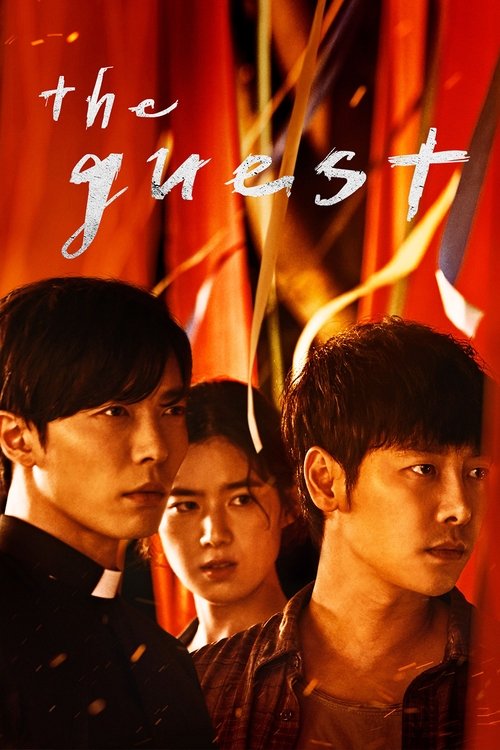
Cast: Kim Dong-wook, Kim Jae-uck, Jung Eun-chae, Lee Won-jong, Park Ho-san

Drama Crime Mystery Generational Trauma and Shared Grief The Social Roots of Malevolence Fusion of Faiths and Collective Solidarity Self-Sacrifice versus Self-Destructive Revenge The Fallibility of Human Institutions

Overview

The Guest (OCN, 2018) is a 16-episode supernatural crime thriller that weaves together Korean shamanism (mu-sok) and Western Catholic exorcism. The story traces the intertwined fates of three individuals whose families were destroyed twenty years earlier by a malevolent entity known as "Sohn" (The Guest) or "Park Il-do"—a demon originating from the East Sea that possesses the vulnerable and compels them to commit horrific acts of violence before stabbing out their right eye.

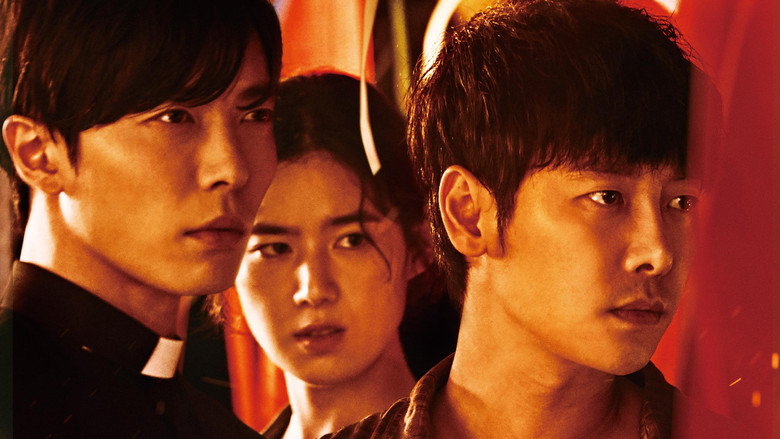
In the present day, the three central figures cross paths once again. Yoon Hwa-pyung is a psychic taxi driver born into a hereditary shaman family who experiences harrowing psychic visions through the eyes of the possessed. Choi Yoon (Father Mateo) is an aloof, cynical Catholic priest and exorcist driven by the trauma of his family's massacre. Kang Kil-young is a pragmatic, hard-boiled violent crimes detective following in the footsteps of her murdered mother, initially skeptical of supernatural phenomena.

As a string of bizarre, gruesome murders breaks out across Seoul and surrounding provinces, the trio forms an uneasy alliance. Moving from one possession case to the next, they uncover a sprawling network of malice connected to institutional corruption, forgotten social outcasts, and a sinister figure orchestrating the return of the ancient demon. Their collective journey shifts from individual quests for vengeance toward a shared battle for redemption, solidarity, and self-sacrifice.


Core Meaning

The fundamental message of The Guest is that demonic evil does not create human darkness out of nothing; it merely exploits, amplifies, and feasts upon the hatred, grief, neglect, and systemic injustices already festering within society.

Through the blending of indigenous shamanistic rituals and Christian exorcism rites, the series asserts that rigid dogmatism and solitary vengeance are powerless against evil. Deliverance and healing can only be achieved when people bridge ideological divides, share in each other's generational trauma, and choose radical empathy and sacrificial love over malice.

Thematic DNA

Generational Trauma and Shared Grief 30%
The Social Roots of Malevolence 25%
Fusion of Faiths and Collective Solidarity 20%
Self-Sacrifice versus Self-Destructive Revenge 15%
The Fallibility of Human Institutions 10%

Generational Trauma and Shared Grief

The narrative is anchored in the childhood tragedy of the three protagonists. Trauma is depicted not merely as a memory, but as an active, lingering curse that stunts emotional development and warps relationships until the trio learns to process their survivor's guilt together.

The Social Roots of Malevolence

"Sohn" only takes hold of individuals driven to despair by societal cruelties—workplace exploitation, domestic abuse, poverty, disability discrimination, and bullying. The drama underscores that the true catalyst for horror is human apathy.

Fusion of Faiths and Collective Solidarity

By contrasting Catholic exorcism liturgy with gut-wrenching Korean shamanic gut ceremonies, the series demonstrates that no single faith or methodology possesses a monopoly on spiritual truth. Victory over darkness requires disparate beliefs and professions to unite.

Self-Sacrifice versus Self-Destructive Revenge

The characters initially pursue Park Il-do out of vengeful fury, which only feeds the entity's power. As their bonds deepen, their motivation evolves from destroying an enemy into protecting one another, culminating in willing self-sacrifice.

The Fallibility of Human Institutions

Both the church hierarchy and the police force consistently fail to protect the vulnerable, frequently covering up wrongdoing or turning a blind eye to corruption.

Character Analysis

Yoon Hwa-pyung

Kim Dong-wook

Archetype: The Wounded Seer / Tragic Hero Key Trait: Relentless emotional empathy paired with psychic receptivity

Motivation

Tracking down Park Il-do to avenge his mother and grandmother, later shifting toward saving Yoon and Kil-young at the cost of his own life.

Character Arc

Begins as an obsessive, reckless loner haunted by guilt and visions of murders. Over the series, he evolves from a man driven by blind vengeance into a selfless protector who embraces his spiritual sensitivity to shield his friends from destruction.

Choi Yoon / Father Mateo

Kim Jae-uck

Archetype: The Ascetic Exorcist / Reluctant Paladin Key Trait: Stoic spiritual fortitude masking profound inner pain

Motivation

Cleansing demonic evil and finding the truth behind his older brother’s murder-suicide.

Character Arc

Starts as an emotionally closed-off, rule-bound priest suffering from physical and spiritual exhaustion caused by demonic backlash. Through his friendship with Hwa-pyung and Kil-young, he breaks free of rigid ecclesiastical dogma and learns the value of emotional vulnerability and human connection.

All 5 characters and cast

Symbols & Motifs

The Right Eye / Self-Enucleation

Meaning:

Symbolizes the violent blinding of conscience, spiritual corruption, and the loss of true moral vision.

Context:

The hallmark of Park Il-do’s possession, where the host is compelled to stab out their own right eye.

The Sea / Salt Water

Meaning:

Represents the subconscious, primordial abyss where unaddressed trauma and malice dwell.

Context:

"Sohn" emerges from the deep waters of the East Sea. Possessed victims consume excessive amounts of water and expel foul salt water during exorcisms.

The Cross and the Shamanic Knife (Sin-kal)

Meaning:

When brought together, they represent the harmony between native Korean spiritual heritage and Western theological ritual.

Context:

Choi Yoon’s rosary/crucifix and the ritual implements of the shamans (Yook Gwang and Hwa-pyung) serve as parallel spiritual weapons.

Taxicab

Meaning:

Functions as a mobile sanctuary and transitional space bridging the spiritual periphery with urban modernity.

Context:

Operated by Yoon Hwa-pyung as he navigates the dark underbelly of Seoul tracking possession cases.

Crow / Black Feathers

Meaning:

Symbolizes physical decay and the rot of human empathy.

Context:

Black feathers and dead crows regularly appear as ominous heralds of Park Il-do’s approach.

Memorable Quotes

손은 동쪽의 바다에서 온다.
— Village Shaman / Yoon Hwa-pyung

Context

Introduced during the Gyeyangjin prologue in Episode 1.

Meaning

The foundational ominous lore of the series, defining the ancient marine origin of the evil entity Park Il-do.

구마는 악마와의 싸움이 아닙니다. 사람을 구하는 일입니다.
— Choi Yoon (Father Mateo)

Context

Spoken in Episode 5 during an exorcism crisis.

Meaning

Captures Yoon's ethical turning point as he stops viewing exorcisms merely as theological combat and recognizes the precious human soul suffering inside the host.

All 5 quotes

Episode Highlights

Episode 1

S1E1

Presents the Gyeyangjin prologue detailing the possession of young Hwa-pyung, the massacre of Choi Yoon’s family by his possessed brother, and the death of Kang Kil-young’s mother.

Significance:

Establishes the core origin, the traumatic triangle of the three protagonists, and introduces the entity Park Il-do.

Episode 3

S1E3

Follows the investigation and exorcism of disabled contract worker Kim Young-soo, marking the first major joint exorcism between Yoon and Hwa-pyung.

Significance:

Demonstrates how socioeconomic exploitation invites demonic possession and solidifies the working dynamic between the trio.

Episode 7

S1E7

Focuses on the investigation into Assemblywoman Park Hong-joo and the mysterious "Sharing Hand" charity foundation.

Significance:

Expands the scope of evil in the narrative from isolated crimes to entrenched political corruption.

Episode 9

S1E9

Depicts Shaman Yook Gwang shattering his spirit knife during a desperate ritual to liberate the possessed young girl Seo-yoon.

Significance:

Serves as the high-water mark for the functional fusion of shamanistic intervention and Catholic exorcism rites.

Episode 12

S1E12

Yoon suffers extreme physical torment from demonic curses (cursus), while Yook Gwang uncovers horrifying evidence buried at the grandfather's house.

Significance:

Shifts the plot into its final act and dramatically escalates the mortal stakes for Choi Yoon.

Episode 14

S1E14

Yook Gwang is brutally murdered by the true host after discovering Park Il-do’s secret burial, and Hwa-pyung's father also meets a tragic death.

Significance:

Marks the emotional nadir of the series for Hwa-pyung, stripping away his remaining surrogate and biological parental figures.

Episode 15

S1E15

Details the confrontation with Priest Yang, a terrifying mass possession incident at the hospital, and Priest Yang's dramatic fatal leap.

Significance:

Deconstructs the primary red herring of the series and sets up the final identity revelation.

Episode 16

S1E16

Reveals Grandfather Yoon Moo-il as the true vessel of Park Il-do; Hwa-pyung absorbs the demon and plunges into the sea, followed by a one-year epilogue.

Significance:

Delivers the climax and philosophical resolution of the 20-year struggle through sacrificial love and spiritual containment.

Philosophical Questions

Is evil an invasive metaphysical force or an innate human condition?

Explored through possession mechanics which consistently demonstrate that Park Il-do cannot enter a soul unless opened by genuine human malice, greed, or despair.

Can institutional dogma replace individual moral agency?

Explored through the institutional failures of both the Catholic Church hierarchy and the police department, showing that true morality requires personal empathy rather than blind institutional allegiance.

What is the true cost of breaking a cycle of generational violence?

Explored through the climax, which posits that ending entrenched trauma demands total, non-retaliatory self-sacrifice rather than reciprocating violence.

Alternative Interpretations

The narrative supports multiple analytical frameworks:

Full ending explanation

Cultural Impact

The Guest marked a historic turning point in South Korean television broadcasting. Prior to 2018, Korean horror on television was predominantly confined to lighthearted romantic comedies with ghosts or period folklore tales. The Guest established the viability of gritty, R-rated cinematic horror on Korean cable networks (OCN/tvN), inaugurating a wave of dark occult thrillers including Priest (2018), Possessed (2019), and The Cursed (2020).

The drama critically engages with Korea’s unique religious landscape, where ancient shamanic traditions (mu-sok) actively co-exist with a large, influential Christian population. Rather than setting them in opposition, the series presents both as cultural frameworks grappling with the universal problem of human suffering and malice.

Audience Reception

The Guest received widespread critical acclaim as a masterclass in Korean television horror, earning praise for its relentless pacing, eerie atmospheric cinematography, visceral exorcism sequences, and the powerful chemistry among lead actors Kim Dong-wook, Kim Jae-uck, and Jung Eun-chae.

Minor criticisms centered around mid-series pacing fatigue in episodes 11–13 due to a repetitive investigative formula, as well as the heavy broadcast blurring applied to bladed weapons under Korean broadcast regulations. Overall, it maintains an enduring cult following as one of the most groundbreaking supernatural horror-thrillers in K-drama history.

Interesting Facts

  • Director Kim Hong-sun previously directed the smash-hit thriller Voice (2017), where he collaborated with Kim Jae-uck.
  • Lead actors Kim Dong-wook and Kim Jae-uck previously co-starred 11 years earlier in the romantic comedy Coffee Prince (MBC, 2007).
  • Director Kim Hong-sun and actor Kim Jae-uck traveled to Vatican City and the Philippines to consult directly with practicing Catholic exorcists and study authentic liturgical procedures.
  • Actors portraying possessed victims underwent intensive physical coaching to execute dislocated, unnatural body contortions and prolonged screams without voice doubles.
  • A theatrical film sequel featuring the original cast and director was officially greenlit in 2019, though production was suspended during development and the COVID-19 pandemic.

Easter Eggs

Yoon Hwa-pyung's Initials ('HP')

Korean fans noted that his initials playfully match Harry Potter, mirroring the trio dynamic of a psychic chosen one (Hwa-pyung), an intellectual spellcaster/priest (Yoon), and a pragmatic protector (Kil-young).

The 'Sharing Hand' (나눔의 손) Foundation

The charity run by Assemblywoman Park Hong-joo weaponizes the Korean word Sohn (meaning both 'Guest' and 'Hand') to conceal demonic malice behind benevolent rhetoric.

Authentic Latin Liturgy

The prayers chanted by Father Mateo are genuine Latin formulas from the Catholic Rituale Romanum (including Exorcismus in Satanam et Angelos Apostaticos), delivered with escalating physical strain.

Frequently Asked Questions

Explore More About This Movie

Dive deeper into specific aspects of the movie with our detailed analysis pages

Comments (0)

Leave a comment

No comments yet. Be the first to share your thoughts!

Similar Movies