Skip to content
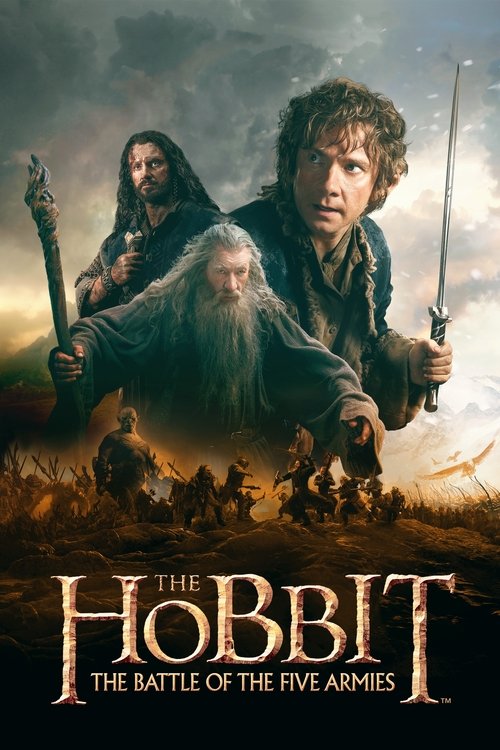
The Hobbit: The Battle of the Five Armies
A tempestuous high-fantasy reckoning charged with tragic grief, where towering fortresses of ancestral gold dissolve into a frozen, bloodstained battlefield under the shadow of encroaching war.
The Hobbit: The Battle of the Five Armies

"Will you follow me... one last time?"

10 December 2014 New Zealand 144 min 7.3 (15,812)

Director: Peter Jackson

Cast: Ian McKellen, Martin Freeman, Richard Armitage, Orlando Bloom, Evangeline Lilly

Fantasy Action Adventure The Corrosive Nature of Greed ('Dragon Sickness') Valuing Peace and Home Over Glory Reconciliation and Unity Against Common Annihilation Honor, Sacrifice, and Atonement
Budget: $250,000,000
Box Office: $956,019,788

The Hobbit: The Battle of the Five Armies — Ending Explained

⚠️ Spoiler Analysis

The film opens with the sudden demise of Smaug, who is pierced through his vulnerable underbelly scale by Bard using a black arrow notched across his son's shoulder. This abrupt resolution leaves Erebor entirely defenseless, shifting the narrative engine from survival horror to geopolitical tragedy. Inside the mountain, Thorin's mind crumbles into psychotic obsession; he accuses his companions of betrayal and threatens to fling Bilbo from the ramparts upon discovering that the hobbit gave the coveted Arkenstone to Bard and Thranduil to force a truce.

Thorin's cathartic breakthrough occurs during a hallucinatory nightmare on the gold-coated throne floor, causing him to discard his crown and lead his brothers into the fray. The narrative reaches its devastating climax on the icy precipice of Ravenhill: Bolg brutally murders Kili before Tauriel's eyes, Fili is executed by Azog, and Thorin sacrifices his life in a mutual deathblow across a frozen lake, letting Azog impale him so he can deliver a fatal thrust. Reunited on the brink of death, Thorin asks Bilbo for forgiveness, releasing the hobbit to return home. The story concludes with Bilbo arriving in Hobbiton just in time to stop an auction of his personal estate, quietly tucking the One Ring into his waistcoat pocket.

Alternative Interpretations

Several critical readings view the film through the lens of J.R.R. Tolkien's real-life combat trauma in the trenches of the Somme during World War I. Seen as an anti-war deconstruction, the narrative reveals the utter futility of diplomatic impasses, where the petty geopolitical squabbles of monarchs lead directly to mechanized massacres and the deaths of promising youth like Fili and Kili. Alternatively, socioeconomic interpretations view Thorin's dragon sickness as a critique of predatory capital hoarding, showing how centralized financial extraction renders leaders paranoid and indifferent to impoverished populations like the displaced workers of Lake-town.

Explore More About This Movie

Dive deeper into specific aspects of the movie with our detailed analysis pages

Similar Movies