Skip to content
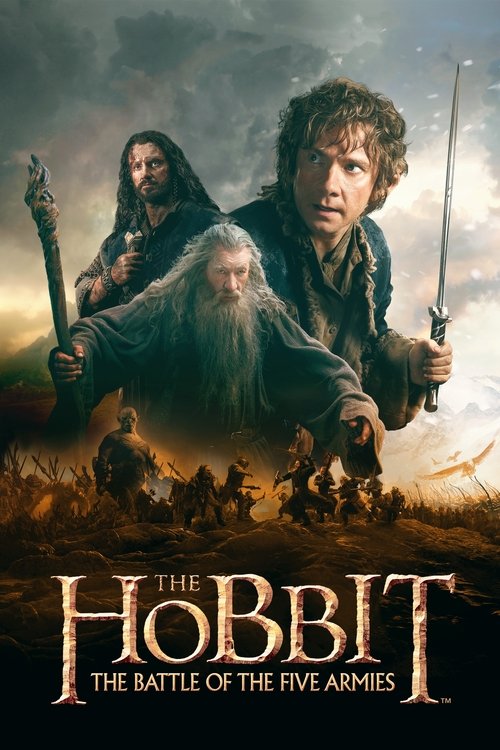
The Hobbit: The Battle of the Five Armies
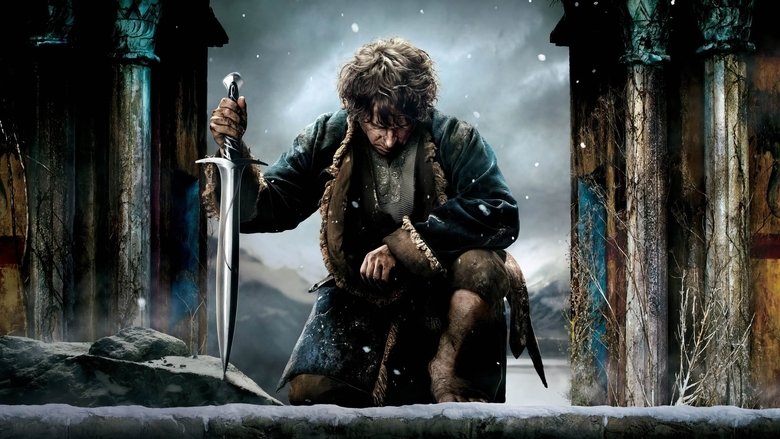
A tempestuous high-fantasy reckoning charged with tragic grief, where towering fortresses of ancestral gold dissolve into a frozen, bloodstained battlefield under the shadow of encroaching war.
The Hobbit: The Battle of the Five Armies

The Hobbit: The Battle of the Five Armies

"Will you follow me... one last time?"

10 December 2014 New Zealand 144 min 7.3 (15,812)

Director: Peter Jackson

Cast: Ian McKellen, Martin Freeman, Richard Armitage, Orlando Bloom, Evangeline Lilly

Fantasy Action Adventure The Corrosive Nature of Greed ('Dragon Sickness') Valuing Peace and Home Over Glory Reconciliation and Unity Against Common Annihilation Honor, Sacrifice, and Atonement
Budget: $250,000,000
Box Office: $956,019,788

Overview

Picking up in the immediate wake of the dwarven reclaim of Erebor, the monstrous dragon Smaug descends with devastating fury upon the wooden settlement of Lake-town. While the valiant bowman Bard risks everything to protect the defenseless townsfolk from dragonfire, the surviving refugees find themselves displaced, destitute, and desperate for the relief and treasure once promised to them by the Company of Dwarves.

Meanwhile, within the echoing halls of the Lonely Mountain, Thorin Oakenshield secures his ancestral throne but falls victim to the intoxicating madness of dragon sickness. Blinded by greed and paranoia as he obsessively hunts for the legendary Arkenstone, Thorin barricades the fortress gates against both the displaced Lake-men and an Elven legion commanded by King Thranduil, refusing diplomatic overtures and edging toward fratricidal conflict.

As diplomatic relations collapse and allied races stand on the brink of war over ancient treasures, a far deadlier menace converges in secret. The Dark Lord Sauron deploys vast Orc legions under Azog the Defiler to seize the strategic stronghold of Erebor, forcing Dwarves, Elves, and Men to confront a shared destiny where mutual survival demands reconciliation over pride.
Core Meaning

The core message of the film explores how unchecked obsession with material wealth and inherited status poisons honor, ruptures fellowship, and fuels needless destruction. Peter Jackson frames Thorin Oakenshield's tragic downfall and eleventh-hour redemption as an enduring moral argument: the humble virtues of home, empathy, and modest community—epitomized by Bilbo Baggins—far surpass the hollow glory of hoarding gold and martial conquest.

Thematic DNA

The Corrosive Nature of Greed ('Dragon Sickness') 35%
Valuing Peace and Home Over Glory 25%
Reconciliation and Unity Against Common Annihilation 25%
Honor, Sacrifice, and Atonement 15%

The Corrosive Nature of Greed ('Dragon Sickness')

The film illustrates how hoarding ancestral wealth corrupts moral judgment. Thorin transforms from an inspiring exile into a paranoid despot who threatens to execute his dearest companions, proving that the psychological infection of the hoard is as perilous as the monster that once guarded it.

Valuing Peace and Home Over Glory

Contrasting dwarven pride and elven aloofness with Bilbo's simple devotion to hearth, garden, and fellowship, the narrative celebrates ordinary decency as a superior moral force to imperial majesty or triumphant slaughter.

Reconciliation and Unity Against Common Annihilation

Historical grievances between Elves, Men, and Dwarves bring them to the brink of senseless slaughter until an existential threat reveals that survival necessitates setting aside prejudice and fighting side by side.

Honor, Sacrifice, and Atonement

Personal redemption requires active, costly sacrifice. Thorin breaks his gold-induced trance not through passive regret, but by leading a desperate charge on the frozen slopes of Ravenhill, choosing a noble death over an ignominious reign.

Character Analysis

Thorin Oakenshield

Richard Armitage

Archetype: Tragic King Key Trait: Haunted pride

Motivation

To restore his kingdom's ancestral supremacy and secure the Arkenstone at all costs.

Character Arc

Reclaims his royal birthright only to be consumed by avarice and paranoia, ultimately breaking free of madness to redeem his honor in mortal combat.

Bilbo Baggins

Martin Freeman

Archetype: Reluctant Hero Key Trait: Unflinching moral integrity

Motivation

To preserve peace, protect his companions, and return safely to the Shire.

Character Arc

Evolves from an insecure burglar into a principled moral mediator willing to risk execution by his friends to avert war.

All 5 characters and cast

Symbols & Motifs

The Arkenstone

Meaning:

Symbolizes supreme sovereignty, ultimate vanity, and the blinding danger of earthly idolatry. Its radiant brilliance mirrors the internal rot of possessive obsession.

Context:

Coveted frantically by Thorin beneath the hoard, the jewel is purloined by Bilbo and surrendered to Bard and Thranduil as a bargaining chip for peace.

The Acorn from Beorn's Garden

Meaning:

Represents life, renewal, patience, and Bilbo's grounding tether to the peaceful earth, sharply contrasted against cold, inanimate jewels.

Context:

Bilbo secretly displays the tiny seed to a suspicious Thorin, noting he intends to plant it back home in Bag End as a quiet reminder of his journey.

The Mithril Shirt

Meaning:

Symbolizes true loyalty and protective love detached from material greed, standing as an enduring ward of genuine friendship.

Context:

Gifted to Bilbo by Thorin as an early token of affection before paranoia consumes the dwarf king, the mail ultimately saves Bilbo's life during the carnage.

The Crown of Erebor

Meaning:

Represents the suffocating burden of royal legacy and prideful isolationism, severing the wearer from kinship and humility.

Context:

Thorin dramatically casts his golden circlet aside onto the polished stone floor when he finally snaps out of his psychological delirium.

Memorable Quotes

Farewell, Master Burglar. Go back to your books, and your armchair. Plant your trees, watch them grow. If more people valued home above gold, this world would be a merrier place.
— Thorin Oakenshield

Context

Spoken to Bilbo as Thorin lies fatally wounded upon the frozen heights of Ravenhill following Azog's defeat.

Meaning

Enapsulates the central moral philosophy of Tolkien's mythos, affirming that domestic peace and simplicity eclipse imperial wealth.

You've won the Mountain. Is that not enough?
— Bilbo Baggins

Context

Bilbo pleads with an increasingly paranoid Thorin as elven and mannish hosts gather outside the gates of Erebor.

Meaning

A piercing challenge to insatiable material ambition, pointing out the absurdity of risking life and friendship for excessive hoards.

All 5 quotes

Philosophical Questions

Can ethical leadership survive the corrupting temptation of absolute wealth and sovereignty?

Through Thorin's swift devolution, the film interrogates whether political authority is intrinsically destined to cannibalize its own foundational morals once immense riches are at stake.

What constitutes true courage: martial conquest or the defiance of armed conflict?

Contrasting the grand battlefield prowess of armored warriors with Bilbo's quiet treachery in surrendering the Arkenstone, the story argues that risking one's reputation for peace is far braver than fighting in battle.

Is profound grief an acceptable price for having experienced genuine love?

Explored through Tauriel's lament over Kili's demise, the film asserts that sorrow validates authentic emotional vulnerability rather than diminished strength.

How It Ends

Alternative Interpretations

Several critical readings view the film through the lens of J.R.R. Tolkien's real-life combat trauma in the trenches of the Somme during World War I. Seen as an anti-war deconstruction, the narrative reveals the utter futility of diplomatic impasses, where the petty geopolitical squabbles of monarchs lead directly to mechanized massacres and the deaths of promising youth like Fili and Kili. Alternatively, socioeconomic interpretations view Thorin's dragon sickness as a critique of predatory capital hoarding, showing how centralized financial extraction renders leaders paranoid and indifferent to impoverished populations like the displaced workers of Lake-town.

Full ending explanation

Cultural Impact

Financially, The Battle of the Five Armies grossed over $956 million worldwide, crowning Peter Jackson's six-film cinematic adaptation of J.R.R. Tolkien's legendarium spanning fourteen years from 2001 to 2014. The film remains a pivotal study in Hollywood franchise expansion, sparking extensive cinematic debate over the artistic risks of ballooning a concise 300-page children's novel into three three-hour high-frame-rate (48 fps) 3D spectacles. While drawing criticism for pioneering heavy digital compositing over tactile practical prosthetics, it solidified the visual canon and architectural language of Middle-earth in mainstream popular culture.

Audience Reception

Audience and critical reception was markedly divided. Reviewers widely praised Martin Freeman's nuanced performance as Bilbo Baggins and Richard Armitage's theatrical, Shakespearean descent as Thorin Oakenshield, alongside Howard Shore's grand orchestral score. However, significant criticism was leveled at the film's relentless battle fatigue, over-reliance on weightless CGI creatures, and controversial narrative inventions—most notably the love triangle between Tauriel, Kili, and Legolas, and the early dispatch of Smaug in the opening minutes rather than serving as a mid-film climax.

Interesting Facts

  • Peter Jackson originally developed the adaptation as a two-film project directed by Guillermo del Toro, before taking the directorial helm himself and expanding it into a full trilogy.
  • The film was initially titled 'The Hobbit: There and Back Again' before Jackson announced the change to 'The Battle of the Five Armies' in April 2014 to better represent its militaristic tone.
  • Sir Christopher Lee filmed his final appearance as Saruman the White at age 91 at London's Elstree Studios, unable to fly to New Zealand due to health and age constraints.
  • Martin Freeman finished his final scheduled day of filming for the trilogy in complete hobbit prosthetic gear, receiving a standing ovation from the entire New Zealand crew.
  • Billy Boyd, who portrayed the hobbit Pippin Took in 'The Lord of the Rings' trilogy, co-wrote and performed the film's evocative end-credits song, 'The Last Goodbye'.
  • The film's extended cut received an R rating from the MPAA for violence, making it the only Middle-earth feature film by Peter Jackson to carry a restricted rating.

Easter Eggs

Thranduil's instruction to find a young Dúnedain ranger known as 'Strider'

Provides an overt narrative link leading directly into The Fellowship of the Ring, acknowledging the early covert deeds of the young Aragorn.

Balin and Ori's close companionship and defense of Erebor

Directly foreshadows their heartbreaking fate in the Mines of Moria, where the Fellowship eventually uncovers Balin's tomb and Ori's final scrawled entries.

Bilbo's 111th birthday prologue and epilogue bookends

Integrates the narrative seamlessly with the opening scenes of Peter Jackson's 2001 film, showing the older Bilbo played by Ian Holm receiving Gandalf's knock.

Frequently Asked Questions

Explore More About This Movie

Dive deeper into specific aspects of the movie with our detailed analysis pages

Comments (0)

Leave a comment

No comments yet. Be the first to share your thoughts!

Similar Movies