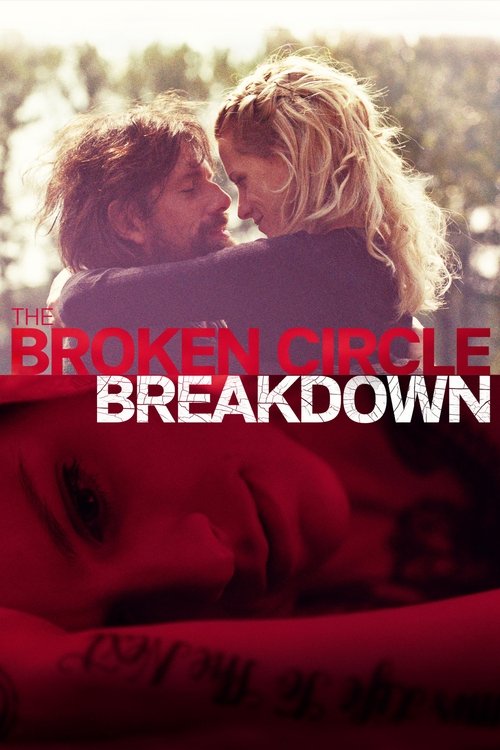
The Broken Circle Breakdown
Overview
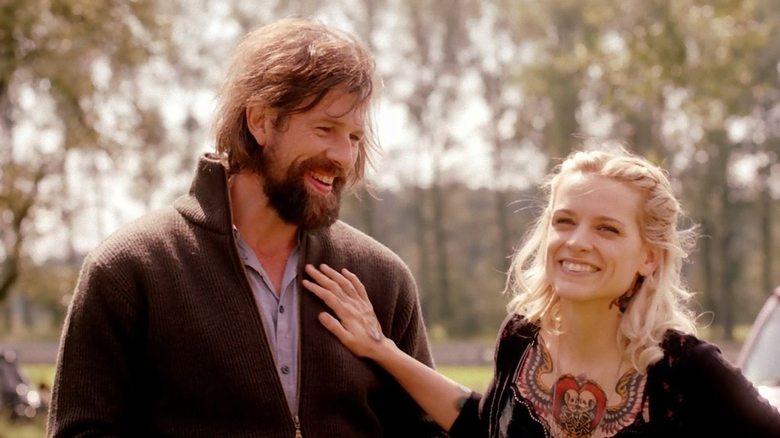
The Broken Circle Breakdown is a non-linear romantic drama that tells the intense love story of Didier, a bluegrass musician and romantic atheist, and Elise, a realistic tattoo artist who embraces spirituality. Their relationship is electric and filled with music, leading to the birth of their daughter, Maybelle. The film interweaves their passionate beginnings with the devastating present, where Maybelle is battling a serious illness.
As the tragedy of their daughter's cancer unfolds, the couple's differing worldviews—Didier's furious rationalism versus Elise's need for spiritual comfort—tear them apart. The narrative jumps back and forth in time, contrasting the vibrant, sun-soaked days of their romance with the cold, gray reality of the hospital and their grieving home.
The film culminates in a heartbreaking exploration of how grief can shatter love. Didier becomes increasingly bitter towards religious conservatism, blaming it for hindering medical progress, while Elise retreats into a world of symbolism and faith. Their inability to reconcile their grief leads to a tragic conclusion that completes the 'broken circle' of their family unit.
Core Meaning
At its heart, the film is a devastating meditation on grief and the incompatibility of coping mechanisms. It asks whether love is enough to survive the unimaginable loss of a child. The director explores the clash between rationalism (represented by Didier) and spirituality/fantasy (represented by Elise), suggesting that both are desperate attempts to control the uncontrollable chaos of life and death.
Thematic DNA
Reason vs. Religion
The central conflict of the film. Didier represents aggressive atheism and rationalism, believing in science and tangible reality. Elise represents spirituality and emotional coping, choosing to believe in an afterlife (stars, birds) to survive her grief. This ideological divide transforms from a playful quirk in their romance to a destructive chasm after their daughter's death.
Grief and Loss
The film unflinchingly portrays the raw, ugly, and isolating nature of grief. It shows how the loss of a child doesn't always bring parents together; instead, it can drive them into solitary confinement within their own minds, destroying the relationship that created the child.
The American Dream vs. Reality
Didier idealizes America as the land of freedom and bluegrass, a 'romantic' fantasy. However, this image is shattered by the reality of American religious conservatism (specifically George W. Bush's veto on stem cell research), which Didier blames for his daughter's death. The film contrasts the aesthetic beauty of the culture with its political realities.
Impermanence and Memory
Symbolized by Elise's tattoos. She covers up the names of past lovers with new designs, trying to rewrite her history. The film suggests that while ink can cover scars, the emotional memory is permanent and cannot be simply drawn over.
Character Analysis
Didier Bontinck
Johan Heldenbergh
Motivation
To live a life of freedom and truth; later, to find a rational target for his overwhelming anger at his daughter's senseless death.
Character Arc
Starts as a free-spirited, America-loving musician who falls deeply in love. The tragedy hardens him into a bitter cynic who rages against religion and politics, ultimately losing his wife to the despair he cannot soothe.
Elise Vandevelde
Veerle Baetens
Motivation
To find connection and, after the tragedy, to find a way to be with her daughter again, whether through faith or death.
Character Arc
Begins as a grounded, 'realist' tattoo artist who is swept up in Didier's romance. Grief breaks her realism, driving her toward spiritualism for comfort. When that fails to heal her pain, she chooses to exit life entirely.
Symbols & Motifs
Tattoos
They symbolize the attempt to edit one's life story and the permanence of emotional choices. They are a visual diary of Elise's past loves and losses.
Elise has a history of tattooing her lovers' names and then covering them up when the relationship ends. She tattoos Didier's name, signifying her hope for permanence, but later attempts to scrub/cover it off in her grief.
The Dead Bird
Represents the finality of death versus the hope of an afterlife. It is a catalyst for the couple's ideological conflict.
Maybelle finds a dead bird. Didier explains it is just 'dead' and biology, while Elise tells her it is a star in the sky to comfort her. This foreshadows their reactions to Maybelle's own death.
The Glass Veranda
Transparency, fragility, and the invisible barriers that kill. It represents the unfinished, dangerous nature of their home and life.
Didier builds a glass porch extension. Birds keep crashing into the invisible glass and dying, mirroring the tragedy striking the family. It is a place of transition between the safe home and the outside world.
Bluegrass Music
The glue of their relationship and a vessel for contradictory emotions. Bluegrass often pairs sad lyrics with upbeat tempos, mirroring the film's tone.
The band performs throughout the film. Songs like 'Will the Circle Be Unbroken' and 'Wayfaring Stranger' comment directly on the plot, serving as a Greek chorus to the tragedy.
Memorable Quotes
If I want to believe that Maybelle is a star up in the sky, I will. If I want to believe she's a bird that perches on our windowsill... I will.
— Elise
Context:
During an argument with Didier after Maybelle's death, defending her spiritual way of grieving against his rationalism.
Meaning:
Defines her desperate need for a coping mechanism that transcends Didier's cold logic. It highlights the film's central conflict between truth and comfort.
God doesn't exist! And he's not a DJ!
— Didier
Context:
A furious on-stage rant during a concert where he breaks character to lecture the audience on stem cell research and religion.
Meaning:
Summarizes Didier's anger at the concept of a benevolent deity who 'orchestrates' life. He rejects the idea that suffering has a purpose.
Life isn't generous. You mustn't love someone. You mustn't become attached to someone. Life begrudges you that.
— Elise
Context:
Spoken in a moment of deep depression as the reality of her loss settles in.
Meaning:
Elise's ultimate conclusion about the cruelty of existence. It foreshadows her decision to end her life to escape the pain of attachment.
Philosophical Questions
Is religious faith a necessary survival mechanism or a delusion?
The film presents Elise's faith as a coping tool that keeps her alive initially, while Didier's truth offers no comfort. It asks if 'truth' is worth the price of despair when facing the void of death.
Do we have a moral obligation to pursue scientific progress over religious ethics?
Through Didier's rant about stem cell research, the film questions the morality of prioritizing religious dogma over technologies that could save the lives of dying children.
Is love stronger than grief?
The film offers a bleak answer: no. It suggests that grief is an isolating force that can dismantle even the most passionate love, turning partners into strangers who grieve in incompatible ways.
Alternative Interpretations
Some critics interpret the entire film as Didier's memory/purgatory. Since the timeline is fractured, the structure mimics the chaotic recall of a grieving mind trying to make sense of what went wrong. Another interpretation focuses on the political allegory: the 'broken circle' is not just the family, but the broken promise of the West (America/Europe), where the dream of freedom and progress is halted by dogmatic conservatism.
The ending is also debated: is Elise's suicide an act of despair, or an act of agency to 'join' her daughter, effectively winning the ideological argument by choosing the 'star' over the 'void'?
Cultural Impact
The Broken Circle Breakdown was a massive critical success, putting Belgian cinema in the global spotlight with its Academy Award nomination. It is credited with reviving interest in bluegrass music in Europe, with the film's soundtrack becoming a number-one hit in Belgium and France.
Culturally, the film sparked debates about the ethics of stem cell research and the role of religion in politics, specifically criticizing the George W. Bush administration's policies. It is often cited in discussions about 'atheist grief'—how those without faith navigate the loss of a child. Philosophically, it is regarded as a modern tragedy that refuses to offer a comforting resolution, contrasting sharply with Hollywood sentimentalism.
Audience Reception
Audience reception was overwhelmingly positive but noted as emotionally devastating. Viewers praised the chemistry between the leads and the authentic bluegrass soundtrack. The non-linear editing was highlighted as a masterful way to heighten the emotional punches.
However, some criticisms focused on the film's relentless misery, with some viewers finding the second half 'trauma porn' or too manipulative. Didier's political rant is a polarized moment; some audiences found it powerful, while others felt it was too preachy and disrupted the personal narrative. Overall, it is considered a masterpiece of tear-jerker cinema.
Interesting Facts
- The film is based on a stage play written by the lead actor, Johan Heldenbergh.
- All the actors sang and played their own instruments live for the film's musical numbers.
- The film was nominated for Best Foreign Language Film at the 86th Academy Awards but lost to 'The Great Beauty'.
- Veerle Baetens (Elise) is actually a professional singer in real life, which added authenticity to the band's performances.
- The timeline was restructured in the editing room; the script was originally more linear, but the editor intercut the timelines to maximize emotional impact.
- The bluegrass songs were chosen specifically because their lyrics often deal with death, sorrow, and the afterlife, contrasting with their upbeat rhythms.
Easter Eggs
"Second star to the right" Tattoo
Elise has a tattoo on her leg that reads 'Second star to the right and straight on till morning.' This is a reference to Peter Pan and the way to Neverland—a place where children never grow up (or die). It symbolizes her desire for an escape to a fantasy world.
Alabama Monroe
The film is known as Alabama Monroe in some European countries. This title references the 'American' identities the characters adopt: 'Alabama' for the state (Americana) and 'Monroe' likely for Bill Monroe, the father of bluegrass.
Maybelle Carter
The daughter is named Maybelle, a direct reference to Mother Maybelle Carter, a matriarch of country music and a member of the Carter Family, whose song 'Will the Circle Be Unbroken' is central to the film.
⚠️ Spoiler Analysis
Click to reveal detailed analysis with spoilers
Frequently Asked Questions
Explore More About This Movie
Dive deeper into specific aspects of the movie with our detailed analysis pages
Comments (0)
No comments yet. Be the first to share your thoughts!