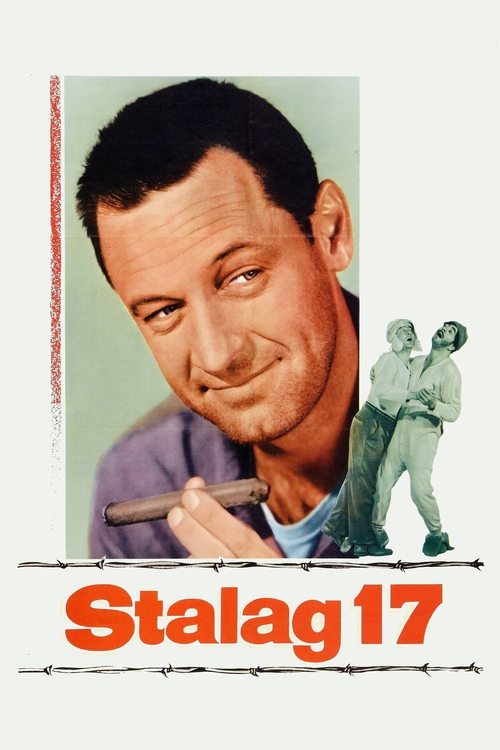
Stalag 17
A gritty, cynical masterpiece blending dark comedy and tense wartime drama. Amidst the claustrophobic squalor of a POW camp, paranoia festers as a mercenary anti-hero becomes the scapegoat for a hidden traitor.
Stalag 17

Stalag 17

"The star-spangled, laugh-loaded salute to our P.W. heroes!"

29 May 1953 United States of America 120 min ⭐ 7.7 (646)
Director: Billy Wilder
Cast: William Holden, Robert Strauss, Don Taylor, Otto Preminger, Harvey Lembeck
Drama War Comedy
Scapegoating and Mob Mentality Cynicism vs. Idealism Class and Capitalism The Absurdity of War
Budget: $1,661,530
Box Office: $10,000,000

Overview

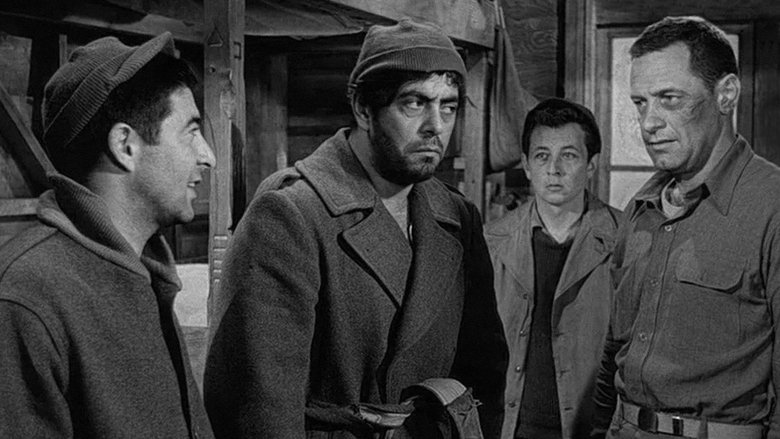
Set in a German prisoner-of-war camp in 1944, Stalag 17 follows the men of Barracks 4, a group of American sergeants who suspect a spy is among them after two escapees are immediately gunned down. Suspicion falls heavily on J.J. Sefton, a cynical and enterprising loner who openly trades with the German guards for privileges and runs a profitable black market within the barracks. While the other prisoners bond over camaraderie and patriotic duty, Sefton focuses solely on his own survival and comfort, making him the perfect pariah when secrets continue to leak to the Commandant.

As tensions rise and Sefton is brutally ostracized by his fellow inmates, the true identity of the informant remains hidden. The arrival of Lieutenant Dunbar, a temporary prisoner who committed a high-profile act of sabotage, raises the stakes. Sefton must use his wits to uncover the real traitor—not to prove his patriotism, but to save his own skin and exact revenge. The film culminates in a tense unveiling of the spy and a desperate escape attempt that challenges the group's mob mentality.
Core Meaning

At its heart, Stalag 17 is a subversive critique of blind conformity and mob mentality. Unlike traditional war films that celebrate unquestioning unity, Wilder presents a complex moral landscape where the "hero" is a selfish capitalist and the "patriots" are easily manipulated into a lynch mob. The film argues that true heroism often resides in the individual who refuses to conform, suggesting that skepticism and self-reliance are better tools for survival than naive idealism.

Thematic DNA

Scapegoating and Mob Mentality 35%
Cynicism vs. Idealism 25%
Class and Capitalism 20%
The Absurdity of War 20%

Scapegoating and Mob Mentality

The men of Barracks 4 quickly turn on Sefton not because they have proof, but because he is different. His individualism and success make him an easy target for their collective fear and frustration. The film illustrates how quickly a group can descend into a dangerous mob, eager to blame the outsider to maintain their own sense of cohesion.

Cynicism vs. Idealism

Sefton represents a hard-edged realism, rejecting the "rah-rah" patriotism of the other prisoners. While the others engage in futile, naive gestures, Sefton understands the harsh reality of their situation. The film validates his cynical worldview as the only practical means of survival, contrasting it with the often foolish idealism of the group leaders.

Class and Capitalism

Even in a prison camp, class structures and capitalism emerge. Sefton is the entrepreneur, running a distillery, organizing races, and trading for luxuries. His accumulation of wealth (cigarettes) grants him power but isolates him from the "proletariat" of the barracks, highlighting the friction between individual enterprise and communal suffering.

The Absurdity of War

Wilder juxtaposes the deadly serious plot with broad, almost slapstick comedy (Animal and Shapiro). This tonal dissonance reflects the absurdity of their existence, where men must find humor in the grotesque to keep their sanity. The German guards are portrayed not just as villains, but as bureaucratic cogs in a ridiculous machine.

Character Analysis

Sgt. J.J. Sefton

William Holden

Archetype: Cynical Anti-hero
Key Trait: Unapologetic Cynicism

Motivation

Survival and self-interest. He wants to endure the war with maximum comfort and minimum risk, though he ultimately acts to clear his name and exact justice.

Character Arc

Starts as a selfish profiteer indifferent to the war effort. After being wrongly accused and beaten, he shifts from passive observer to active investigator. He redeems himself not by changing his nature, but by using his cunning to save the day, maintaining his cynical edge to the very end.

Sgt. Price

Peter Graves

Archetype: The Mole / False Ally
Key Trait: Deceptive Charm

Motivation

Loyalty to Nazi Germany. He is a spy planted to gather intelligence and thwart escape attempts.

Character Arc

Appear as a model soldier and security chief, trusted by everyone. His arc is a static facade of patriotism that crumbles only in the final moments when Sefton exposes his true identity as a German agent.

Col. von Scherbach

Otto Preminger

Archetype: The Sophisticated Villain
Key Trait: Sadistic Bureaucracy

Motivation

Maintaining order and preventing escapes to further his own military career and ego.

Character Arc

A static antagonist who rules the camp with a mix of bureaucratic cruelty and aristocratic arrogance. He views the prisoners as children to be managed or eliminated.

Sgt. "Animal" Kuzawa

Robert Strauss

Archetype: The Fool / Comic Relief
Key Trait: Grotesque Humor

Motivation

To distract himself and others from the grim reality of their captivity.

Character Arc

Provides the emotional and comedic release for the barracks. His obsession with Betty Grable and his clownish behavior mask the deep despair and sexual frustration of imprisonment.

Symbols & Motifs

The Light Bulb Cord

Meaning:

It symbolizes the precarious nature of their secrets and the connection to the enemy. It is the literal and figurative line of communication for the traitor.

Context:

The spy signals the German guards by tying a loop in the electric light cord hanging in the center of the barracks. Sefton eventually notices the shadow of this loop, which becomes the key clue in solving the mystery.

The Black Queen Chess Piece

Meaning:

Represents the hidden treachery within the game of war. A tool of strategy used for betrayal.

Context:

The hollowed-out Black Queen on the chessboard serves as the "mailbox" where the spy leaves written notes for the German guards to retrieve during inspections.

Sefton's Trunk

Meaning:

A symbol of capitalist success and hoarding amidst scarcity. It represents the barrier between Sefton and the collective.

Context:

Filled with silk stockings, food, and contraband, the trunk is the envy of the barracks and the first thing the mob destroys when they decide Sefton is the traitor.

Memorable Quotes

If I ever run into any of you bums on a street corner, just let's pretend we've never met before.

— Sefton

Context:

Sefton says this to the men in the barracks just before he escapes down the trapdoor, after having saved them and exposed the spy.

Meaning:

Encapsulates Sefton's total rejection of the group's camaraderie and his lingering resentment for how they treated him. A final declaration of his independence.

I trade. Everybody trades. I just trade sharper.

— Sefton

Context:

Sefton defending his black market activities when accused of being a collaborator.

Meaning:

Sefton's defense of his capitalism. He refuses to apologize for his survival skills, highlighting the hypocrisy of the others who also trade but with less success.

Ach so!

— Col. von Scherbach

Context:

Used repeatedly by the Commandant when interacting with prisoners or his subordinates, usually when putting on his boots.

Meaning:

A catchphrase that signifies the Commandant's arrogant dismissal or realization. It became a signature of Preminger's performance.

Maybe he's the guy who does have the apple. But I'm the guy who's got the knife.

— Sefton

Context:

Sefton explaining his philosophy of always having leverage in a negotiation.

Meaning:

A metaphor for power dynamics. Even if someone else has the prize (the apple), Sefton has the tool (the knife) to take it or control the situation.

Philosophical Questions

Is the individual obligated to the group?

Sefton refuses to sacrifice for the group, yet he is the one who ultimately saves them. The film questions whether collectivism is always virtuous or if individual autonomy is a higher form of survival.

Does fear justify injustice?

The prisoners beat and ostracize Sefton out of fear and frustration. The film explores the morality of the mob, asking if fear validates the suspension of fairness and due process.

What is the nature of a hero?

The 'traditional' heroes in the film are often ineffective or killed. Sefton, a self-serving anti-hero, is the only one effective enough to defeat the enemy. This challenges the audience's definition of heroism.

Alternative Interpretations

Many critics view the film as an allegory for the McCarthyism and the Red Scare of the 1950s. The barracks represents a paranoid society where fear leads to witch-hunts and the persecution of the non-conformist (Sefton). In this reading, the 'mob' is the American public ready to turn on their own based on suspicion rather than evidence. Another interpretation suggests the film is a critique of unchecked capitalism vs. socialism, with Sefton's 'racket' exposing the moral ambiguities of profiting from collective misery.

Cultural Impact

Stalag 17 marked a significant shift in the war movie genre, moving away from the patriotic propaganda of the 1940s toward a more cynical, realistic, and psychologically complex portrayal of war. It introduced the concept of the anti-hero soldier to a broad audience, influencing future films like The Great Escape and M*A*S*H. The film's success solidified Billy Wilder's reputation as a master of varying genres and gave William Holden his signature role as the hard-edged cynic. It remains a definitive text on the prisoner-of-war experience, blending American resilience with a dark commentary on group dynamics.

Audience Reception

Upon release, Stalag 17 was a critical and commercial smash, praised for its sharp script, biting humor, and Holden's powerhouse performance. Critics lauded Wilder for successfully balancing lowbrow comedy with high-stakes drama. In modern times, it holds a stellar reputation (often 95/100 or higher) as one of the greatest war films ever made. However, some modern viewers and critics occasionally find the broad comedy of the 'Animal' and 'Shapiro' characters to be dated or jarring against the serious backdrop, though most accept it as a product of its time.

Interesting Facts

  • The film was shot in chronological order, a rarity in Hollywood. This meant the actors themselves did not know who the spy was until the final days of shooting, heightening the real suspicion on set.
  • William Holden initially refused the role of Sefton, finding the character too selfish and unlikable. The studio forced him to take the part, which eventually won him the Academy Award for Best Actor.
  • Director Otto Preminger, known for his tyrannical directing style, played the Nazi commandant. Ironically, Billy Wilder (the director) reportedly treated Preminger with the same strictness Preminger usually inflicted on his own actors.
  • Edmund Trzcinski, who co-wrote the original Broadway play based on his own experiences in Stalag 17B, appears in the film as a prisoner who receives a 'Dear John' letter.
  • William Holden's Oscar acceptance speech was one of the shortest in history, simply saying 'Thank you' due to strict TV timing constraints.
  • The film was a major inspiration for the TV show Hogan's Heroes, leading to a lawsuit by the creators of Stalag 17 for plagiarism.
  • Billy Wilder insisted on authentic mud for the camp set, reportedly wearing his own expensive shoes in the mud to prove to the cast that they shouldn't complain.

Easter Eggs

Edmund Trzcinski Cameo

The man in the barracks who receives a letter from his wife saying she 'found' a baby on their doorstep is played by Edmund Trzcinski, the actual playwright and real-life POW of Stalag 17B.

Realistic Camp Number

The film is based on the real Stalag 17B in Austria. The layout and some incidents were drawn directly from the playwrights' actual imprisonment.

⚠️ Spoiler Analysis

Click to reveal detailed analysis with spoilers

Frequently Asked Questions

Explore More About This Movie

Dive deeper into specific aspects of the movie with our detailed analysis pages

Comments (0)

Leave a comment

No comments yet. Be the first to share your thoughts!