Skip to content
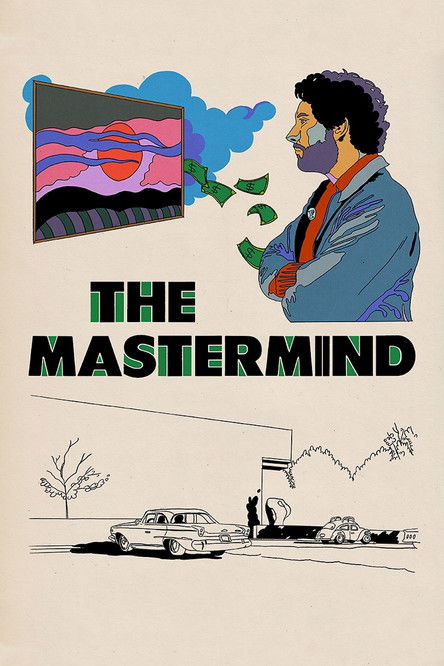
The Mastermind
A rumpled, sun-faded crime drama about a small man with a big plan, where the thrill of the getaway curdles into loneliness — America in 1970, drifting like smoke off a stolen canvas.
The Mastermind

The Mastermind

"It’s not stealing if you don’t get caught."

16 October 2025 United Kingdom 110 min 5.7 (223)

Director: Kelly Reichardt

Cast: Josh O'Connor, Alana Haim, Hope Davis, John Magaro, Gaby Hoffmann

Drama Crime The myth of the criminal mastermind Failure, drift and the aftermath Class, comfort and entitlement America in 1970 / the Vietnam backdrop The uselessness of art as currency
Budget: $2,000,000
Box Office: $2,143,645

Overview

Kelly Reichardt's The Mastermind unfolds in Framingham, Massachusetts, in 1970. James Blaine "J.B." Mooney (Josh O'Connor) is an unemployed carpenter from a comfortable family, a husband and father whose sense of his own capabilities has quietly outgrown his circumstances. Casing the local art museum with the patience of a man who has nothing else to fill his days, he fixes on four paintings by the American modernist Arthur Dove and assembles a crew of amateurs to take them.

The heist itself arrives early and without glamour. Reichardt is far less interested in the mechanics of the theft than in everything that follows: the calls that don't get returned, the money that doesn't materialize, the accomplices who were never as committed as J.B. assumed, and the slow discovery that stolen art is nearly impossible to convert into a life. Around the edges of the story, the Vietnam War plays on televisions and spills into street protests, a country coming apart in the background of one man's private unraveling.

Written and directed by Reichardt and premiered in competition at the 2025 Cannes Film Festival, the film plays as an ironic deconstruction of the heist genre — a crime story stripped of cool, shot in warm 1970s tones, scored with restless jazz, and built around a protagonist whose confidence is his most dangerous asset.
Core Meaning

Reichardt uses the heist — cinema's most reliable fantasy of competence — to tell a story about incompetence dressed up as destiny. J.B. Mooney is the mastermind only in his own estimation; the title is both his self-image and a sardonic joke, the sort of nickname inmates give the new guy whose sense of his abilities never matched reality.

Beneath that irony sits a harder argument about class and moral drift. J.B. isn't driven by desperation so much as by entitlement and boredom: the compromises, petty immorality and small greeds of a man who assumes the world owes him a shortcut. As his plan collapses, the film peels back his likability to reveal something colder underneath — being hapless does not make you harmless. The people he uses pay for his choices more than he does.

And by setting all this against 1970 America — Vietnam on the news, the draft, protest in the streets — Reichardt suggests a parallel between a nation blundering through a catastrophe it insisted it had planned, and one man convinced he has everything under control.

Thematic DNA

The myth of the criminal mastermind 28%
Failure, drift and the aftermath 24%
Class, comfort and entitlement 20%
America in 1970 / the Vietnam backdrop 16%
The uselessness of art as currency 12%

The myth of the criminal mastermind

The film systematically dismantles heist-movie iconography. There is no montage of specialists, no elegant plan, no cathartic score over a clean getaway — just an amateur who has watched enough of the world to think he understands it. Reichardt makes the heist unsexy on purpose: the theft is easy, the aftermath is impossible, and the gap between J.B.'s self-conception and his actual skill becomes the engine of the whole picture.

Failure, drift and the aftermath

Where genre films end, this one begins. After an initial burst of purpose, Reichardt turns her attention to what a man does while everything unravels — how it feels to be on the run with no clear destination, how quickly momentum becomes aimlessness. The Mastermind is structured as a long decompression, a portrait of consequence arriving slowly and without drama.

Class, comfort and entitlement

J.B. is not a man crushed by poverty; he comes from a respectable New England family and steals partly because he can imagine getting away with it. The film is pointed about the particular immorality of the comfortable — the assumption that rules are negotiable, that family will absorb the damage, that someone else will handle the fallout.

America in 1970 / the Vietnam backdrop

The war is never the subject and never absent: broadcasts, protests and the draft press in at the margins of J.B.'s scheme. Reichardt lets a nation's public delusion rhyme with a private one, so that the film becomes a period portrait of a whole country improvising badly and calling it a plan.

The uselessness of art as currency

Four Arthur Dove canvases are priceless and worthless at once — beautiful objects that cannot be spent, eaten, or explained away. The choice of a quietly abstract American modernist rather than a marquee name sharpens the irony: J.B. steals things whose value he does not understand and cannot access.

Character Analysis

James Blaine "J.B." Mooney

Josh O'Connor

Archetype: Antihero / deluded everyman Key Trait: Unearned confidence

Motivation

Not survival but self-image: he wants to be the man who pulled it off, to convert boredom and thwarted pride into proof that he is exceptional.

Character Arc

Begins as an unemployed carpenter with time on his hands and an inflated sense of his own cleverness; executes the museum theft; then spends the rest of the film watching the plan, the money and the people around him fall away. A hairline crack in his seemingly decent personality is prised open by overreach and bad luck, until we understand he was never quite as nice as he appeared — and that his haplessness has been costing other people all along.

J.B.'s wife

Alana Haim

Archetype: The grounded counterweight Key Trait: Weary practicality

Motivation

Keeping the household intact and demanding, gently and then less gently, that her husband be an adult in it.

Character Arc

Holds the domestic reality J.B. is bored by — children, bills, routine — and is increasingly left to absorb the consequences of a scheme she did not choose. Her steadiness measures exactly how much he is throwing away and how little he registers its cost.

All 3 characters and cast

Symbols & Motifs

The Arthur Dove paintings

Meaning:

Value that cannot be converted. The canvases stand for everything J.B. wants — status, transcendence, a life larger than his own — and for his total inability to convert desire into reality. Abstract, beautiful, unsellable.

Context:

Four Dove works are the target of the museum theft and remain a dead weight through the film's second half, an inheritance of trouble rather than a fortune.

The museum itself

Meaning:

Institutional order and civic decency — the polite surface of American life that J.B. treats as a shop. Its cool modernist architecture reads as everything rational and designed, against which his improvisation looks absurd.

Context:

Reichardt shot the museum interiors at the I. M. Pei–designed Cleo Rogers Memorial Library in Columbus, Indiana, lending the target an air of serene, high-modern authority.

The title word 'mastermind'

Meaning:

An ironic label. It names both how the protagonist sees himself and how the world will eventually mock him — a nickname with a sneer inside it.

Context:

Applied across the film to a man whose planning consists largely of confidence, it operates as the movie's central joke and its thesis.

Television news and the war

Meaning:

The collective version of J.B.'s delusion: a country insisting it is in control of something it is losing. It also marks the era's exhausted moral atmosphere.

Context:

Vietnam coverage and protest activity recur at the edges of domestic scenes, never foregrounded, always audible.

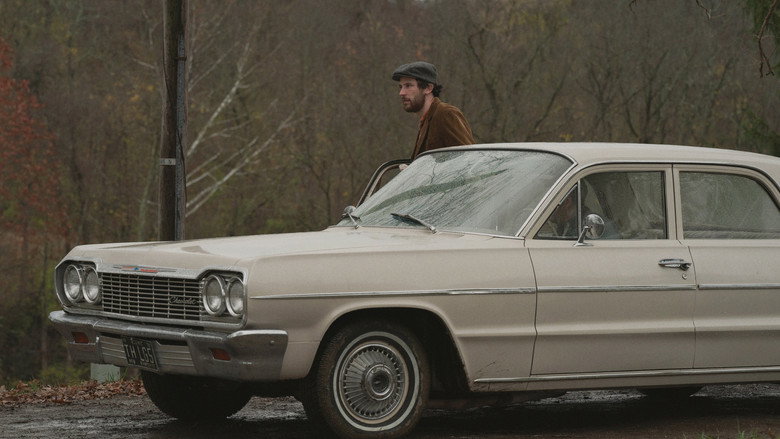
Cars, roads and motels

Meaning:

Movement without direction. The classic American iconography of escape is emptied out — the road stops being freedom and becomes a holding pattern.

Context:

The post-heist stretch follows J.B. in transit, a fugitive whose flight has no destination worth reaching.

The restless jazz score

Meaning:

Improvisation as both style and fate — music that sounds like thinking on your feet, which is precisely what J.B. is doing and precisely why he fails.

Context:

Rob Mazurek's score runs against the film's placid images, supplying the nervous energy the protagonist's plan lacks.

Philosophical Questions

Can a person's self-image ever be corrected by reality?

J.B. absorbs failure after failure without ever quite revising his estimate of himself. The film suggests that self-delusion is not a single mistake but a renewable resource — and that catastrophe is often processed as bad luck rather than evidence.

Does incompetence diminish moral guilt?

The movie's sharpest provocation is that just because you're hapless doesn't mean you're harmless. J.B. hurts people not through malice but through carelessness, raising the question of whether failing badly is morally lighter than succeeding at something wrong.

What is a work of art actually worth?

Four Dove paintings are simultaneously invaluable and unusable. By making stolen art functionally inert, the film separates aesthetic value from market value and asks what we are really protecting when we guard a museum.

Is freedom possible without a destination?

The long post-heist drift converts the American escape myth into aimlessness. Reichardt lets the road go on and on until running away is revealed as another kind of confinement.

How does private delusion relate to public catastrophe?

By keeping Vietnam permanently in the background, the film proposes that individual and national self-deception share a grammar: confidence first, plan second, consequences last.

Alternative Interpretations

The sarcastic reading. The dominant critical interpretation treats the title as pure irony: J.B. is a "mastermind" only in the way prison nicknames are earned, and the film is a comedy of self-delusion played with a straight face. Under this reading, the movie is fundamentally funny — painful and funny in equal measure, as critics noted of O'Connor's performance.

Full ending explanation

Cultural Impact

The Mastermind arrived as a high-profile entry in Kelly Reichardt's long project of American minimalism — the same patient, unsentimental attention she brought to Old Joy, Wendy and Lucy, First Cow and Showing Up, here aimed at a genre that normally runs on adrenaline. Competing for the Palme d'Or at Cannes 2025, it was read by critics as an ironic deconstruction of the heist film, a corrective to the slickness of the Ocean's lineage and a deliberate inversion of Melville-style criminal cool.

Its 1970 setting placed it in conversation with a wave of contemporary films revisiting Vietnam-era America as a mirror for present-day drift. The film also landed as an art-world object in its own right: outlets covering the art press discussed its use of Arthur Dove and its dry, knowing portrait of how stolen art actually circulates — which is to say, badly.

Critically it was a success, holding a 90% approval rating from 155 reviews on Rotten Tomatoes with an average score of 7.5/10 (93% among top critics), with the site's consensus praising a "contemplative crime drama that glides along Josh O'Connor's effortless watchability and a sumptuously vintage aesthetic." Commercially it remained resolutely indie, earning about $2.1 million worldwide against a sub-$2 million budget, and it further consolidated O'Connor's run as the defining art-house leading man of the mid-2020s.

Audience Reception

Critics and general audiences split notably. On Rotten Tomatoes the film registered 90% positive from 155 critic reviews (average 7.5/10) and 93% among top critics, while the audience score sat far lower, around 53% — a gap that maps almost exactly onto the film's deliberate withholding of genre pleasure.

Praised: Josh O'Connor's performance is the near-universal high point, described as the engine of the film — a man in arrested development played entirely straight, which is what makes him both painful and funny. Critics also singled out the sumptuously vintage 1970s aesthetic, Christopher Blauvelt's photography, Rob Mazurek's jazz score, and Reichardt's nerve in making a heist movie that refuses to be exciting.

Criticized: Viewers expecting a crime thriller found it meandering and anticlimactic; the word "slow" recurs in negative reactions, along with frustration that the protagonist remains opaque and that the story deliberately declines to build momentum after the theft. Some found the Vietnam material too muted to register as commentary.

Points of contention: whether the film's flatness is a sophisticated strategy or an evasion, and whether J.B.'s late-revealed unlikability is a payoff or simply leaves the audience stranded without anyone to hold onto.

Verdict: a critics' film in the truest sense — admired as a precise, dryly funny anti-heist and a showcase for O'Connor, but an acquired taste for anyone who came for the caper.

Interesting Facts

  • The film was written and directed by Kelly Reichardt and premiered in competition for the Palme d'Or at the Cannes Film Festival on 23 May 2025.
  • It was inspired in part by a real crime: the 1972 robbery of the Worcester Art Museum in Massachusetts.
  • Reichardt has cited the films of Jean-Pierre Melville among the movie's influences, alongside the real-life case.
  • Although set in 1970 Framingham, Massachusetts, the production shot in Ohio and Indiana.
  • The I. M. Pei–designed Cleo Rogers Memorial Library in Columbus, Indiana stands in for the film's art museum.
  • The heist targets paintings by the American modernist Arthur Dove rather than a more famous marquee artist.
  • Cinematography is by Christopher Blauvelt, a frequent Reichardt collaborator, with an original score by jazz musician Rob Mazurek.
  • The ensemble includes Josh O'Connor, Alana Haim, Hope Davis, John Magaro, Gaby Hoffmann and Bill Camp.
  • The film was made for under $2 million and grossed roughly $2.1 million worldwide.

Easter Eggs

Jean-Pierre Melville as stylistic ancestor

Reichardt has named Melville's crime films as an influence, and the movie's deadpan procedure, taciturn protagonist and refusal of suspense-music cues read as a New England transposition of Le Cercle rouge-era French policier — but with the competence drained out.

The Worcester Art Museum robbery of 1972

The plot draws on an actual Massachusetts art theft, so the film functions as a sideways true-crime story: viewers who know the case will recognize how unromantic real art heists tend to be.

I. M. Pei's Columbus, Indiana library as the museum

Columbus is a famous pilgrimage site for modernist architecture (and the setting of Kogonada's Columbus). Using a Pei building as the target quietly places J.B.'s shabby scheme inside a temple of design and intention.

Arthur Dove as the stolen artist

Dove is often called America's first abstract painter — admired, canonical, and commercially obscure. The choice is a joke at J.B.'s expense and a nod toward a specifically American, under-celebrated modernism.

Frequently Asked Questions

Explore More About This Movie

Dive deeper into specific aspects of the movie with our detailed analysis pages

Comments (0)

Leave a comment

No comments yet. Be the first to share your thoughts!

Similar Movies