Skip to content
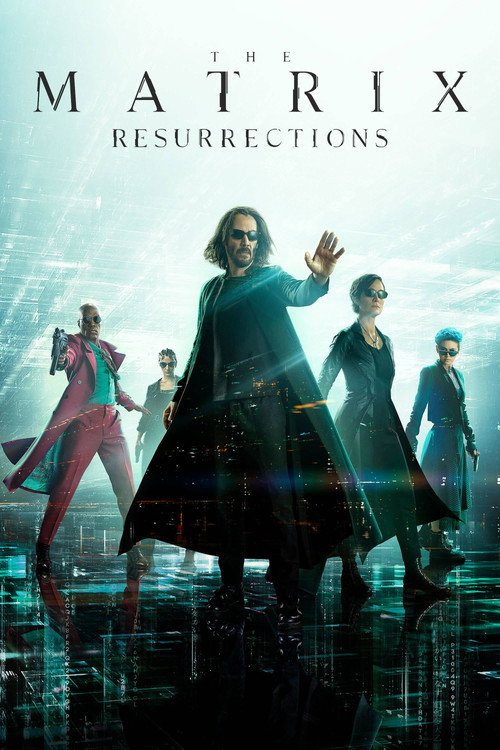
The Matrix Resurrections
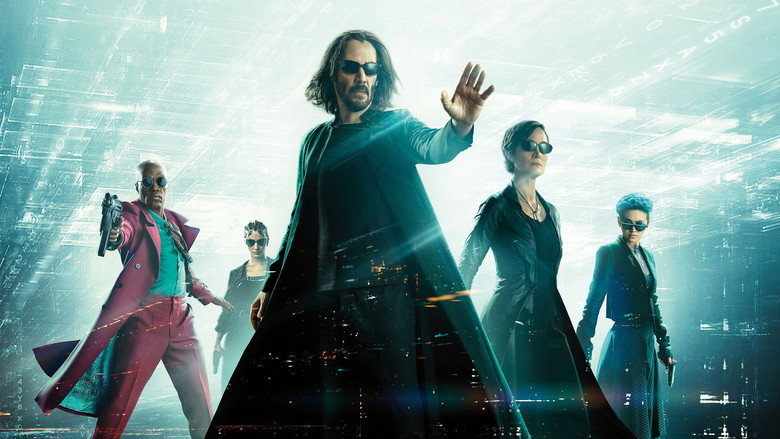
A neon-lit meta-fable of memory and longing, tender and mischievous, in which a man's reflection in a cracked mirror turns out to be a door and love is the code that keeps it open.
The Matrix Resurrections

The Matrix Resurrections

"Return to the Source."

16 December 2021 United States of America 148 min 6.3 (6,833)

Director: Lana Wachowski

Cast: Keanu Reeves, Carrie-Anne Moss, Yahya Abdul-Mateen II, Jonathan Groff, Jessica Henwick

Action Adventure Science Fiction Love and connection as liberation Nostalgia, sequels and corporate storytelling Control, manipulation and free will Identity, memory and grief Shared heroism and new generations
Budget: $190,000,000
Box Office: $156,497,322

Overview

The Matrix Resurrections (2021) is the fourth film in the Matrix series and a sequel to The Matrix Revolutions (2003). Lana Wachowski directed it and co-wrote it with David Mitchell and Aleksandar Hemon. Keanu Reeves and Carrie-Anne Moss return as Neo and Trinity, and the cast adds Yahya Abdul-Mateen II, Jonathan Groff, Neil Patrick Harris and Jessica Henwick.

Neo is living as Thomas Anderson, a celebrated video game designer. He is famous for a trilogy of games called The Matrix, and he is haunted by dreams that feel more like memories. He sees a therapist, takes blue pills, and keeps running into a woman at a coffee shop who seems strangely familiar. Meanwhile a hacker named Bugs notices that the Matrix is replaying old code, and she sets out to find the man she believes is Neo.

The film comes back to the franchise with humor, self-awareness and a sense of mourning. It questions why stories get remade, who controls them, and what it means to choose for yourself while being fed a script. The tone is more playful than the earlier films, and it is as interested in love and grief as in action.
Core Meaning

The film is about reclaiming a story from the machinery that exploits it, whether that machinery is a studio, a market or a simulation. Wachowski has said she made the film to process grief, and the film turns that grief into a case for love and connection. It argues that feelings are the most powerful force in any system, and that this is why systems try to manipulate them.

The Analyst runs his Matrix on desire and fear, keeping Neo and Trinity close but apart. Neo and Trinity win by choosing each other and by refusing to be cast as tools of the system. The film suggests that real freedom comes from questioning what you want and why, and from an equal partnership, not from a lone chosen savior.

Thematic DNA

Love and connection as liberation 30%
Nostalgia, sequels and corporate storytelling 25%
Control, manipulation and free will 20%
Identity, memory and grief 15%
Shared heroism and new generations 10%

Love and connection as liberation

The Analyst learned that Neo and Trinity are not special on their own. Together they can break the Matrix, and love is the force that the system exploits and cannot fully contain. Their reunion is the film's emotional core.

Nostalgia, sequels and corporate storytelling

The film is openly meta. Smith jokes that Warner Bros. wants a sequel to the trilogy, and Neo's game studio is told to produce a new installment. The film comments on its own existence while also delivering the nostalgia it criticizes.

Control, manipulation and free will

The Analyst's Matrix works by manipulating feelings, which he says are easier to control than facts. Trinity asks how anyone can know whether they want something or were programmed to want it.

Identity, memory and grief

Thomas and Tiffany are shells of Neo and Trinity. Reclaiming their real selves is a form of transition and self-recognition. The film also grows out of Wachowski's own grief at losing loved ones.

Shared heroism and new generations

Bugs, Sati, Lexy and the Synthients show that the revolution does not belong to one chosen man. Trinity becomes an equal power, and the story moves toward collective agency.

Character Analysis

Neo / Thomas Anderson

Keanu Reeves

Archetype: Reluctant hero Key Trait: Doubting but devoted

Motivation

To rescue Trinity and be reunited with her.

Character Arc

He begins as a famous game designer who doubts his own mind. He is pulled out of the Matrix, relearns his powers, and fights for Trinity. In the end he accepts that he is stronger as a partner than as a lone savior.

Trinity / Tiffany

Carrie-Anne Moss

Archetype: Awakened partner Key Trait: Fearless

Motivation

To discover who she truly is and to be with Neo.

Character Arc

She lives as Tiffany, a wife and mother who rides motorcycles. She realizes she is not Tiffany, chooses to leave, and frees her own mind. She then gains her own powers, including flight.

All 5 characters and cast

Symbols & Motifs

The mirror

Meaning:

Self-recognition and the doorway between false and true selves.

Context:

Mirrors act as portals in the Matrix. Neo's reflection is a way out, and a mirror is how Bugs's crew reaches him.

Pills and pods

Meaning:

Comfort against truth, and the ways people are kept docile.

Context:

Thomas takes blue pills prescribed by his therapist. Morpheus offers a red pill, and Neo wakes in a pod with Trinity in the pod beside him.

The Analyst's bullet-time and Swarm mode

Meaning:

Control through spectacle, and conformity weaponized.

Context:

The Analyst's new feature slows the humans jacked in. Swarm mode turns everyone in the Matrix into a threat against Neo and Trinity.

The motorcycle

Meaning:

Trinity's lost freedom and her real identity.

Context:

Tiffany works on motorcycles in her spare time. Neo and Trinity escape the Analyst's swarm on one.

Flight

Meaning:

Liberation of the mind, now shared between two people.

Context:

Trinity discovers she can fly. In the final scene she and Neo fly over the city as equals.

The video game within the film

Meaning:

The reduction of a meaningful story to a product.

Context:

Thomas Anderson is the designer of a trilogy of games called The Matrix. Bugs says his story was turned into something trivial.

Memorable Quotes

Quietly yearning for what you don't have, while dreading losing what you do.
— The Analyst

Context

He explains how his version of the Matrix works.

Meaning

It sums up his model of control. Desire and fear keep people docile.

You know the difference between us, Tom? Anyone could have been you, whereas I've always been anyone.
— Smith

Context

Smith talks with Neo in their business setting at the start.

Meaning

It points to the mismatch between the lone chosen one and Smith's ability to be anyone.

All 7 quotes

Philosophical Questions

Can you tell whether your desires are your own?

Trinity asks how anyone knows if they want something or were programmed to want it. The Analyst's Matrix runs on manipulated desire and fear, and the film suggests that self-awareness is a first step toward freedom.

Who owns a story once it is told?

Neo's life story becomes a video game and a corporate property. The film asks whether stories belong to their creators, their audiences, or the companies that sell them.

Are feelings more real than facts?

The Analyst says feelings validate fiction and are easier to control than facts. The film answers by showing love as a force that can survive manipulation.

Is a chosen one necessary?

The film moves from a lone savior to a pair, and then to a wider community of rebels, suggesting that liberation is collective.

How It Ends

Alternative Interpretations

Meta-commentary: Some read the film mainly as Wachowski's commentary on studio-driven sequels, with the story as a way to reclaim the franchise.

Full ending explanation

Cultural Impact

Resurrections arrived 18 years after the end of the trilogy, in an era when franchises are routinely revived. The film openly comments on that practice, and Smith jokes about Warner Bros. wanting a sequel. It also reflects Lana Wachowski's own history. She came out as a trans woman, and some critics read the film's treatment of Thomas and Tiffany as speaking to transition and self-recognition.

Critical response was divided. Rotten Tomatoes lists the film at 63%, and its consensus describes a film that lacks the original's bracing craft but revisits the world with wit, a timely perspective, and heart. Reviews were mixed on the action, with some critics calling the setpieces perfunctory. Others praised its ambition and its meta-commentary.

Commercially, the film underperformed. It opened against Spider-Man: No Way Home, was released at the same time on HBO Max, and arrived during an Omicron surge. A Matrix 5 is reported to be in development, though the film's mixed reception posed challenges.

Audience Reception

Audiences were divided, and the Rotten Tomatoes audience score was 63%, close to the critics' score. Viewers praised the heart, the romance between Neo and Trinity, and the humor. Many liked the meta-commentary, and some audience reviews called it a better ending than the third film.

Criticism focused on action that felt less inventive than the original, a goofy tone, and a self-aware approach that casually dismisses its own lore. Some thought it had no memorable setpieces. Others thought the marketing promised more epic action than the film delivered. The overall verdict was that it falls short of the original but is a bold, personal and entertaining return.

Interesting Facts

  • The Matrix Resurrections was directed by Lana Wachowski without her sister Lilly, and was co-written with David Mitchell and Aleksandar Hemon.
  • After Revolutions, the Wachowskis had denied the possibility of another Matrix film. A fourth film was announced in late 2019.
  • Wachowski considered abandoning the film but was encouraged by the cast to finish it.
  • Lana Wachowski said that she returned to the Matrix to process grief after losing her parents and a close friend.
  • The film grossed about $160.2 million worldwide against a $190 million production budget.
  • Producer James McTeigue was first assistant director on the first three Matrix films and produced Resurrections. He has said that Warner Bros. had been developing another Matrix sequel without the Wachowskis.
  • Production designer Peter Walpole said that San Francisco's light and fog helped create a more natural, less calculated look. He also said he planted a few Easter eggs.
  • Much of Sense8's behind-the-scenes crew, including Aleksandar Hemon, John Toll and Joseph Jett Sally, followed Lana Wachowski to Resurrections.
  • Lana Wachowski has described the film's tone as deliberately varied, adding comedy as another dimension for the Matrix.
  • Tiffany's husband is played by Reeves's stunt double from the original Matrix, who is also the director of John Wick.

Easter Eggs

A movie theater banner in the opening chase shows a film linked to Sense8.

It is a nod to Lito Rodriguez, a character from the Wachowskis' series Sense8, and reflects the crew overlap between the two projects.

The film repeats lines and framings from the original, and intercuts footage from the trilogy.

The identically-framed shots and repeated dialogue show how Resurrections replays the original code in a loop, as Bugs notices in the story.

The Alice in Wonderland references return.

The first Matrix was loaded with references to the book. They suggest that Neo, like Alice, is stuck in a dream world.

A cameo by Breed, who helped secure permits for the film's key setpieces.

It was Wachowski's way of saying thank you to the person who helped secure permits.

Production designer Peter Walpole planted recognizable props in a scene.

He said he included a few Easter eggs, which fits the film's habit of hiding callbacks for fans.

Frequently Asked Questions

Explore More About This Movie

Dive deeper into specific aspects of the movie with our detailed analysis pages

Comments (0)

Leave a comment

No comments yet. Be the first to share your thoughts!

Similar Movies