
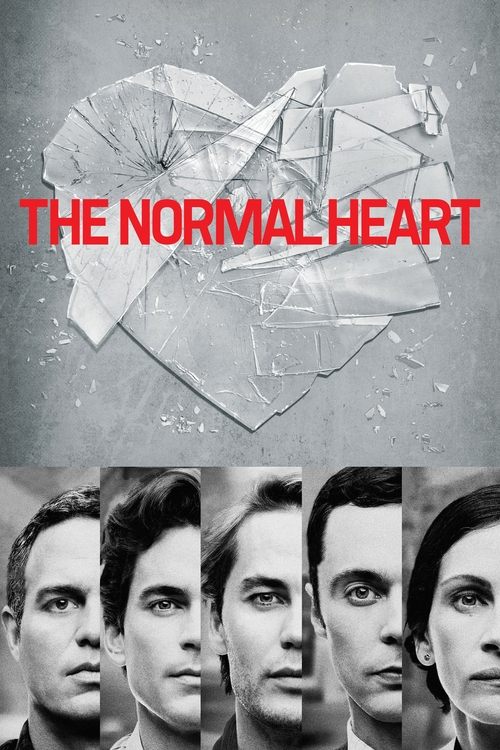
The Normal Heart
"To win a war, You have to start one"
Overview
Set in New York City between 1981 and 1984, the film chronicles the onset of the HIV/AIDS crisis through the eyes of Ned Weeks, a writer and activist based on playwright Larry Kramer. As a mysterious cancer begins killing gay men, Ned joins forces with Dr. Emma Brookner, a polio survivor and physician who is one of the few medical professionals taking the epidemic seriously.
Ned helps found the Gay Men's Health Crisis (GMHC) but finds himself at odds with the group's president, Bruce Niles, and the board over his confrontational tactics. While fighting for government recognition and funding, Ned falls in love with Felix Turner, a closeted fashion reporter for The New York Times. The film depicts their tragic romance alongside the escalating political battle against a backdrop of fear, denial, and mounting death tolls.

Core Meaning
At its heart, The Normal Heart is a scream against silence and apathy. It posits that silence equals death and that anger is a necessary, life-saving response to injustice. The film argues for the recognition of gay culture as something profound and worthy of preservation, transcending mere sexuality, while exposing the institutional failures that allowed a generation to perish.
Thematic DNA
The Politics of Activism
The film explores the tension between radical confrontation (represented by Ned) and diplomatic caution (represented by Bruce). It questions which method is effective in the face of a crisis, ultimately suggesting that while diplomacy keeps the peace, only loud, disruptive activism forces the world to pay attention.
Love Amidst Plague
Through Ned and Felix's relationship, the film asserts that gay love is equal to any other. Their romance serves as the emotional anchor, transforming statistics into a personal tragedy and challenging the dehumanization of victims.
The Closet as a Prison
Many characters, including Bruce and Felix (initially), are terrified of being outed, fearing the loss of their careers and social standing. The film portrays the closet not just as a personal choice but as a dangerous barrier to political organization and survival.
Institutional Apathy
The government, the medical establishment, and the media are depicted as willfully negligent. The film illustrates how systemic homophobia allowed the virus to spread unchecked, viewing the victims as expendable.
Character Analysis
Ned Weeks
Mark Ruffalo
Motivation
To save his friends' lives and force the world to acknowledge the humanity of gay men.
Character Arc
Ned starts as an angry observer and becomes the reluctant leader of a movement. His combative nature alienates his allies, leading to his expulsion from the very group he founded. He ends the film battered but unbroken, witnessing the next generation's freedom at Yale.
Felix Turner
Matt Bomer
Motivation
To love Ned and to live his truth before he dies.
Character Arc
Felix transforms from a closeted, polished professional into a physically ravaged but emotionally open man. His physical decline serves as the film's most visceral representation of the disease's horror.
Dr. Emma Brookner
Julia Roberts
Motivation
To stop the virus and protect her patients, driven by her own experience with disability.
Character Arc
A polio survivor who recognizes the epidemic early. She moves from clinical frustration to fierce advocacy, pushing Ned to lead when she cannot.
Bruce Niles
Taylor Kitsch
Motivation
To manage the crisis without destroying his life or career; to maintain 'normalcy'.
Character Arc
A closeted ex-Green Beret who leads with caution. He clashes with Ned, fearing exposure. By the end, the tragedy strikes him personally, but he remains a tragic figure trapped by fear.
Symbols & Motifs
Tommy's Rolodex
The Rolodex represents the accumulating human cost of the epidemic. As friends die, Tommy silently removes their cards and bands them together.
It appears throughout the film in Tommy's office. The final shot reveals a drawer overflowing with banded cards, including those of key characters, serving as a silent, devastating memorial.
The White Envelope / Sack of Groceries
Symbolizes the abject rejection and fear surrounding the sick. It highlights how the victims were treated as hazardous waste rather than human beings.
When a friend dies in the hospital, the staff refuses to handle the body. He is unceremoniously stuffed into a garbage bag, and his partner is left to dispose of him like trash.
Fire Island vs. The City
Represents the stark contrast between the freedom of the past and the terror of the present. The island is initially a paradise of sexual liberation, which transforms into a site of collapse and fear.
The film opens with a lush, sun-drenched sequence on Fire Island, which stands in grim juxtaposition to the cold, sterile, and dark interiors of the hospitals and subway cars later in the film.
Memorable Quotes
Men do not naturally not love.
— Ned Weeks
Context:
Spoken during a television interview where he tries to humanize the gay community to the general public.
Meaning:
Ned challenges the stereotype that gay men are only interested in sex, arguing that their capacity for love is innate and profound.
I belong to a culture that includes Proust, Henry James, Tchaikovsky, Cole Porter, Plato, Socrates, Aristotle... These are not invisible men!
— Ned Weeks
Context:
During a heated argument where he tries to explain why their fight is about more than just sexual freedom.
Meaning:
A defiant assertion of gay identity and history. Ned claims his place in a lineage of greatness to combat the erasure of his people.
We could all be dead before you do anything!
— Dr. Emma Brookner
Context:
Emma yells this at the government board that refuses to fund her research.
Meaning:
Captures the desperate urgency of the medical crisis against the slow pace of bureaucracy.
Philosophical Questions
Does the end justify the means in activism?
The film juxtaposes Ned's aggression with Bruce's diplomacy. It asks whether it is better to be polite and survive, or loud and risk everything for the truth.
What is the moral obligation of the bystander?
Through the character of Ned's brother, Ben, the film explores the guilt and responsibility of those who love the oppressed but refuse to fully join their fight.
Alternative Interpretations
Some critics view Ned Weeks not as a hero, but as a flawed protagonist whose abrasive personality actually hindered the cause in the short term, despite being historically vindicated. The film can be read as a tragedy of internal conflict, where the community's inability to unite was as damaging as the virus itself. Another interpretation focuses on the erasure of sexuality, questioning if the film's emphasis on "romantic love" (to appeal to mainstream audiences) sanitizes the sexual liberation that was central to the gay rights movement of the 70s.
Cultural Impact
Released on HBO, The Normal Heart brought Larry Kramer's seminal play to millions who would never see a stage production. It reignited discussions about the early years of the AIDS crisis and the government's failure. Coming out in 2014, amidst the push for marriage equality, it provided crucial historical context for the modern LGBTQ+ rights movement, reminding the world of the generation lost to pave the way. It won the Emmy for Outstanding Television Movie.
Audience Reception
Audiences were deeply moved, with many praising the raw emotional power and the chemistry between Ruffalo and Bomer. The "shower scene" and the "wedding scene" are frequently cited as tear-jerkers. Critics praised the acting universally but were divided on Ryan Murphy's direction; some found it overly stylized or melodramatic (flashing lights, horror-movie aesthetics), while others felt the visual flair elevated the stage play. The film holds a high rating on Rotten Tomatoes.
Interesting Facts
- Matt Bomer lost 40 pounds for the role of Felix to realistically portray the ravages of AIDS, stopping production for months to achieve the weight loss.
- The film took nearly 30 years to get made; Barbra Streisand held the rights for decades but couldn't get it financed.
- Mark Ruffalo's character, Ned Weeks, is a direct stand-in for the playwright Larry Kramer.
- Jim Parsons reprised his role as Tommy Boatwright from the 2011 Broadway revival.
- The film was shot in 21 days, a remarkably short schedule for such a period piece.
Easter Eggs
The Yale Reunion
The ending at Yale is based on a real event (Gay Week at Yale). It serves as a bittersweet glimpse of the future generation reaping the benefits of the activism that cost the characters their lives.
The Title
The title comes from W.H. Auden's poem 'September 1, 1939': 'The windsiest militant trash / Important Persons shout / Is not so crude as our wish: / What mad Nijinsky wrote / About Diaghilev / Is true of the normal heart; / For the error bred in the bone / Of each woman and each man / Craves what it cannot have, / Not universal love / But to be loved alone.'
⚠️ Spoiler Analysis
Click to reveal detailed analysis with spoilers
Frequently Asked Questions
Explore More About This Movie
Dive deeper into specific aspects of the movie with our detailed analysis pages
Comments (0)
No comments yet. Be the first to share your thoughts!