
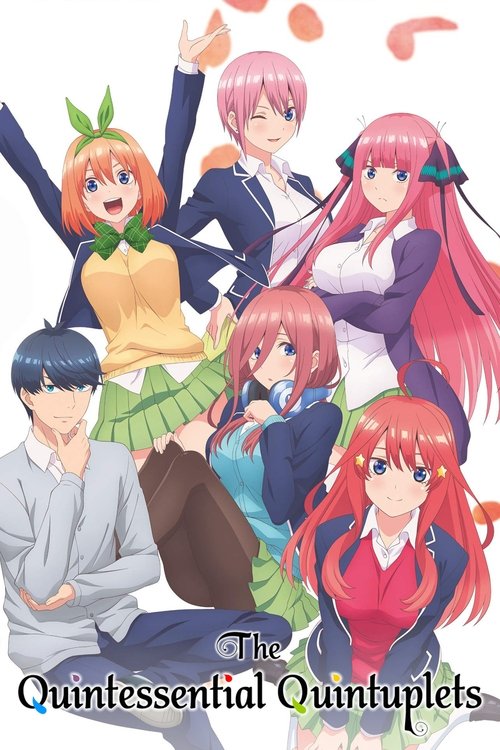
The Quintessential Quintuplets
A heartfelt romantic comedy that blossoms like five identical flowers on a single branch, each vying for the sun in a warm, poignant, and often hilarious whirlwind of love and self-discovery.
The Quintessential Quintuplets

The Quintessential Quintuplets

五等分の花嫁

11 January 2019 — 26 March 2021 Japan 2 season 24 episode Ended ⭐ 8.5 (725)
Cast: Yoshitsugu Matsuoka, Kana Hanazawa, Ayana Taketatsu, Miku Ito, Ayane Sakura
Drama Animation Comedy
Individuality vs. Shared Identity Past Grievances and Forgiveness The Nature of Love and Support Growth and Self-Improvement

Overview

"The Quintessential Quintuplets" follows Futaro Uesugi, a brilliant but impoverished high school student who takes on a lucrative tutoring job to pull his family out of debt. He is horrified to discover his students are his new classmates: the identical, beautiful, yet academically hopeless Nakano quintuplets—Ichika, Nino, Miku, Yotsuba, and Itsuki. Initially, the sisters want nothing to do with him or their studies, presenting a formidable challenge to the pragmatic Futaro.

As the series progresses across two seasons and a concluding movie, Futaro's relationship with each sister deepens beyond that of a tutor and his students. He navigates their complex personalities, helps them overcome personal insecurities, and fosters in them a desire to learn and succeed. The story is told as a flashback, framed by the revelation that Futaro will eventually marry one of the five sisters, creating a central mystery that invites viewers to guess the identity of the bride as each quintuplet grows, changes, and falls for him in her own unique way.

Core Meaning

The core meaning of "The Quintessential Quintuplets" revolves around the idea that love is not just a matter of fate, but an accumulation of shared moments, genuine connection, and mutual support. It posits that true love is found in recognizing the subtle but crucial differences in individuals who may seem identical on the surface. The series champions the themes of personal growth, the importance of family bonds, and the difficult but necessary journey of moving on from the past to forge one's own future. Ultimately, it conveys that love is an active choice, built on a foundation of shared experiences and unwavering support, rather than a predetermined destiny.

Thematic DNA

Individuality vs. Shared Identity 35%
Past Grievances and Forgiveness 30%
The Nature of Love and Support 25%
Growth and Self-Improvement 10%

Individuality vs. Shared Identity

As identical quintuplets, the Nakano sisters initially struggle to establish their own identities. Throughout the series, they adopt different hairstyles, accessories, and hobbies to differentiate themselves. Their journey is about learning to be individuals while still cherishing their shared bond as sisters. This theme is central to their character development and their individual relationships with Futaro, who makes a point of learning to tell them apart not just by their appearance, but by their unique personalities.

Past Grievances and Forgiveness

The past plays a significant role in the quintuplets' lives, particularly a childhood encounter one of them had with Futaro. This event shapes their present motivations and creates underlying tensions. Yotsuba, for example, carries a heavy burden of guilt from the past, which influences her selfless-to-a-fault personality. The series explores how the characters must confront, understand, and ultimately forgive themselves and each other to move forward and find happiness.

The Nature of Love and Support

The series presents love in various forms: familial, platonic, and romantic. It questions what it means to truly love and support someone. Initially, the sisters' bond is tested by their romantic rivalry for Futaro. However, they eventually learn that supporting a sister's happiness, even if it means sacrificing their own, is a profound expression of love. Futaro's role as a tutor evolves into one of genuine support for their dreams, separate from any romantic outcome.

Growth and Self-Improvement

The entire premise is built on the theme of growth. The quintuplets must grow academically to graduate, but their more significant development is emotional and personal. Miku learns to find her confidence, Nino learns to be honest with her feelings, and Ichika grapples with the responsibilities of being the eldest. Futaro also grows from a cold, socially isolated student into someone who deeply values his connections with others.

Character Analysis

Futaro Uesugi

Yoshitsugu Matsuoka

Archetype: The Mentor/The Cynic with a Heart of Gold
Key Trait: Academically brilliant but socially inept

Motivation

Initially, his sole motivation is to earn money to relieve his family's massive debt. As the story progresses, this motivation shifts. He develops a genuine desire to see the quintuplets succeed and graduate, and later, to understand his own complex feelings for them and choose a future with one of them.

Character Arc

Futaro begins as a cold, anti-social, and purely transactional individual, focused solely on his grades and earning money. His journey tutoring the quintuplets forces him to engage with others' emotions and problems. He slowly transforms from seeing the sisters as a mere job to cherishing them as individuals and friends. By the end of the series, he learns the value of love, connection, and companionship, evolving into a much more emotionally aware and caring person who makes his final choice based on love rather than obligation or logic.

Ichika Nakano

Kana Hanazawa

Archetype: The Responsible Elder Sister/The Temptress
Key Trait: Teasing and cunning

Motivation

Her motivation is a constant struggle between her desire to be a responsible older sister and her personal desire for Futaro's love. She feels immense pressure to be the mature one, which she later tries to shed in order to pursue her own happiness.

Character Arc

As the eldest, Ichika initially acts as a mature, supportive sister, often teasing Futaro but also helping him connect with the others. Her arc becomes complicated when her love for Futaro conflicts with her sisterly duty. This leads to a controversial period where she acts selfishly, using deceit to get ahead—a phase fans dubbed her "snake" arc. However, she ultimately realizes her mistake, atones for her actions, and reverts to a supportive role, prioritizing her sisters' happiness and her own dream of becoming an actress.

Nino Nakano

Ayana Taketatsu

Archetype: The Tsundere/The Loyalist
Key Trait: Sharp-tongued but fiercely loving

Motivation

Initially, her motivation is to protect the status quo and keep the five sisters together, viewing Futaro as an outsider. After falling in love, her motivation becomes winning his affection with unwavering, direct honesty, abandoning all pretense and games.

Character Arc

Nino starts as the most hostile of the quintuplets, actively trying to sabotage Futaro's tutoring efforts out of a fierce, protective love for her sisters and a desire to maintain their bond. Her character undergoes one of the most significant developments in the series. After realizing her feelings for Futaro, she does a complete 180, becoming fiercely direct, honest, and aggressive in her romantic pursuit. She sheds her hostile exterior to become arguably the most proactive and emotionally honest character.

Miku Nakano

Miku Ito

Archetype: The Shy Girl/The Deredere
Key Trait: Shy and history-obsessed

Motivation

Her primary motivation is to win Futaro's affection and be seen by him as an equal, not just a student. This drives her to overcome her shyness and insecurities, pushing her to take actions she never would have dared to before.

Character Arc

Miku is initially quiet, reserved, and has very low self-esteem, communicating her thoughts and feelings with difficulty. She is the first sister to fall for Futaro. Her love for him becomes the catalyst for her personal growth. Throughout the series, she learns to be more confident, to voice her opinions, and to compete for what she wants. She takes up cooking to impress him and strives to improve herself, transforming from a passive girl into a determined young woman.

Yotsuba Nakano

Ayane Sakura

Archetype: The Genki Girl/The Martyr
Key Trait: Energetic and selfless

Motivation

Her motivation is twofold and contradictory. Outwardly, she is motivated by a selfless desire to make her sisters happy. Internally, this is driven by a deep sense of guilt, which makes her feel she must atone by sacrificing her own desires. She has loved Futaro the longest, since a childhood encounter, but hides it out of this sense of obligation.

Character Arc

Yotsuba is presented as the cheerful, athletic, and unfailingly helpful sister who always supports Futaro from the very beginning. Her arc reveals this energetic persona masks deep-seated guilt and self-loathing over a past failure that caused her sisters to transfer schools. She believes she doesn't deserve happiness and dedicates herself to supporting her sisters' dreams, actively suppressing her own long-held feelings for Futaro. Her journey is about learning to forgive herself, accept her own worth, and finally allow herself to pursue her own happiness.

Symbols & Motifs

The Bell of Vows

Meaning:

The Bell of Vows symbolizes fate, romantic destiny, and pivotal moments in a relationship. According to legend, couples who kiss under this bell during the school trip's campfire will be bound together forever.

Context:

During a school trip, Futaro is accidentally kissed by one of the disguised quintuplets under the Bell of Vows. This event becomes a major point of mystery and foreshadowing, as the identity of the "bell kisser" is kept secret for a large portion of the story, fueling speculation about who the final bride will be.

The Quintuplets' Individual Accessories

Meaning:

Each sister's unique accessory (Ichika's earring, Nino's butterfly ribbons, Miku's headphones, Yotsuba's ribbon, Itsuki's star hairpins) symbolizes their burgeoning individuality and their conscious effort to distinguish themselves from one another.

Context:

These items are constant visual cues that help Futaro and the audience tell the sisters apart. They represent the personalities each sister has cultivated. Nino changing her hairstyle, for example, marks a significant turning point in her character arc, signifying her resolve to move forward.

Rena (Disguise)

Meaning:

The character of "Rena" represents the past and the idealized memory of a first love. It symbolizes an unresolved connection that ties Futaro to one of the quintuplets from their childhood.

Context:

Itsuki initially dons a disguise and calls herself Rena to interact with Futaro and return a charm he lost. This persona is based on the girl Futaro met in Kyoto five years prior. It is later revealed that Yotsuba was the original girl, and she asked Itsuki to play the part of Rena to cut ties with the past, adding a layer of tragic sacrifice to Yotsuba's character.

Memorable Quotes

I... I can't lie to Uesugi-san... I've always loved you.

— Yotsuba Nakano

Context:

This quote is from the final arc during the school festival, right after Futaro has chosen her. Despite her initial attempts to reject him for her sisters' sake, Futaro's persistence leads to this raw, emotional admission.

Meaning:

This is the pivotal confession of the series. After trying to suppress her feelings for the entire story out of guilt and a desire for her sisters to be happy, Yotsuba finally breaks down and admits her true, long-held love for Futaro. It's the culmination of her entire character arc.

Make the choice you won't regret, because things won't keep going like this forever.

— Ichika Nakano

Context:

Ichika says this line, reflecting on the escalating romantic tension between the sisters and the fact that a choice must eventually be made, by both Futaro and the sisters themselves. It foreshadows the end of their carefree school days.

Meaning:

This line encapsulates the bittersweet reality that the quintuplets and Futaro face. Their current situation is temporary, and they must all make difficult decisions about their futures and their relationships. It reflects Ichika's maturity and her understanding of the fleeting nature of their time together.

Even you might find someone you love in the future, Uesugi-san. And when that happens, no matter who you love... I'll always be on your side, supporting you with everything I've got!

— Yotsuba Nakano

Context:

Yotsuba says this to Futaro early in the series, establishing her role as his number one supporter. It's a key moment that highlights her character's core conflict: her selfless support versus her hidden personal desires.

Meaning:

This quote perfectly illustrates Yotsuba's seemingly selfless nature. It's deeply ironic because she is already in love with him, but she is willing to suppress her feelings completely to ensure his happiness, even if it's with one of her sisters.

Episode Highlights

The Photo That Started It All

S1E8

This episode delves into Futaro's past, revealing he met one of the quintuplets in Kyoto five years ago. This girl, whose identity is unknown to him, had a profound impact on his decision to become a diligent student. This revelation adds a significant layer of mystery and destiny to the plot.

Significance:

It establishes the "girl from the past" subplot, a crucial element of the central mystery. It shifts the dynamic from a simple tutoring job to a story with deep-rooted connections, making the audience question which of the five sisters shares this history with Futaro.

Seven Goodbyes Part 3

S2E4

Following a major argument, Nino and Itsuki move out. Futaro works to reunite the five sisters, culminating in a powerful moment where they move into a new, smaller apartment together, reaffirming their bond. Nino also comes to terms with her feelings for Futaro in this arc.

Significance:

This episode solidifies the theme that the sisters' bond is paramount. It marks a huge turning point for Nino's character, as she begins to see Futaro in a new light, setting the stage for her dramatic confession later. It also shows Futaro's growing emotional investment in the family's well-being.

Scrambled Eggs

S2E8

During a family trip to a hot springs inn, the quintuplets repeatedly disguise themselves as Itsuki, creating a chaotic and comedic scenario for Futaro. The episode culminates in the mysterious "bell kisser" moment, where one of the sisters kisses Futaro under the Bell of Vows.

Significance:

This is one of the most pivotal episodes in the entire series. The "bell kisser" becomes a central mystery, second only to the identity of the bride. It's a moment of fated romance that heavily influences the final act of the story.

Sisters' War: Part 2

S2E12

The season two finale brings the romantic rivalry to a fever pitch during the school trip. Ichika's deceptive tactics are exposed, and Nino delivers a second, stunningly direct confession to Futaro. The episode ends with all five sisters having confessed in their own way, leaving Futaro to ponder his choice.

Significance:

It's the climax of the romantic conflict built up over two seasons. All cards are on the table, setting the stage for the final decision in the movie. It resolves Ichika's controversial arc and showcases Nino's incredible character growth.

The Quintessential Quintuplets Movie

SE

Serving as the grand finale, the movie adapts the final arcs of the manga, focusing on the last school festival. Each sister gets a chance to have a final, meaningful interaction with Futaro before he makes his ultimate decision. The film reveals who he chooses and culminates in their wedding five years later.

Significance:

It provides the definitive conclusion to the entire series. The movie resolves the central mystery of who the bride is, gives each character a satisfying emotional send-off, and reinforces the series' core themes of love, family, and growth.

Philosophical Questions

Is love a product of fate or the accumulation of shared time?

The series constantly plays with this question. Futaro's past encounter with one of the quintuplets and the legend of the Bell of Vows suggest a fated connection. However, the narrative spends the majority of its time emphasizing the day-to-day interactions, the struggles, the support, and the emotional bonds Futaro builds with each sister in the present. The ending suggests that while fate might create a starting point, it is the conscious effort, shared experiences, and genuine connection forged over time that truly define love.

What is the balance between familial duty and individual desire?

This is a core conflict for all the sisters. They deeply love each other and feel a duty to maintain their bond. However, they all fall in love with the same person, forcing them to navigate the treacherous waters of romantic rivalry. Ichika's arc directly explores the negative consequences of prioritizing personal desire dishonestly, while Yotsuba's arc shows the self-destructive nature of completely sacrificing one's desires for the sake of others. The series concludes that a healthy balance is needed, where one can be true to their own feelings while still respecting and loving their family.

Alternative Interpretations

A major point of contention and alternative interpretation among the fanbase revolves around the series' ending. While the story concludes with Futaro marrying Yotsuba, a significant portion of the audience felt this outcome was underdeveloped compared to the character arcs of other sisters, particularly Nino and Miku. Critics of the ending argue that Yotsuba spent too much of the series as a background or purely supportive character, with her crucial backstory and feelings revealed very late in the narrative.

This has led to the interpretation that the choice was based more on the "first girl" trope (as Yotsuba was the girl Futaro met in his past) rather than on the romantic and personal growth demonstrated throughout the present-day story. Many fans have written extensive analyses arguing why Miku, who grew the most as a person because of her love for Futaro, or Nino, whose direct and passionate pursuit was a highlight of the series, would have been more satisfying choices. These alternative readings suggest the story could be interpreted not just as a romance, but as a tragedy for the sisters who underwent immense personal development only to have their love unrequited.

Cultural Impact

"The Quintessential Quintuplets" is widely regarded as one of the most significant and popular romantic comedy anime of the late 2010s and early 2020s. It revitalized the harem genre by presenting a compelling mystery and focusing heavily on the genuine character development of each female lead, making them more than just romantic options. The series garnered a massive and highly engaged fanbase, leading to fierce online debates and "waifu wars" over which sister was the "best girl" and most deserving bride.

Its most significant legacy within the genre is its commitment to a definitive ending. Unlike many harem series that leave the romantic conclusion ambiguous to appease all fans, "The Quintessential Quintuplets" provides a clear and final choice, bringing the story to a conclusive end with the movie. This narrative decisiveness was praised by many for respecting the story's integrity. The series has had a lasting impact on pop culture, spawning vast amounts of merchandise, figures, and collaborations, and solidifying its place as a modern classic in the rom-com anime landscape.

Audience Reception

The audience reception for "The Quintessential Quintuplets" was overwhelmingly positive, though it evolved and faced some points of contention. Season 1 was well-received for its charming premise and for introducing the lovable quintuplets. However, the animation by Tezuka Productions was sometimes criticized.

Season 2, with Bibury Animation Studios at the helm, saw a notable change in art style that was largely praised for being more fluid and closer to the manga's aesthetic. The story in the second season was acclaimed for its deeper character development, particularly for Nino, whose transformation from antagonist to devoted romantic lead made her a massive fan favorite. Conversely, Ichika's actions during the "Sisters' War" arc were highly controversial, sparking intense debate among viewers.

The movie finale and the manga's ending were the most divisive aspect of the series. While many were satisfied with the conclusive ending, the choice of Yotsuba as the bride was met with a mixed reaction. Many fans felt her victory was unearned compared to the extensive development given to sisters like Miku and Nino, leading to widespread and passionate online discussions that continue long after the series' conclusion. Despite the debate, the series as a whole is remembered fondly as a standout in its genre.

Interesting Facts

  • The creator of the original manga, Negi Haruba, chose his pen name as a tribute to Negi Springfield, the main character of the manga 'Negima! Magister Negi Magi'.
  • The animation studio changed between seasons. Season 1 was produced by Tezuka Productions, while Season 2 and the concluding movie were handled by Bibury Animation Studios, leading to a noticeable shift in art style and character designs.
  • Negi Haruba won the award for Best Shōnen Manga at the 43rd Kodansha Manga Awards in 2019 for 'The Quintessential Quintuplets'.
  • The original manga ran from August 2017 to February 2020 in Kodansha's Weekly Shōnen Magazine, concluding in 14 volumes.
  • Ayana Taketatsu, the Japanese voice actress for Nino, is married to Yuki Kaji, a prominent voice actor known for roles like Eren Yeager in 'Attack on Titan'.

⚠️ Spoiler Analysis

Click to reveal detailed analysis with spoilers

Frequently Asked Questions

Explore More About This Movie

Dive deeper into specific aspects of the movie with our detailed analysis pages

Comments (0)

Leave a comment

No comments yet. Be the first to share your thoughts!