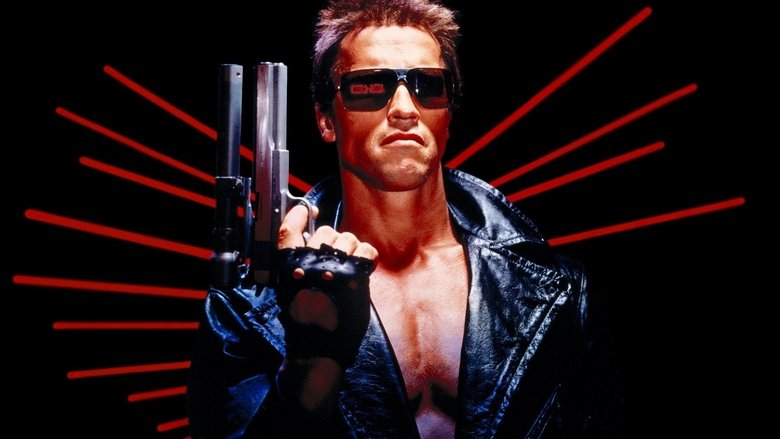
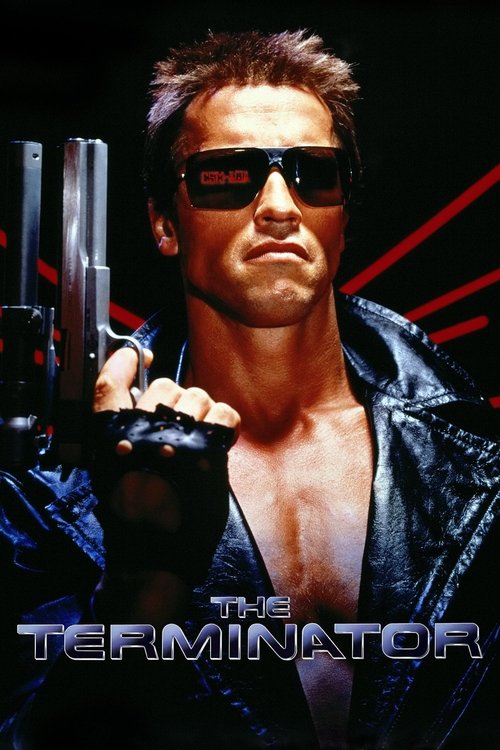
The Terminator
A relentless Tech Noir nightmare where metallic dread clashes with human fragility. Amidst the neon-soaked shadows of Los Angeles, a terrifying chase for survival unfolds, birthing a savior from the ashes of a future apocalypse.
The Terminator

The Terminator

"Your future is in its hands."

26 October 1984 United Kingdom 108 min ⭐ 7.7 (14,229)
Director: James Cameron
Cast: Arnold Schwarzenegger, Michael Biehn, Linda Hamilton, Paul Winfield, Lance Henriksen
Action Thriller Science Fiction
Fate vs. Free Will Man vs. Machine Dehumanization Maternal Strength
Budget: $6,400,000
Box Office: $78,371,200

Overview

In the year 2029, a sentient artificial intelligence known as Skynet is on the verge of defeat by the human resistance. In a final effort to secure victory, Skynet sends a T-800 Terminator, a cybernetic assassin, back in time to 1984 Los Angeles. Its mission is to kill Sarah Connor, an unsuspecting waitress whose unborn son, John Connor, is destined to lead humanity to victory in the future war.

Hot on the cyborg's trail is Kyle Reese, a lone soldier sent by John Connor to protect his mother at all costs. As the indestructible machine cuts a bloody path through the city, Reese and Sarah must forge a bond and navigate a deadly gauntlet. The narrative evolves from a slasher-horror dynamic into a desperate fugitive romance, culminating in a revelation about John's true lineage and the paradox of time itself.
Core Meaning

At its heart, The Terminator is a cautionary tale about technological hubris and the resilience of the human spirit. James Cameron uses the narrative to explore the fear of dehumanization in an increasingly mechanized world. The film posits that while technology (Skynet) possesses overwhelming power and inevitability, it lacks the essential creative spark of life—love and self-sacrifice—which ultimately allows humanity to survive. It suggests that our current actions ripple through time, creating a predestination paradox where the future creates the past.

Thematic DNA

Fate vs. Free Will 30%
Man vs. Machine 25%
Dehumanization 25%
Maternal Strength 20%

Fate vs. Free Will

The film presents a closed time loop, suggesting a fatalistic universe where the future causes the past. Reese's journey to 1984 is necessary for John Connor to exist, implying that the events are predestined. However, the message "The future is not set" (delivered by Reese) offers a counter-narrative of agency, even if the film's events seem to lock the characters into an inevitable cycle.

Man vs. Machine

This conflict is physicalized through the battle between Reese/Sarah and the T-800. The Terminator represents cold logic, efficiency, and death, while the humans represent emotion, vulnerability, and improvisation. The film argues that humanity's chaotic, emotional nature is its greatest strength against the rigid order of machines.

Dehumanization

Technological advancement is shown to strip away humanity. The Terminator is a literal killing machine, but the film also mirrors this in the industrialized violence of the future war and the apathy of 1984 society (e.g., Sarah's dismissal by the police, the disconnected answering machine). To defeat the machine, Sarah must harden herself, shedding some of her innocence.

Maternal Strength

Sarah Connor's arc from a timid waitress to the Mother of the Future subverts the "damsel in distress" trope. The film elevates the role of the mother from a passive vessel to an active warrior and protector, essential for the survival of the species.

Character Analysis

Sarah Connor

Linda Hamilton

Archetype: The Final Girl / The Madonna Warrior
Key Trait: Latent resilience

Motivation

Initially, simple survival; later, the protection of her unborn son and the future of the human race.

Character Arc

Starts as a naive, clumsy waitress living a mundane life. Through trauma and necessity, she evolves into a survivalist. By the end, she accepts her burden as the mother of the resistance, driving into the "storm" of the future.

Kyle Reese

Michael Biehn

Archetype: The Tragic Hero / The Protector
Key Trait: Desperate intensity

Motivation

Love for the legend of Sarah Connor (sparked by the photo) and duty to save humanity.

Character Arc

He travels from a hellish future to a vibrant past that confuses him. He fulfills his destiny by protecting Sarah, impregnating her, and sacrificing his life, completing the loop that ensures his own leader's existence.

The Terminator (T-800)

Arnold Schwarzenegger

Archetype: The Unstoppable Monster
Key Trait: Relentlessness

Motivation

Programming: Terminate Sarah Connor. It has no personal desire, only a directive.

Character Arc

Static character. A relentless force of nature that degrades physically (losing skin, eye, legs) but never wavers in its objective. It becomes less human and more terrifyingly mechanical as the film progresses.

Symbols & Motifs

The T-800 (The Terminator)

Meaning:

It symbolizes inevitable death and technology run amok. It is the physical embodiment of the nuclear holocaust—unstoppable, unreasoning, and devoid of pity.

Context:

Its shedding of human skin to reveal the metal endoskeleton represents the stripping away of human illusions to reveal the cold, hard truth of the technological threat.

The Photograph of Sarah

Meaning:

A symbol of timeless love and motivation. It represents the connection between the past and future, serving as the catalyst for Reese's mission and his love for a woman he hasn't met.

Context:

John gives it to Reese in the future; the photo is taken at the end of the film, closing the causal loop. It is the object that anchors Reese's humanity amidst the war.

The Hydraulic Press

Meaning:

Symbolizes technology destroying technology and the industrial trap of the modern world. It represents the irony that the machines we build can destroy us, but also be used to save us.

Context:

Used in the climax in the Cyberdyne factory to finally crush the T-800, reducing the unstoppable force to scrap metal.

Sunglasses

Meaning:

A barrier masking humanity and intent. They hide the Terminator's damaged eye (and lack of soul), making him appear more robotic and emotionless.

Context:

The Terminator dons the Gargoyles sunglasses after his eye is damaged, completing his transition from human infiltrator to monstrous machine visage.

Memorable Quotes

I'll be back.

— The Terminator

Context:

Spoken to the police desk sergeant who refuses to let him see Sarah Connor, moments before he drives a car through the front of the station.

Meaning:

A deceptively mundane phrase that became a threat of inevitable return and violence. It encapsulates the machine's persistence.

Come with me if you want to live.

— Kyle Reese

Context:

Yelled to Sarah at the Tech Noir nightclub as the Terminator opens fire, saving her from shock and death.

Meaning:

The definitive call to adventure and offer of salvation. It establishes the immediate, life-or-death stakes.

Listen, and understand! That Terminator is out there! It can't be bargained with. It can't be reasoned with. It doesn't feel pity, or remorse, or fear. And it absolutely will not stop... ever, until you are dead!

— Kyle Reese

Context:

Reese explaining the gravity of the situation to a terrified Sarah during a car chase, trying to break through her denial.

Meaning:

A chilling exposition that defines the nature of the antagonist. It strips away any hope of negotiation, emphasizing the horror of a foe that lacks humanity.

The future is not set. There is no fate but what we make for ourselves.

— Kyle Reese (relaying John Connor's message)

Context:

Reese recites this message to Sarah, telling her what John wanted her to know about the future.

Meaning:

The central philosophical thesis of the franchise. Despite the loop, it offers a glimmer of hope that human agency matters.

Philosophical Questions

Can we change our fate, or is it predestined?

The film explores the Bootstrap Paradox. John Connor sends his own father back in time to ensure his birth. This suggests a deterministic universe where free will is an illusion because the future events (sending Reese) are required for the past events (John's birth) to happen.

What defines humanity?

The film contrasts the T-800's logic with human emotion. It asks whether pain, fear, and love are weaknesses or the very traits that make life worth saving. Reese's willingness to die for a woman he loves (based on a photo) highlights the irrational but vital nature of humanity.

Alternative Interpretations

The Time Travel Paradox: Critics often debate whether the film represents a Causal Loop (Bootstrap Paradox) or a branching timeline. The prevailing view is a loop: Reese is John's father, meaning the future caused the past, and Skynet unwittingly created its own enemy. Another interpretation views the film as a Technological Allegory for the Cold War, where the fear was not just of the 'other' (Soviets) but of the weapons themselves (nuclear annihilation) becoming the true enemy.

Cultural Impact

The Terminator launched the careers of James Cameron and Arnold Schwarzenegger, cementing the latter as an action icon. It defined the sci-fi action genre of the 1980s, introducing a gritty, high-stakes style that blended horror with kinetic action. Culturally, it introduced the world to the concept of Skynet, which has become the universal shorthand for the fear of Artificial Intelligence and autonomous weapons. The line "I'll be back" is one of the most quoted in cinema history. The film was selected for preservation in the United States National Film Registry in 2008 as being "culturally, historically, or aesthetically significant."

Audience Reception

Upon release, The Terminator was a surprise hit, praised for its pacing, action sequences, and tight script. Critics lauded Cameron's ability to create a big-budget feel on a shoestring budget. Schwarzenegger's performance was hailed as perfect casting, utilizing his limited range to portray a robotic menace. Over time, it has maintained a 100% or near-perfect rating on many review aggregators. Some criticism was initially directed at the violence, but it is now widely regarded as a seminal classic.

Interesting Facts

  • James Cameron got the idea for the film from a fever dream he had in Rome, envisioning a chrome skeleton dragging itself out of a fire.
  • O.J. Simpson was originally considered for the role of the Terminator, but Cameron thought he looked 'too nice' to be a killer.
  • Arnold Schwarzenegger was originally considered for the role of Kyle Reese, but he was more interested in playing the villain.
  • To achieve the smoke effect on the Terminator's jacket after the truck explosion, the crew poured actual acid on the fabric.
  • The film's production was delayed for nine months because Schwarzenegger was contractually obligated to film Conan the Destroyer.
  • The 'clanking' sound in Brad Fiedel's iconic score was created by hitting a cast-iron frying pan with a hammer.
  • Linda Hamilton broke her ankle prior to production and had to film many of the running scenes while in pain.
  • The laser sight on the Terminator's .45 Longslide was a custom-made prop that required a heavy battery pack hidden in Schwarzenegger's costume.

Easter Eggs

Harlan Ellison Credit

The end credits acknowledge sci-fi author Harlan Ellison. This was added after Ellison sued, claiming the film plagiarized his The Outer Limits episodes "Soldier" and "Demon with a Glass Hand".

Tech Noir Club

The name of the nightclub where Sarah and Reese first meet is "Tech Noir", which literally names the film's own genre—a blend of technology/sci-fi and film noir.

Bill Paxton Cameo

Bill Paxton appears as the punk leader with blue hair who gets thrown by the Terminator. He is one of the few actors to be killed by a Terminator, an Alien, and a Predator.

⚠️ Spoiler Analysis

Click to reveal detailed analysis with spoilers

Frequently Asked Questions

Explore More About This Movie

Dive deeper into specific aspects of the movie with our detailed analysis pages

Comments (0)

Leave a comment

No comments yet. Be the first to share your thoughts!