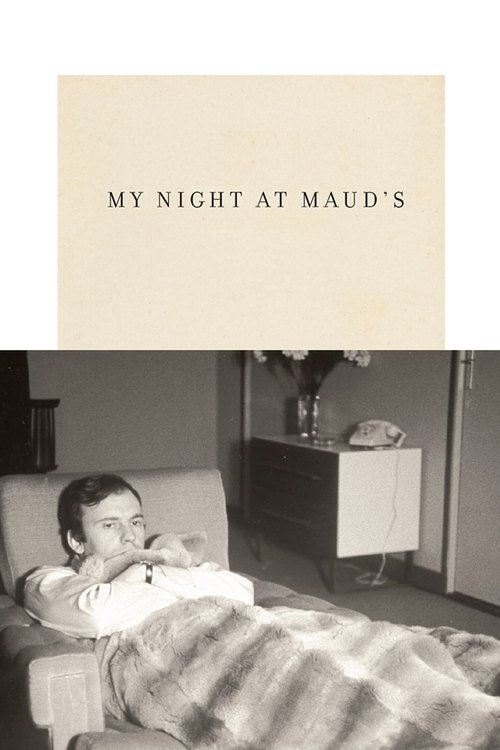
My Night at Maud's
Ma nuit chez Maud
Overview
In the snowy provincial city of Clermont-Ferrand, Jean-Louis, a devout Catholic engineer, attends Mass and spots a blonde woman, Françoise, whom he instantly decides is his destined wife despite never having spoken to her. His rigid, principled life is interrupted when he runs into an old friend, Vidal, a Marxist professor who invites him to spend Christmas Eve with Maud, a charming and intelligent divorcée.
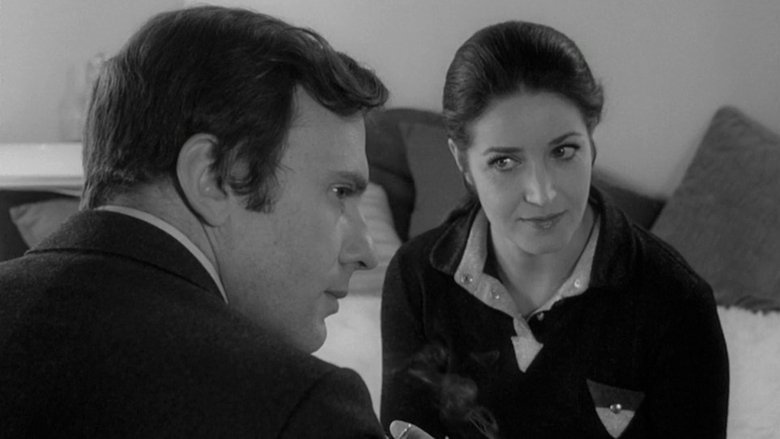
As a snowstorm traps Jean-Louis at Maud's apartment, the night turns into a simmering intellectual duel. Maud, aware of Jean-Louis's inhibitions, challenges his conservative views on religion and love. They spend the night in her bedroom discussing Blaise Pascal and morality, with Jean-Louis resisting Maud's subtle seduction to preserve his self-imposed ideals. This "night at Maud's" becomes the crucible for his beliefs.
The following day, Jean-Louis finally meets and courts Françoise, finding her to be the "good Catholic girl" he envisioned. However, as their relationship progresses towards marriage, secrets from the past begin to surface, revealing that the lines between the "pure" and the "sinful" are far more blurred than Jean-Louis's moral calculus initially accounted for.
Core Meaning
At its heart, My Night at Maud's is a cinematic illustration of Pascal's Wager applied to romance and life choices. Rohmer uses the film to critique the way intellectuals rationalize their instincts. Jean-Louis justifies his rejection of the sensual, intellectual Maud in favor of the "safe" Françoise not through divine guidance, but through a calculated bet on salvation and social respectability.
The film exposes the irony of moral judgment. Jean-Louis seeks a "pure" partner to fit his Catholic self-image, only to discover that life is too complex for binary categories of saint and sinner. The core message suggests that rigid adherence to abstract principles often serves as a mask for fear of intimacy and life's chaotic reality.
Thematic DNA
Pascal's Wager
The central philosophical engine of the film. Just as Pascal argued one should bet on God's existence because the reward is infinite and the loss negligible, Jean-Louis applies this probability theory to his love life. He bets on the "safe" Catholic marriage (Françoise) over the "risky" secular passion (Maud), treating happiness as a mathematical equation rather than an emotional truth.
Chance vs. Predestination
The characters constantly debate whether their meetings are random accidents or fate. Jean-Louis claims his choice of Françoise is predestined, yet the film emphasizes the random encounters (meeting Vidal, the snowstorm) that actually drive the plot. Rohmer suggests that what we call "fate" is often just us retroactively assigning meaning to chance.
Moral Hypocrisy
Jean-Louis judges Maud for her divorce and lifestyle while failing to see his own inconsistencies. He prides himself on Catholic guilt but uses it to manipulate situations. The ultimate irony lies in his discovery that his "ideal" wife has a "sinful" past, forcing him to compromise the very standards he preached to Maud.
Intellectualism as Defense
Characters use philosophy, theology, and politics as shields against vulnerability. The endless talk in Maud's apartment is a form of sublimation; they discuss abstract concepts of love and sin to avoid dealing with the immediate, physical attraction and loneliness present in the room.
Character Analysis
Jean-Louis
Jean-Louis Trintignant
Motivation
To secure a traditional, sanctified life (salvation) and avoid the chaos of unpredictable passion.
Character Arc
Starts as a lonely engineer confident in his rigid Catholic principles. He undergoes a test of faith/flesh at Maud's, which he "passes" by fleeing. He marries his "ideal" woman, Françoise, but the ending implies he must live with a lie to maintain his constructed happiness.
Maud
Françoise Fabian
Motivation
To find authentic connection and intellectual companionship without the pretense of social morality.
Character Arc
She begins as a confident, cynical woman of the world. Through the night, she exposes her vulnerability and desire for connection. She challenges Jean-Louis's hypocrisy but ultimately realizes they are incompatible due to his fear of life.
Vidal
Antoine Vitez
Motivation
To reconcile his political ideology with the uncertainty of existence.
Character Arc
Functions as the bridge between Jean-Louis's piety and Maud's secularism. He tries to synthesize Marxism with Pascal's Wager, showing that even atheists rely on a form of faith in history.
Françoise
Marie-Christine Barrault
Motivation
To escape her past shame and find a respectable partner.
Character Arc
Initially presented as the silent, blonde ideal of Catholic purity. She later reveals she had an affair with a married man, shattering Jean-Louis's projection of her and revealing she is just as human and flawed as Maud.
Symbols & Motifs
The Snow
Symbolizes isolation and the suspension of time. The snowstorm cuts Jean-Louis off from the outside world and his routine, forcing him into the intimate, enclosed space of Maud's apartment where his principles can be tested.
The snow begins falling when Jean-Louis is at Maud's, preventing him from driving home and necessitating the titular "night."
Pascal's <i>Pensées</i>
Represents the intellectual framework Jean-Louis imposes on his life. It is his rulebook for navigating chaos, yet the film suggests he misunderstands Pascal by using the text to avoid life rather than engage with it.
Jean-Louis is seen reading the book in a bookstore and discusses it extensively with Vidal and Maud as a justification for his worldview.
The Bed
A stage for temptation and the battlefield of the mind. Unlike typical cinematic beds used for sex, here it is used for conversation, emphasizing that for these characters, the intellect is the primary erogenous zone.
Maud spends the central scene lying in bed while Jean-Louis sits awkwardly in a chair and later lies clothed on top of the blanket, physically manifesting his barrier against intimacy.
Memorable Quotes
Christianity is not a moral code, it's a way of life.
— Jean-Louis
Context:
During the dinner conversation at Maud's apartment, defending his faith against Maud's skepticism.
Meaning:
Jean-Louis attempts to separate his religion from strict rule-following to justify his behavior, yet he ironically clings to strict rules when it suits him.
I like to make the most of chance opportunities. But I'm only lucky in worthy causes. I doubt I'd have any luck committing a crime.
— Jean-Louis
Context:
Speaking to Vidal early in the film about his life philosophy.
Meaning:
Highlights his belief that his luck is divinely ordained, a way of framing random chance as a sign of his moral righteousness.
I don't like your love with conditions attached.
— Maud
Context:
During the night, when Jean-Louis explains why he resists her and what he looks for in a wife.
Meaning:
Maud pierces through Jean-Louis's romanticism, pointing out that he doesn't love a person, but an abstract category (a Catholic wife) that a woman must fit into.
Philosophical Questions
Can faith be rationalized?
The film asks if belief in God (or love) can be the result of a mathematical calculation (Pascal's Wager) or if it requires a leap of faith that defies logic. Jean-Louis tries to use logic to control his fate, but the film suggests life is governed by chance.
Is inaction a moral choice?
Jean-Louis prides himself on what he doesn't do (sleep with Maud). The film questions whether morality is defined by the avoidance of sin or the active pursuit of truth and connection.
Do we choose who we love?
Jean-Louis 'decides' to marry Françoise before meeting her. The film explores the tension between this willed, calculated love and the organic, spontaneous connection he feels with Maud.
Alternative Interpretations
The Cynical Reading: Jean-Louis is not a hero of faith but a coward. He runs from Maud not because of virtue, but because she intimidates him with her freedom and intelligence. He chooses Françoise because she is 'safe' and he can project his fantasy onto her.
The Feminist Reading: Maud is the true protagonist and the only honest character. The film exposes the fragility of the male ego, which requires women to fit into madonna/whore archetypes to feel secure.
The 'Wager' Reinterpretation: The wager isn't about God, but about marriage. Jean-Louis bets his life that a traditional marriage will bring happiness, ignoring the evidence (Françoise's past) that contradicts his probability model.
Cultural Impact
My Night at Maud's is a landmark of the French New Wave and defined the stereotype of 'French cinema' as intellectually dense, conversation-driven, and philosophically focused. It proved that a film could be gripping solely through dialogue and the tension of not having sex.
Culturally, it introduced the concept of Pascal's Wager to a broader public, framing it as a tool for modern existential dilemmas. Its influence is heavily felt in the 'talky' independent cinema of the US, particularly in the works of Richard Linklater (the Before trilogy) and Whit Stillman, who emulate Rohmer's focus on articulate, self-analyzing characters.
Audience Reception
Praised: Critics and intellectual audiences lauded the film for its intelligent script, the chemistry between Trintignant and Fabian, and Almendros's stunning black-and-white cinematography. It is often cited as Rohmer's masterpiece.
Criticized: Mainstream audiences often find the film slow and pretentious. The lack of physical action and the density of the theological debate led to the famous 'watching paint dry' criticism. Some viewers find Jean-Louis to be an insufferable, judgmental protagonist.
Verdict: A polarizing classic that is revered by cinephiles as the pinnacle of 'intellectual cinema.'
Interesting Facts
- The film was shot in Clermont-Ferrand, the actual birthplace of Blaise Pascal, adding a layer of geographical authenticity to the philosophical theme.
- Director Éric Rohmer waited an entire year to film so that he could secure Jean-Louis Trintignant for the lead role and ensure the film took place during the real snowy Christmas season.
- The film caused a sales explosion for 'Chanturgue', a local wine mentioned and drunk by the characters in the film.
- Cinematographer Nestor Almendros used a technique of 'bouncing' light off white ceilings and walls to create a natural, shadowless look that mimicked available light.
- The film is the third (sometimes numbered fourth due to release order) entry in Rohmer's 'Six Moral Tales' series.
- It was nominated for Best Original Screenplay and Best Foreign Language Film at the Academy Awards, a rare feat for such a talk-heavy French film.
- In the film 'Night Moves' (1975), Gene Hackman's character famously says, 'I saw a Rohmer film once. It was kinda like watching paint dry,' a reference to this film's deliberate pacing.
Easter Eggs
The Wine 'Chanturgue'
The specific wine drunk in the film is a local specialty of Clermont-Ferrand. Its prominence in the film turned it into a cult item, saving the vineyard from obscurity.
Moral Tales Structure
The film strictly follows the 'Moral Tale' formula: A man committed to one woman meets a temptress, resists (or doesn't), and returns to the first woman. The 'Easter egg' is recognizing how this film varies the formula by making the 'temptation' intellectual rather than purely physical.
⚠️ Spoiler Analysis
Click to reveal detailed analysis with spoilers
Frequently Asked Questions
Explore More About This Movie
Dive deeper into specific aspects of the movie with our detailed analysis pages
Comments (0)
No comments yet. Be the first to share your thoughts!