Skip to content
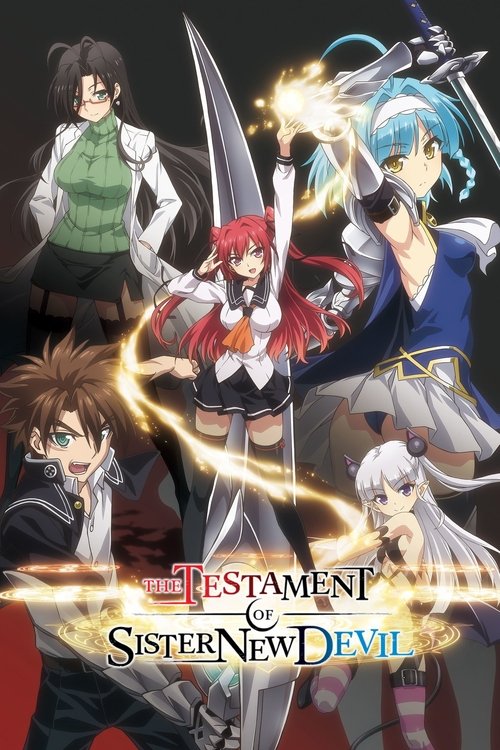
The Testament of Sister New Devil
An intoxicating fusion of dark urban fantasy and unrestrained intimacy, pulsating with the desperation of exile, fierce loyalty, and taboo bloodbaths that bleed into sacred sanctuaries of warmth and defiance.
The Testament of Sister New Devil

The Testament of Sister New Devil

新妹魔王の契約者

07 January 2015 — 11 December 2015 Japan 2 season 22 episode Ended 7.9 (366)

Cast: Yuichi Nakamura, Ayaka Asai, Kaori Fukuhara, Sarah Emi Bridcutt, Tomokazu Sugita

Animation Sci-Fi & Fantasy Action & Adventure Comedy Chosen Family vs. Dogmatic Heritage The Trauma of Power and Restraint Intimacy, Vulnerability, and Mutual Trust Institutional Corruption and the Illusion of Justice

Overview

The Testament of Sister New Devil (Shinmai Maō no Keiyakusha) is an action-fantasy harem series adapted from the light novels written by Tetsuto Uesu and illustrated by Nekosuke Ōkuma. Produced by studio Production IMS and directed by Hisashi Saito, the anime encompasses two television seasons—Season 1 (12 episodes) and Season 2 (BURST, 10 episodes)—alongside associated OVAs, tracing the hazardous convergence of demonic geopolitics, holy warrior traditions, and unconventional domestic life.

The narrative ignites when high school student Basara Tojo is introduced by his eccentric, globe-trotting father to two new stepsisters: the fiery Mio and the mischievous Maria. However, the domestic facade swiftly shatters: Mio is the biological daughter of the late Demon King Wilbert, carrying immense latent demonic power coveted by power-hungry factions, while Maria is a succubus guardian. Complicating matters further, Basara is an exiled prodigy from the clandestine Hero Clan. When an attempt by Maria to force Basara into magical servitude backfires, a Master-Servant curse accidentally binds Mio as the servant and Basara as the master.

Across both seasons, the narrative expands from a claustrophobic struggle for survival within a suburban home to high-stakes political warfare across the Demon Realm and the Hero Clan's hierarchical institutions. While the core cast wards off demonic hunters, treacherous factions, and former allies, Basara must continually reinforce and calibrate the magical master-servant bonds through escalating physical intimacy to keep the lethal curse from consuming his companions. The overarching storyline traverses themes of belonging, guilt, and the pursuit of true family autonomy amid external wars fought by angels, demons, and hero syndicates.
Core Meaning

Across its run, The Testament of Sister New Devil explores the subversion of predestined allegiance and institutional dogma. Through the union of an exiled Hero and the orphaned heir to the Demon Lord, the creators reject black-and-white moral binaries: the so-called "righteous" Hero Clan often harbors hypocritical cruelty and cold pragmatism, while demons demonstrate genuine loyalty, grief, and tenderness. The core message argues that true family and righteous purpose are neither inherited by bloodline nor mandated by sovereign authorities; they are forged through radical empathy, mutual vulnerability, and the willful choice to protect individual personhood against systemic exploitation.

Thematic DNA

Chosen Family vs. Dogmatic Heritage 30%
The Trauma of Power and Restraint 25%
Intimacy, Vulnerability, and Mutual Trust 25%
Institutional Corruption and the Illusion of Justice 20%

Chosen Family vs. Dogmatic Heritage

The conflict between birthright and autonomous connection is central to the entire narrative. Basara is severed from the Hero Clan due to their intolerance, while Mio is pursued by factions who view her solely as an engine of political succession or a weapon of mass slaughter. Over two seasons, the domestic household gradually incorporates childhood friend Yuki, Kurumi, and the demon knight Zest, evolving into an unbreakable clan of outcasts who choose each other over the decrees of ancestral blood.

The Trauma of Power and Restraint

Rather than reveling purely in martial dominance, Basara's arc is defined by psychological restraint and the terrifying consequence of absolute power. His signature ability, the Banishing Shift, previously wiped out comrades during a catastrophic accident in his youth, leaving him haunted by self-loathing and physical scars. Over time, power shifts from a source of dread into a carefully channeled tool of preservation, illustrating how past failures can be integrated rather than repressed.

Intimacy, Vulnerability, and Mutual Trust

While often framed within overt ecchi spectacle, physical and magical intimacy serves as a narrative vehicle for emotional unmasking. The Master-Servant contract punishes emotional concealment and rewards sincerity. As the seasons progress from Season 1 to BURST, the physical acts transition from frantic defensive necessities into consensual affirmations of devotion and mutual empowerment between Basara and the women.

Institutional Corruption and the Illusion of Justice

The series deconstructs established institutions of authority. Both the ruling bodies of the Demon Realm and the high council of the Hero Clan exhibit internal betrayal, political machinations, and disdain for human life. Justice is rarely embodied by organizations; rather, it exists strictly in grassroots resistance and the integrity of individual moral compasses.

Character Analysis

Basara Tojo (東城 刃更)

Yuichi Nakamura

Archetype: The Traumatized Protector / Fallen Hero Key Trait: Unshakable resolve balanced by deep empathy and formidable tactical intelligence

Motivation

To protect his newly formed family and prevent anyone else from dying because of his inaction.

Character Arc

Beginning as an exiled swordsman haunted by guilt over accidentally disintegrating his village peers, Basara transitions across Seasons 1 and 2 from a reactive, self-sacrificing youth into an assertive leader capable of outmaneuvering high-ranking demon lords and challenging ancient clans.

Mio Naruse (成瀬 澪)

Ayaka Asai

Archetype: The Reluctant Sovereign / Tsundere Princess Key Trait: Fierce emotional passion masked behind defensive pride

Motivation

To live a peaceful life free from assassination while honoring the legacy and sacrifices of her parents.

Character Arc

Starting as an insecure, cornered fugitive overwhelmed by the legacy of her demonic father Wilbert, Mio gradually embraces her heritage. In BURST, she stands upright in demon realm arenas, claiming her voice and agency rather than merely relying on Basara's shield.

All 5 characters and cast

Symbols & Motifs

The Demonic Blade Brynhildr (ブリュンヒルデ)

Meaning:

An ancient blade cursed by dark energy, Brynhildr serves as both an instrument of devastation and a physical reminder of Basara’s past failure in the Hero Village. Unleashing it represents his willingness to bear the weight of violence for the sake of those he loves.

Context:

Wielded by Basara in high-stakes confrontations where lethal demonic power must be suppressed or destroyed.

The Master-Servant Ring/Pact

Meaning:

The magical collar/contract represents involuntary bondage subverted into shared destiny. While initially feared as a subjugating enslavement ritual, it functions symbolically as a two-way emotional tether where master and servant share pain, strength, and vulnerability.

Context:

Initiated through a botched ritual in the opening episodes, it serves as the recurrent magical mechanic binding the household together.

Basara’s Dual Eyes / Body Scars

Meaning:

Basara’s heterochromatic/sharpened gaze and scarred body serve as visible marks of his past trauma with Banishing Shift. They represent the irreversible costs of battle and the invisible scars borne by warriors.

Context:

Visible during intense battle sequences and moments of quiet, vulnerable domestic exposure.

The Crimson Core / Wilbert’s Seal

Meaning:

The pulsating demonic core inherited by Mio signifies both an agonizing burden of inheritance and unbidden responsibility. It acts as a target for predators and a test of whether she will become a tyrant or retain her humanity.

Context:

Manifests within Mio as latent, overwhelming demonic energy coveted by hostile political factions.

The Shared Dining Table

Meaning:

Mundane domestic scenes—cooking, dining, and household chores—stand in stark visual and narrative contrast to interdimensional battles. The home's dining table symbolizes peace, normalcy, and the tangible world the characters fight to protect.

Context:

Featured prominently in the Tojo household between combat missions and realm-spanning crises.

Memorable Quotes

俺は、お前たちを守る。たとえ相手が魔王だろうと、神だろうとな!
— Basara Tojo

Context

Spoken in Season 1, Episode 2 as Basara makes his vow to his new stepsisters.

Meaning

Cementing the core premise of his character, Basara resolves to shelter Mio and Maria against both the Hero Clan and the Demon Realm regardless of the enemy's stature.

バサラ…私、もう逃げない。貴方の隣に立つために、私は私の力と向き合う!
— Mio Naruse

Context

Spoken in Season 2 (BURST), Episode 7 during a pivotal stage in the Demon Realm conflict.

Meaning

Marks a critical emotional turning point where Mio stops viewing her demon heritage as an affliction and claims it to fight alongside Basara as an equal.

All 4 quotes

Episode Highlights

The Day a Little Sister Was Born

S1E1

Establishes the domestic premise, introduces Basara's hidden identity as a former Hero, and executes the rapid revelation of Mio’s heritage as Wilbert's daughter.

Significance:

Subverts standard slice-of-life expectations within the first 20 minutes, setting up the political hunt.

First Master-Servant Contract

S1E2

Depicts the botched contract ritual where Basara accidentally becomes the Master instead of the servant.

Significance:

Establishes the mechanics of the master-servant curse and links high-risk magical survival to physical intimacy.

Until Sadness Reaches Zero

S1E4

Delves deeply into Basara’s traumatic past in the Hero Village, uncovering how the Banishing Shift went berserk and killed his comrades.

Significance:

Transforms Basara from an overpowered protagonist into a deeply wounded survivor, contextualizing his dread of wielding Brynhildr.

Plaintive Betrayal

S1E10

Zolgia schemes against Mio; Maria appears to betray the group under coercion, and Lars confronts Zolgia's forces.

Significance:

Deepens the emotional stakes, proving that loyalty in the Demon Realm is complicated by hostages and survival.

For This Night, For This Moment

S1E12

Features the climactic battle against Zolgia, where Basara unleashes the full destructive force of Brynhildr and Banishing Shift to rescue Mio.

Significance:

Closes the initial arc of exile, cements the household’s bond, and sets the stage for diplomatic conflict in the Demon Realm.

Suspicions Deepening Within Mysteries

S2E2

Blends high school athletic festival dynamics with hostile magical infiltration by masked assailants targeting Mio.

Significance:

Demonstrates the expanding circle of defenders, integrating Kurumi Nonaka into the combat fold.

Between Entwining Plots and Desires

S2E7

Political intrigue peaks as the Demon Realm tournament escalates, with factions led by Ramsus and Leohart showing their true colors.

Significance:

Forces Mio to step into her sovereign agency and prompts Basara to form deeper contracts to survive multi-front wars.

The Consequences of What Must Be Done

S2E10

The TV series finale, highlighting Basara's battle against Shiba Kyouichi and demonic conspirators utilizing the advanced Banishing Shift Geminus.

Significance:

Resolves the immediate Demon Realm succession war, securing Mio’s safety and affirming the household’s sovereignty as an independent faction.

Philosophical Questions

Does inherited guilt exist?

The series repeatedly asks whether Mio should be condemned or targeted for the cosmic wars waged by her demon father, answering through Basara that individuals must be judged solely on their personal choices rather than ancestral lineage.

Can absolute destruction serve preservation?

Basara's Banishing Shift represents pure nonexistence—sending targets to zero dimensions. The narrative wrestles with whether a force inherently nihilistic can be wielded with benevolence and protective intent.

What constitutes genuine consent under asymmetrical power?

The Master-Servant curse creates inescapable physical imbalances, continually questioning whether true love and egalitarian loyalty can flourish inside an inherently coercive magical structure.

How It Ends

Alternative Interpretations

Viewers and critics approach the series through several analytical lenses:

Full ending explanation

Cultural Impact

Premiering in 2015, The Testament of Sister New Devil arrived at the absolute peak of the "battle harem ecchi" boom that defined early-to-mid 2010s light novel adaptations. The show was frequently compared to, and measured against, its contemporary juggernaut High School DxD. While both shows featured demon politics, sacred gear-like weapons, and explicit fanservice, The Testament of Sister New Devil distinguished itself through darker trauma-based backstories, grittier swordplay choreography, and far more explicit boundary-pushing sexual mechanics.

Culturally, the series stands as one of the final high-budget examples of uncensored late-night ecchi television before stricter Japanese broadcast streaming guidelines and shifting market trends steered mainstream studios primarily toward isekai power fantasies.

Audience Reception

Season 1 was well received by ecchi and dark-fantasy enthusiasts, who praised Yasuharu Takanashi’s score, the aggressive combat animation, and the unexpectedly rich world-building. Critics noted that while its premise bore similarities to rival fantasy harems, its dark tone gave it a distinct flavor.

Season 2 (BURST) received a more polarized response. While fans celebrated the introduction of Zest and Kurumi and the Demon Realm tournament action, several reviewers felt the compressed 10-episode format rushed complex political maneuvering and prioritized shock-value fanservice over steady emotional progression.

Overall, it is regarded as an audacious, top-tier cult classic of the battle-harem genre, lauded for pushing censorship boundaries to their absolute limits without neglecting fluid swordplay and solid voice acting.

Interesting Facts

  • The series was one of the premier high-profile adaptations handled by Production IMS, showcasing elaborate combat choreography and distinct magical particle animation.
  • Director Hisashi Saito brought extensive experience from helming Sora no Otoshimono (Heaven’s Lost Property), focusing heavily on dynamic expressive comedy juxtaposed with graphic action.
  • The musical score was composed by Yasuharu Takanashi, renowned for his heavy metal, symphonic battle tracks on Fairy Tail and Naruto Shippuden.
  • The television broadcast on Tokyo MX famously utilized extreme censorship overlays—including chibi mascot decals, screen darkening, and obscuring white beams—while AT-X broadcasted with significantly fewer visual restrictions.
  • Season 2 (BURST) was announced immediately during the broadcast of the Season 1 finale in March 2015 and debuted just seven months later in October 2015.

Easter Eggs

Norse Mythological Weaponry

Basara’s demon-sealing broadsword is named Brynhildr, directly referencing the tragic Valkyrie of Norse myth, symbolizing a divine instrument wrapped in doomed mortal fate.

Chibi Mascots Censorship Humor

In broadcast versions, the censorship screens frequently incorporated humorous chibi caricatures of Maria and Mio holding stop signs and scolding viewers, turning strict broadcast regulatory constraints into self-aware fourth-wall jokes.

Kadokawa Sneaker Bunko Cameos

Subtle bookstore and magazine rack background details in school sequences showcase covers and promotional illustrations reminiscent of fellow Kadokawa Sneaker Bunko franchises.

Frequently Asked Questions

Explore More About This Movie

Dive deeper into specific aspects of the movie with our detailed analysis pages

Comments (0)

Leave a comment

No comments yet. Be the first to share your thoughts!

Similar Movies