Skip to content
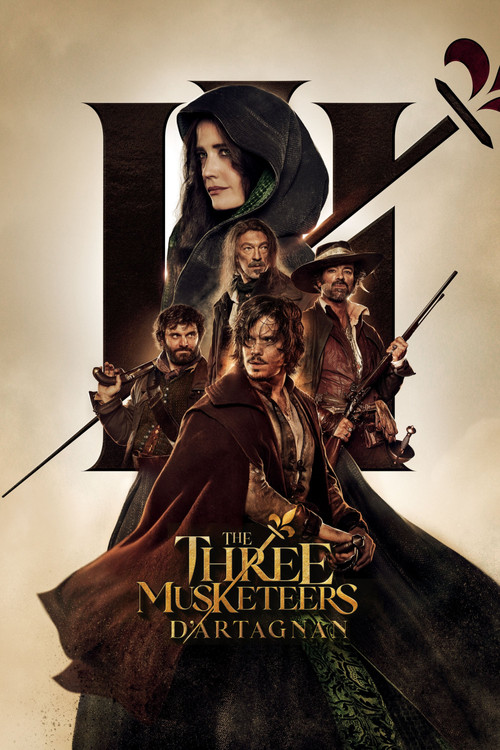
The Three Musketeers: D'Artagnan
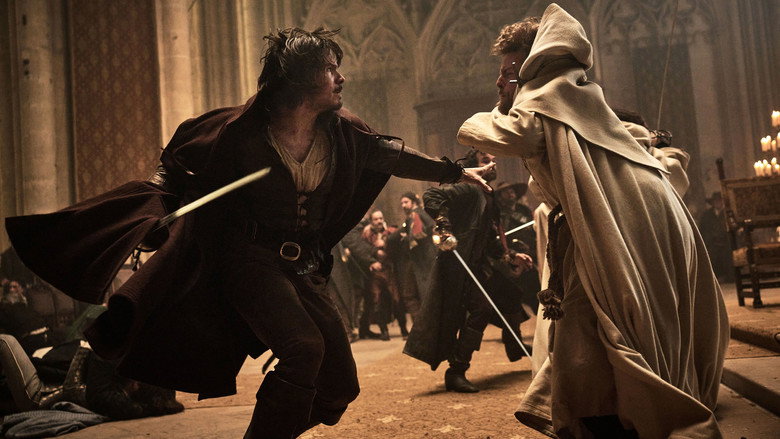
In a dirt-caked, candlelit seventeenth-century France, visceral fear and youthful bravado clash as flashing steel cuts through shadows like lightning over a kingdom standing on the razor-thin edge of civil war.
The Three Musketeers: D'Artagnan

The Three Musketeers: D'Artagnan

Les Trois Mousquetaires : D'Artagnan

"One for all and all for France!"

05 April 2023 Belgium 121 min 6.9 (1,434)

Director: Martin Bourboulon

Cast: François Civil, Vincent Cassel, Romain Duris, Pio Marmaï, Eva Green

Drama History Action Adventure Brotherhood and Unbreakable Loyalty Political Manipulation and Treason Youthful Idealism vs. World-Weary Realism Forbidden Love and Sacred Honor Religious Division and State Paranoia
Budget: $27,500,000
Box Office: $31,843,086

Overview

Set in 1627 France, The Three Musketeers: D'Artagnan follows Charles d'Artagnan, an impetuous young man from Gascony who travels to Paris with dreams of joining King Louis XIII's elite Musketeers. En route, his heroic instincts force him into a violent confrontation when he attempts to stop the kidnapping of a mysterious noblewoman, an encounter that leaves him shot and left for dead in a shallow grave. Surviving the ordeal, d'Artagnan arrives at the Louvre capital determined to track down his assailants.

Upon arriving in Paris, d'Artagnan's hot-headed nature causes him to accidentally insult three veteran Musketeers in rapid succession—Athos, Porthos, and Aramis—leading him to accept three consecutive duels against them in a single afternoon. However, before their swords can cross in combat, Cardinal Richelieu's paramilitary guards arrive to arrest them for illegal dueling. Uniting against their common tormentors, d'Artagnan fights alongside the trio, earning their respect and initiating an unbreakable bond of brotherhood.

As political tensions escalate between French Catholics and Protestant rebels supported by the English, d'Artagnan and his new comrades are drawn into a web of high-stakes court conspiracy. When a plot threatens to ruin Queen Anne of Austria and destabilize the realm, d'Artagnan embarks on a treacherous cross-channel mission to protect the crown, completely unaware of the lethal shadow cast by Cardinal Richelieu's master operative, Milady de Winter.

Core Meaning

Director Martin Bourboulon and screenwriters Matthieu Delaporte and Alexandre de La Patellière sought to reclaim Alexandre Dumas's classic 1844 novel for French cinema, stripping away decades of Hollywood camp and digital sheen to present a grounded, visceral historical epic. The core message of the film centers on the tension between personal loyalty and state politics. It asserts that true honor is found not in blind obedience to political systems or monarchs, but in unflinching solidarity between comrades who risk their lives for one another amidst a corrupt and polarizing world.

Thematic DNA

Brotherhood and Unbreakable Loyalty 30%
Political Manipulation and Treason 25%
Youthful Idealism vs. World-Weary Realism 20%
Forbidden Love and Sacred Honor 15%
Religious Division and State Paranoia 10%

Brotherhood and Unbreakable Loyalty

Revealed through the central bond forged between d'Artagnan, Athos, Porthos, and Aramis. Their oath—'Tous pour un, un pour tous'—is tested as they repeatedly shield each other from state execution, royal displeasure, and political assassination.

Political Manipulation and Treason

Manifested through Cardinal Richelieu, the Count of Chalais, and Milady de Winter, who view human lives as disposable pawns on a geopolitical chessboard designed to consolidate power and provoke war.

Youthful Idealism vs. World-Weary Realism

Expressed through the contrast between d'Artagnan's naïve, passionate hunger for glory and Athos's deeply traumatized, alcoholic melancholy born from past betrayal.

Forbidden Love and Sacred Honor

Explored through Queen Anne's covert, perilous affair with the Duke of Buckingham and d'Artagnan's nascent, tender romance with Constance Bonacieux.

Religious Division and State Paranoia

Framed by the impending war between Catholic royalists and Protestant insurgents, highlighting how sectarian ideology is weaponized by elites.

Character Analysis

d'Artagnan

François Civil

Archetype: Rash Hero / Eager Novice Key Trait: Reckless courage and rapid blade reflexes

Motivation

To become a King's Musketeer and protect Constance Bonacieux.

Character Arc

A hot-headed Gascon seeking personal fame who matures into a self-sacrificing defender of the realm.

Athos / Comte de La Fère

Vincent Cassel

Archetype: Melancholy Mentor Key Trait: Stoic gravitas and fatalistic dignity

Motivation

Honor and protecting his comrades from destruction.

Character Arc

A world-weary alcoholic haunted by past grief who reclaims his sense of purpose through his love for his brothers-in-arms.

All 5 characters and cast

Symbols & Motifs

The Queen's Diamond Studs (Les ferrets de la reine)

Meaning:

Symbolize royal innocence, personal passion, and political vulnerability.

Context:

They serve as the central narrative catalyst driving d'Artagnan's race against time across the English Channel.

Mud, Dust, and Blood

Meaning:

A pervasive visual motif symbolizing raw historical realism that strips away romanticized swashbuckling tropes.

Context:

Used throughout combat scenes and traveling sequences to emphasize the physical, brutal reality of 17th-century violence.

The Fleur-de-lis Brand

Meaning:

Symbolizes state judgment, secret shame, and patriarchal oppression.

Context:

Tied directly to the traumatic history and hidden background of Milady de Winter.

Candlelight and Deep Shadows (Chiaroscuro)

Meaning:

Represents court duplicity, conspiracy, and moral ambiguity.

Context:

Used in palace corridors and secret rooms where allegiances are forged and broken away from public view.

The Rapier / Steel Blade

Meaning:

Symbolizes personal honor, masculinity, and survival.

Context:

Functions as an extension of the Musketeers' identity and their personal code of ethics in battle.

Memorable Quotes

Trois duels en trois heures avec trois mousquetaires... Si je ne devais vous tuer, je vous inviterais à boire un verre.
— Athos

Context

Spoken when Athos realizes d'Artagnan has accidentally challenged Athos, Porthos, and Aramis to duels back-to-back.

Meaning

Captures the dark humor, aristocratic composure, and nascent respect defining their relationship.

Eh bien, vous boirez à ma santé.
— d'Artagnan

Context

D'Artagnan's immediate retort to Athos's duel invitation.

Meaning

Highlights d'Artagnan's irrepressible Gascon audacity and refusal to be intimidated by death.

All 5 quotes

Philosophical Questions

Does duty to state authority take precedence over personal moral truth?

Athos accepts a death sentence rather than lie to save himself, highlighting the conflict between state law and individual conscience.

Can peace be genuinely achieved through political violence and deceit?

Cardinal Richelieu and Milady orchestrate covert violence under the guise of preventing civil war, questioning whether corrupt means invalidate noble ends.

Is human redemption possible after catastrophic trauma and betrayal?

Both Athos and Milady embody scarred pasts; Athos seeks redemption through brotherhood, while Milady seeks empowerment through vengeance.

Alternative Interpretations

The film can be viewed through multiple analytical lenses:

Full ending explanation

Cultural Impact

The film represented a major effort by French producers (Dimitri Rassam and Pathé) to reclaim national literary IP from stylized Hollywood blockbusters. It became a major commercial success in France, drawing over 3.3 million theater admissions nationally and over 1.5 million internationally, proving the commercial viability of European-produced historical blockbusters. Furthermore, it revitalized the classic French cape et d'épée (cloak-and-dagger) genre, modernizing it for contemporary global audiences.

Audience Reception

The Three Musketeers: D'Artagnan was widely acclaimed by European and international critics as a thrilling, authentic, and ambitious revival of a timeless literary classic.

Praised Aspects:

  • Grounded, visceral visual realism and authentic real-location production design.
  • Charismatic chemistry among the lead quartet (François Civil, Vincent Cassel, Romain Duris, Pio Marmaï).
  • Eva Green's magnetic performance as Milady de Winter.
  • Practical stunt work and immersive sword choreography.

Main Points of Criticism:

  • Handheld camera work during fight sequences occasionally resulted in confusing, shaky action.
  • Dimly lit, muddy color palette obscuring fine visual details.
  • Abrupt cliffhanger ending leaving major story threads unresolved.

Controversial Elements: Narrative deviations from Alexandre Dumas's original novel to fit a modern two-part cinematic structure.

Interesting Facts

  • Co-produced across France, Germany, Spain, and Belgium with a total combined budget of €72 million for the two-part saga (~€36 million for D'Artagnan alone), making it one of the most expensive French productions of 2023.
  • Filmed simultaneously with its sequel (The Three Musketeers: Milady) over a continuous 150 shooting days between August 2021 and June 2022.
  • Production utilized 650 live horses and more than 9,000 extras across historical locations.
  • Shot almost entirely on location in authentic French heritage sites, including the Louvre, Château de Fontainebleau, Hôtel des Invalides, Abbaye de Royaumont, Saint-Malo, and Troyes, minimizing green-screen sets.
  • François Civil and the cast underwent four months of intensive fencing under master choreographers and stunt coordinator Dominique Fouassier to perform their own combat scenes.
  • Cinematographer Nicolas Bolduc filmed action scenes in lengthy, handheld sequence shots designed to plunge the audience directly into the chaos of 17th-century sword fighting.

Easter Eggs

Historical Inclusion of Hannibal

Introduces Hannibal (played by Ralph Amoussou), a character inspired by Prince Louis Anniaba, recognized in historical archives as the first Black officer/musketeer in the French Royal Army.

Tribute to Alexandre Dumas's Heritage

The inclusion of diverse figures pays implicit homage to author Alexandre Dumas himself, who was of Afro-Caribbean descent through his grandfather and father, General Thomas-Alexandre Dumas.

Pathé Centennial Homage

Production house Pathé released its first silent film adaptation of The Three Musketeers in 1921; the 2023 project was greenlit to mark a century of Pathé cinematic musketeers.

Visual Western Homage

Director Martin Bourboulon explicitly framed several sequences (such as d'Artagnan's arrival and rural standoffs) as homage to classic Sergio Leone Spaghetti Westerns.

Cinematic Homage to Christopher Nolan

Critics and crew noted visual and pacing nods to Christopher Nolan's The Dark Knight trilogy in its gritty realism and ominous orchestral scoring by Guillaume Roussel.

Frequently Asked Questions

Explore More About This Movie

Dive deeper into specific aspects of the movie with our detailed analysis pages

Comments (0)

Leave a comment

No comments yet. Be the first to share your thoughts!

Similar Movies