Skip to content
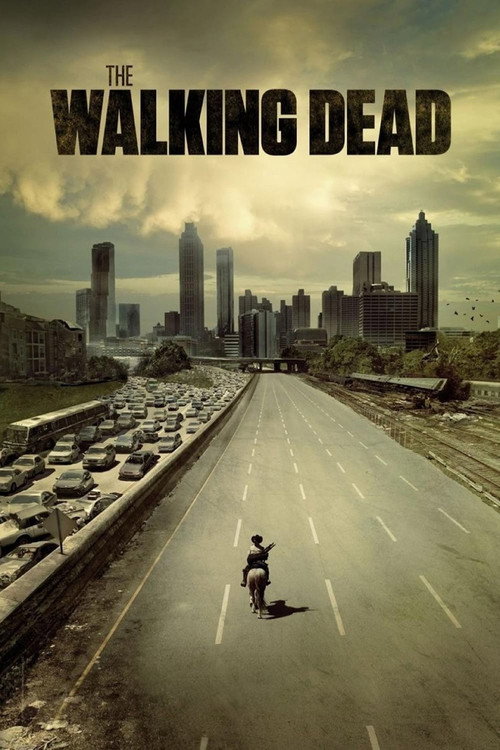
The Walking Dead
A bleak post-apocalyptic drama where suffocating grief collides with fragile hope, depicting humanity as a crumbling lighthouse desperately weathering an endless, surging ocean of decay and moral erosion.
The Walking Dead

The Walking Dead

"Fight the dead. Fear the living."

31 October 2010 — 20 November 2022 United States of America 11 season 177 episode Ended 8.1 (18,058)

Cast: Norman Reedus, Melissa McBride, Lauren Cohan, Danai Gurira, Andrew Lincoln

Drama Sci-Fi & Fantasy Action & Adventure Humanity vs. Monstrosity Tribalism vs. Civilization Leadership & Moral Compromise Grief, Loss, & Psychological Trauma Hope, Legacy, & Rebuilding

Overview

The Walking Dead is an epic 11-season post-apocalyptic television saga that chronicles the collapse of modern society following a worldwide catastrophic outbreak. Emerging from a coma into a world overrun by the reanimated dead, former sheriff's deputy Rick Grimes searches for his family and becomes the reluctant leader of a band of survivors. The narrative follows this roving community across the Georgia countryside, rural farms, abandoned prisons, and eventually fortified Virginia safe zones as they battle both the roaming dead and the far more sinister threat posed by hostile human factions.

As years pass, the core conflict shifts from immediate physical survival against flesh-eating "walkers" to the complex sociological challenge of rebuilding civilization. The survivors confront tyrants, megalomaniacs, cultish factions, and corrupt bureaucratic empires, facing agonizing moral choices regarding who to trust, how to govern, and what sacrifices must be made to protect future generations. Across its 177 episodes, the overarching narrative traces humanity's journey through societal collapse, moral degradation, total warfare, and ultimate rebirth.
Core Meaning

The fundamental thesis of The Walking Dead is that the true threat to human existence in an apocalyptic world is not the mindless, reanimated dead, but the darkness within living human beings when social structures dissolve. Through its expansive narrative, the show asserts that physical survival is meaningless if achieved at the cost of one's humanity.

The series explores whether empathy, moral law, and social cooperation can survive when stripped of institutional enforcement. Across eleven seasons, the creators demonstrate that while cruelty and tribalism offer short-term survival advantages, genuine restoration and progress are only possible through mercy, shared community, trust, and the willingness to break cycles of revenge. Ultimately, the title refers as much to the living survivors who have surrendered their humanity as it does to the roaming corpses.

Thematic DNA

Humanity vs. Monstrosity 30%
Tribalism vs. Civilization 25%
Leadership & Moral Compromise 20%
Grief, Loss, & Psychological Trauma 15%
Hope, Legacy, & Rebuilding 10%

Humanity vs. Monstrosity

Examines the thin line between surviving and becoming the monster one fears. Early seasons focus on preserving human life, but as resources shrink, characters adopt ruthless survival tactics. The theme peaks during interactions with extreme survival ideologies (e.g., Terminus, the Saviors, the Whisperers), forcing protagonists to ask whether living as a ruthless predator renders them no different from the dead.

Tribalism vs. Civilization

Traces the evolutionary stages of human society following a collapse. The story moves from isolated nomadic tribes into feudal autocratic enclaves (Woodbury, the Sanctuary), democratic agricultural collectives (Alexandria, Hilltop), and finally a highly stratified, technologically restored oligarchy (The Commonwealth). It continually questions whether human beings are destined to divide into hostile tribes or if universal law can endure.

Leadership & Moral Compromise

Focuses on the burden of decision-making in high-stakes survival scenarios. Rick Grimes transitions from an idealistic lawman to an unyielding autocrat ("Ricktatorship"), then to a violent pragmatist, and finally into a visionary diplomat who chooses mercy over execution. The show contrasts different leadership styles—from tyrannical authority to communal democracy.

Grief, Loss, & Psychological Trauma

Explores how prolonged suffering alters human psychology. Characters process profound loss through varying coping mechanisms: madness, emotional detachment, religious devotion, or nihilism. The series highlights that trauma accumulates over time, shaping character choices and interpersonal bonds across generations.

Hope, Legacy, & Rebuilding

Serves as the series' emotional counterweight. Initially rooted in finding immediate safety or a scientific cure, the concept of hope evolves into building self-sustaining communities for the next generation. Children raised in the apocalypse symbolize the future and the necessity of instilling moral values.

Character Analysis

Rick Grimes

Andrew Lincoln

Archetype: The Reluctant Hero / Transforming Leader Key Trait: Unwavering determination and fierce devotion to his group.

Motivation

Protecting his family and community; evolves from immediate tactical survival to building a lasting, moral society.

Character Arc

Awakens as an idealistic small-town deputy trying to maintain moral order. Traumatized by loss, he hardens into a ruthless autocrat who distrusts outsiders, before eventually realizing that total savagery destroys the soul. He evolves into a visionary leader who spares his greatest enemy to establish law and honor his son's vision.

Daryl Dixon

Norman Reedus

Archetype: The Lone Wolf / Loyal Defender Key Trait: Exceptional survival instincts coupled with quiet, deep loyalty.

Motivation

Finding belonging and purpose; evolves from self-preservation/sibling loyalty to fierce protection of his chosen family.

Character Arc

Begins as an abusive brother’s defensive, volatile follower. Through his tracking skills and empathy, he transforms into Rick's most trusted brother-in-arms, a compassionate protector, and an essential leader who learns to open his heart to a broader community.

All 5 characters and cast

Symbols & Motifs

Rick's Colt Python Revolver

Meaning:

Represents old-world justice, authority, protection, and the heavy burden of leadership.

Context:

Carried by Rick Grimes throughout his journey; its drawn hammer signals moments of moral crisis or lethal intention. It is later passed down, symbolizing the transfer of responsibility.

The Cherokee Rose

Meaning:

Represents grief, endurance, miracle, and quiet hope amidst tragic loss.

Context:

Introduced in Season 2 when Daryl gives it to Carol while searching for her missing daughter Sophia. Reappears throughout the series as a subtle motif during moments of deep emotional bond or mourning.

Dale’s Pocket Watch

Meaning:

Represents the passage of time, old-world civil morality, humanity, and legacy.

Context:

Gifted by Dale to Glenn, passing down moral responsibility. The watch’s philosophy connects directly to Season 5’s episodic thematic titles ("Remember", "Forget", "Spend", "Try", "Conquer").

Lucille (Barbed-Wire Baseball Bat)

Meaning:

Represents brute authoritarian terror, lawlessness, ego, and trauma.

Context:

Wielded by Negan as an instrument of psychological subjugation. Foreshadowed multiple times in earlier seasons before its iconic, horrific debut in Season 7.

Flowers / "Look at the Flowers"

Meaning:

Represents innocence, delusion, terminal mercy, and tragic inevitability.

Context:

Prominently used in Season 4's "The Grove" when Carol euphemistically tells the psychologically disturbed child Lizzie to look at the yellow wildflowers before executing her. Echoed in subsequent seasons as a motif for death and psychological detachment.

The Title Sequence Decay

Meaning:

Represents the decay of human civilization over time, mirrored by nature reclaiming the built environment.

Context:

The show's opening title card progressively rots, cracks, and degrades from Season 1 to Season 8. In Season 9, the sequence shifts to show green plants and growth sprouting over the rot, reflecting the theme of rebirth and civilization rebuilding.

Memorable Quotes

We are the walking dead!
— Rick Grimes

Context

Huddled in a barn during a torrential storm in Season 5, Episode 10 ("The Them"), Rick gives a somber speech to his exhausted group about surviving trauma.

Meaning

Re-contextualizes the series title, highlighting that the living survivors are the ones fundamentally altered and scarred by the apocalypse.

Just look at the flowers.
— Carol Peletier

Context

In Season 4, Episode 14 ("The Grove"), Carol stands behind the mentally disturbed child Lizzie, who murdered her sister to prove walkers were just "different." Carol tearfully instructs her to turn around and look at the flowers before shooting her.

Meaning

Summarizes the unbearable moral sacrifices required for survival in a broken world.

All 5 quotes

Episode Highlights

Days Gone Bye

S1E1

Introduces Rick Grimes waking up in an abandoned hospital into a world overrun by the reanimated dead.

Significance:

Directed by Frank Darabont, this pilot episode set a visual and narrative benchmark for television horror.

Pretty Much Dead Already

S2E7

Shane opens Hershel’s barn to destroy the kept walkers, only for the missing young girl Sophia to walk out reanimated.

Significance:

A watershed turning point that shatters the group's lingering illusions of safety and marks a loss of innocence.

Too Far Gone

S4E8

The Governor attacks the prison with a tank, executing Hershel during a failed negotiation.

Significance:

The sanctuary is completely destroyed, scattering the core survivors into small groups across the wilderness.

The Grove

S4E14

Carol is forced to execute young Lizzie after Lizzie kills her sister Mika to prove walkers are merely different.

Significance:

Widely considered one of television's most emotionally devastating character studies, capturing peak psychological tragedy.

No Sanctuary

S5E1

Carol single-handedly rescues the group from a cannibalistic enclave at Terminus.

Significance:

Marked a peak in viewer ratings and established the main characters as formidable, high-octane survivors.

No Way Out

S6E9

A massive walker herd breaches Alexandria's walls, resulting in Carl losing his eye before the community unites to reclaim their home.

Significance:

Transforms passive residents into resilient survivors, showcasing unity and reclaiming Alexandria.

The Day Will Come When You Won't Be

S7E1

Negan brutally executes Glenn and Abraham with his bat, breaking Rick’s group psychologically.

Significance:

A visceral turning point that reshaped the narrative landscape and brought the arrival of Negan.

What Comes After

S9E5

Rick Grimes sacrifices himself by detonating a bridge to stop a giant walker herd, leading to his secret rescue by the CRM.

Significance:

Marks Rick Grimes' farewell and triggers a massive six-year narrative time jump.

Rest in Peace

S11E24

The series finale ties together 11 seasons of character arcs, overthrows corrupt Commonwealth governance, and features key character farewells.

Significance:

Concludes the main saga while setting up future legacy and universe spin-offs.

Philosophical Questions

Does the end justify the means when survival is at stake?

Explored through Carol and Rick's decisions—such as killing sick group members to prevent contagion or launching preemptive strikes against unknown threats. The series continuously tests whether survival justifies losing moral boundaries.

Is moral law inherent to human nature or merely a byproduct of society?

Examined through how quickly societal collapse leads to brutal factions (The Claimers, Wolves, Whisperers), contrasting them with characters who actively uphold ethical standards even when it puts them in danger.

Can true forgiveness exist without justice?

Explored through Rick sparing Negan and Maggie's long, complicated path toward working alongside her husband's killer. It asks whether society can move forward without continuing cycles of retribution.

What defines a human life when consciousness or morality is stripped away?

Illustrated by the contrasting perspectives on walkers—from Hershel treating them as sick relatives, to Alpha embracing them as humanity's natural evolution, to Rick viewing them as empty husks.

Alternative Interpretations

Critics and scholars frequently analyze The Walking Dead as an examination of governance models:

Full ending explanation

Cultural Impact

Premiering on AMC on Halloween night in 2010, The Walking Dead arrived during a wave of post-9/11 cultural anxiety and post-2008 economic uncertainty, capitalizing on fears about societal vulnerability and institutional collapse.

The series proved that serial horror could succeed on mainstream television. By Season 5, it became the highest-rated scripted show in basic cable history, outperforming prime-time broadcast network television with over 17 million live viewers for its Season 7 premiere. It normalized high-budget horror on basic cable, paving the way for cinematic genre storytelling across modern networks and streaming services.

Beyond its main run, the show launched an expanded universe including spin-offs (Fear the Walking Dead, Dead City, Daryl Dixon, The Ones Who Live), video games, and graphic novel adaptations, cementing its place as a cornerstone of modern pop culture horror.

Audience Reception

The Walking Dead received widespread praise for its exceptional character development and long-term performance arcs (particularly Andrew Lincoln, Melissa McBride, and Norman Reedus), practical special makeup effects by Greg Nicotero, high-stakes narrative tension, and cinematic Super 16mm visual aesthetic in early seasons.

However, main points of criticism included pacing drag during multi-episode arc setups (such as the farm in Season 2 and the Savior War in Seasons 7–8), manipulative cliffhangers (notably the Season 6 finale cliffhanger), and viewer burnout due to excessive cynicism and gore in Seasons 7 and 8.

Overall, despite its middle-season slump, the series remains a landmark television achievement whose final seasons re-anchored its narrative, leaving a lasting legacy as television's premiere apocalyptic drama.

Interesting Facts

  • To give the apocalypse a raw, grainy, classic horror film texture, the show was shot primarily on Super 16mm motion picture film (Kodak Vision3) until Season 10C.
  • Producer Gale Anne Hurd and creator Frank Darabont originally pitched the series to NBC and HBO; NBC asked if the show could exist without zombies as a crime procedural, while HBO rejected it for being excessively violent.
  • During Season 1 filming in downtown Atlanta, actor Michael Rooker fired blanks from a rooftop rifle setup, causing local residents to call a SWAT team that arrived on set before being alerted to the production.
  • Special effects guru and producer Greg Nicotero ran a mandatory 'Zombie School' before every season to train extra actors on how to move, walk, and act like sluggish corpses.
  • Daryl Dixon does not exist in the original Robert Kirkman comic books; Frank Darabont created the character specifically for Norman Reedus after being impressed by his audition for Merle Dixon.
  • The cast and crew instituted a formal 'Last Supper' dinner tradition whenever a major cast member's character was scripted to die, giving the team a final moment to celebrate the actor's contribution.

Easter Eggs

The Breaking Bad Connection

In Season 2, Episode 2, Merle's drug bag contains Walter White's signature 'Blue Sky' meth. In Season 4, Daryl describes Merle's dealer as a 'janky little white guy' who said 'I'm gonna kill you, bitch', which references Jesse Pinkman.

"Don't Dead Open Inside"

The spray-painted warning on the cafeteria doors in the pilot episode was written across two double doors. Read left-to-right, it famously looks like 'Don't Dead Open Inside', spawning a viral internet meme and iconic Reddit subreddit.

Celebrity Cameos & Head Molds

Anthrax guitarist Scott Ian appeared as a walker killed by Carl. In Season 6, special effects artist Greg Nicotero used a mold of actor Johnny Depp's face as one of the props for a severed head.

Dale’s Speech Title Hidden Callback

The final five episode titles of Season 5 ('Remember', 'Forget', 'Spend', 'Try', 'Conquer') directly quote a monologue Dale gave in Season 1 about time and a pocket watch.

George A. Romero Homages

Features numerous tributes to classic zombie horror: an arena walker in Season 3 wears the exact outfit of 'Flyboy' from Dawn of the Dead, and a Season 5 crate is labeled 'Ship to Horlicks University', referencing Creepshow.

Frequently Asked Questions

Explore More About This Movie

Dive deeper into specific aspects of the movie with our detailed analysis pages

Comments (0)

Leave a comment

No comments yet. Be the first to share your thoughts!

Similar Movies