Skip to content
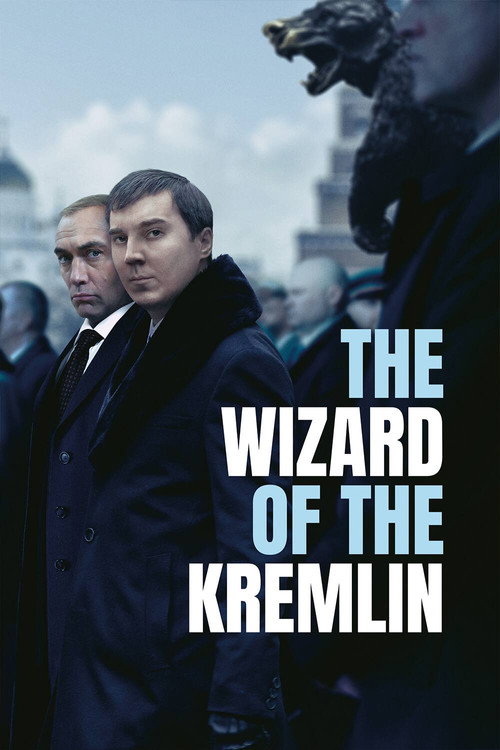
The Wizard of the Kremlin
A chilly, dialogue-driven geopolitical drama drenched in cynical intellectualism, unfurling like a chess match inside a frosted glass terrarium where artists manufacture monsters they can no longer control.
The Wizard of the Kremlin

The Wizard of the Kremlin

Le Mage du Kremlin

"Power was the plan. Putin was the consequence."

21 January 2026 France 136 min 6.5 (217)

Director: Olivier Assayas

Cast: Paul Dano, Jude Law, Alicia Vikander, Tom Sturridge, Will Keen

Drama The Theatricality of Power and Post-Truth Politics The Illusion of Freedom and Authoritarian Nostalgia Moral Complicity and the Consigliere’s Hubris Proximity to Absolute Power vs. Personal Alienation
Box Office: $8,440,584

Overview

Directed by French auteur Olivier Assayas and co-written with acclaimed author Emmanuel Carrère, The Wizard of the Kremlin (Le Mage du Kremlin) adapts Giuliano da Empoli’s prize-winning 2022 novel into a sweeping, English-language political drama. The narrative spans three turbulent decades of modern Russian history, beginning in the anarchic, neon-lit vacuum of post-Soviet Moscow in the early 1990s and tracing the country's gradual transformation into a centralized 21st-century autocracy.

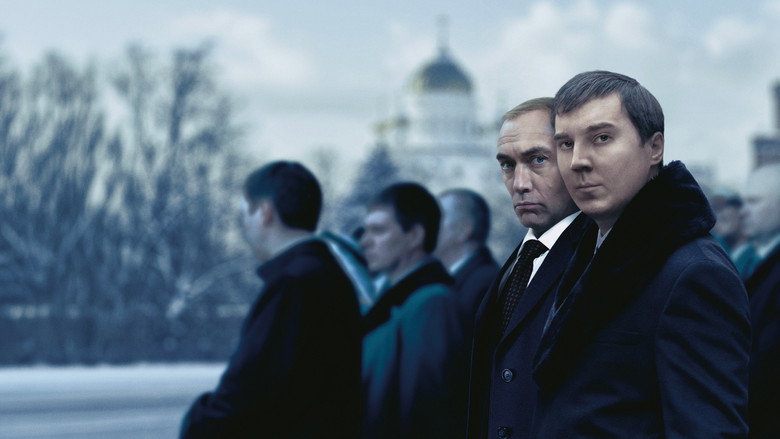
The story is framed through an extended nocturnal encounter in 2019. Lawrence Rowland, an American academic and journalist visiting Moscow, is unexpectedly summoned to the secluded, snow-blanketed dacha of Vadim Baranov. Baranov—a fictionalized stand-in for real-life political strategist Vladislav Surkov—was once the enigmatic "grey cardinal" and chief spin doctor at the right hand of Russia's ruler. Having withdrawn into silent, mysterious retirement, Baranov agrees to walk Rowland through his memoirs.

Through episodic recollections, Baranov recounts his journey from underground avant-garde theater director and commercial reality-TV producer to the architect of modern state mythology. In the late 1990s, oligarch Boris Berezovsky recruits Baranov into political strategy, where he encounters a quiet, methodical former KGB operative named Vladimir Putin. Recognizing the public's exhaustion with post-communist chaos, Baranov applies avant-garde theatrical techniques, narrative fiction, and media disorientation to sculpt Putin into an indispensable national savior, only to watch the engineered apparatus take on a terrifying life of its own.
Core Meaning

Assayas and Carrère use Baranov’s trajectory to deconstruct the mechanics of modern political theater and authoritarian restoration. The film's primary message posits that contemporary autocratic power does not merely rely on raw physical oppression; it operates as an aesthetic spectacle engineered through the deliberate subversion of truth.

By framing politics as an extension of avant-garde dramaturgy, the film demonstrates how Western-style media, television saturation, and algorithmic confusion can be weaponized to manufacture reality. Ultimately, the director warns of the Faustian peril of intellectual hubris: amoral strategists who treat nations like artistic playgrounds inevitably find themselves discarded by the brutal, unchecked forces they helped create.

Thematic DNA

The Theatricality of Power and Post-Truth Politics 30%
The Illusion of Freedom and Authoritarian Nostalgia 25%
Moral Complicity and the Consigliere’s Hubris 25%
Proximity to Absolute Power vs. Personal Alienation 20%

The Theatricality of Power and Post-Truth Politics

Politics is depicted as a manufactured simulation. Baranov applies theatrical staging, contradictory state narratives, and reality-TV editing to confuse political opposition, showing that controlling public perception matters far more than policy.

The Illusion of Freedom and Authoritarian Nostalgia

The wild, chaotic freedoms of 1990s capitalism left Russian society disoriented and impoverished. The film explores the thesis that a populace scarred by instability will willingly trade democratic liberties for order and the perceived strength of a Tsar.

Moral Complicity and the Consigliere’s Hubris

Baranov treats statecraft as a detached, intellectual game. His descent highlights how technocrats and intellectuals rationalize atrocities and state terror as necessary choreography, only to face profound moral bankruptcy.

Proximity to Absolute Power vs. Personal Alienation

As Baranov ascends into the Kremlin’s inner sanctum, genuine human connection becomes impossible. His relationship with Ksenia unravels, showing that absolute power isolates and consumes everything outside its orbit.

Character Analysis

Vadim Baranov

Paul Dano

Archetype: Antihero / Amoral Visionary / "The Grey Cardinal" Key Trait: Soft-spoken, chillingly detached intellectualism.

Motivation

Aesthetic mastery and testing the limits of psychological manipulation on a national stage.

Character Arc

Starts as an ambitious avant-garde theater director and cynical TV producer, ascends to the apex of Kremlin influence as Putin's chief propagandist, and ends as a reclusive, weary outcast haunted by the political leviathan he spawned.

Vladimir Putin / "The Tsar"

Jude Law

Archetype: The Autocrat / Pragmatic Tyrant Key Trait: Cold, economical calculation masked beneath suppressed fury and composed charisma.

Motivation

Consolidating state dominance, restoring imperial dignity, and eliminating internal and external threats.

Character Arc

Introduced as a disciplined, seemingly unassuming former intelligence officer chosen by oligarchs for stability; gradually strips away all outside influence to become an absolute, unyielding ruler.

All 5 characters and cast

Symbols & Motifs

The Snowbound Dacha

Meaning:

Symbolizes Vadim Baranov's moral purgatory—a gilded, frozen exile detached from the chaos he engineered.

Context:

Bookends the film as the setting of Baranov's isolated estate surrounded by cold white drifts where he meets Lawrence Rowland.

Yevgeny Zamyatin’s Novel We

Meaning:

Symbolizes Russia’s recurrent cycle toward technocratic totalitarianism and the erasure of individual identity.

Context:

Serves as the intellectual password in an anonymous online debate that connects Rowland and Baranov.

Television Studio Monitors

Meaning:

Represents the modern regime’s primary weapon—distorting reality through continuous entertainment and sensationalism.

Context:

Featured glowing with broadcasts of reality television and staged political debates during Baranov's rise as a media producer and strategist.

The Puppeteer’s Strings / Stage Props

Meaning:

Illustrates how Russian statecraft turned citizens into spectators and political rivals into cast members.

Context:

Appears through Baranov’s frequent references to theatrical scripts, costumes, and stages when orchestrating political moves.

Ksenia’s Changing Wigs and Styles

Meaning:

Mirrors the restless, uncontainable soul of post-Soviet youth that resists total Kremlin curation.

Context:

Shown across Ksenia's shifts in hair color and subversive fashion throughout her appearances.

Memorable Quotes

Most men of power get their aura from the position they hold. When they lose it, it's like a plug has been pulled. Baranov was a different breed.
— Lawrence Rowland

Context

Delivered in the opening voiceover of the film.

Meaning

Establishes Baranov's lasting mystique as an ideologue whose influence transcended official titles.

In the West, status comes from money. In Russia, it's all about proximity to power.
— Vadim Baranov

Context

Spoken by Baranov during his discussions on political structure and hierarchy.

Meaning

Encapsulates the film's core sociopolitical premise regarding the difference between Western oligarchy and Russian state centralization.

All 3 quotes

Philosophical Questions

Is objective truth sustainable in a media-saturated democracy?

The film asks whether democratic discourse can survive when media is weaponized purely to generate noise, contradiction, and exhaustion.

Do societies naturally default to strongmen in times of economic chaos?

It questions whether human beings prioritize individual freedom over order and national pride.

Can an intellectual remain detached from the crimes of the regime they design?

Baranov’s journey interrogates the boundary between intellectual observation and moral guilt.

Alternative Interpretations

The Postmodern Confessional / Mythmaker’s Deception: Some critics argue that Baranov’s narrative to Rowland is not an objective history, but his final act of spin. By painting himself as the mastermind who invented Putin’s power, Baranov may simply be feeding his own vanity to secure his place in history.Historical Inevitability vs. Individual Manipulation: Another reading debates whether Putin's...

Full ending explanation

Cultural Impact

Released against the backdrop of the protracted Russia-Ukraine conflict and a wider global conversation on democratic backsliding, The Wizard of the Kremlin arrived as a highly scrutinized political critique.

The film bridges the gap between historical biopic and philosophical treatise. Critical discourse highlighted its resonance with contemporary debates over disinformation, algorithmic manipulation, and post-truth geopolitics. In European cinematic discourse, it has been compared to historical character studies like Assayas's own Carlos, Ali Abbasi’s The Apprentice, and Armando Iannucci’s The Death of Stalin, albeit framed with a far more austere, intellectual tone.

Audience Reception

Critical Consensus: An ambitious, intellectually dense political drama that excels as an analytical breakdown of autocratic power, even if its theatrical dialogue and deliberate pacing prioritize geopolitical discourse over visceral thriller mechanics.

Key Highlights from Reviews:

  • Performances: Praise was directed at Jude Law’s restrained, chilling transformation into Putin and Paul Dano’s unsettling, soft-spoken intellect, though some critics felt Dano’s aloof delivery created excessive emotional distance.
  • Directing & Tone: Critics lauded Yorick Le Saux's elegant cinematography and the sharp intellectual dialogue co-written by Emmanuel Carrère, but criticized the dialogue-heavy "tell, don't show" structure and pacing that could feel like an extended lecture.
  • Stylistic Choices: The ambitious 30-year historical scope was commended, while the lack of uniform accents among international stars proved distracting for some viewers.

Interesting Facts

  • The film marks a major writing collaboration between Olivier Assayas and celebrated French writer Emmanuel Carrère, whose deep biographical knowledge of Russian culture informed the dialogue.
  • The movie is adapted from Giuliano da Empoli’s award-winning French novel Le Mage du Kremlin (Gallimard, 2022), which was a finalist for the Prix Goncourt and became an international bestseller.
  • Due to sanctions and the ongoing political climate making filming in Moscow impossible, principal photography was conducted in Latvia to recreate post-Soviet and contemporary Russian locales.
  • Jude Law and Olivier Assayas conducted extensive early rehearsals and character development over Zoom to capture Putin's subtle vocal cadences and physical posture.
  • Assayas instructed the international cast (Paul Dano, Jude Law, Alicia Vikander) to speak in natural English rather than affected heavy Russian accents, aiming to focus on thematic dialogue rather than superficial caricature.
  • The film had its world premiere in competition for the Golden Lion at the 82nd Venice International Film Festival on August 31, 2025.

Easter Eggs

Emmanuel Carrère Cameo

Co-screenwriter Emmanuel Carrère makes a brief cameo appearance during the Moscow cultural scenes.

Literary Mirror to Zamyatin’s We

The film’s philosophical framing directly evokes Yevgeny Zamyatin’s classic dystopian novel We, contrasting 1920s totalitarian literature with 21st-century reality.

Oligarch Counterparts

Characters like Dmitri Sidorov (played by Tom Sturridge) are heavily inspired by real-life figures like Mikhail Khodorkovsky, who clashed with the state and were imprisoned.

Underground Counterculture References

The narrative incorporates real Russian cultural movements, including Eduard Limonov's National Bolsheviks, punk groups, and Pussy Riot.

Vladislav Surkov Real-Life Echoes

Baranov's underground rock references and artistic musings mirror Vladislav Surkov's real-life collaborations with Russian rock band Agatha Christie and his pseudonymous fiction writing.

Frequently Asked Questions

Explore More About This Movie

Dive deeper into specific aspects of the movie with our detailed analysis pages

Comments (0)

Leave a comment

No comments yet. Be the first to share your thoughts!

Similar Movies