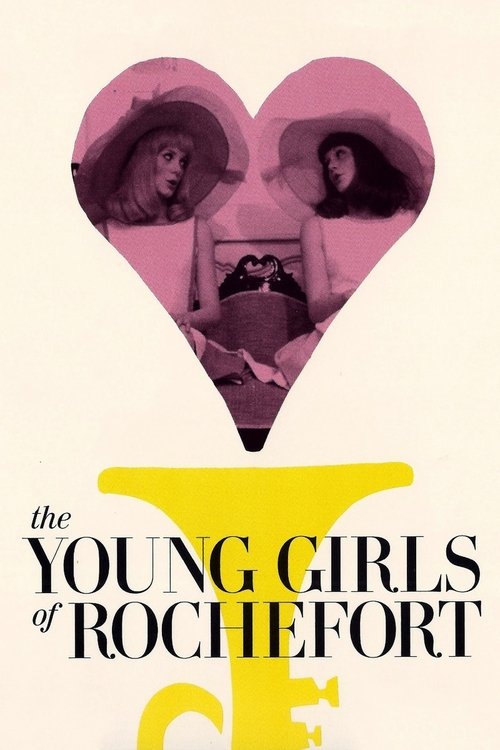
The Young Girls of Rochefort
Les Demoiselles de Rochefort
"…They're singing and dancing in the streets."
Overview
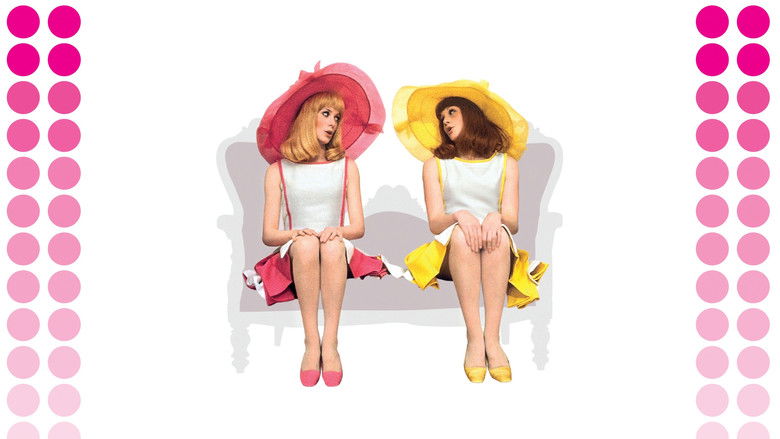
In the seaside town of Rochefort, twin sisters Delphine and Solange Garnier dream of finding love and artistic success in Paris. As a traveling fair arrives to set up in the town square, the sisters' lives intersect with a cast of dreamers: a sailor searching for his ideal woman, an American composer visiting an old friend, and their own mother who pines for a lost love. Over the course of a weekend, the town becomes a stage for song, dance, and romance.
However, the film is not a simple fairy tale. The characters constantly miss each other by mere seconds, unaware that their soulmates are just around the corner or sitting in the same café. Amidst the vibrant musical numbers and colorful costumes, a darker subplot involves a local axe murderer, adding a layer of surreal tension to the otherwise buoyant atmosphere. The film builds to a crescendo of departures and near-misses as the fair leaves town.
Core Meaning
The Young Girls of Rochefort is a cinematic exploration of the tension between idealized romance and the randomness of reality. Demy suggests that while life can be as colorful and harmonious as a musical, it is also governed by chance, missed opportunities, and hidden darkness. The film posits that to dream is to live, even if the fulfillment of those dreams is constantly deferred by the whims of fate.
Thematic DNA
Fate and Missed Connections
The central engine of the plot is the series of near-misses between soulmates. Maxence and Delphine, perfect for each other, constantly occupy the same spaces without meeting until the very end. This theme highlights the fragility of destiny and how easily happiness can be missed by a split second.
Idealism vs. Reality
The film visually presents a candy-colored, perfect world, yet narrative elements like the axe murderer subplot and the characters' dissatisfaction with provincial life ground the fantasy. The characters project their ideals onto the world (Maxence's painting, Solange's concerto) while navigating a reality that includes crime and regret.
Art as Existence
For the main characters, art is not just a hobby but a way of being. Delphine dances, Solange composes, Maxence paints, and Andy plays music. Their artistic expression is their primary means of connecting with the world and seeking their 'ideal' existence.
Sisterhood and Duality
The bond between Delphine and Solange is the film's most stable relationship. As twins (played by real-life sisters), they represent two halves of a whole—one visual (dance), one auditory (music)—supporting each other's dreams even as they seek separate romantic fulfillments.
Character Analysis
Delphine Garnier
Catherine Deneuve
Motivation
To find the 'ideal man' (whom she recognizes in Maxence's painting) and to pursue her career as a dancer in Paris.
Character Arc
A dance teacher who feels stifled in Rochefort and longs for a love that matches her romantic ideals. She breaks up with her egotistical boyfriend and eventually leaves for Paris, unknowingly hitching a ride with her soulmate.
Solange Garnier
Françoise Dorléac
Motivation
To have her concerto played and to find a partner who understands her music and passion.
Character Arc
A composer who is more proactive and energetic than her twin. She actively seeks out professional connections, leading her to meet Andy Miller, with whom she falls in love at first sight (and sound).
Maxence
Jacques Perrin
Motivation
To find the 'Ideal Woman' he has painted and to live a life of art and poetry.
Character Arc
A sailor completing his service who spends his time painting a woman he has seen only in his dreams. He wanders the town searching for her, constantly missing Delphine by seconds.
Andy Miller
Gene Kelly
Motivation
To reconnect with his friend and pursue the enchanting woman he met by chance.
Character Arc
A famous American composer visiting his friend Simon. He bumps into Solange on the street and is instantly smitten, eventually reuniting with her at the music shop.
Symbols & Motifs
The Transporter Bridge
Symbolizes the transition between the mundane world and the world of dreams (Paris/The Fair). It is a mechanical connection that physically links the characters but also underscores their transient nature.
The film opens and closes with the carnival trucks crossing this bridge, framing the narrative as a fleeting moment of possibility suspended over the river.
Maxence's Painting
Represents the 'Ideal Woman' and the projection of romantic fantasy. It is the visual manifestation of a dream that actually exists in reality (Delphine).
Displayed in the gallery, recognized by Delphine, and carried by Maxence; it serves as the link that *should* connect them but often just misses doing so.
The Glass Café
A symbol of transparency and the 'aquarium' of life where characters are on display yet isolated. It represents the proximity of connection without actual contact.
Located in the town square, it is the central hub where almost all characters pass through, often sitting tables away from their destiny without knowing it.
The Axe Murderer Subplot
A jarring symbol of the darkness and violence lurking beneath the pastel-colored, joyous surface of the film's world. It disrupts the Hollywood musical escapism.
News of the murders is discussed casually in the café and song lyrics, and the killer turns out to be a familiar, seemingly harmless local figure.
Memorable Quotes
Nous sommes deux sœurs jumelles / Nées sous le signe des gémeaux
— Delphine & Solange
Context:
Sung by the sisters in their dance studio as they introduce themselves and their aspirations.
Meaning:
The opening lines of their iconic song establish their unity, their astrological destiny (Gemini), and the film's playful, doubled nature.
Monsieur Dame, c'est un nom de dame... Je ne voulais pas m'appeler Madame Dame.
— Yvonne Garnier
Context:
Yvonne explaining to a customer (and the audience) why she left the love of her life, Simon Dame.
Meaning:
Explains the absurd yet tragic reason Yvonne left Simon years ago: she didn't want to be 'Mrs. Lady' (Madame Dame). It highlights the film's mix of whimsy and regret.
En amour, on ne pardonne pas les crimes.
— Yvonne Garnier
Context:
Discussing the news of the local murders, contrasting the horror of the crime with the lightness of the setting.
Meaning:
A double entendre referencing both the axe murders and the 'crimes' of the heart, suggesting that while violence is unforgivable, romantic mistakes are also heavily weighed.
Philosophical Questions
Does fate exist, or is it just coincidence?
The film relentlessly teases the audience with 'almost' meetings. It questions whether there is a grand design bringing lovers together or if life is simply a chaotic series of random events where happiness depends on being in the right café at the right second.
Is the Ideal preferable to the Real?
Maxence loves a painted image; Delphine loves a man she hasn't met. The film explores Platonism in romance—whether the idea of a person is more powerful and sustaining than the actual person.
Alternative Interpretations
The 'Missed Connection' Ending: While the film is often seen as a happy musical, a darker interpretation suggests that Delphine and Maxence might never actually meet. Although they end up in the same truck, they do not see each other on screen. Some critics argue this ambiguity implies they are destined to be 'ships in the night' forever.
The Denial of Reality: The characters' cheerful obliviousness to the axe murderer in their midst can be read as a critique of escapism—how people (and cinema audiences) ignore the horrors of the real world to maintain a fantasy of happiness.
Cultural Impact
The Young Girls of Rochefort is considered a cornerstone of the French New Wave's experimentation with genre. While initially less successful than The Umbrellas of Cherbourg, it has gained cult status as a masterpiece of joy and melancholy. It heavily influenced modern filmmakers, most notably Damien Chazelle's La La Land, which borrows its opening highway number, color palette, and jazz score directly from Demy's film. It is celebrated for successfully grafting the Hollywood musical tradition onto a distinctly French, existential landscape.
Audience Reception
Modern audiences and critics overwhelmingly praise the film, holding a 98% approval rating on Rotten Tomatoes. Viewers adore the vibrant color palette, the infectious Michel Legrand score, and the chemistry between the Deneuve/Dorléac sisters. Some criticism historically focused on the 'frivolity' of the plot compared to the deeper tragedy of Umbrellas of Cherbourg, but today it is recognized as a sophisticated work that uses frivolity to mask deep existential longing.
Interesting Facts
- Catherine Deneuve and Françoise Dorléac were real-life sisters. Tragically, Dorléac died in a car accident just months after the film's release, making this their only film together.
- Jacques Demy had the town of Rochefort repaint 40,000 square meters of building facades in pastel colors to match the film's visual aesthetic.
- Gene Kelly, despite being a legendary musical star, did not sing his own parts; his voice was dubbed by a Canadian singer, though he learned the French lyrics to lip-sync perfectly.
- The film was shot simultaneously in French and English versions, but the English version is rarely seen and features the actors speaking English.
- The plot involves a serial killer who cuts women into pieces, a surprisingly dark element for a candy-colored musical, inspired by Demy's desire to mix genres.
- George Chakiris (from West Side Story) and Grover Dale play the carnival dancers; they were cast to bring American musical energy to the French production.
- Agnès Varda, Demy's wife, appears briefly as a nun in the film.
- The choreography was not done by Gene Kelly (who only choreographed his own solos) but by Norman Maen, aiming for a style that blended jazz and classical ballet.
Easter Eggs
Connection to 'Lola' (1961)
The film exists in the same universe as Demy's Lola. A character mentions a hairdresser from Cherbourg named Aimé who married a widow from Nantes, referencing characters from the earlier film.
Pélagie Rosier
The name of the axe murder victim. While some critics mistakenly identified her as Lola (Anouk Aimée), she is a distinct character, though her death serves as a dark grim reaper figure in Demy's interconnected universe.
An American in Paris References
Gene Kelly's character and costume (often white or light colors) directly reference his role in An American in Paris, serving as a meta-textual homage to the Hollywood musicals Demy loved.
⚠️ Spoiler Analysis
Click to reveal detailed analysis with spoilers
Frequently Asked Questions
Explore More About This Movie
Dive deeper into specific aspects of the movie with our detailed analysis pages
Comments (0)
No comments yet. Be the first to share your thoughts!