Skip to content
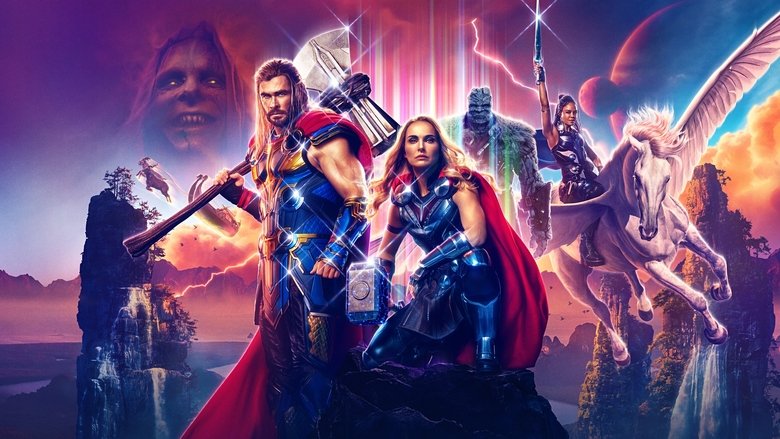
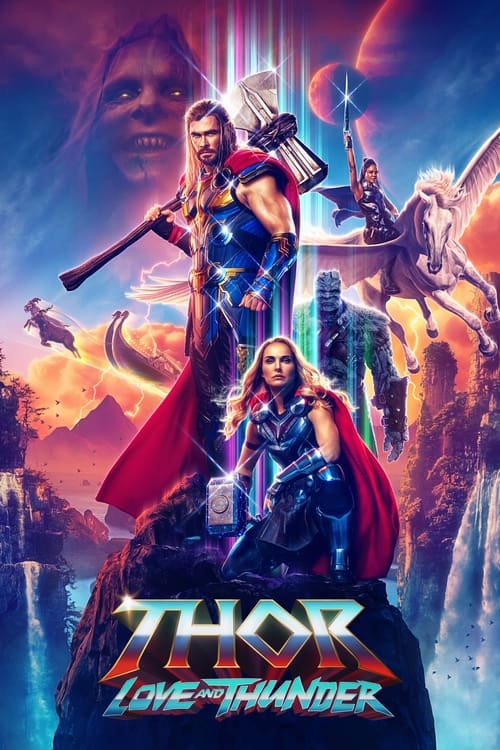
Thor: Love and Thunder
A vibrant space-metal opera vibrating between irreverent cosmic farce and tender mortality, painting grief as a monochrome shadow realm illuminated only by the defiant, golden lightning of rekindled love.
Thor: Love and Thunder

Thor: Love and Thunder

"The one is not the only."

06 July 2022 United States of America 119 min 6.4 (8,855)

Director: Taika Waititi

Cast: Chris Hemsworth, Natalie Portman, Christian Bale, Tessa Thompson, Taika Waititi

Fantasy Action Comedy Love vs. Loss and the Courage of Vulnerability The Nature of Faith, Divine Indifference, and False Idols Mortality vs. Immortality and the Toll of Power Purpose, Reinvention, and Legacy
Budget: $250,000,000
Box Office: $760,928,081

Overview

Following the universe-shattering conflicts of the Infinity Saga, Thor Odinson embarks on a soul-searching odyssey to discover his purpose beyond war. While traveling alongside the Guardians of the Galaxy and answering distress calls across the cosmos, his quest for inner peace is violently interrupted by the emergence of a terrifying new threat: Gorr the God Butcher, a grieving mortal waging a genocidal crusade to wipe out every divine being in existence.

To counter Gorr's path of slaughter and save endangered gods across the cosmos, Thor teams up with his stalwart rocky companion Korg and King Valkyrie of New Asgard. Their journey leads them back to Earth, where Thor is astonished to discover that his former love, astrophysicist Dr. Jane Foster, has mysteriously reassembled his shattered hammer, Mjolnir, and wields the cosmic power of the Mighty Thor.

Together, this disparate band of warriors embarks on an intergalactic mission—navigating the decadent pantheon of Omnipotence City and venturing into the darkest depths of the Shadow Realm. As they race against time to stop Gorr before he reaches an omnipotent entity capable of granting any wish, Thor and Jane must confront lingering feelings from their shared past alongside the creeping realization that wielding godly power comes with devastating mortal consequences.
Core Meaning

Director Taika Waititi uses the bombastic canvas of an 1980s heavy-metal fantasy to deliver a vulnerable meditation on love, grief, and the inevitability of mortality. The central message posits that choosing to love—despite the guaranteed heartbreak, pain, and loss inherent to mortal existence—is humanity's greatest triumph and highest form of courage.

Through the juxtaposition of indifferent, self-serving gods and mortal beings risking their final breaths for one another, the film critiques detachment and institutional apathy. Waititi asserts that true divinity is not defined by immortality, worship, or unchecked power, but by empathy, sacrifice, and the willingness to open one's heart to another even when the ending is known.

Thematic DNA

Love vs. Loss and the Courage of Vulnerability 35%
The Nature of Faith, Divine Indifference, and False Idols 25%
Mortality vs. Immortality and the Toll of Power 20%
Purpose, Reinvention, and Legacy 20%

Love vs. Loss and the Courage of Vulnerability

The emotional engine of the narrative explores how past trauma leads people to build emotional walls. Thor guards his heart after losing his family, while Gorr's unbearable grief twists into nihilistic fury. The film demonstrates that emotional vulnerability is not weakness; choosing to love—even when loss is inevitable—is the only path to genuine peace.

The Nature of Faith, Divine Indifference, and False Idols

Explored through the contrasting pantheons and Gorr's origin. Gorr's tragedy begins when his god mocks his dying daughter's devotion. Later, Omnipotence City reveals gods (led by Zeus) who are vain, hedonistic, and cowardly. The film deconstructs traditional idolatry, showing that deities are unworthy of worship if they lack compassion for their followers.

Mortality vs. Immortality and the Toll of Power

Jane Foster's arc as the Mighty Thor highlights the tragic paradox of human limitations and cosmic strength. While Mjolnir grants her godlike invulnerability, it purges the chemotherapy treatments keeping her cancer in check, accelerating her physical demise. The theme emphasizes that physical immortality is hollow compared to living a finite life filled with purpose.

Purpose, Reinvention, and Legacy

Every major protagonist grapples with finding meaning after their original roles have ended. Valkyrie struggles with administrative boredom as king of a tourist-friendly New Asgard; Thor seeks a destiny beyond endless battle; Gorr channels his existential void into destruction; and Jane transforms herself from a patient into a legendary protector.

Character Analysis

Thor Odinson

Chris Hemsworth

Archetype: Hero / Maturing Protector Key Trait: Resilient, boisterous, and deeply affectionate.

Motivation

To discover inner peace and protect the universe from divine genocide.

Character Arc

Transitions from an emotionally detached cosmic drifter searching for purpose to an empathetic father figure who embraces love despite knowing the pain of loss.

Dr. Jane Foster / The Mighty Thor

Natalie Portman

Archetype: Tragic Hero / Transcendent Warrior Key Trait: Brilliant, courageous, and fiercely determined.

Motivation

To fight illness, make a lasting difference, and protect the innocent.

Character Arc

Evolves from a scientist facing terminal stage-4 cancer into a godlike hero who chooses one final, heroic stand over clinging to a declining life.

All 5 characters and cast

Symbols & Motifs

Mjolnir

Meaning:

Symbolizes mending past brokenness, the rekindling of emotional bonds, and the tragic price of heroism.

Context:

Having been shattered previously, Mjolnir reassembles itself due to Thor's protective enchantment, empowering Jane Foster as the Mighty Thor while tragically accelerating her terminal cancer.

Stormbreaker

Meaning:

Represents Thor's lingering emotional attachment to his past love and jealousy toward his former weapon.

Context:

Personified with comedic anthropomorphism, the battle-axe hovers and reacts with visible jealousy whenever Thor looks at or interacts with Mjolnir.

The Necrosword

Meaning:

Embodiment of the corruption of grief and toxic vengeance that consumes the wielder from within.

Context:

Wielded by Gorr, the blade feeds on his despair and leaches color and life from everything around it, fueling his deicidal crusade.

The Shadow Realm and Absence of Color

Meaning:

Symbolizes nihilism, the emotional void left by profound loss, and the total absence of love.

Context:

Gorr's home domain is completely desaturated into high-contrast monochrome, contrasting sharply with the vibrant, multi-hued cosmos of the living.

Guns N' Roses Soundtrack

Meaning:

Represents unbridled vitality, joyful energy, and the celebratory defiance of death.

Context:

Iconic tracks such as Sweet Child o' Mine, Welcome to the Jungle, Paradise City, and November Rain play during key high-octane action sequences and emotional beats.

Zeus's Thunderbolt

Meaning:

Represents institutional divine privilege reclaimed for righteous purpose and genuine heroism.

Context:

Originally an emblem of Zeus's decadent authority in Omnipotence City, it is seized by Thor and Valkyrie and used to empower and protect the kidnapped Asgardian children.

Memorable Quotes

I want to feel something again. I want to feel love.
— Thor Odinson

Context

Spoken during his inner reflections and conversations early in the film as he seeks meaning beyond hollow battlefield victories.

Meaning

Establishes Thor's core emotional arc—moving from emotional numbness and isolation to embracing vulnerability.

All gods will die.
— Gorr the God Butcher

Context

Uttered by Gorr after claiming the Necrosword and slaughtering his first deity in the oasis.

Meaning

Sets the terrifying stakes of his cosmic vendetta, taken directly from Jason Aaron's comic run.

All 4 quotes

Philosophical Questions

Is faith justified if higher powers are indifferent to suffering?

The film uses Gorr's tragedy to probe the classical problem of evil, questioning why mortals should devote themselves to divine beings who disregard mortal agony and pain.

Is it better to love and risk severe loss, or detach oneself to avoid pain?

Thor's initial emotional isolation and eventual reconnection with Jane examine whether shielding oneself from heartbreak is worth the resulting emotional numbness.

What truly defines a meaningful life—its duration or its purpose?

Jane Foster's choice to wield Mjolnir despite it accelerating her cancer explores whether the quality and positive impact of one's actions outweigh the quantity of days lived.

Alternative Interpretations

The film invites several alternative readings:

Full ending explanation

Cultural Impact

Released during Phase Four of the Marvel Cinematic Universe in summer 2022, Thor: Love and Thunder arrived during a transitional period for superhero cinema. The film sought to replicate the critical and tonal success of Thor: Ragnarok (2017) by doubling down on Taika Waititi's irreverent humor, colorful camp, and improvisational style.

While it achieved strong commercial returns ($760.9 million worldwide), it also marked a turning point in MCU audience discourse, sparking debate regarding 'Marvel fatigue' and the over-reliance on comedy at the expense of dramatic stakes. Simultaneously, its inclusion of Jane Foster's illness and queer representation (Valkyrie's bisexuality and Korg's Kronan courtship) reflected modern blockbuster storytelling's broadening scope of personal narratives.

Audience Reception

Critical and audience sentiment for Thor: Love and Thunder was highly polarized:

  • What was Praised: Christian Bale's portrayal of Gorr the God Butcher received widespread acclaim for its chilling gravitas and emotional depth. Natalie Portman was lauded for bringing agency and physical presence to Jane Foster. The high-contrast black-and-white Moon of Shame battle and Guns N' Roses soundtrack were highlighted as standout visual and sonic elements.
  • Main Points of Criticism: The film faced significant backlash for tonal whiplash, rapidly jumping between somber cancer battles or child loss and juvenile slapstick humor, which many critics argued undercut genuine emotional stakes.
  • Overall Consensus: Regarded as a brisk and entertaining cosmic adventure with standout performances, but hindered by excessive comedic irreverence that softened its tragic themes.

Interesting Facts

  • Thor: Love and Thunder was the first MCU feature film to heavily utilize Industrial Light & Magic's StageCraft (The Volume) technology, immersing actors in 360-degree real-time digital LED screen environments.
  • To create moving sunlight on the Moon of Shame in the Shadow Realm, VFX teams and DP Baz Idoine synced six static key lights flashing at 1/600th of a second with Phantom Onyx high-speed cameras.
  • The storyline directly adapts two major arcs from Jason Aaron's Marvel Comics run: the 2012 God Butcher saga and the 2014 Mighty Thor run.
  • Chris Hemsworth's real-life family appears extensively: daughter India Rose plays Love, twin son Tristan plays young Thor, wife Elsa Pataky plays Wolf Woman, and brother Luke Hemsworth plays the Asgardian stage actor portraying Thor.
  • Taika Waititi licensed four major Guns N' Roses tracks ('Sweet Child O' Mine', 'Welcome to the Jungle', 'Paradise City', and 'November Rain') as core sonic pillars.
  • Christian Bale underwent substantial makeup and white prosthetics for a gaunt, Nosferatu-inspired look, intentionally avoiding the alien tentacle comic design to preserve his facial acting nuances.
  • Russell Crowe filmed his scenes as Zeus with an exaggerated Grecian accent to emphasize the satirical parody of mythological deities.
  • Produced on an estimated budget of $250 million, the film grossed over $760.9 million worldwide, opening with $143 million domestically.

Easter Eggs

The Asgardian Theater Troupe

Luke Hemsworth (Thor), Matt Damon (Loki), and Sam Neill (Odin) return from Thor: Ragnarok to stage a melodramatic performance of Asgardian history, joined by Melissa McCarthy playing Hela.

Falligar the Behemoth

The scene showing Thor standing by the corpse of the giant beast god Falligar is an exact shot-for-shot recreation of a famous comic panel from Thor: God of Thunder #3 by Jason Aaron and Esad Ribić.

Cosmic Pantheon Cameos in Omnipotence City

Cosmic entities such as The Living Tribunal, The Watcher, Arishem the Judge, and the Mayan god Nin-Kuni-Moot appear throughout Omnipotence City and Eternity scenes.

Thor's Loki Back Tattoos

When Zeus strips Thor's armor in Omnipotence City, Thor's back reveals a large tribute tattoo featuring Loki's horned helmet and the phrase 'Rest in Peace'.

Toothgnasher and Toothgrinder

The screaming mystic goats gifted to Thor originate in Norse mythology (Tanngrisnir and Tanngnjóstr) and classic Thor comic books.

Mid-Credits Introduction of Hercules

Zeus survives his injury and orders his demigod son Hercules—played by Brett Goldstein (Ted Lasso)—to seek revenge and restore worship of gods.

Post-Credits Valhalla Scene

Jane Foster dissolves into golden stardust after dying a warrior's death and arrives in the Norse afterlife of Valhalla, greeted by Idris Elba's Heimdall.

Frequently Asked Questions

Explore More About This Movie

Dive deeper into specific aspects of the movie with our detailed analysis pages

Comments (0)

Leave a comment

No comments yet. Be the first to share your thoughts!

Similar Movies