Skip to content
Top Management
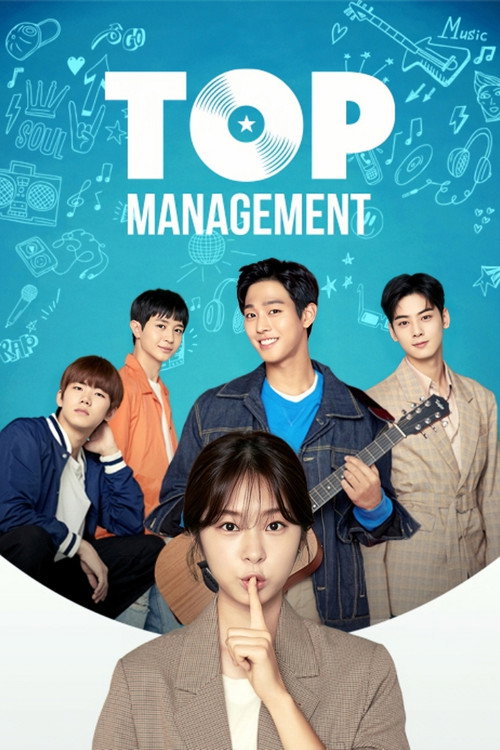
A neon-lit backstage fairy tale about K-pop's machinery, where a rookie manager glimpses tomorrow and learns that saving five boys' dreams may cost her own.
Top Management

Top Management

탑 매니지먼트

"A boy band without a future meets a manager who sees the future!"

30 October 2018 — 12 December 2018 South Korea 1 season 16 episode Ended 7.7 (100)

Cast: Seo Eun-soo, Ahn Hyo-seop, Cha Eun-woo, Jung Yoo-ahn, Bang Jae-min

Drama The invisible labour behind the idol industry Foreknowledge, fate and the ethics of intervention The manufacture and destruction of reputation Deferred and displaced dreams Found family under commercial pressure

Overview

Top Management (탑 매니지먼트, 2018) is a sixteen-episode South Korean web series that premiered on YouTube Premium on 31 October 2018, directed by Yoon Sung-ho and adapted from the web novel of the same name by Jang Woosan, originally serialised on the platform MUNPIA. Running roughly thirty minutes an episode, it was promoted as the first Korean drama produced for and released on YouTube, and it uses that short-form rhythm to tell a single, tightly contained story rather than a sprawling multi-season saga.

The series follows Yoo Eun-sung (Seo Eun-soo), a former girl-group trainee whose own idol dream collapsed and who now takes a job as a rookie manager at an entertainment agency. Her assignment is S.O.U.L, a boy group teetering on the edge of disbandment. What separates Eun-sung from every other overworked manager in the industry is a strange gift: she can catch flashes of the future. Those glimpses become both her professional advantage and her private burden as she tries to steer five young men toward a comeback that the industry has already written off.

Around her orbit the two poles of the group: Woo Yeon-woo (Cha Eun-woo), the visual and the member the public already adores, and Hyun Soo-ryong (Ahn Hyo-seop), a musical prodigy raised in Mongolia whose talent is real and whose temperament is not built for the machine, with Jung Yoo-ahn and Bang Jae-min rounding out S.O.U.L. Blending comedy, music, fantasy and romance, the show moves between the polished front of the K-pop ecosystem — stages, fan events, chart positions — and the ugly back rooms of contracts, scandal management and the online bashing that follows an accusation of plagiarism. It is, finally, less a story about becoming famous than about what fame costs the people who carry it, including the ones standing just off camera.

Core Meaning

At its heart, Top Management argues that the K-pop industry runs not on talent but on labour that is designed to be invisible — and it deliberately places the invisible worker, the manager, at the centre of the frame instead of the idols. By making Yoo Eun-sung a failed trainee who now serves the dream she was denied, the series stages a quiet act of restitution: the person the system discarded becomes the person who keeps it running.

The precognition device sharpens that argument rather than softening it. Knowing the future does not make Eun-sung powerful; it makes her responsible. Every vision is a choice about whose life to alter, and the show repeatedly suggests that a foreseen catastrophe can be redirected but never simply deleted — something is always traded for it. That is the series' image of the industry itself, where every comeback is purchased with somebody's health, privacy or youth.

The creators' final message is deceptively modest: success is not the point of the story. S.O.U.L. climbing the charts is not the resolution but the beginning of a new problem, and the closing movement asks whether a person can love this world without being consumed by it. The series ends open rather than triumphant, and that openness is the meaning — the machine keeps turning, and the only real freedom is deciding how much of yourself to feed it.

Thematic DNA

The invisible labour behind the idol industry 27%
Foreknowledge, fate and the ethics of intervention 24%
The manufacture and destruction of reputation 19%
Deferred and displaced dreams 17%
Found family under commercial pressure 13%

The invisible labour behind the idol industry

The series' governing choice is structural: the protagonist is the manager, not the star. Where most idol dramas follow the person on stage, Top Management follows the person holding the water bottle, negotiating the schedule and absorbing the fallout. Early episodes play this for comedy — the rookie who cannot do anything right — but as the run continues the tone hardens into something closer to a workplace drama about care work.

By the later episodes, when S.O.U.L.'s music finally climbs the charts, the reward arrives as a punishingly packed schedule rather than as rest. The finale explicitly turns on Eun-sung reassessing what her job as a Starlight manager actually is, which retroactively reframes the whole series: the arc was never about whether the group would succeed, but about what success does to the people who engineer it.

Foreknowledge, fate and the ethics of intervention

Eun-sung's flashes of the future begin as a gimmick — a cheat code for an underdog — and gradually become a moral problem. Each vision forces a choice about interference, and the show is careful never to let the ability function as clean wish-fulfilment: she sees fragments, not explanations, and fragments invite misreading.

The device deepens across the run as her visions start touching people she loves rather than career outcomes. The closing vision, which viewers have debated precisely because Eun-sung does not appear to recognise everyone in it, leaves the question deliberately unresolved: is the future a script she is reading, or one she is writing by reacting to it? The series withholds the answer, which is itself the position it takes.

The manufacture and destruction of reputation

S.O.U.L.'s central crisis is a plagiarism accusation, and the series treats online opinion as a weather system rather than a villain — impersonal, fast-moving and impossible to argue with. Popularity is shown to be a rented asset that can be repossessed overnight by a comment section.

What evolves over the sixteen episodes is the characters' relationship to that scrutiny. Early on the group treats bad press as an injustice to be corrected; later they treat it as a permanent condition of the work. The comeback, when it arrives, does not clear the record so much as outrun it, which is the series' most cynical and most accurate observation about the industry.

Deferred and displaced dreams

Eun-sung was a trainee before she was a manager. The series keeps that wound in view: she is building for others the exact life she was refused, and the show refuses to treat this as either pure generosity or pure bitterness. Her competence is her grief, professionalised.

Across the run this theme spreads outward to the group — Hyun Soo-ryong's outsider musicianship, Woo Yeon-woo's fame that arrived before he chose it — until the drama has assembled a portrait of an industry full of people living slightly beside the dream they actually wanted. The ending's ambivalence about whether Eun-sung stays in this world is the theme's final statement.

Found family under commercial pressure

S.O.U.L. is a manufactured unit that has to become a real one. The comedy of the early episodes comes from five incompatible young men and one flailing manager; the drama of the later ones comes from those same people discovering that loyalty is the only thing the contract cannot supply.

The romance strand between Eun-sung and a member of the group is threaded through this rather than separated from it, and it carries a built-in structural cruelty: in this industry, the relationship that would make them happiest is the one that could destroy the thing they have both worked for. The show lets that tension sit unresolved rather than pretending affection can be scheduled around.

Character Analysis

Yoo Eun-sung

Seo Eun-soo

Archetype: Reluctant hero / caretaker protagonist Key Trait: Stubborn, self-sacrificing competence

Motivation

Initially the simple need to keep a job and prove she is not a failure. This evolves into a genuine investment in the five members' survival, and finally into a harder question about whether she can protect them from an industry she is also serving — whether staying is love or self-erasure.

Character Arc

Begins as a former girl-group trainee whose own debut never happened, entering an entertainment agency as a rookie manager assigned to a group on the verge of disbandment. Her early episodes are those of an underdog using a strange gift — flashes of the future — simply to survive a job she is unqualified for.

Over the sixteen episodes she grows from someone who reacts to her visions into someone who accepts responsibility for them, and from a hired hand into the group's actual protector. Her endpoint is not promotion or vindication but doubt: in the finale, with S.O.U.L.'s music climbing the charts and the schedule overflowing, an event pushes her to reevaluate whether she should be a Starlight manager at all. The series ends on that reevaluation rather than resolving it.

Woo Yeon-woo

Cha Eun-woo

Archetype: The golden boy / romantic lead Key Trait: Warm, dutiful, quietly stubborn

Motivation

At first, holding the group together and meeting the expectations attached to his popularity; increasingly, a desire to be seen as himself rather than as the group's visual, and to protect the manager who has been protecting all of them.

Character Arc

The popular member of S.O.U.L., already carrying the group's public affection when the story begins. His trajectory across the run moves from being an asset — the face that keeps the group commercially alive — toward being a person with his own claim on his life, particularly as the plagiarism fallout tests whether public love is worth anything when it turns.

His relationship with Eun-sung develops alongside that, and the series uses him to ask what happens when the most marketable member wants something the market cannot approve of.

All 3 characters and cast

Symbols & Motifs

The vision / flash of the future

Meaning:

Eun-sung's precognition works as a symbol of experience without authority — she knows what is coming but has no institutional power to act on it, which is the condition of every low-ranking worker in the story.

Context:

Deployed from the first episodes as a comic advantage and progressively weaponised against her emotionally, culminating in a final, unexplained vision containing figures she does not seem to recognise — the image the series chooses to close on rather than resolve.

The stage and the backstage corridor

Meaning:

The threshold between the manufactured self and the actual person. The stage is where value is produced; the corridor is where the cost is paid, and the series spends most of its time in the corridor.

Context:

Structurally recurrent throughout the sixteen episodes: performances are frequently framed as the reward at the end of a sequence of backstage crises rather than as the sequence's subject.

The group name S.O.U.L.

Meaning:

An ironic label — a marketing acronym stamped on five people who spend the series trying to prove they still have the thing the name claims to sell. It encodes the show's core joke about commodified authenticity.

Context:

Present in every promotional beat, fan-facing scene and chart reference, so that each mention of the name quietly asks whether the group has earned it yet.

The chart position

Meaning:

The industry's substitute for meaning: a single number that determines whether a year of work counts as existence or failure. It stands for the reduction of art to measurable rank.

Context:

The engine of the plot from the disbandment threat onward; in the finale the chart climb arrives as a genuine triumph that immediately converts into exhaustion, exposing the number as hollow.

The manager's schedule / phone

Meaning:

The instrument of care and of control at once — the object through which Eun-sung protects the group and through which the company controls all six of them.

Context:

A constant physical presence across the run, escalating in the final episodes when success fills the calendar so completely that it becomes the thing forcing Eun-sung to reconsider the job.

The trainee past

Meaning:

A ghost limb. It symbolises the enormous population the industry consumes without ever showing on camera — those who trained and never debuted.

Context:

Established as Eun-sung's backstory and reactivated whenever she has to decide between the company's interests and a young performer's wellbeing.

Episode Highlights

Episode 1 (series premiere)

S1E1

Released 31 October 2018 as the opening of YouTube's first Korean original drama. It establishes the premise in a single half-hour: Yoo Eun-sung, an ex-trainee, becomes manager to S.O.U.L., a boy group facing disbandment, and her ability to glimpse the future is introduced as the tool that might save them.

Contemporary reviewers treated the premiere as the show's audition with the audience — the episode most widely written about at launch, largely on the strength of Cha Eun-woo's casting and the novelty of the platform.

Significance:

Sets the series' central inversion — the manager, not the idol, is the protagonist — and installs the precognition device that every later crisis will test.

Me Gustas Tu (finale)

S1E16

The season finale. S.O.U.L.'s music climbs the charts, and the unexpected wave of attention brings a tightly packed schedule for every member. Eun-sung is proud of them — and then an event causes her to reevaluate her job as a Starlight manager.

The episode closes the story open rather than shut, including a final vision whose contents viewers have argued over ever since, notably the question of why Eun-sung does not appear to recognise certain figures in it.

Significance:

Converts the show's apparent goal — the comeback — into its actual subject: what victory costs the person who engineered it. The unresolved ending became the single most discussed element of the series and the main driver of calls for a second season that never arrived.

Philosophical Questions

If you could see the future, would you be freer or more trapped?

Eun-sung's gift never functions as pure advantage. Each flash imposes an obligation to act, and because her visions are fragments rather than explanations they invite misreading. The series suggests foreknowledge converts a person from participant into custodian — she can no longer plead ignorance, and every outcome becomes partly hers. The unresolved final vision leaves the question permanently open rather than answering it.

Who owns a dream that another person has to perform?

Eun-sung was a trainee who never debuted and now builds the exact life she was denied for five other people. The drama sits in that ambiguity across the run: is her devotion generosity, or is it a deferred attempt to live the dream by proxy? The finale's turn toward reevaluating her job forces the question into the open without settling it.

Is success worth having if it consumes the people who achieved it?

The series structures its finale as an apparent triumph — S.O.U.L.'s music climbing the charts — that immediately manifests as a punishing schedule and a crisis of vocation. By making the reward and the injury the same event, the show argues that in this industry victory is simply the next form the pressure takes.

Can a reputation destroyed by public opinion ever actually be repaired?

The plagiarism bashing that nearly ends the group is never really refuted so much as outlived. The drama presents online judgement as a weather system: impersonal, unappealable, and indifferent to truth. What the characters recover is not innocence but momentum, which is a bleaker and more accurate proposition than vindication.

Does the person off camera have a self?

By centring the manager rather than the idols, the series continuously asks whether someone whose entire function is enabling others can be a protagonist of her own life. Sixteen episodes of Eun-sung solving other people's crises make the finale's question — whether she should keep doing this at all — land as a question about existence rather than employment.

Alternative Interpretations

The most contested element is the ending, which the series leaves open. The dominant fan reading treats the unresolved final vision — including the widely noted puzzle of why Eun-sung does not appear to recognise certain figures in it — as a deliberate setup for a second season that was never made, and therefore as an incomplete story rather than an artistic choice.

Full ending explanation

Cultural Impact

Top Management matters less for what it said than for where it appeared. Arriving on 31 October 2018 as YouTube's first Korean original drama, it was part of the moment when streaming platforms began commissioning Korean content directly rather than licensing broadcast series — a shift that Netflix, Viki and eventually Disney+ would industrialise over the following few years. Korean outlets covered Cha Eun-woo's casting in a YouTube Original as a genuine news event, which now reads as a marker of how unusual the arrangement was at the time.

Its second contribution is generic. The K-pop workplace drama had generally been told from the stage side; Top Management is structured around the manager, and it foregrounds the machinery — plagiarism accusations, online bashing, disbandment economics, schedule attrition — that idol-centred stories tend to treat as background. Combining that with a supernatural device also placed it within a long Korean tradition of precognition and time-manipulation dramas, using a fantasy premise to make a labour story legible.

Culturally, the series sits inside the web-drama boom aimed at international K-pop fandom: half-hour episodes, an idol lead, English-subtitled global release from day one, no domestic broadcast slot required. That model was designed for a diaspora audience, and the show's afterlife has been almost entirely in that space — fan discussion, drama-community reviews, recommendation lists — rather than in the awards and ratings ecosystem that defines mainstream Korean television. Its legacy is therefore modest but real: an early, watchable proof that a global platform could commission Korean drama for Korean-fandom audiences, and a persistent example cited whenever viewers ask for an idol drama told from the staff's point of view.

Audience Reception

As a single-season web drama, Top Management was received largely by K-pop fandom rather than by mainstream television critics, and its reputation reflects that. The draw was the cast — reviewers covering the premiere were explicit that Cha Eun-woo's presence was the entry point, and Soompi's pre-release coverage was pitched at idol-drama viewers rather than general drama audiences. The novelty of the format also generated goodwill: a Korean original commissioned by YouTube, released globally with subtitles, in bingeable thirty-minute pieces.

What audiences consistently praised was the premise's inversion — an idol story told from the manager's side, with the plagiarism scandal, disbandment threat and scheduling grind treated as the actual plot. The compressed episode length was widely seen as a strength for a story of this scale, keeping the pacing brisk where a broadcast-length version would have padded.

The criticism concentrates almost entirely on the ending. The finale's open conclusion left a substantial share of viewers unsatisfied, with recurring complaints about unanswered questions — most persistently, why Eun-sung does not seem to recognise certain figures in her final vision. Rather than reading it as closure, much of the audience read it as an unfulfilled promise of a second season, and the wish for that season became the single most durable piece of discourse around the show. No continuation was made.

Overall verdict: a well-liked, modestly scaled idol drama that won affection for its cast and its behind-the-curtain premise, and lost some of that affection at the finish line. It is generally recommended as a light, fast watch with an unresolved ending — a series whose ambitions outran the sixteen half-hours it was given.

Interesting Facts

  • The series premiered on YouTube Premium on 31 October 2018 and was promoted as the first Korean drama produced for and aired on the YouTube platform.
  • It runs 16 episodes of roughly 30 minutes each — a web-drama format far shorter than the standard 60–70 minute Korean broadcast hour.
  • It was directed by Yoon Sung-ho.
  • The drama is an adaptation of the web novel 'Top Management' by Jang Woosan, originally serialised on the Korean web-novel platform MUNPIA.
  • Cha Eun-woo, a member of the real K-pop group ASTRO, plays idol Woo Yeon-woo — casting an actual working idol as a fictional one.
  • Ahn Hyo-seop plays Hyun Soo-ryong, written as a musical prodigy from Mongolia; the character's name is romanised inconsistently across databases (IMDb lists him as 'Hyeon Soo-yong').
  • Soompi ran a pre-release feature titled '4 Things To Look Out For In Upcoming Web Drama Top Management', and the Korea Herald covered Cha Eun-woo's casting in a YouTube Original as news in itself — a measure of how novel the platform was for Korean drama in 2018.
  • The finale carries the episode title 'Me Gustas Tu'.
  • Jung Yoo-ahn and Bang Jae-min round out the fictional group S.O.U.L. alongside Cha Eun-woo and Ahn Hyo-seop.
  • The series ended after its single 16-episode run; despite persistent audience requests, no second season was produced.

Easter Eggs

The finale is titled 'Me Gustas Tu'.

The phrase is best known to K-pop audiences as the title of GFriend's 2015 hit, making the episode title a wink at the real idol landscape the fictional group S.O.U.L. inhabits — and a Spanish-language confession ('I like you') used as the header for an episode about a manager's unresolved feelings.

Cha Eun-woo, an active member of ASTRO, plays a fictional idol.

The casting builds a permanent meta-layer into the show: scenes about fan attention, schedules and the pressure on a group's 'visual' are performed by someone living that job in reality. Promotional coverage leaned on this overlap, and it gives the drama's backstage material a documentary undertone it would not otherwise have.

The drama exists on YouTube — the same platform where real K-pop careers are made — as YouTube's first Korean original.

A story about chart positions, viral opinion and comeback videos was distributed through the exact infrastructure it depicts, so the audience's act of watching mirrors the fan behaviour the plot turns on.

Frequently Asked Questions

Explore More About This Movie

Dive deeper into specific aspects of the movie with our detailed analysis pages

Comments (0)

Leave a comment

No comments yet. Be the first to share your thoughts!

Similar Movies