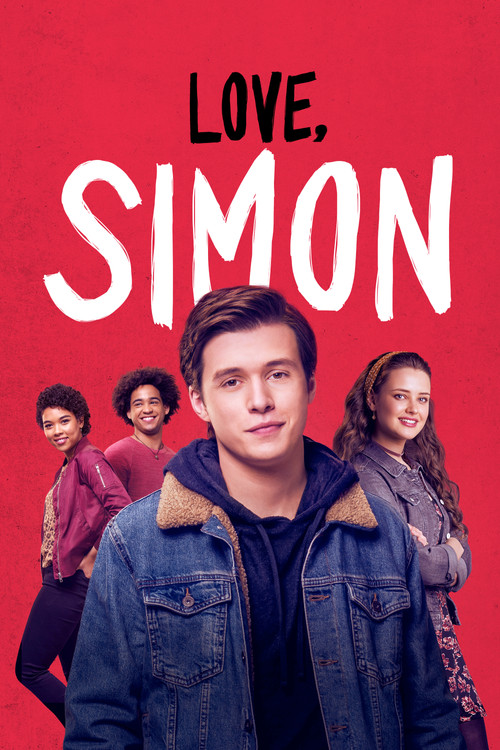
Love, Simon
"Everyone deserves a great love story."
Overview
"Love, Simon" centers on Simon Spier, a seventeen-year-old high school student living a seemingly perfect life in a suburb of Atlanta. He has a loving family and a tight-knit group of friends. However, Simon is harboring a significant secret: he is gay.
When an anonymous classmate comes out as gay on their school's online forum under the pseudonym "Blue," Simon, using the alias "Jacques," begins an email correspondence with him. They form a deep connection, sharing their fears and experiences about being closeted. Their anonymous romance becomes a central part of Simon's life as he tries to uncover Blue's real identity.
The situation becomes complicated when another student, Martin, discovers Simon's emails and threatens to out him to the entire school unless Simon helps him win the affection of one of his best friends, Abby. Simon is then forced to navigate the treacherous waters of high school social dynamics, balancing his friendships, family life, and the threat of being outed before he is ready, all while falling for someone he's never met.

Core Meaning
At its core, "Love, Simon" is a universal story about the terrifying and liberating journey of self-acceptance and the courage it takes to announce who you are to the world. Director Greg Berlanti aimed to create a heartfelt, coming-of-age story that places a gay protagonist at the center of a mainstream romantic comedy, a genre historically dominated by heterosexual narratives. The film's primary message is that everyone, regardless of their sexual orientation, deserves a great love story and the chance to be their authentic self. It explores the complexities of identity, the fear of judgment, and the profound importance of acceptance from friends, family, and oneself. The film champions the idea that while coming out can be an intensely personal and frightening experience, it is also a vital step towards living a full and honest life.
Thematic DNA
Identity and Self-Acceptance
The central theme is Simon's journey toward accepting his own identity as a gay teenager. The film portrays his internal struggle, balancing the person he presents to the world with who he truly is. His anonymous emails with Blue are a crucial outlet where he can be his authentic self without fear of judgment. The narrative arc follows his progression from fear and secrecy to the brave declaration, "I'm done being scared. I'm done living in a world where I don't get to be who I am." This journey highlights the universal adolescent experience of figuring out who you are and finding the courage to embrace it.
The Coming Out Experience
"Love, Simon" provides a nuanced exploration of the coming out process. It emphasizes that coming out is a deeply personal decision and that everyone has the right to control their own narrative. This is powerfully shown when Simon's agency is stripped from him by Martin's blackmail, leading to his quote: "I'm supposed to be the one that decides when and where and how and who knows... and you took that away from me!" The film also portrays a range of reactions, from the unconditional love of his mother to the initial awkwardness of his father, and the supportive, though sometimes complicated, reactions of his friends, illustrating that even in a liberal environment, the process is fraught with anxiety.
Friendship and Betrayal
Simon's relationships with his three best friends—Leah, Nick, and Abby—are central to the film. His fear of how his secret might change these dynamics is a major source of his anxiety. In his desperation to protect his secret from Martin, Simon manipulates his friends, leading to moments of betrayal and hurt feelings, particularly with Leah, who has been his friend the longest. The film explores the strain that secrecy and fear can put on even the strongest friendships, and the subsequent path to forgiveness and deeper understanding once the truth is revealed.
Love in the Digital Age
The entire premise of Simon and Blue's relationship is built on anonymity and digital communication. Their romance blossoms through emails, where they can be vulnerable and honest in a way they feel they cannot be in person. This theme reflects a modern reality of forming connections online. The film uses this digital-age romance to build suspense around Blue's identity, as Simon (and the audience) tries to piece together clues from their online interactions to figure out who he is in the real world.
Character Analysis
Simon Spier
Nick Robinson
Motivation
Initially, Simon is motivated by fear—the fear of change, of losing his friends and family, and of how the world will see him differently. This fear drives him to keep his sexuality a secret and to comply with Martin's blackmail. As the film progresses, his motivation shifts to love and self-worth, fueled by his connection with Blue and the realization that he deserves to be happy and authentic.
Character Arc
Simon begins the film as a closeted teenager, terrified of how coming out will disrupt his comfortable, "normal" life. His primary goal is to maintain the status quo. Through his anonymous relationship with Blue and the crisis of being blackmailed, he is forced to confront his fears. He makes mistakes, hurting his friends in his desperation. However, this turmoil forces him to grow, moving from a place of fear to one of courage. His arc culminates in him taking control of his own narrative, coming out to his family and publicly declaring his right to a great love story, ultimately embracing his true self without reservation.
Leah Burke
Katherine Langford
Motivation
Leah is motivated by her deep, protective love for Simon. Her actions are driven by a desire to maintain their lifelong friendship and a secret hope for something more. Her emotional reactions stem from a fear of losing the unique closeness she shares with him.
Character Arc
Leah is Simon's fiercely loyal and oldest friend, who harbors a secret crush on him. Her arc involves dealing with the hurt of Simon confiding in their newer friend, Abby, before her. She feels betrayed not by his sexuality, but by what she perceives as a lack of trust. Her journey is about understanding Simon's reasons and reaffirming their deep, platonic bond. She learns to separate her romantic feelings from their friendship, ultimately offering him her unwavering support.
Martin Addison
Logan Miller
Motivation
Martin is driven by a desperate need for popularity and the affection of his crush, Abby. His social awkwardness and insecurity fuel his poor decision-making, as he believes manipulating Simon is the only way to achieve his goals.
Character Arc
Martin starts as an overly eager, socially awkward classmate. His desperation for social acceptance and a date with Abby leads him to blackmail Simon. He is not portrayed as purely malicious, but rather as deeply insecure and misguided. After his actions lead to Simon being publicly outed and ostracized, Martin experiences remorse. His arc is one of redemption; he realizes the gravity of his mistake and tries to make amends by helping Simon get one last chance to meet Blue at the Ferris wheel, showing growth and a newfound sense of empathy.
Bram Greenfeld ('Blue')
Keiynan Lonsdale
Motivation
Like Simon, Bram is motivated by a desire for connection and the fear of the consequences of coming out. His anonymity as Blue allows him to explore his feelings safely. Ultimately, Simon's public vulnerability inspires him, and his motivation shifts to a desire to reciprocate that bravery and embrace a real relationship.
Character Arc
Bram, known for most of the film only as the anonymous "Blue," is also on a journey of self-acceptance. Initially, he is even more hesitant than Simon to come out. His arc is largely unseen but mirrored in Simon's. He struggles with his own fears and confusion, as shown when Simon sees him kissing a girl at a party. His development culminates in the film's climax, where he overcomes his fear and publicly reveals himself to Simon on the Ferris wheel, choosing love and authenticity over staying hidden.
Symbols & Motifs
The Ferris Wheel
The Ferris wheel symbolizes the emotional rollercoaster of adolescence, love, and the coming out experience. Simon himself states, "Sometimes I feel like I'm stuck on a ferris wheel. One minute I'm on top of the world, the next I'm at rock bottom." It represents the highs of his connection with Blue and the lows of his fear and blackmail. Ultimately, it becomes a place of optimistic culmination, a public space where Simon takes a brave stand and where he and Blue finally meet, representing the peak of his journey to self-acceptance and the beginning of their public love story.
The Ferris wheel is a recurring motif. Simon mentions it in his narration early in the film to describe his emotional state. The climax of the film takes place on the Ferris wheel at the winter carnival, where Simon publicly asks Blue to meet him. He rides it alone, round and round, in a vulnerable public display, before Bram joins him, revealing himself as Blue.
Email Pseudonyms: 'Jacques' and 'Blue'
The pseudonyms Simon ('Jacques') and his correspondent ('Blue') use symbolize the masks they wear and the safety of anonymity. It allows them to express their true feelings and identities without the risks associated with coming out in their real lives. 'Blue' can also be interpreted as representing the melancholy or sadness associated with being closeted, as well as the mystery surrounding his identity. For Simon, 'Jacques' might be a playful, more confident version of himself he wishes he could be openly.
These names are used exclusively in their email correspondence, which forms the narrative backbone of their relationship. The entire plot is driven by Simon's desire to attach a real face and name to 'Blue', effectively bridging the gap between his secret online life and his real-world existence. The mystery of Blue's identity is a central plot device, with Simon speculating it could be several different classmates.
Iced Coffee
Iced coffee represents the normalcy and routine of Simon's life before and after his coming out. It's a mundane, everyday detail that grounds his extraordinary journey in a relatable teenage experience. He describes his life with his friends as doing normal things like drinking "way too much iced coffee." The continuation of this routine at the end of the film signifies that despite the monumental changes in his life, the core of his friendships and his identity remains the same.
In the opening narration, Simon establishes his "totally perfectly normal life" by describing his daily routine with his friends, which includes getting iced coffee every morning before school. The film's final scene shows Simon picking up his friends and his new boyfriend, Bram, for their morning coffee run, bringing his journey full circle and reinforcing the theme that he is still the same person.
Memorable Quotes
I'm supposed to be the one that decides when and where and how and who knows and how I get to say it, that's supposed to be my thing! And you took that away from me.
— Simon Spier
Context:
Simon confronts Martin in the school parking lot after Martin's actions led to Simon's emails being leaked on the school's gossip blog, outing him to everyone against his will.
Meaning:
This quote powerfully articulates the core message about the personal nature of coming out. It underscores that revealing one's identity is a right, not a piece of gossip, and that taking that control away from someone is a profound violation.
You are still you, Simon. You are the same son who I love to tease... And you're the same brother... You get to exhale now, Simon. You get to be more you than you have been in a very long time. You deserve everything you want.
— Emily Spier (Simon's mother)
Context:
A couple of days after Simon comes out to his parents, his mother finds him in his room to have a heartfelt conversation, reassuring him of her unwavering love and support.
Meaning:
This is a pivotal moment of parental acceptance. Emily's speech reassures Simon—and the audience—that his sexuality doesn't change who he is as a person. It's a beautiful expression of unconditional love and validation, highlighting the relief and freedom that comes with being able to live authentically.
I'm done being scared. I'm done living in a world where I don't get to be who I am. I deserve a great love story.
— Simon Spier
Context:
Simon writes this in a public post on the school's gossip blog, coming out on his own terms to the entire school and asking Blue to meet him at the carnival.
Meaning:
This is Simon's declaration of independence and self-worth. It marks the climax of his character arc, moving from fear to empowerment. The line resonates as a universal anthem for anyone who has felt the need to hide a part of themselves, asserting the fundamental right to love and be loved for who you are.
Announcing who you are to the world is pretty terrifying, because what if the world doesn't like you?
— Simon Spier
Context:
This line is part of Simon's internal monologue and narration, explaining his hesitation and the fear that keeps him in the closet.
Meaning:
This quote captures the universal fear of vulnerability and rejection that accompanies revealing one's true self, whether it relates to sexuality or any other aspect of identity. It encapsulates the central emotional conflict of the film and makes Simon's struggle relatable to a broad audience.
Philosophical Questions
What is the relationship between our private selves and our public personas?
The film deeply explores the tension between Simon's internal identity and the image he projects to the world. His anonymous emails with Blue represent a space where his private self can flourish without fear. The central conflict arises when this private world is threatened with public exposure. The film asks viewers to consider the parts of themselves they keep hidden and the courage it takes to integrate those private truths into their public lives. It posits that true happiness and fulfillment come from closing the gap between who we are and who we pretend to be.
Does everyone have a 'coming out' story?
While the film is explicitly about a gay teenager's coming out, it universalizes the experience. Simon's mother tells him he can finally "exhale," and director Greg Berlanti has said that everyone has a "coming out moment" where they choose to announce their true selves to the world, regardless of whether it relates to sexuality. The film suggests that the process of revealing a profound, hidden truth about oneself is a universal human journey, making Simon's specific story a metaphor for any act of self-revelation and the quest for authenticity.
Who has the right to tell someone's story?
The act of Martin outing Simon is presented as a profound ethical violation. Simon's furious reaction—"I'm supposed to be the one that decides!"—is the film's moral centerpiece on this issue. It raises the philosophical question of autonomy and ownership over one's own narrative. The film argues unequivocally that personal truths, especially those concerning identity, belong to the individual and that to reveal them without consent is to steal something fundamental.
Alternative Interpretations
While overwhelmingly praised, some critical analysis of "Love, Simon" offers alternative interpretations of its impact and message. One perspective argues that the film's focus on a white, upper-middle-class, conventionally masculine protagonist makes its portrayal of the gay experience "palatable" and non-threatening to a heterosexual audience. This critique suggests that in its effort to be a mainstream, universal story, it reinforces a type of "homonormativity," where acceptance is granted more easily to those who conform to otherwise traditional societal norms. The film's happy ending, set in an impeccably liberal and accepting community, has been described by some as idealistic and less representative of the harsher realities many LGBTQ+ youth face.
Another point of discussion is the climactic Ferris wheel scene. In the source novel, Simon's meeting with Blue is a private, intimate moment. The film transforms it into a public spectacle, with the entire student body cheering them on. One interpretation sees this as a powerful display of community allyship and celebration. An alternative reading suggests it detracts from the personal intimacy of the moment, turning a deeply personal milestone into a performance for the validation of a straight audience, and puts undue pressure on Blue to come out publicly before he may be ready.
Cultural Impact
"Love, Simon" is widely regarded as a landmark film for LGBTQ+ representation in mainstream cinema. Released in 2018 by 20th Century Fox, it was the first movie from a major American studio to center on a gay teenage protagonist and his love story. This was a significant departure from previous queer cinema, which was often independently produced or ended in tragedy. The film's success, grossing over $66 million worldwide on a modest budget, demonstrated to Hollywood that there was a broad, commercially viable audience for uplifting LGBTQ+ stories.
The film was praised by critics for its warmth, humor, and revolutionary normalcy, framing a gay love story within the familiar and accessible conventions of a John Hughes-style teen romantic comedy. This approach made Simon's story universally relatable, transcending sexuality to touch on themes of identity, friendship, and first love. Its impact was felt on a personal level by many viewers; the film inspired numerous young people to come out to their own friends and families. The supportive reaction from celebrities who bought out screenings further amplified its message of acceptance.
"Love, Simon" helped pave the way for more mainstream LGBTQ+ representation in film and television, proving that queer stories could be joyful, hopeful, and successful. It challenged the narrative that LGBTQ+ stories must be about suffering and instead presented a hopeful and affirming vision that resonated deeply with audiences, solidifying its place as a significant cultural touchstone.
Audience Reception
Audience reception for "Love, Simon" was overwhelmingly positive. Viewers praised the film for its heartfelt story, humor, and emotional depth. Many connected deeply with Nick Robinson's endearing and relatable portrayal of Simon. The film was celebrated for being a feel-good, crowd-pleasing movie that managed to be both entertaining and culturally significant. The emotional moments, particularly Simon's coming out to his family and his mother's subsequent speech, were frequently highlighted as powerful and tear-jerking.
For many LGBTQ+ viewers, the film was a landmark moment, offering the rare chance to see a happy, hopeful, and mainstream romantic comedy centered on characters they could identify with. The common sentiment was that the film provided much-needed positive representation. Points of minor criticism among some viewers included the feeling that Simon's life was somewhat idealized—with a financially stable, liberal, and ultimately supportive family and community—which might not reflect the experience of all LGBTQ+ teens. However, the overall verdict was that the film's warmth, charm, and groundbreaking message of love and acceptance made it a beloved and important film.
Interesting Facts
- The film is based on the 2015 Young Adult novel "Simon vs. the Homo Sapiens Agenda" by Becky Albertalli.
- "Love, Simon" is considered the first film by a major Hollywood studio to focus on a gay teenage romance.
- Director Greg Berlanti, who is openly gay, drew from his own experiences as a closeted teen to inform the film's emotional authenticity.
- Many celebrities, including Jennifer Garner, Kristen Bell, Matt Bomer, and Neil Patrick Harris, bought out theater screenings to allow people to see the film for free because they believed its message was important.
- The character of Ethan, an openly gay and confident student, was not in the original book and was added by the filmmakers to show that there can be more than one way to be gay in a high school.
- The carnival at the end of the movie was built entirely from scratch for the production.
- The screenwriters, Isaac Aptaker and Elizabeth Berger, were also the showrunners for the hit TV series "This Is Us".
- Actor Keiynan Lonsdale, who plays Bram/Blue, came out publicly during the filming of the movie.
- The film's soundtrack was executive produced by Jack Antonoff of the band Bleachers and features an original song, "Alfie's Song (Not So Typical Love Song)," that was co-written with Harry Styles.
Easter Eggs
In Simon's bedroom, several books written by prominent LGBTQ+ young adult authors can be seen on his shelves.
This includes books like Adam Silvera's "More Happy Than Not." It serves as a nod to the growing genre of queer YA literature that paved the way for a story like "Love, Simon" and shows the character is connected to the broader LGBTQ+ culture.
The director, Greg Berlanti, was heavily inspired by the films of John Hughes (e.g., "The Breakfast Club," "Sixteen Candles").
This influence is visible in the film's visual style, its focus on heartfelt teen drama, and its memorable soundtrack. Berlanti aimed to create a film that felt like a classic, nostalgic teen movie but with a contemporary and inclusive perspective.
⚠️ Spoiler Analysis
Click to reveal detailed analysis with spoilers
Frequently Asked Questions
Explore More About This Movie
Dive deeper into specific aspects of the movie with our detailed analysis pages
Comments (0)
No comments yet. Be the first to share your thoughts!