Skip to content
Turning Red
A neon-bright, giggling coming-of-age comedy where adolescence arrives as a fluffy, uncontrollable storm. Love, embarrassment and ancestral expectation tumble together like a giant red panda sprinting through a pastel Toronto.
Turning Red

Turning Red

"Growing up is a beast."

10 March 2022 United States of America 100 min 7.3 (6,076)

Director: Domee Shi

Cast: Rosalie Chiang, Sandra Oh, Ava Morse, Hyein Park, Maitreyi Ramakrishnan

Animation Family Fantasy Comedy Puberty and self-acceptance Mothers, daughters and generational expectation Honoring family versus honoring yourself Friendship and belonging Cultural heritage and diaspora
Budget: $175,000,000
Box Office: $21,813,358

Overview

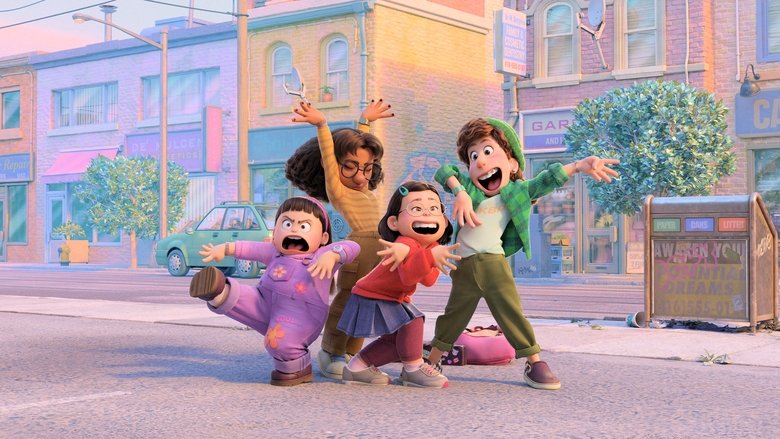
Turning Red follows Meilin "Mei" Lee, a confident, dorky 13-year-old in Toronto in 2002. She is devoted to her friends, her family's temple duties and her strict, loving mother Ming. Her life is a balancing act between being the "perfect daughter" and the messier person she is becoming, one who loves boy bands, boys and loud fun.

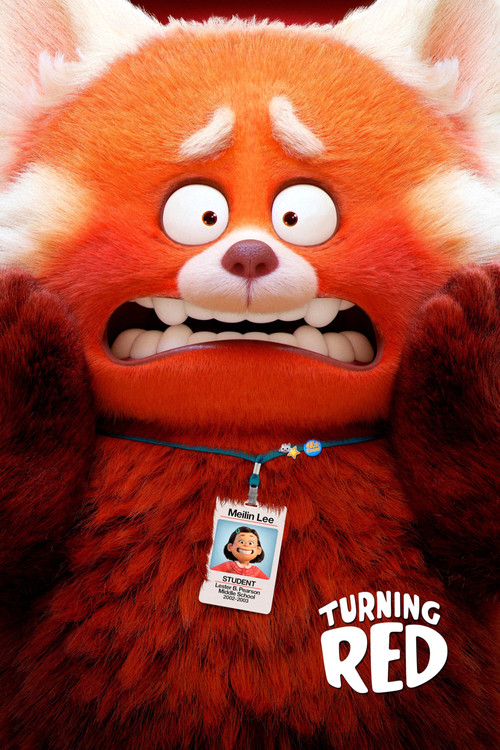
Then Mei wakes up transformed into a giant red panda whenever her emotions run too high. The film is Pixar's first feature directed solely by a woman, Domee Shi, and it treats the change as a comic, heartfelt metaphor for puberty and for the strain between generations.

As Mei and her three best friends scheme to see their favorite band, 4*Town, in concert, she has to decide how much of herself to hide, how much to share, and what she owes her family. The film is fast, funny and anime-influenced, and it grounds its fantasy in a specific time and place.
Core Meaning

The film argues that growing up means accepting your messy, loud, contradictory self instead of suppressing it, and that this acceptance can coexist with love for your family. Mei's panda is not a curse to be removed but a part of her. Honoring your parents does not require erasing yourself. Her father puts the idea plainly: the point is not to push the bad stuff away but to make room for it.

It is also about inherited burdens. Ming's own panda, and the pain behind her perfectionism, were handed down through generations. Healing requires parent and child to see each other honestly, and to see that a parent's love can wound without intending to.

Thematic DNA

Puberty and self-acceptance 30%
Mothers, daughters and generational expectation 30%
Honoring family versus honoring yourself 20%
Friendship and belonging 12%
Cultural heritage and diaspora 8%

Puberty and self-acceptance

The panda arrives with strong emotion, mirroring the body and feelings of adolescence. Ming's awkward response, with pads and herbal tea for cramps, is played for comedy. Mei learns to embrace her wild side instead of hiding it.

Mothers, daughters and generational expectation

Ming's overprotectiveness comes from her own pain with her mother and from the pressure to be perfect. Mei's attempt to please everyone mirrors it, and the climax lets each see the other's fear.

Honoring family versus honoring yourself

Mei opens the film by joking that honoring your parents is the number one rule but can be taken too far. Her struggle is to keep faith with her family and culture without abandoning her own desires.

Friendship and belonging

Mei's friends Miriam, Priya and Abby accept her panda at once and support her. A real rupture occurs when Mei lets them take the blame, which shows that growing up includes accountability.

Cultural heritage and diaspora

The panda is a gift from ancestor Sun Yee that later generations came to see as an inconvenience. The story sits within a Chinese-Canadian family and a temple, and it treats tradition as something to be re-negotiated, not simply discarded.

Character Analysis

Meilin "Mei" Lee

Rosalie Chiang

Archetype: Coming-of-age hero Key Trait: Eager, passionate, and quick to embarrass herself

Motivation

To please her mother while also becoming her own person and enjoying her friends and interests.

Character Arc

She begins as a dutiful, high-achieving daughter who hides what she wants. As she turns into a panda she learns to own her contradictory feelings, and she chooses to keep the panda instead of sealing it away.

Ming Lee

Sandra Oh

Archetype: Overprotective parent / shadow Key Trait: Fiercely loving but suffocating

Motivation

To protect Mei from the embarrassment and harm she feared, and to preserve family honor.

Character Arc

She moves from controlling her daughter's changes to confronting her own history with her mother and the pain behind her perfectionism, and finally to accepting her daughter.

All 5 characters and cast

Symbols & Motifs

The red panda

Meaning:

The unruly self: emotions, desire, anger and individuality, and also the inheritance of the family's women.

Context:

It appears when Mei's emotions surge. Mei first hides it, then uses it for self-expression and for money, and finally keeps it for good.

Red color and the period motif

Meaning:

Red points to the physical changes of puberty, to anger and shame, and to luck and ritual in Chinese culture.

Context:

The film's title and its main visual identity play on these overlapping meanings, from menstruation jokes to the red moon of the ritual.

The red moon ritual

Meaning:

The ritual stands for the old way of dealing with difficult feelings: sealing them away for the sake of order and comfort.

Context:

The family plans to seal the panda into a talisman at the red moon, and the ritual's failed outcome becomes the story's crisis.

Ming's own panda

Meaning:

It shows that perfection was a mask, and that the generational pain Mei faces is one her mother also lived through.

Context:

In the climax Mei sees young Ming's rage and her wish to be good enough for her own mother.

4*Town and the concert

Meaning:

Pop fandom is a safe outlet for desire and community, the first place where Mei's interests belong only to her.

Context:

The boy band drives the plot as the friends scheme to get tickets, and the concert becomes the setting for the finale.

Mei's notebook of drawings

Meaning:

Private desire and imagination, and the shame attached to them.

Context:

Mei draws a boy she likes, and her mother's reaction to the drawings sets off her sense of being exposed.

Memorable Quotes

I'm Meilin Lee. And ever since I turned 13, I've been doin' my own thing, makin' my own moves; 24/7/365.
— Meilin Lee

Context

Mei's opening narration.

Meaning

It establishes her confident narration, which the film then tests.

Honoring your parents sounds great, but if you take it too far... well, you might forget to honor yourself.
— Meilin Lee

Context

Mei's opening narration about the family's number one rule.

Meaning

It states the film's central tension, and it foreshadows her journey.

All 6 quotes

Philosophical Questions

How much of yourself should you hide to keep the peace with those you love?

Mei hides her panda and her desires to be good, and the cost is her honesty and eventually her friendships.

Can love be harmful when it is controlling?

Ming's care is genuine but suffocating, and the film shows how a parent's fear can pass pain on to the next generation.

Should inherited traditions be preserved, rewritten or discarded?

The ritual to seal the panda is a tradition that suppresses, while the family's ancestral gift is reclaimed. The film suggests tradition can be kept while being reinterpreted.

How It Ends

Alternative Interpretations

The panda is most often read as puberty, and menstruation in particular. Others read it as inherited trauma and the immigrant family's complicated relationship with heritage, or as the creative spark, as the Washington Post suggested. Some critics felt the ending tidies up its messy emotions too neatly (the LA Times said it falls short of the catharsis it aims for), while others see Mei's choice to keep the panda as the more honest resolution, with her family accepting the whole of her.

Full ending explanation

Cultural Impact

The film arrived as a corrective to Pixar's male-buddy tradition: the New York Times described it as an unabashedly female story. Critics praised its specificity of place and time, a pastel Toronto in 2002, and its anime-influenced look and editing. Reviewers, including Cartoon Brew's roundup, noted that it broadens what a Pixar film can be.

Reception was strong with critics: Metacritic gave it a Metascore of 83 on 53 reviews. Some audiences were less enthusiastic, and the film's release straight to Disney+ and pre-release online arguments about its subject matter were part of the discussion. It has since been rediscovered and was given a theatrical release in 2024.

Audience Reception

Critics were highly positive. Metacritic's Metascore is 83 from 53 reviews, with 94% positive, and the Cartoon Brew roundup cited a 95% critics' score on Rotten Tomatoes. IGN called it Pixar's funniest and most imaginative film in years, and The Hollywood Reporter called it original, funny and tender.

Audience scores were more divided: Metacritic's user score is 6.0, with 58% positive and 25% negative ratings, and the Rotten Tomatoes audience score cited was 66% at one point. Praise focused on the mother-daughter relationship, humor, the animation and the specificity of the setting. Criticism came from viewers put off by its focus on a teen girl's experience and from some critics, such as the LA Times, who felt the ending is too neat. The overall verdict: an energetic, distinctive and well-loved Pixar entry.

Interesting Facts

  • Turning Red was directed by Domee Shi, who earlier won an Oscar for the Pixar short Bao, and the screenplay is credited to Shi and Julia Cho.
  • It was produced by Lindsey Collins, and the music was composed by Ludwig Göransson.
  • It premiered at the El Capitan Theatre on March 1, 2022, and was released on Disney+ on March 11, 2022.
  • The film skipped a general theatrical release initially and was released theatrically in the United States on February 9, 2024.
  • Wikipedia lists its budget as $175 million and its box office as $21.8 million, largely from the later theatrical run.
  • The Cartoon Brew roundup noted an unusual split: a 95% critics' score on Rotten Tomatoes against 66% from the public at that time.
  • Critics have noted the influence of anime on the film's look, including shivering pupils and big tears.

Frequently Asked Questions

Explore More About This Movie

Dive deeper into specific aspects of the movie with our detailed analysis pages

Comments (0)

Leave a comment

No comments yet. Be the first to share your thoughts!

Similar Movies