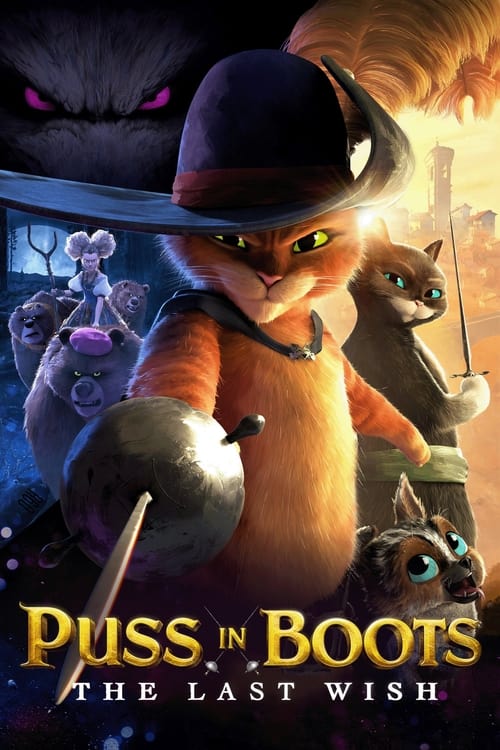
Puss in Boots: The Last Wish
"Say hola to his little friends."
Overview
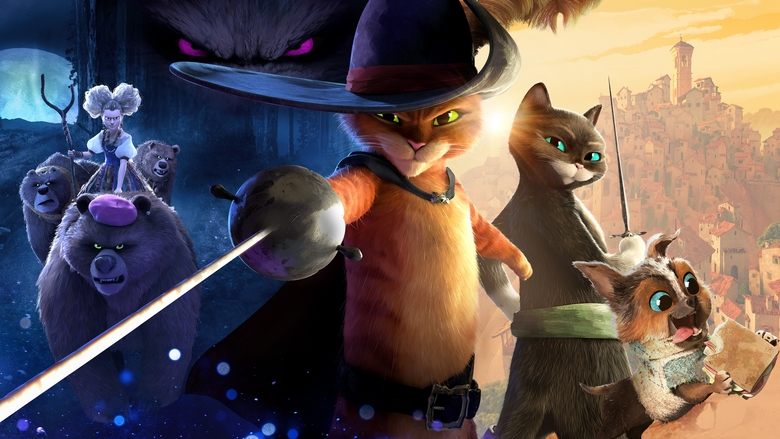
In "Puss in Boots: The Last Wish," the charismatic and arrogant feline hero, Puss in Boots, discovers he has recklessly burned through eight of his nine lives. This terrifying realization sends him into a spiral of fear, especially after a chilling encounter with a mysterious, sickle-wielding Wolf who is revealed to be Death himself, intent on claiming Puss's final life. Forced to retire, Puss hangs up his signature boots and hides away in a cat sanctuary.
However, the allure of adventure and a chance at redemption proves too strong when he learns of the mythical Wishing Star, which can restore his lost lives. This sets him on a perilous journey into the Dark Forest, where he reluctantly teams up with his estranged former flame, the capable Kitty Softpaws, and a relentlessly optimistic therapy dog-in-training named Perrito. Their quest becomes a frantic race against other fairytale figures with their own desires for the wish: the formidable Goldilocks and her Three Bears Crime Family, and the irredeemably evil "Big" Jack Horner, who seeks to control all magic in the world.
Core Meaning
The core meaning of "Puss in Boots: The Last Wish" is an exploration of mortality and the profound realization that a life's value is not measured in quantity, but in its quality and the connections we forge. Director Joel Crawford and the creative team wanted to move beyond a simple fairytale to ask a universal question: "How are you gonna live your life?" The film posits that confronting our own vulnerability and the inevitability of death is what allows us to truly live.
Puss's journey from a legend who "laughs in the face of death" to someone who learns to fight for one precious life is the heart of the film's message. It suggests that true heroism isn't about being fearless or immortal, but about embracing fear and finding the courage to live fully and selflessly for others. Ultimately, the film argues that one life, shared with loved ones, is more than enough and is the greatest treasure one can have.
Thematic DNA
Confronting Mortality and Fear
The central theme is the confrontation with mortality. Puss, who has always seen his nine lives as a mark of immortality, is thrown into an existential crisis when faced with his final life. This fear is personified by the Wolf, the literal embodiment of Death, who relentlessly hunts him. The film masterfully portrays Puss's anxiety, including a realistic depiction of a panic attack, to explore how the fear of death can be paralyzing. His arc is about moving from running from death to accepting its inevitability, which in turn allows him to truly value the life he has left. He learns that while he can never defeat Death, he can fight bravely for his one life, which earns Death's respect.
The Value of One Life vs. The Myth of a Legend
The film deconstructs Puss's identity as a "legend." He initially believes his worth comes from his fearless, larger-than-life persona, which is built on the safety net of his nine lives. When that is stripped away, he feels he is nothing. His journey to the Wishing Star is initially a selfish quest to reclaim his legendary status. However, through his relationships with Kitty and Perrito, he discovers that a single, authentic life shared with others holds more meaning than being an idolized but lonely legend. He ultimately rejects the wish for more lives, choosing instead the richness of the one he has.
Found Family and Trust
The concept of the "found family" is explored through multiple character arcs. Goldilocks' initial wish is for a "proper" human family, which makes her adoptive family, the Three Bears, feel inadequate. Her journey leads her to realize that the love and loyalty of the bears are what truly make a family, and she chooses them over her wish. Similarly, the trio of Puss, Kitty, and Perrito form an unlikely but powerful bond. Kitty's wish was for someone she could trust, which she finds in the changed Puss. Puss, who always believed he walked alone, learns to rely on and fight for his friends. Perrito, despite his traumatic past, provides the unconditional love that glues their group together.
Selfishness vs. Selflessness
Each character seeking the Wishing Star begins with a selfish motivation. Puss wants his lives back to preserve his legend. Goldilocks wants a different family. And "Big" Jack Horner represents pure, unadulterated selfishness, wishing for all magic for himself and sacrificing his own men without a second thought. The film contrasts these motivations to highlight that fulfillment comes not from getting what you want, but from appreciating what you have. Puss, Kitty, and Goldi achieve happiness by sacrificing their wishes for the sake of others, while Jack Horner's irredeemable greed leads to his own destruction.
Character Analysis
Puss in Boots
Antonio Banderas
Motivation
Initially, his motivation is pure survival and the restoration of his ego: he wants to use the Wishing Star to get his nine lives back so he can continue being the 'fearless hero' he believes he is supposed to be. This evolves into a motivation to protect his new friends, Kitty and Perrito, and to prove to Kitty that he can be someone she can trust.
Character Arc
Puss begins as an arrogant, self-absorbed legend who believes he is immortal. The discovery of his mortality shatters his identity, turning him into a fearful, broken man hiding from his past. His journey is one of rediscovery, moving from a selfish desire to reclaim his lost lives to a selfless understanding that one life, lived for others, is what truly matters. He learns to embrace vulnerability, accept fear, and value friendship and love over fame. By the end, he is no longer just a legend; he is a true, courageous hero.
Kitty Softpaws
Salma Hayek Pinault
Motivation
Her stated wish is to find someone she can finally trust, a desire born from a lifetime of betrayal and loneliness. This drives her quest for the Wishing Star, as she believes magic is the only way to achieve it. Ultimately, she realizes that trust is something that must be built and earned, not wished for.
Character Arc
Kitty starts the film cynical and distrustful, particularly of Puss, who abandoned her at the altar. She is guarded and independent, believing she can only rely on herself. Throughout the journey, she is forced to confront her past hurt and her own role in their failed wedding (she didn't show up either, believing Puss loved himself too much). By seeing Puss's genuine change and vulnerability, and by opening herself up to the earnest friendship of Perrito, she learns to trust again and rediscovers her love for Puss.
Perrito
Harvey Guillén
Motivation
Perrito's motivation is simple and pure: he wants to be a therapy dog and have friends. He doesn't seek the Wishing Star for himself but happily tags along to support Puss and Kitty. His selfless support and ability to see the good in any situation—even his own abandonment—is his driving force.
Character Arc
Perrito is a static character whose role is to inspire change in others. He begins and ends the film as a beacon of unwavering optimism and kindness, despite having a deeply traumatic and abusive backstory that he recounts with cheerful naivety. He doesn't have a traditional arc of change; rather, his steadfast goodness and simple wisdom act as the emotional core of the group, teaching Puss how to cope with his anxiety and showing Kitty what unconditional love looks like. His arc is about finding his own 'found family' and finally getting a name.
The Wolf / Death
Wagner Moura
Motivation
His motivation is twofold. Primarily, he is Death, and it is his job to collect Puss's last soul. More personally, he is offended by Puss's blatant disrespect for the gift of his nine lives. He wants to personally punish Puss for his arrogance and for laughing in the face of death, a concept he takes very seriously.
Character Arc
Death is also a largely static character, representing an unchanging, fundamental force. His goal is to claim the life of the arrogant Puss who has wasted so many of his lives. However, he does experience a subtle shift. He begins by hunting Puss with a cold, almost gleeful purpose. By the end, after Puss stands up to him not to cheat death but to fight for the life he has, Death gains a measure of respect for him. He spares Puss, acknowledging that he is no longer the arrogant legend he came for, and states they will meet again, but at their appointed time.
Goldilocks
Florence Pugh
Motivation
Her primary motivation is to wish for a biological, human family. As an orphan who stumbled into the Three Bears' cottage, she has always harbored a feeling of not truly belonging, despite their genuine love for her.
Character Arc
Goldilocks starts as the leader of a crime family, driven by the belief that her happiness lies with a human family, making her feel like an outsider among the bears who raised her. Her quest for the Wishing Star is a quest for what she thinks is her 'just right' life. Her arc is one of acceptance and gratitude. She realizes through the journey, especially when she chooses to save Baby Bear over the wish, that the loving, albeit imperfect, family she already has is the one that is truly 'just right' for her.
Symbols & Motifs
The Wolf (Death)
The Wolf is the literal, physical embodiment of Death. He represents not just the end of life, but the inescapable reality of mortality that Puss has ignored for so long. His red eyes, twin sickles, and haunting whistle symbolize the terror and inevitability of death. He is not purely evil; he is a force of nature, disgusted by Puss's casual disregard for the gift of his past lives. He serves as the catalyst for Puss's entire psychological journey, forcing him to confront his deepest fear.
Death appears to Puss shortly after Puss learns he is on his last life. He first presents himself as a bounty hunter, easily defeating Puss and drawing his blood, which instills a profound fear in the hero for the first time. He then haunts Puss throughout the film, his whistle signaling his chilling presence and often triggering Puss's panic attacks. In the climax, he traps Puss in a ring of fire for a final duel, not just to kill him, but to test whether Puss has learned the value of life.
The Wishing Star
The Wishing Star represents the ultimate shortcut—the magical solution to life's deepest problems. For each character, it symbolizes what they believe is missing from their lives: for Puss, it's immortality; for Kitty, trust; for Goldilocks, a perfect family; for Jack Horner, absolute power. Thematically, the film argues that the pursuit of such a quick fix causes the characters to overlook the blessings they already possess. The journey to the star is ultimately more important than the wish itself.
The Wishing Star is the central MacGuffin of the plot. Its map is stolen from Big Jack Horner, setting off the race between all the main characters. The star itself is located at the heart of the Dark Forest. In the end, no one uses the wish. Puss, Kitty, and Goldilocks all realize they no longer need it, and they destroy the map to defeat Jack Horner, causing the star to collapse and consume him.
The Dark Forest Map
The map to the Wishing Star is a magical object that reflects the soul of its holder. It is not a static guide but a dynamic representation of the characters' internal struggles and desires. The path it reveals changes based on who is holding it, forcing them to confront their personal challenges. For Puss and Kitty, who are filled with fear and mistrust, the forest becomes a landscape of deadly obstacles. For the innocent and content Perrito, the path is a beautiful and easy stroll.
The map is the object everyone is fighting over. When Puss or Kitty hold it, it shows perilous routes like the "Cave of Lost Souls" or the "Grotto of Solitude." When Perrito holds it, the path transforms into the "Field of Quick & Easy Solutions" and the "River of Relaxation." This magical quality is a key plot device that reveals the characters' inner states and forces them to grow before they can reach their goal.
Death's Sickles
The Wolf's twin sickles are a clear and terrifying symbol of his identity as Death, reminiscent of the Grim Reaper's scythe. They represent mortality and the severing of life. The fact that he wields two makes him a relentless and unstoppable opponent. The sickles can also combine into a double-bladed glaive, symbolizing that there are multiple ways death can come and no way to truly escape it.
The sickles are used in every confrontation between Puss and the Wolf. In their first duel, the Wolf uses a sickle to draw Puss's blood, a symbolic act that shatters Puss's illusion of invincibility. In the final battle, Puss manages to disarm the Wolf of one sickle, a temporary victory that shows his newfound courage, not to defeat death, but to stand up to it.
Memorable Quotes
I'm Death. Straight up.
— The Wolf / Death
Context:
In the Cave of Lost Souls, the Wolf corners Puss, who is already in a state of terror. After Puss defiantly says the Wolf is just a bounty hunter, the Wolf calmly reveals his true identity, explaining he's not speaking metaphorically or poetically before delivering this iconic line.
Meaning:
This line is the chilling turning point of the film. It confirms that the antagonist is not just a bounty hunter but a primal, inescapable force. The blunt, conversational delivery—"Straight up"—makes the revelation even more terrifying, stripping away any fairytale ambiguity and presenting Puss with a cold, hard reality he cannot escape.
I know I can never defeat you, Lobo. But I will never stop fighting for this life.
— Puss in Boots
Context:
During their final duel inside the Wishing Star's ring of fire, Puss manages to disarm Death. Instead of making a wish, Puss looks Death in the eye and delivers this line, signifying his transformation. This declaration earns Death's respect, who then spares him.
Meaning:
This quote marks the climax of Puss's character arc. He finally accepts his own mortality ("I know I can never defeat you") but refuses to be ruled by fear. He is no longer fighting for more lives or for his legend, but for the intrinsic value of the one life he has left. It's a statement of profound courage and a complete reversal of his initial cowardice.
Maybe one life is enough.
— Perrito
Context:
After Puss has a panic attack and confesses his fear of being on his last life to Perrito, Perrito comforts him. Later, as the quest intensifies, Perrito offers this piece of simple wisdom, reflecting on how special his one life has been since meeting Puss and Kitty, helping to shift Puss's perspective.
Meaning:
This simple, profound statement from Perrito encapsulates the film's core message. Coming from a character who has only ever had one, often difficult, life but has cherished it, the line serves as a gentle rebuke to Puss's desperate quest for more. It suggests that a life's worth is found in its quality and the love shared, not its length.
What's the matter? Lives flashing before your eyes?
— The Wolf / Death
Context:
In the final confrontation, as Puss hesitates, Death mockingly asks this question. Puss replies, "No... just one," before picking up his sword to fight for his present, not for his past.
Meaning:
This is a taunt from Death that Puss turns into a moment of epiphany. Death assumes Puss is seeing all his wasted past lives, but Puss realizes he's only thinking of one: his current life with Kitty and Perrito. The line prompts Puss to realize his present is more valuable than his legendary past.
You're an irredeemable monster!
— The Ethical Bug
Context:
After Jack Horner casually and cruelly sacrifices yet another one of his Baker's Dozen minions, his long-suffering Ethical Bug finally snaps. He gives up trying to find the good in Jack and screams this line at him before Jack contemptuously flicks him away.
Meaning:
Delivered by Jack Horner's Jiminy Cricket-like conscience, this line serves as the definitive moral judgment on pure selfishness. While other characters have nuance and redeemable qualities, Jack Horner is presented as wholly evil. The bug's exasperated declaration confirms that some choices are simply monstrous, providing a stark contrast to the growth seen in the other characters.
Philosophical Questions
What is the true measure of a well-lived life?
The film explores this question by contrasting Puss's eight 'legendary' but frivolous lives with his one remaining, fear-filled life. It posits that a life's value isn't in its duration, number of adventures, or the fame it accrues, but in its capacity for love, trust, and meaningful connection. Puss's journey demonstrates that a single life lived with and for others holds more weight and brings more fulfillment than numerous lives lived for oneself. The film concludes that appreciating what you have, rather than chasing what you lack, is the key to a valuable existence.
How should one live in the face of inevitable death?
"The Last Wish" is a direct meditation on this existential question. Initially, Puss's response to the imminent threat of death is to stop living entirely—to retire in fear. The narrative rejects this, showing it as a hollow existence. The alternative it presents is not to be fearless, but to act courageously despite fear. The film argues that the awareness of death is what gives life its urgency and meaning. By accepting that his time is finite, Puss is finally able to commit to others and live his one remaining life to the absolute fullest.
Does happiness come from achieving what we wish for, or appreciating what we have?
This question is central to the arcs of Puss, Kitty, and Goldilocks. All three characters believe a single wish will solve their problems. However, the journey to the star forces them to confront the reality of their situations. Goldilocks realizes the family she has is the one she truly wants. Kitty finds the trust she sought in Puss's changed character, not in a magical wish. Puss discovers the love of his friends is worth more than all nine lives. The film unequivocally answers that true happiness is found in gratitude for the present, not in the magical fulfillment of desires.
Alternative Interpretations
While the film's primary interpretation is straightforward, some alternative readings have been discussed by critics and fans:
- The Wolf as a Manifestation of Puss's Anxiety: An early theory among viewers was that the Wolf was not a real entity but a psychosomatic hallucination representing Puss's panic and fear of death. This interpretation sees the final duel not as a physical battle, but as Puss internally conquering his own anxiety. The film ultimately presents Death as a real character seen by others, but this reading highlights the power of the Wolf as a metaphor for internal struggle.
- Perrito as a Christ Figure or Bodhisattva: Some interpretations elevate Perrito beyond a simple comic relief character. His traumatic backstory (being cast into a river in a sock with a stone) and his subsequent unwavering love, forgiveness, and ability to heal the emotional wounds of others (calming Puss's panic attack) have led to readings of him as a Christ-like figure of unconditional love or a Bodhisattva who forgoes his own needs to guide others toward enlightenment.
- A Stoic Philosophical Allegory: The film can be viewed as an allegory for Stoic philosophy. Puss's journey reflects the Stoic principle of focusing on what one can control (one's own actions and character) rather than what one cannot (death). He learns to find happiness not by changing his fate (getting more lives) but by accepting it and living virtuously in the present moment, appreciating the relationships he already has.
Cultural Impact
"Puss in Boots: The Last Wish" had a significant cultural impact upon its release, earning widespread critical acclaim and an Academy Award nomination for Best Animated Feature. It is widely considered one of the best films in the entire "Shrek" franchise. Its success reinvigorated the franchise after more than a decade, generating significant excitement for a potential "Shrek 5".
Artistically, its bold visual style, inspired by "Spider-Man: Into the Spider-Verse," further popularized the trend of "2.5D" animation in mainstream Western features, blending painterly, illustrative textures with CG characters. This marked a deliberate and celebrated departure from DreamWorks' established visual formula.
Perhaps its most significant impact was on storytelling within family films. The movie was lauded for its mature and sophisticated handling of dark themes like mortality, anxiety, and existential dread. It challenged the notion that animated films are solely for children by treating these complex emotions with sincerity and depth, most notably in its realistic portrayal of Puss's panic attacks. This sparked widespread discussion about the capacity of family-oriented animation to explore profound philosophical questions without sacrificing entertainment, setting a new benchmark for emotional intelligence in the medium.
Audience Reception
Audience reception for "Puss in Boots: The Last Wish" was overwhelmingly positive, with many viewers considering it a surprise masterpiece and one of DreamWorks' best films. It holds a very high audience score on platforms like Rotten Tomatoes and IMDb.
Aspects Praised:
- Mature Themes: Audiences widely praised the film's deep and emotionally resonant handling of themes like mortality, fear, and anxiety, which connected with adults as much as children.
- The Villain: Death, the Wolf, was hailed as one of the greatest and most terrifying villains in animation history, praised for his chilling design, superb voice acting by Wagner Moura, and genuine menace.
- Animation and Style: The unique, painterly visual style was a massive point of praise, with many viewers finding it stunning, dynamic, and a refreshing change for the franchise.
- Characters and Humor: The emotional depth of the returning characters, the heartfelt addition of Perrito, and the genuinely funny, sharp humor were frequently highlighted.
Main Points of Criticism:
- Criticism of the film is sparse. Some viewers found the frenetic action sequences occasionally overwhelming. A small minority of viewers were not fond of the stylized, lower-frame-rate animation, preferring the more traditional CG look of the original films.
Overall Verdict: The audience verdict was that the film is a spectacular sequel that surpassed the original in every way, offering a perfect blend of thrilling action, heartfelt emotion, stunning visuals, and surprising thematic depth.
Interesting Facts
- The film was in development for over a decade, with various writers and directors attached before Joel Crawford took the helm.
- The film's visual style was heavily inspired by "Spider-Man: Into the Spider-Verse" (2018), moving away from the more realistic rendering of previous Shrek films to a more painterly, storybook aesthetic.
- The creative team used the Spaghetti Western classic "The Good, the Bad and the Ugly" (1966) as a major template for the film's tone and the dynamic between the competing characters seeking the wish.
- The animation technique changes throughout the film. Action sequences often use a "stepped" animation on 2s (12 frames per second) to feel more stylized and impactful, like anime, while emotional, grounded moments are animated on 1s (24 frames per second) for fluidity and realism.
- Harvey Guillén, the voice of Perrito, ad-libbed the character's tragic backstory about being thrown in a sock in the river, which the directors loved and kept in the film.
- During Puss's panic attack scene, the sound design muffles the surrounding noise and focuses on Puss's heartbeat to authentically portray the sensory experience of anxiety.
- Wagner Moura, who voices the Wolf/Death, also voiced the character in the Brazilian Portuguese and Spanish dubs of the film.
- The first appearance of Death in the tavern is foreshadowed by the number of empty milk glasses on Puss's table—eight empty, and he is drinking the ninth, representing his last life.
Easter Eggs
A quick shot of Shrek and Donkey walking across a log with Puss.
This is a direct visual reference to a similar scene in Disney's "The Lion King" with Simba, Timon, and Pumbaa. It serves as a brief but beloved cameo from the main characters of the original franchise.
In the flashback montage of Puss's eight deaths, the Gingerbread Man appears next to Puss as they are engulfed by flames from an oven.
This is a fun cameo from another iconic "Shrek" character, showing that Gingy was part of one of Puss's many reckless adventures that led to one of his deaths.
Pinocchio is seen performing on stage during a flashback of Big Jack Horner's childhood.
This cameo shows that Jack Horner's resentment of fairytale magic characters stems from being overshadowed by figures like Pinocchio in his youth, providing a comedic backstory for his villainy.
At the very end of the film, Puss, Kitty, and Perrito sail their stolen ship towards a very familiar-looking kingdom.
The kingdom is Far Far Away, the central location from the "Shrek" films. This ending directly teases a reunion with Shrek and the gang, setting up a potential "Shrek 5".
Big Jack Horner's bag contains numerous magical artifacts from other fairy tales.
These serve as a series of rapid-fire Easter eggs. Items include Cinderella's glass slipper, Aladdin's magic carpet, Captain Hook's hook, Mary Poppins' bottomless bag (which he uses), and Alice's "Eat Me" and "Drink Me" snacks from Wonderland.
The silhouette of the Wolf (Death) is hidden in the corners of the numbered cards depicting Puss's deaths.
This subtle detail foreshadows the Wolf's reveal that he has been watching over all of Puss's deaths, waiting for him to reach his last one. It implies he has been a presence in Puss's life all along.
⚠️ Spoiler Analysis
Click to reveal detailed analysis with spoilers
Frequently Asked Questions
Explore More About This Movie
Dive deeper into specific aspects of the movie with our detailed analysis pages
Comments (0)
No comments yet. Be the first to share your thoughts!