Skip to content
Usagi Drop
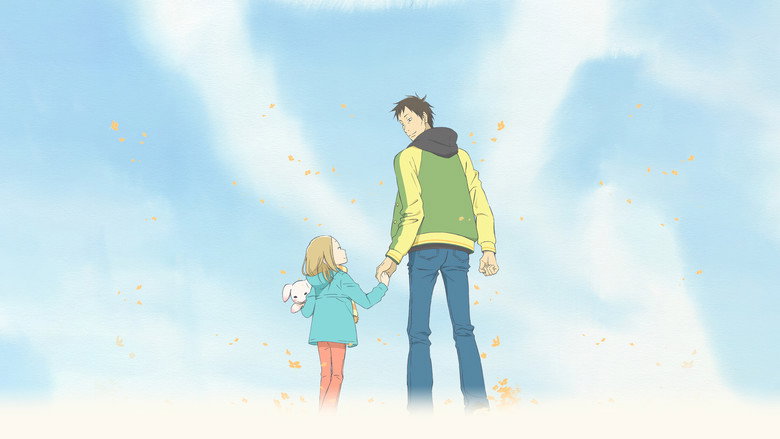
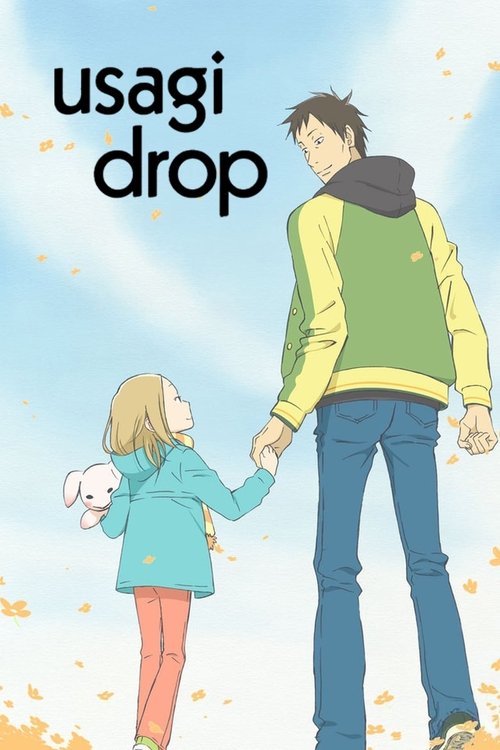
A quiet domestic drama in watercolor: a thirty-year-old bachelor inherits a six-year-old girl at a funeral, and ordinary days — bento boxes, bus stops, fevers — bloom into a life.
Usagi Drop

Usagi Drop

うさぎドロップ

08 July 2011 — 16 September 2011 Japan 1 season 11 episode Ended 8.2 (199)

Cast: Ayu Matsuura, Hiroshi Tsuchida, Atsuko Mine, Sayaka Ohara, Noa Sakai

Drama Animation Chosen family over blood The cost and craft of parenting Absent parents and inherited regret Growing up in both directions Mortality, memory and the ordinary day

Overview

Usagi Drop (うさぎドロップ) is an 11-episode Production I.G series that aired in Fuji TV's noitaminA block from July 7 to September 15, 2011, directed by Kanta Kamei and written by Taku Kishimoto, adapting Yumi Unita's josei manga. Thirty-year-old salaryman Daikichi Kawachi returns to his grandfather's house for the funeral and finds a silent six-year-old girl, Rin, hiding in the garden — his grandfather's illegitimate daughter, and therefore, absurdly, Daikichi's aunt. When the assembled relatives argue over who is least inconvenienced by her, Daikichi announces on impulse that he will take her himself.

What follows is not a story of dramatic crises but of logistics turned into love. Daikichi requests a transfer to a lower-track department to make daycare pickups, learns to braid hair and pack lunches, discovers what school fees and childhood fevers actually cost, and slowly grasps the compromises his own parents made. Rin, for her part, moves from watchful silence to laughter, forming a fierce friendship with the handful of Kouki Nitani and an alliance with Kouki's overworked single mother, Yukari. The series' running undercurrent is the absent Masako — Rin's biological mother, a manga artist who chose her career over her child — and the question of whether Daikichi should find her, and what he owes Rin when he does.

The anime covers only the first four volumes of the manga, ending its story where the childhood arc naturally closes. It is deliberately small in scale: a show about grocery bags, kindergarten paperwork, and the slow arrival of the word "family," told in a soft, hand-painted register that made it one of noitaminA's most quietly beloved entries.

Core Meaning

Usagi Drop argues that family is a verb — something built out of repeated, unglamorous choices rather than inherited by blood. Daikichi takes in a child to whom he owes nothing legally and little emotionally, and the series follows the argument all the way through the boring parts: the career sacrifice, the money, the sleeplessness, the total reorganization of a life around another person's schedule.

Its second, quieter claim is that parenting is an education for the parent. Every practical obstacle Daikichi hits — a fever at 2 a.m., a daycare that closes too early, a promotion he can no longer accept — retroactively reveals what his own mother and grandfather did for him, and what Yukari does alone. The show extends the same grace to those who fail: Masako's refusal to be a mother is presented as a real, comprehensible choice rather than a villainy, so that Daikichi's decision reads as a choice and not a duty.

Finally, it is a series about time as the medium of love. Nothing important in it happens quickly. Trust accrues; a child grows out of shoes; a man becomes someone's father by doing the same small things every day until they add up.

Thematic DNA

Chosen family over blood 28%
The cost and craft of parenting 24%
Absent parents and inherited regret 20%
Growing up in both directions 16%
Mortality, memory and the ordinary day 12%

Chosen family over blood

The premise is a genealogical joke — Rin is legally Daikichi's aunt — that immediately exposes how little biology decides. The relatives who share Rin's blood treat her as a liability to be assigned; the man with the most tenuous claim takes her home. Across the eleven episodes the theme deepens rather than resolves: Daikichi's mother warms from disapproval to help, Yukari and Kouki become an unofficial second household, and the eventual question of Rin's surname turns the abstract theme into a concrete decision. The series never pretends blood is meaningless — it simply insists that showing up outranks it.

The cost and craft of parenting

The show is unusually literal about what raising a child requires: transfer requests to a less prestigious department, daycare hours, school entrance fees, the mechanics of a ponytail. Early episodes play these as comedy — Daikichi hopeless with hair and bentos — and later ones as quiet drama, when illness and typhoons and other people's crises arrive on schedules that do not accommodate work. Through Yukari, a single mother without Daikichi's safety net, the series shows the same labor performed with less margin, refusing to let his choice look easy or exceptional.

Absent parents and inherited regret

Masako, Rin's mother, hovers over the series as its unresolved chord: a woman who chose her work and left. The narrative builds toward Daikichi meeting her and returns with no comfortable verdict. Around her orbit other absences — the grandfather whose secret started everything, Kouki's dead father, Daikichi's own parents seen newly through adult eyes. The theme evolves from grievance toward comprehension: understanding why someone left does not excuse it, but it lets Rin grow up without being defined by it.

Growing up in both directions

Rin's arc — from a mute, watchful child at a funeral to a girl walking into her elementary school entrance ceremony — runs in parallel with Daikichi's, and the series keeps insisting they are the same arc. He learns responsibility while she learns trust; she loses baby teeth while he loses the assumption that his time is his own. The finale's school gate deliberately frames both of them at a threshold, not just her.

Mortality, memory and the ordinary day

The series opens at a funeral and never quite leaves its shadow: the grandfather's house, his garden, his flowers and the tree Rin claims as her own keep the dead present inside daily life. Death here is not tragedy but a fact that gives the small routines their weight — the reason a bento matters is that the days are finite. This is the theme that lends the show its Takahata-esque, memory-tinted texture.

Character Analysis

Daikichi Kawachi

Hiroshi Tsuchida

Archetype: Reluctant hero / accidental father Key Trait: Blunt, unshowy decency

Motivation

Initially a flash of moral stubbornness: someone should take this child, and no one will. This hardens into a durable purpose — to give Rin an ordinary, unashamed childhood — and finally into something he wants for himself, as he realizes he cannot imagine the version of his life without her.

Character Arc

Begins as a competent but unreflective thirty-year-old whose life has no shape beyond work, and who takes Rin in out of indignation at his own family rather than any parental instinct. Across the series his transformation is measured in concessions: a transfer to a less demanding department, evenings surrendered, ambitions quietly downgraded. Comedy (defeated by a ponytail) gives way to gravity as he confronts Rin's mother, weathers illness and disaster, and finally decides what legal and emotional shape their household will take. By the school entrance ceremony he is unmistakably a father — not because he declared it, but because he did it for a year.

Rin Kaga

Ayu Matsuura

Archetype: The wise child / catalyst Key Trait: Composure far older than she is

Motivation

Begins with pure survival instinct — be good, be small, be kept. It matures into a wish to belong specifically to Daikichi rather than to anyone who will have her, and eventually into curiosity about where she came from, which she can afford only because she feels secure.

Character Arc

Introduced as a silent six-year-old hiding in a garden at a stranger's funeral, watchful and preternaturally undemanding — a child who has learned not to be a burden. Her arc is a slow thaw: first practical trust (she will let him pack her lunch), then friendship with Kouki, then the confidence to be difficult, tearful and ordinary. The series' most quietly radical move is letting her be an actual child rather than a plot device, and her final walk into elementary school marks a girl who now assumes she will be looked after.

All 4 characters and cast

Symbols & Motifs

The bellflower / grandfather's garden

Meaning:

Inheritance as something living rather than legal. The flowers the grandfather tended outlive him and become the ground on which Rin is first found and first known.

Context:

The first episode, titled The Bellflower Girl, introduces Rin among the plants at the funeral house; the garden and its cuttings recur as the family's real estate of memory, and later episodes return to it whenever the grandfather's choices resurface.

Rin's tree

Meaning:

Rootedness and the child's claim on a place. A tree cannot be moved; naming one as "mine" is a child's way of saying I live here now, and of measuring her own growth against something older.

Context:

Episode 6, My Tree, builds an entire quiet installment around Rin's attachment to a specific tree — one of the show's clearest statements that belonging is territorial and sensory before it is emotional.

The pinky swear

Meaning:

A contract between unequals. The most binding promise available to a six-year-old, offered to an adult who is still deciding whether he is allowed to make promises at all.

Context:

Episode 2 takes its title, Pinky Swear, from the gesture, and the motif of small promises kept — pickups on time, being where he said he would be — becomes the show's measure of Daikichi's fatherhood.

The letter

Meaning:

Communication across an unbridgeable distance. Writing stands in for the parents who cannot or will not speak directly, and for feelings a child cannot yet say aloud.

Context:

Episode 4, Letter, turns correspondence into the vehicle for the Masako question; the motif carries the series' idea that some relationships survive only in mediated, partial form.

Hand-holding and the walk to school

Meaning:

Guardianship rendered physically. The height difference between adult and child, and the loosening grip over time, chart the whole relationship without dialogue.

Context:

Recurring in the opening sequence and in nearly every episode's transitions, culminating at the elementary school entrance ceremony that closes the series — the same walk, a longer stride.

Bento boxes and hair braiding

Meaning:

Love as competence. Domestic skill is the show's love language: caring is not declared, it is prepared, packed, and tied.

Context:

Introduced as running gags in the early episodes when Daikichi is comically bad at both, they quietly become proof of transformation as his hands get better across the run.

Episode Highlights

The Bellflower Girl

S1E1

Daikichi arrives at his grandfather's funeral and finds a silent six-year-old in the garden — the old man's illegitimate daughter. As the relatives bicker over who is stuck with her, he announces he'll take her, and the two leave together.

Significance:

Establishes the entire series in one gesture: the premise, the moral temperature, and the fact that this show's turning points are decisions made in ordinary rooms rather than dramatic events.

Pinky Swear

S1E2

The logistics of the impulse arrive: daycare, work hours, laundry, hair. Daikichi discovers that wanting to help a child and being able to are entirely different skills, and seals his commitment with a child's promise.

Significance:

Converts an emotional impulse into a contract, and sets up the series' method of measuring love in schedules kept rather than words spoken.

Daikichi's Decision

S1E3

Facing an incompatibility between his career track and Rin's pickup time, Daikichi requests a transfer to a less prestigious department — trading advancement for evenings.

Significance:

The series' first irreversible sacrifice, and the moment temporary guardianship becomes a life. Widely cited by viewers as the episode where the show earns its emotional credit.

Letter

S1E4

The question of Rin's biological mother, Masako, moves from background to foreground through written contact, forcing Daikichi to decide how much truth a six-year-old is owed.

Significance:

Opens the show's central unresolved wound and shifts it from domestic comedy into genuine drama about abandonment and honesty.

Daikichi Should Stay Daikichi

S1E5

The question of what Rin should call him — and what he should be to her — is confronted directly, with Rin asserting her own answer.

Significance:

The naming episode: it lets the child define the relationship rather than the adult, and articulates the series' thesis that roles are chosen, not assigned by title.

My Tree

S1E6

A near-plotless installment built around Rin's attachment to a particular tree, her sense of place, and the physical world of the grandfather's house.

Significance:

The clearest demonstration of the show's aesthetic confidence — trusting a child's small preoccupation to carry an episode — and the emotional register that made it a noitaminA standout.

Secretly Leaving Home

S1E7

A child's flight from home — the classic small rebellion — tests whether Rin and Kouki believe they will be missed, and how the adults respond when a routine breaks.

Significance:

Tests the security Daikichi has built; the answer to "will you come find me" is the real measure of whether the household has become a family.

Grandpa's Precious Thing

S1E8

The late grandfather's legacy and the reasons behind Rin's existence come back into focus, reframing the man whose funeral opened the series.

Significance:

Retroactively rewrites the pilot: the scandal that produced Rin is recast as an act of love, aligning grandfather and grandson as men who made inconvenient choices for a child.

A Typhoon Came

S1E9

A storm strands and rearranges the households, pushing Daikichi, Rin, Yukari and Kouki into improvised mutual dependence.

Significance:

Externalizes the series' argument about extended, chosen family — when the weather removes every institution, what's left is neighbors who show up.

Stomach Flu

S1E10

Illness arrives, and with it the unglamorous night-shift of parenting: vomit, fever, missed work, and fear entirely disproportionate to the diagnosis.

Significance:

The final stress test before the finale, and the show's most honest sequence about how care feels from the inside. It sets up the closing school-entrance ceremony, where the year's accumulated labor is quietly cashed in.

Philosophical Questions

What actually makes someone a parent?

The series systematically strips away every conventional answer — biology (Rin is his aunt), law (his claim is the weakest in the room), preparation (he has none), and even desire (he did not want a child). What remains is repetition: presence, meals, pickups, night-time fevers. By the finale the show has demonstrated its answer rather than argued it.

Is it permissible to choose yourself over a child?

Masako left; Daikichi stayed; Yukari does both by necessity, giving up her time and still failing to be everywhere. The anime refuses a verdict, letting Masako articulate her reasoning without punishing her narratively, so the viewer must weigh whether obligation to another life outranks the right to one's own.

How much of the truth does a child deserve?

From the letter arc onward, Daikichi has to decide what Rin is told about her mother, her father, and her own origin. The series suggests that truth withheld to protect a child usually protects the adult, but it also shows that timing is a real ethical variable — and that a secure child can survive facts an insecure one cannot.

Can a life shrink and still be a good life?

Daikichi's transfer to a lower track is presented without triumphant framing: it is a genuine loss of ambition. The show asks whether meaning scales with achievement, and answers by making the smallest events — a tree, a bento, a walk to school — carry the greatest emotional weight in the entire eleven episodes.

Does a story belong to its author or to the reader who received it?

Unintentionally, the franchise poses this outside the text. The anime's curated ending and the manga's stated, long-planned conclusion diverge so sharply that audiences have had to decide whether authorial intent settles a work's meaning, or whether the version that exists on screen is its own complete argument.

Alternative Interpretations

The anime as the \"true\" ending. The dominant reading treats the 11-episode arc as a complete, self-authored work: it covers the first four manga volumes and closes on Rin's elementary school entrance ceremony, and many manga readers openly prefer this ending as better suited to the story. Under this view, Production I.G did not truncate the story so much as identify where it actually ends.

Full ending explanation

Cultural Impact

Usagi Drop arrived in the summer 2011 noitaminA block — Fuji TV's late-night slot explicitly designed to bring anime to adult and female audiences — and became one of the strand's most durable calling cards. It aired months after the March 2011 Tōhoku disaster, into a Japan preoccupied with family, precarity and ordinary life, and its subject matter (single parenting, work-life compromise, an aging household, a child raised outside the standard family unit) mapped onto real anxieties about declining birth rates and inflexible corporate hours.

Critically it was received as an unusual achievement in restraint. Reviewers described it as rich and insightful, mature without being profane or callous, and called it eleven episodes of beauty, laughter, heartache and love; one widely echoed comparison positioned it as a spiritual descendant of Isao Takahata's Only Yesterday, placing it in the Ghibli-adjacent lineage of realist, memory-inflected domestic drama rather than in genre anime. Its user standing has remained very high — on Anime News Network's encyclopedia it sits in the \"Excellent−\" band with a weighted score around 8.68, ranked around #101 out of more than ten thousand titles. NIS America's 2012 North American license brought it to a Western audience already primed by the manga's Eisner Award nomination.

Its longer legacy is double-edged. The anime is routinely cited as a benchmark for slice-of-life realism and for anime that takes childcare seriously as drama, and it is the standard recommendation for viewers who want a story about fatherhood without sentimentality. But it is equally famous as the definitive case study in adaptation-as-curation: because the anime stops at the end of the manga's fourth volume, discussion of the franchise is now inseparable from the manga's much-loathed later arc, and \"read/watch only the anime\" has become one of anime fandom's most repeated pieces of advice. The series is therefore invoked in ongoing debates about authorial intent, adaptation ethics, and whether a work can be retroactively damaged by its own continuation.

Audience Reception

Overall. The single season is one of the best-regarded slice-of-life dramas of its era. It holds an \"Excellent−\" standing on Anime News Network's encyclopedia with a weighted score near 8.68 and a rank around #101 of more than 10,000 titles, and reviewers converged on the same praise: mature without being cynical, funny and devastating in the same scene, and — as one critic put it — the spiritual descendant of Takahata's Only Yesterday.

Most-praised elements. The writing's refusal of melodrama; Ayu Matsuura's casting as an actual child in the role of Rin, repeatedly singled out as the source of the show's realism; Hiroshi Tsuchida's understated Daikichi; the soft watercolor art direction; Puffy's \"SWEET DROPS\" opening and Kasarinchu's \"High High High\" ending; and the show's willingness to dramatize daycare hours and career sacrifice as genuine stakes. Parents in particular reported the strongest reactions.

Criticism. The main reservations are structural rather than qualitative: the pacing is deliberate to the point of stillness for some viewers, the conflicts are low-stakes by design, and eleven episodes covering four manga volumes leaves the Masako thread and Daikichi's own future only partly resolved. A minority of viewers find the premise's convenience — a bachelor who copes remarkably well — softer than the show's realist reputation suggests.

The controversy, and how opinion evolved. Reception of the anime itself has stayed remarkably stable; what changed is the context around it. As readers discovered the manga's post-timeskip arc, in which the story becomes a romance between Daikichi and the grown Rin, the fandom split hard. Criticism centered on the sense of a bait-and-switch — a work that spends roughly forty percent of its length establishing one genre before switching to another — and the backlash was international, with Japanese readers objecting on their own forums when the manga ended in 2011. Yumi Unita's statement that the romantic ending had been planned from the beginning, as a josei work about age gaps and child-rearing, did little to settle it. The practical consensus that emerged, and still dominates recommendation threads, is to watch the anime and stop there.

Verdict. A near-unanimously loved eleven episodes, permanently shadowed by a source ending most of its audience has chosen not to accept.

Interesting Facts

  • The series was produced by Production I.G and aired in Fuji TV's noitaminA block from July 7 to September 15, 2011, running 11 episodes.
  • It was directed by Kanta Kamei, with series composition and scripts by Taku Kishimoto and music by Suguru Matsutani.
  • The anime adapts only the first four volumes of Yumi Unita's manga, which was still running when production began — the manga's serialization ended in April 2011, the same year the anime premiered.
  • Because the adaptation stops at the end of the manga's childhood arc, Production I.G was able to construct a self-contained ending that many manga readers consider better suited to the story than the manga's own conclusion.
  • The opening theme is "SWEET DROPS" by the rock duo Puffy (Puffy AmiYumi), written by Shoko Suzuki; the ending theme is "High High High" by Kasarinchu.
  • Anime News Network reported in August 2011 that both members of Puffy also took voice-acting roles in the anime, in addition to performing the opening song.
  • Rin Kaga is voiced by Ayu Matsuura, an age-appropriate child performer rather than an adult actress — a casting choice reviewers repeatedly credited for the character's realism.
  • Daikichi is voiced by Hiroshi Tsuchida, with Sayaka Ohara as single mother Yukari Nitani and Noa Sakai as her son Kouki.
  • The production leans on a soft, watercolor-influenced look, with painterly backgrounds and hand-painted title and transition art that set it apart from the flatter digital style typical of 2011 TV anime.
  • NIS America licensed the TV series for North America, announcing the acquisition in April 2012.
  • A live-action feature film adaptation of Bunny Drop was also released in 2011, the same year as the anime.
  • Yumi Unita's manga was nominated for an Eisner Award.

Easter Eggs

Both members of the rock duo Puffy, who perform the opening theme "SWEET DROPS," appear in the anime as voice actors.

A double cameo that ties the show's musical identity to its cast — Puffy AmiYumi are pop-culture veterans well known internationally, and their appearance is a nod to noitaminA's tradition of recruiting mainstream musicians rather than anison specialists.

The watercolor-painted opening and eyecatch artwork mimics the loose, wet-media look of the manga's own cover illustrations.

A direct visual quotation of Yumi Unita's source art; the anime chose to reproduce the manga's texture rather than just its character designs, which is why the show reads as hand-made even in motion.

Rin is technically Daikichi's aunt — his grandfather's daughter — despite being twenty-four years younger.

A structural joke hidden inside the premise: the series' funniest fact is also its thesis statement, since the genealogically "correct" relationship is the one that means the least to either of them.

The series and a live-action Bunny Drop film both arrived in 2011.

Rare simultaneous cross-media exposure for a quiet josei title; viewers who came to the anime via the film encountered the same story in two registers within months.

Frequently Asked Questions

Explore More About This Movie

Dive deeper into specific aspects of the movie with our detailed analysis pages

Comments (0)

Leave a comment

No comments yet. Be the first to share your thoughts!

Similar Movies