Skip to content
Verity
A feverish erotic psychological thriller where grief and desire seep through a lakeside house like cold water under a door. Truth flickers like a manuscript page held to candlelight, tempting you to read on.
Verity

Verity

"There is no light where we're going."

30 September 2026 United States of America 114 min 6.4 (204)

Director: Michael Showalter

Cast: Anne Hathaway, Dakota Johnson, Josh Hartnett, Brady Wagner, Ismael Cruz Cordova

Thriller Mystery Truth versus narrative Desire and obsession Grief and loss Authorship and identity Complicity and moral rationalization
Budget: $40,000,000
Box Office: $113,961,372

Overview

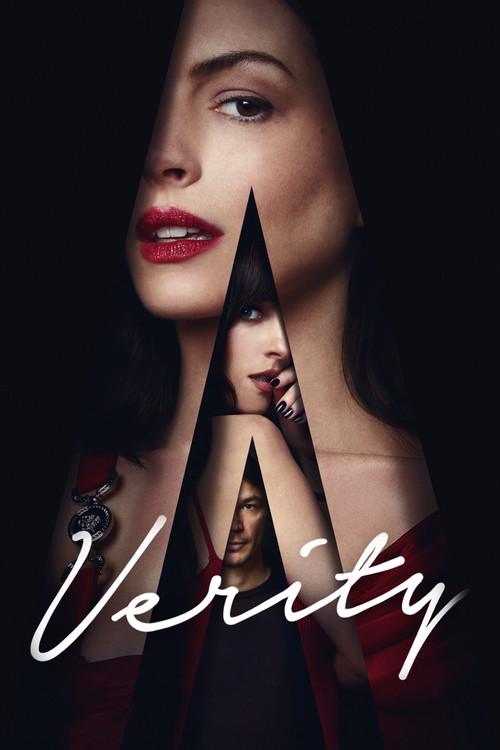
Verity (2026) is an erotic psychological thriller directed by Michael Showalter. Nick Antosca wrote the screenplay, which adapts Colleen Hoover's 2018 novel. Dakota Johnson plays Lowen Ashleigh, a struggling writer who is broke, grieving and facing eviction. After a chance encounter with Jeremy Crawford (Josh Hartnett), she is hired to finish the bestselling book series of his wife, Verity (Anne Hathaway). Verity is a famous author who is incapacitated after a car accident.

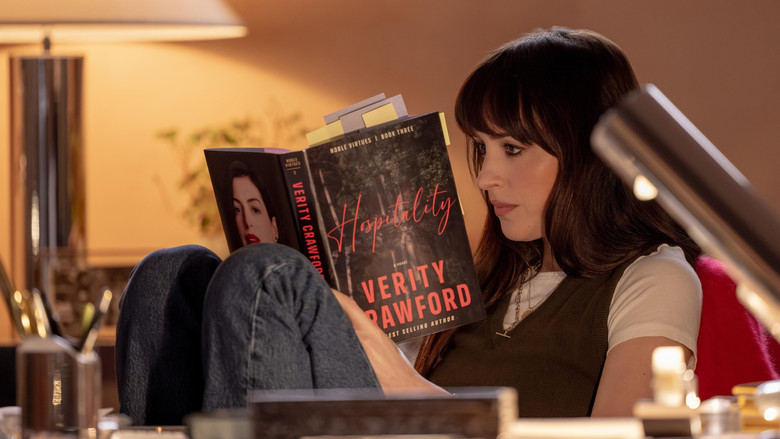
Lowen moves into the Crawford house to go through Verity's notes. She finds a hidden manuscript that reads as a confessional account of the marriage rather than a novel. As she reads it, the line between fiction and reality starts to blur. Her attraction to Jeremy grows, and she becomes unsure what is true.

The film mixes gothic domestic suspense, a love triangle and a story about authorship. It is a Hitchcock-style puzzle about who is telling the truth. It runs 117 minutes and was released by Amazon MGM Studios in October 2026.
Core Meaning

The film is about the unreliability of narrative and the way people pick the story they need. Lowen has to choose between two competing accounts of Verity: the manuscript and a later letter. Her choice depends less on evidence than on what lets her keep the life she now wants. The film declines to settle the question. Showalter and Hoover have described that ambiguity as the whole idea. Verity ends on the title character and a remark about certainty, so the final image is about how certainty is manufactured. Anyone who tells a story, and anyone who believes one, is shaping the truth.

Thematic DNA

Truth versus narrative 30%
Desire and obsession 25%
Grief and loss 20%
Authorship and identity 15%
Complicity and moral rationalization 10%

Truth versus narrative

Two documents give contradictory accounts of Verity: a hidden manuscript, then a letter. Lowen must decide which to believe, and the film leaves the answer open.

Desire and obsession

Lowen's attraction to Jeremy grows as she reads, and her longing for his life begins to drive her judgment. The erotic charge is tied to her wish to take over Verity's place.

Grief and loss

Lowen has lost her mother, and Jeremy has lost a daughter who drowned in a lake. Grief makes both of them vulnerable, and it also gives them justifications.

Authorship and identity

Lowen ghostwrites another woman's voice and gradually takes over her house, her clothes and her husband. Writing becomes a form of possession.

Complicity and moral rationalization

Lowen is complicit in a killing because she believes Verity is a threat. The film asks how far belief lets people justify violence.

Character Analysis

Lowen Ashleigh

Dakota Johnson

Archetype: Antiheroine / unreliable protagonist Key Trait: Impressionable and morally flexible

Motivation

Security, love and a sense of purpose after loss.

Character Arc

She begins as a struggling, grieving writer and ends as a woman who has taken Verity's place. By the end she has been complicit in a killing and is pregnant with Jeremy's child. She is left wondering what the truth about Verity really was.

Verity Crawford

Anne Hathaway

Archetype: Femme fatale / enigma Key Trait: Unknowable

Motivation

Unknown. Control and survival are the likeliest readings.

Character Arc

She is a bestselling author who seems silent and immobile after a car accident. She is either a manipulative sociopath or a tragic victim. The film never fully resolves which.

All 3 characters and cast

Symbols & Motifs

The hidden manuscript

Meaning:

Confession, seduction and unreliable testimony. It is a story that persuades its reader.

Context:

Lowen finds it on a USB drive hidden in a cigarette pack in Verity's desk. It is an autobiography of the marriage, not the book the publisher wanted.

The lake

Meaning:

Death, secrets and the place where the truth is buried.

Context:

Jeremy's young daughter drowned in a lake. Verity's body is later carried down to it. The ending shows Verity sinking in the water.

The red dress

Meaning:

Desire, and the passing of identity from one woman to another.

Context:

The manuscript opens on the night Verity, in a red dress, first caught Jeremy's eye.

The Crawford house

Meaning:

A gothic container for secrets, where the domestic and the sinister meet.

Context:

Lowen lives and works here, close to the incapacitated Verity. The film is a house-bound thriller in the Hitchcock tradition.

The television interview

Meaning:

Verity's public persona, and the gap between the image and the person.

Context:

The film opens and closes on an interview with Gayle King, filmed before the accident. Verity gets the last line, a remark about certainty.

Memorable Quotes

I've seen worse, unfortunately.
— Jeremy Crawford

Context

Outside Grand Central, after Lowen is spattered with a stranger's blood, Jeremy takes her to a coffee shop and hands her a clean shirt.

Meaning

It introduces Jeremy as a man steadied by tragedy, and it hints at the darkness behind his calm.

Philosophical Questions

Can we ever know the truth when it comes to us as a story?

The manuscript and the letter are competing narratives, and neither can be independently checked. The film makes the audience weigh them the way Lowen does.

Does belief justify violence?

Lowen takes part in a killing because she is convinced Verity is a danger. The film asks whether conviction without proof is enough.

Does grief excuse moral choices?

Lowen and Jeremy are both grieving, and both use that grief to explain what they do. The film leaves open how much it should excuse.

How It Ends

Alternative Interpretations

The main dispute is over Verity. In one reading she is a sociopathic manipulator who drowned her own child and then faked her condition. In the other she is a tragic victim of a manuscript and a letter whose authorship cannot be verified, and Lowen and Jeremy are the real predators. Both readings are supported by the film. Another reading treats the film as camp or satire of erotic thrillers and of grief-counseling language. A third takes Lowen as the real villain, a woman who reads herself into another woman's life. Showalter has said the team explored versions in which Verity survives or Lowen is a 'dark phoenix,' but chose the ambiguous one.

Full ending explanation

Cultural Impact

The film adapts a self-published 2018 novel that Grand Central Publishing acquired in 2021. It spent months on the New York Times bestseller list and sold more than a million copies in 2023 alone. This made the film a prominent example of the BookTok-era adaptation. Critics compared it with the erotic thrillers of the 1980s and 1990s, and some noted its Hitchcock-style climax. Reviews were mixed. On the box office side, it is reported to have grossed over $100 million against a $40 million budget. Online, the ending was widely joked about on Letterboxd, especially the closing interview.

Audience Reception

Critical reception was mixed. Some reviewers faulted the film for lacking a visual or thematic identity and for not committing to camp. One gave it 1.5 out of 5. Another said it played safe by leaving the truth to the audience. Audience reactions on Letterboxd were often jokey. Viewers praised the cast, especially Anne Hathaway, and the film's campy pleasures. Many mocked the stilted dialogue and the ending, which closes on a television interview. Overall it is seen as an entertaining but uneven adaptation, and it was a commercial success.

Interesting Facts

  • The screenplay is by Nick Antosca. Earlier versions were written by Hoover and Lauren Levine, Hillary Seitz, Angela LaManna, and Will Honley and April Maguire.
  • The film was originally dated for a wide release on May 15, 2026, as counterprogramming to male-skewing tentpoles. It was later released on October 2, 2026.
  • It premiered at the Curzon Mayfair in London on September 24, 2026.
  • Colleen Hoover, the novel's author, is a producer and consulted on the film. Anne Hathaway is also a producer, and Dakota Johnson is an executive producer.
  • Showalter removed one of the dead children from the novel. Hoover called it 'the best change we could have made.'
  • Showalter says he tried alternate endings after focus group screenings. In one, Verity is still alive in the lake and her eyes open. In another, Lowen is a 'dark phoenix.'
  • The budget was reported as $40 million. Wikipedia lists a box office of $114 million.
  • The score is by Volker Bertelmann and the cinematography by Jim Frohna.

Frequently Asked Questions

Explore More About This Movie

Dive deeper into specific aspects of the movie with our detailed analysis pages

Comments (0)

Leave a comment

No comments yet. Be the first to share your thoughts!

Similar Movies