Skip to content
Good Boy
A suffocating psychological thriller draped in domestic quietude, where violent delinquency clashes against forced civility like a leashed wolf pacing inside a pristine, velvet-lined cage.
Good Boy

Good Boy

"Some people only learn the hard way."

06 March 2026 United Kingdom 110 min 7.2 (200)

Director: Jan Komasa

Cast: Stephen Graham, Andrea Riseborough, Anson Boon, Kit Rakusen, Monika Frajczyk

Drama Thriller Mystery Coercive Control and Operant Conditioning vs. Autonomy Toxic Masculinity, Delinquency, and Social Media Alienation Middle-Class Hypocrisy and Performative Morality Grief, Trauma, and Substituted Family Dynamics Stockholm Syndrome and the Cycle of Abuse

Overview

Nineteen-year-old Tommy (Anson Boon) lives a life of unchecked chaos in Northern England. Fuelled by alcohol, drugs, and violent thrills, he records his antisocial rampages and uploads them to social media for instant notoriety. His reckless spiral abruptly stops when, after stumbling out of a nightclub on a heavy bender, he is abducted off the street by a mysterious stranger.

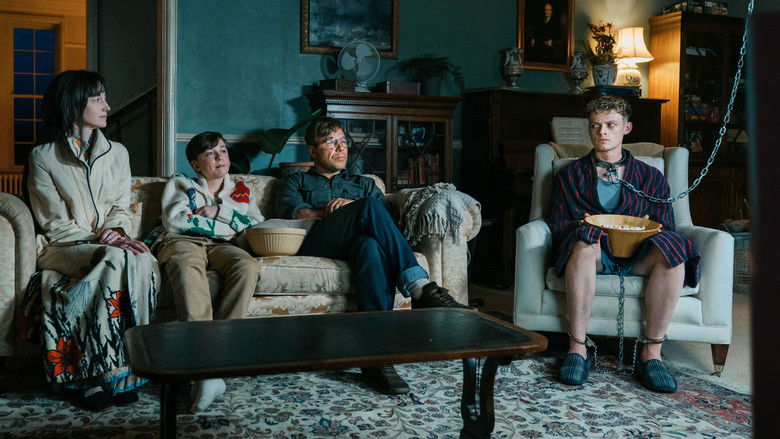
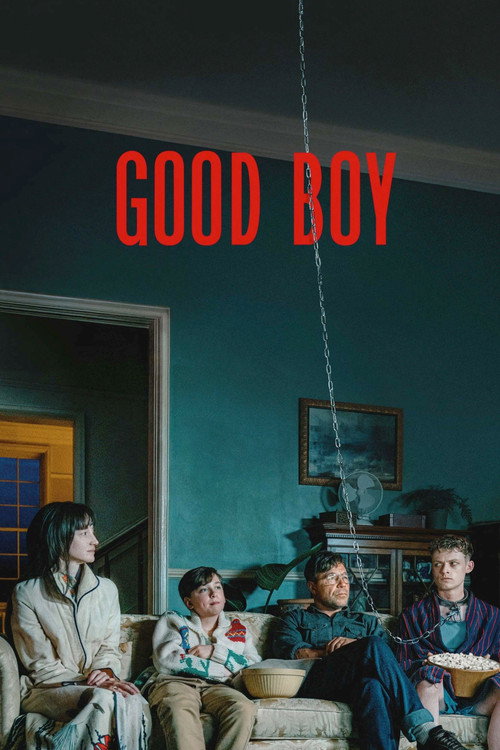
Tommy wakes up in the damp cellar of an isolated Yorkshire estate, bound by an iron chain fastened to an overhead track on the ceiling. His captors are Chris (Stephen Graham), a soft-spoken, virtue-obsessed family man, and Kathryn (Andrea Riseborough), his eerie, withdrawn wife. Alongside their impeccably mannered 10-year-old son Jonathan (Kit Rakusen), the couple subjects Tommy to a regimented routine of behavioral modification, operant conditioning, and strict discipline designed to break his spirit and force him to become a "good boy".

As housekeeper Rina (Monika Frajczyk)—trapped in her own ordeal due to visa insecurities—becomes an unwilling bystander, Tommy must navigate relentless mind games. He quickly learns that disobedience brings swift corporal punishment, while submission earns small privileges, forcing him to choose between fighting his captors or adapting to survive.
Core Meaning

Director Jan Komasa uses the film to interrogate modern anxieties about lost, disaffected youth, social media decay, and the dark boundaries of authoritarian rehabilitation. Rather than presenting a simple story of rescue or revenge, Good Boy explores whether true personal transformation can emerge from coercive control, or whether forced civility merely imposes a polite, superficial mask over deep-seated trauma. The film asks whether middle-class domesticity and vigilante moralism are fundamentally any less violent than the street delinquency they seek to eradicate.

Thematic DNA

Coercive Control and Operant Conditioning vs. Autonomy 30%
Toxic Masculinity, Delinquency, and Social Media Alienation 25%
Middle-Class Hypocrisy and Performative Morality 20%
Grief, Trauma, and Substituted Family Dynamics 15%
Stockholm Syndrome and the Cycle of Abuse 10%

Coercive Control and Operant Conditioning vs. Autonomy

The film contrasts physical imprisonment with psychological retraining. Chris manipulates Tommy's basic human needs—food, sanitation, mobility—to enforce obedience, showing how easily human agency can be eroded under systematic pressure.

Toxic Masculinity, Delinquency, and Social Media Alienation

Tommy’s initial identity relies entirely on performative aggression and online validation. His journey highlights how modern youth culture can foster profound emotional isolation under the guise of reckless hedonism.

Middle-Class Hypocrisy and Performative Morality

Chris and Kathryn represent a manicured, respectable facade that masks horrifying psychological abuse. The film satirizes the sanctimonious belief that polite manners, classic literature, and strict discipline justify violent control.

Grief, Trauma, and Substituted Family Dynamics

The captors' actions stem from unhealed grief over a lost son. They attempt to rebuild their broken family by forcing a violent stranger into a rigid domestic role, exposing how unresolved trauma breeds dysfunction.

Stockholm Syndrome and the Cycle of Abuse

The narrative examines how long-term abuse can rewrite a victim's worldview, making captivity feel like safety and leading victims to internalize and repeat their tormentors' methods.

Character Analysis

Tommy

Anson Boon

Archetype: Antihero / Fallen Youth / Subject of Re-education Key Trait: Volatile, highly adaptable, and deeply starved for genuine connection.

Motivation

Survival and escape, shifting into a need for belonging, structure, and approval.

Character Arc

Evolves from an aggressive, drug-fueled social media delinquent into a compliant, well-read captive, before ultimately internalizing his captors' methods.

Chris

Stephen Graham

Archetype: Tyrannical Patriarch / False Savior Key Trait: Calmly authoritarian, manipulative, and relentlessly structured.

Motivation

To heal his wife’s severe depression and replace their lost son by reforming a delinquent.

Character Arc

Appears as a soft-spoken, civic-minded citizen, but reveals a controlling, obsessive personality who uses domestic discipline to manage his family.

All 5 characters and cast

Symbols & Motifs

The Ceiling Chain & Overhead Track

Meaning:

Symbolizes conditional freedom and society’s figurative leash.

Context:

As Tommy complies, Chris extends the chain, allowing him step-by-step access to higher floors and proper amenities.

The Slop Bucket vs. Flush Toilet

Meaning:

Symbolizes human degradation versus granted dignity.

Context:

Earning access to a proper bathroom serves as Tommy’s first major psychological reward for obedience.

Smartphone vs. Classic Literature

Meaning:

The smartphone represents Tommy’s loud, chaotic, and superficial past, while books represent structured re-education.

Context:

Books and quiet reading represent the imposed, structured "re-education" forced upon him by his captors in contrast to his past smartphone use.

Chris's Wig

Meaning:

Symbolizes the false, artificial mask of respectability and order worn by the patriarch.

Context:

Worn by Chris to conceal his volatile, vigilante impulses.

The Ghostly Absence of "Charlie"

Meaning:

Symbolizes the family's secret trauma, past failures, and original sin.

Context:

The off-screen presence of a former son named Charlie lingers throughout the household as a constant implicit presence.

Memorable Quotes

I'm my own man. I'm not some dog you can just take in. I'm a real fucking person.
— Tommy

Context

Tommy screams this at Chris during his early period of captivity while chained in the basement.

Meaning

Highlights his desperate attempt to retain his humanity against Chris’s canine-like conditioning methods.

You're only hurting yourself... Good boy.
— Chris

Context

Uttered by Chris after using corporal punishment or rewarding Tommy for following rules.

Meaning

Encapsulates the psychological framing of the captors, who position abuse as necessary self-discipline.

All 3 quotes

Philosophical Questions

Can moral behavior be enforced through violence and operant conditioning?

The film explores whether moral behavior forced through conditioning and violence creates genuine ethical transformation or merely superficial compliance masking inner trauma.

Where does legitimate discipline end and coercive abuse begin?

Examined through Chris's extreme domestic routine, testing the boundaries between parental authority, reform, and psychological torture.

Is personal freedom valuable if it leads only to self-destruction?

Contrasts Tommy's chaotic initial liberty with his structured captivity, raising questions about autonomy versus destructive impulses.

Does trauma inevitably cause victims to repeat the cycle of abuse?

Illustrated by Tommy's final turn, taking on the role of captor after internalizing his captors' methods and rationale.

Alternative Interpretations

The film can be interpreted through several distinct lenses:

Full ending explanation

Cultural Impact

Released in early 2026, Good Boy taps into contemporary UK media panics surrounding youth crime, viral social media hooliganism, and debates over social rehabilitation versus punitive justice.

The film debuted at the Toronto International Film Festival (TIFF 2025) and screened at the BFI London Film Festival before its theatrical distribution. Critics highlighted its dark satirical edge and central performances. Its depiction of domestic vigilante reform sparked discussions about youth mental health, generational disconnects, and coercive control.

Audience Reception

Praised: Critics and viewers lauded Stephen Graham and Anson Boon for their intense screen dynamic. The film’s dark humor, tight pacing, and claustrophobic atmosphere were widely celebrated.

Criticisms: Some viewers found the shift from wild social media satire to insular hostage drama jarring. Others felt the character motivations of Chris and Kathryn remained overly cryptic.

Controversial Elements: The scenes of chain captivity, corporal punishment, and the bleak twist ending split audience reactions.

Overall Verdict: A gripping, highly provocative psychological thriller that solidified Jan Komasa’s reputation for compelling character studies.

Interesting Facts

  • Polish Origins: The original screenplay was written in Polish by Bartek Bartosik and set in Warsaw, focusing on class shifts in modern Poland. Master filmmaker Jerzy Skolimowski passed the script to Jan Komasa during Komasa's Oscar campaign for Corpus Christi.
  • British Adaptation: Producer Jeremy Thomas suggested relocating the film to the UK to reach a wider audience. Manchester screenwriter Naqqash Khalid was brought in to rewrite the dialogue with authentic Northern English slang.
  • Regional Funding & Setting: The production secured funding from Screen Yorkshire and shifted its filming locations from Manchester to Leeds and remote Yorkshire countryside estates.
  • Title Change in the US: The film was retitled Heel for its American theatrical release by Magnolia Pictures to avoid confusion with Ben Leonberg's 2025 canine horror film Good Boy.
  • Single-Location Intensity: Filming relied heavily on a real suburban Yorkshire home, enhancing claustrophobia for the actors and crew during long shoot days.

Easter Eggs

Nods to A Clockwork Orange (1971)

Tommy’s hedonistic opening spree and his subsequent forced rehabilitation mirror Alex DeLarge and the Ludovico Technique, exploring state/individual mind control.

Influences of Lanthimos & Seidl

Noted stylistic similarities to Yorgos Lanthimos's Dogtooth and Ulrich Seidl's In the Basement, particularly in how dark, absurd human behavior is hidden behind neat suburban facades.

The Ghost of "Charlie"

Mentions of a previous boy named Charlie serve as an off-stage narrative device, dropping clues about the family's past without ever showing him on screen.

Frequently Asked Questions

Explore More About This Movie

Dive deeper into specific aspects of the movie with our detailed analysis pages

Comments (0)

Leave a comment

No comments yet. Be the first to share your thoughts!

Similar Movies